Electrical Engineering Technician Resume Examples: free
Create an Electrical Engineering Technician Resume That Gets Read
By Mustafa Tarabya, founder of CVBooster · Published · Updated
Electrical engineering technician resume example with circuit test and panel bullets, instrumentation keywords and a full writing guide.
Sample resumes for a electrical engineering technician
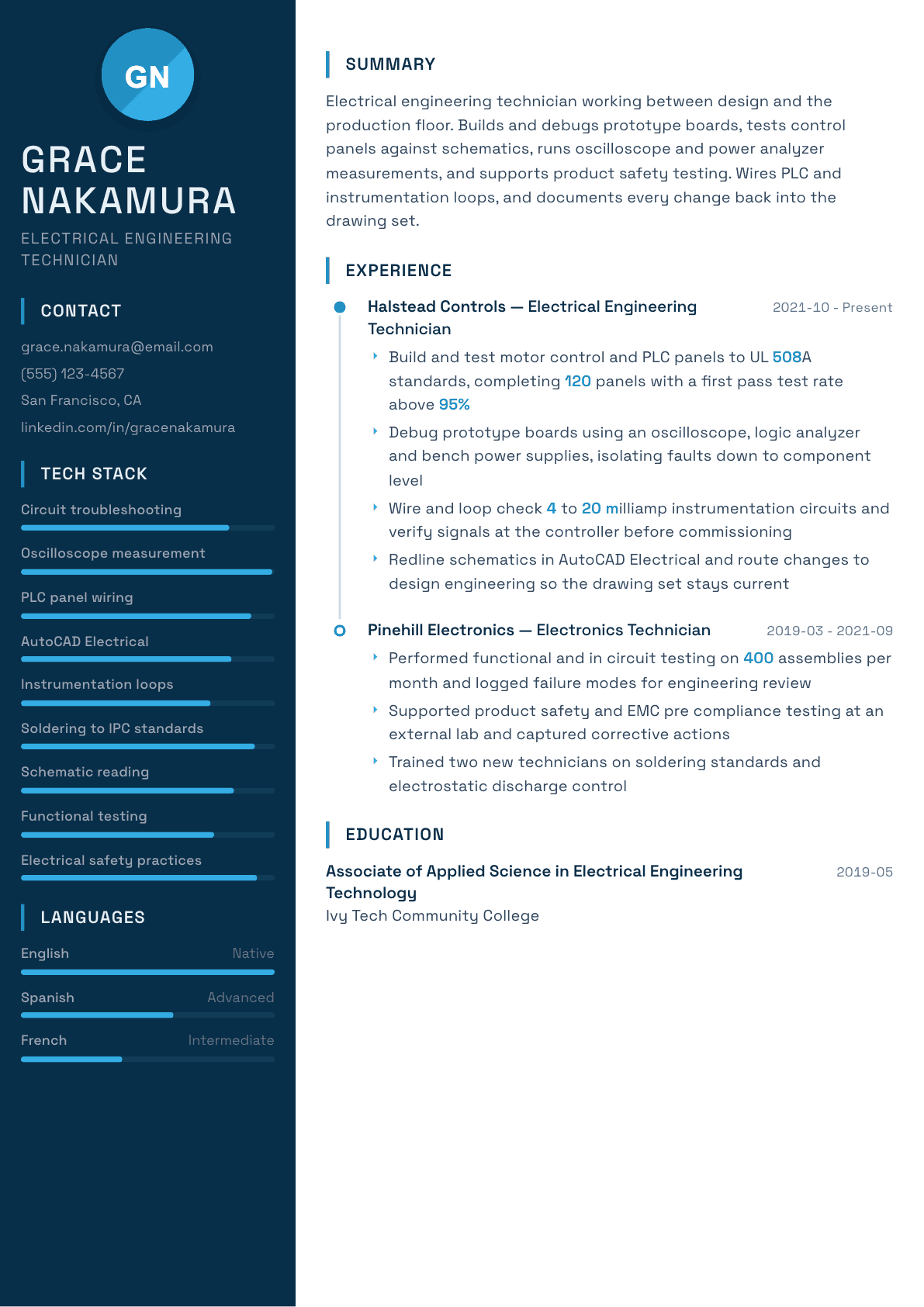
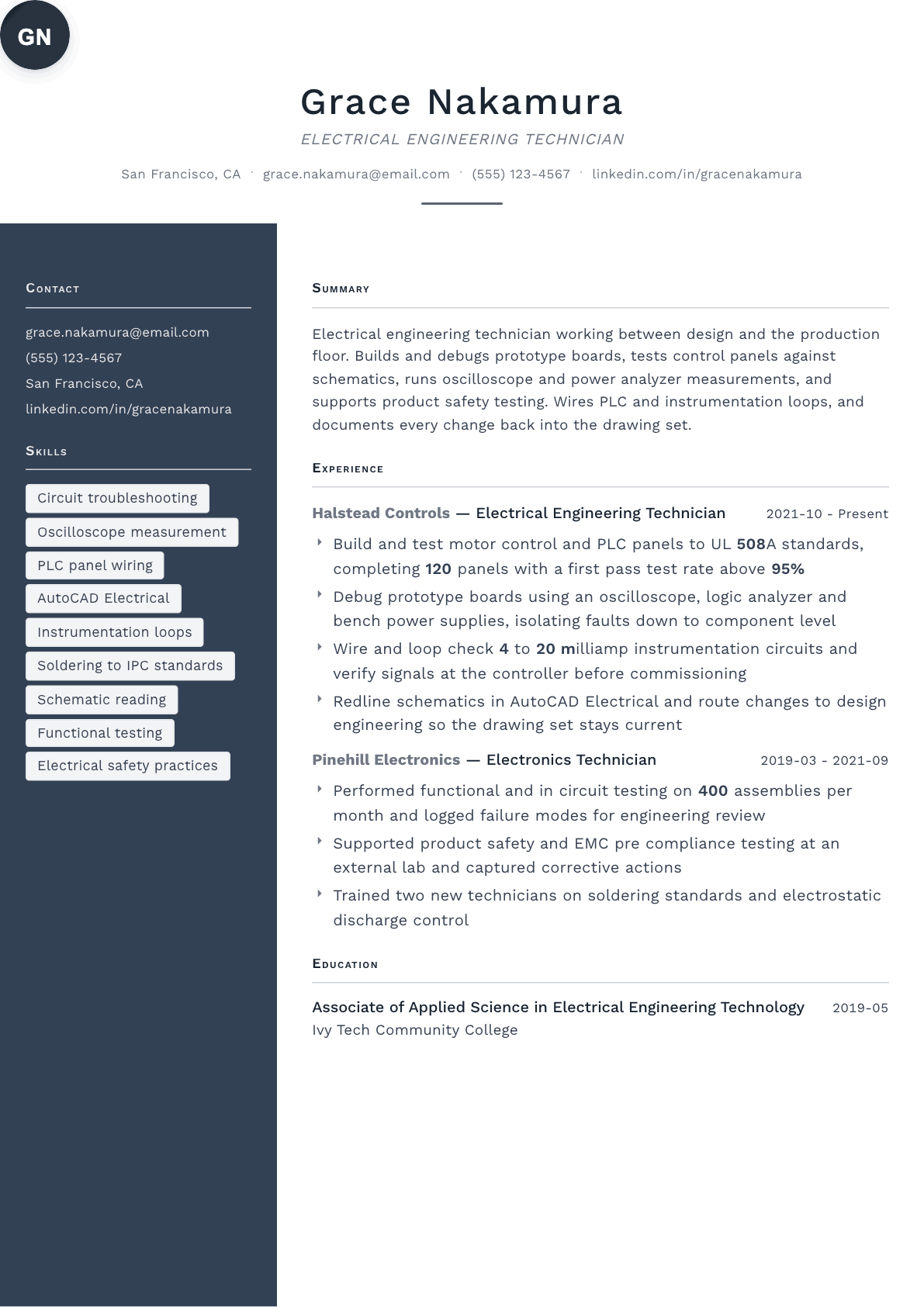
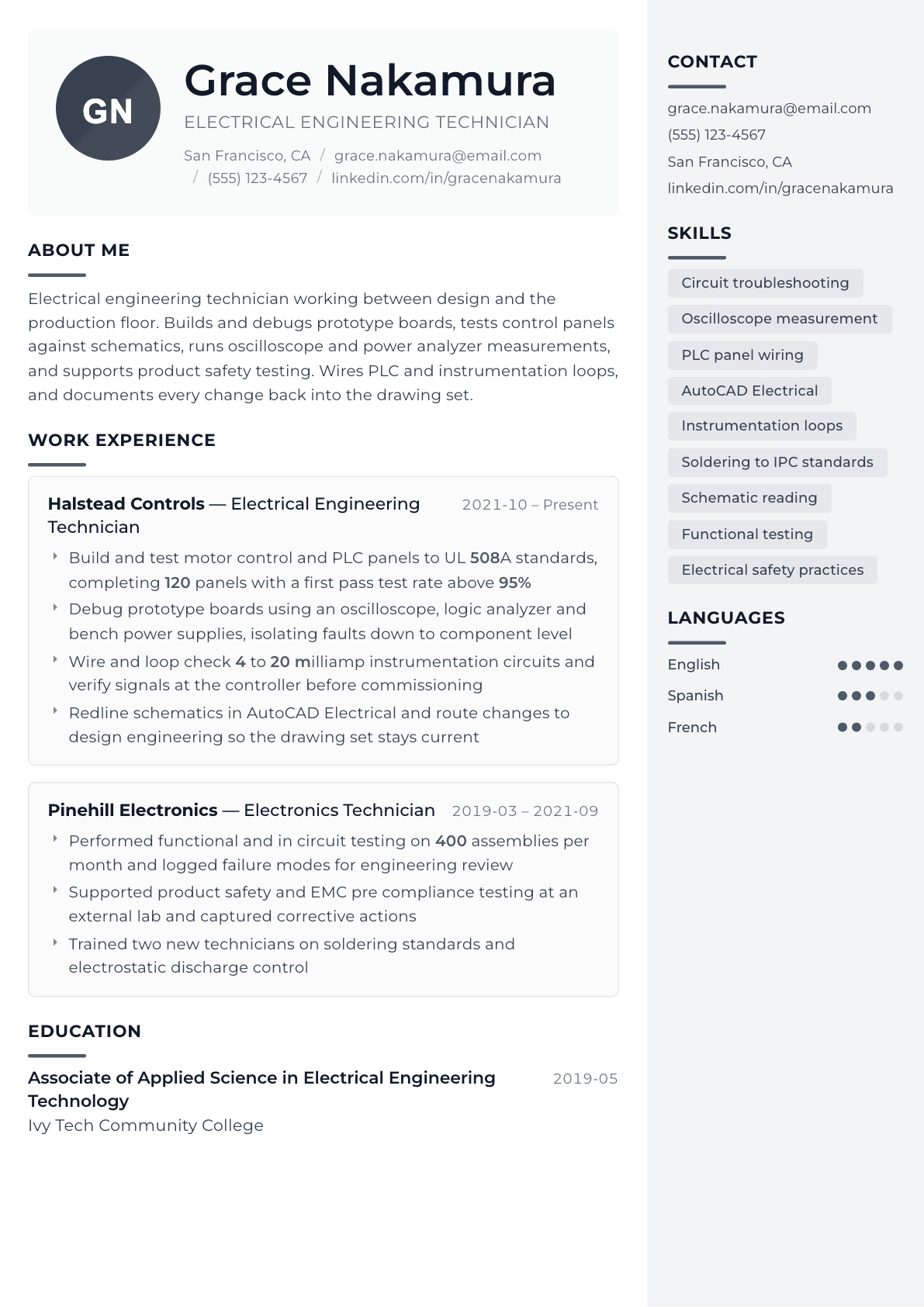
The same electrical engineering technician content laid out in three CVBooster templates, so you can see what the finished document looks like before you write a word.
Example Electrical Engineering Technician summary
Electrical engineering technician with five years bridging design and production. Builds and tests motor control and PLC panels to UL 508A, debugs prototype boards to component level with an oscilloscope and logic analyzer, and loop checks instrumentation circuits before commissioning. Completed one hundred twenty panels at a first pass test rate above 95% and keeps schematics current through disciplined redlines. Seeking a senior technician role.
Skills to list on a Electrical Engineering Technician resume
- Circuit troubleshooting
- Oscilloscope and logic analyzer use
- Board level debug
- Soldering and rework to IPC standards
- Control panel build
- UL 508A panel standards
- PLC wiring and loop checks
- Instrumentation calibration
- Schematic and wiring diagram reading
- AutoCAD Electrical
- Functional and in circuit testing
- EMC pre compliance support
- Electrical safety and lockout tagout
- Test documentation
- Bill of material maintenance
What actually gets this resume read
- List test equipment by type and model class: oscilloscopes, logic analyzers, power analyzers, insulation testers.
- Say which standards your work is built to, such as UL 508A for panels or IPC soldering acceptance classes.
- Show troubleshooting depth by naming the level you isolate to, whether that is board, module or component.
- Include control systems work separately, since PLC wiring and loop checks are a different hiring pool.
- Name your electrical safety training and any arc flash or lockout tagout qualification you hold.
- Keep documentation duties visible: redlines, test records, bills of material and change requests you filed.
How to write a electrical engineering technician resume
An electrical engineering technician sits between a schematic and a working assembly. Design hands over a drawing set, production hands back a panel that will not pass its test, and the technician is the person who finds out why. Employers hiring for this role screen for two things above everything else: the test equipment you can use unsupervised, and how deep you can troubleshoot before you hand the problem back to an engineer.
Troubleshooting depth is the phrase to think about while writing. Swapping a module until the fault disappears is one level. Following a signal through a schematic with an oscilloscope until you find the failed component is another, and it is worth a great deal more to a manufacturer. State the level you work at plainly, because it will be established in the first technical question of any interview.
This guide covers the layout electronics and controls employers expect, two complete electrical engineering resume examples for technicians, three summaries from a first job through a senior technician, before and after bullets from bench debug and panel build work, and the questions technicians ask when they move between electronics manufacturing, industrial controls and field service.
Format: one page with the bench in plain sight
One page, one column, reverse chronological. Put a test equipment and standards block just under the summary. A hiring supervisor is matching your list against the bench they need staffed, and burying that list on page two costs you the match.
Add any electrical safety qualification near the top. Arc flash awareness, lockout tagout training and permission to work on energized equipment decide whether you can be scheduled on certain tasks, so treat them as gating information rather than as a footnote.
- Header: name, city, phone, email, and electrical safety training you hold.
- Order: summary, test equipment and standards, experience, education and training, certifications.
- Field service candidates add travel range and driving status.
Summary: environment, equipment, and how deep you troubleshoot
Name the environment: electronics manufacturing, control panel build, product development bench, field service or plant instrumentation. These are different hiring pools that happen to share a title, and the reader wants to place you in one within a line.
Then the equipment and the depth. Oscilloscope, logic analyzer, power analyzer, insulation resistance tester, loop calibrator and bench supplies, followed by whether you isolate faults to component, board or module level. Finish with the standards your work is built to, such as panel construction standards or soldering acceptance classes.
Experience: build, test, debug, document
Group your bullets by activity. Build bullets cover panel assembly, wiring to a drawing, terminations, cable harnesses and enclosure layout. Test bullets cover functional testing, in circuit testing, insulation and continuity checks, burn in and first pass yield. Debug bullets cover the faults you traced and how. Documentation bullets cover redlines, test records, bills of material and change requests.
Debug bullets carry the most weight, so write them concretely. A power supply rail sagging under load traced to a failed capacitor. A control loop reading full scale because of a wiring error at the terminal block. An intermittent fault caught by monitoring on a scope over a long soak. Specific faults show a way of thinking that no adjective can convey.
If you work in controls, separate that work out. Wiring and loop checking four to twenty milliamp instrumentation, verifying signals at the controller, checking discrete inputs and outputs against the drawing, and supporting commissioning are a different skill set from board level electronics and are hired by different people.
Test equipment, standards and software
List instruments by type rather than by every model number: oscilloscopes, logic analyzers, spectrum analyzers, power supplies, electronic loads, insulation testers, loop calibrators, thermal cameras. Add the standards next to them, since panel construction standards and soldering workmanship classes are verifiable requirements on many job descriptions.
Software matters here too. Name the electrical CAD package you redline or draft in, the test executive or data logging software you use, and any programmable logic controller platform you wire to and monitor even if programming is not your responsibility. Say what you do in each so the level is not overstated.
Documentation, safety and posting keywords
Show that drawings stayed current because of you. Redlines routed to design engineering, bill of material corrections, test records filed and change requests raised are the difference between a technician who fixes one unit and one who prevents the next hundred from failing.
Common posting keywords include circuit troubleshooting, schematic reading, wiring diagrams, control panel assembly, functional test, in circuit test, instrumentation calibration, loop checks, soldering standards, electrostatic discharge control, lockout tagout and preventive maintenance support. Place each one where it is genuinely true of your work.
Electrical engineering resume examples, start to finish
Electrical engineering resume examples are most useful when they are whole, so here are two complete technician pages in outline. The people and employers are invented; the order is what to copy. Both put the test equipment and the troubleshooting level near the top, because those are the two facts a hiring engineer checks first.
Sample one, electronics bench: Andre Mills, Electrical Engineering Technician. Associate degree in electrical engineering technology, several years on the test and repair bench of a medical device manufacturer, trained to a soldering workmanship standard. Traces faults to component level with an oscilloscope and logic analyzer.
Sample two, industrial controls: Rosa Delgado, Electrical Engineering Technician. Builds and tests control panels for packaging machinery, checks inputs and outputs against the drawing, and supports commissioning at customer sites with the controls engineer.
- Bench sample, current role: debug failed circuit card assemblies from production test to component level, log every root cause and route repeat faults to the design engineer with a proposed fix.
- Bench sample: build and maintain the functional test fixtures for two product lines, and write the test procedures the night shift runs without supervision.
- Bench sample: mark up schematics and the bill of materials when a rework changes the build, so drawings stay current with the product.
- Controls sample, current role: wire and test control panels from schematics and wiring diagrams, perform point to point checks and insulation tests before power up.
- Controls sample: run input and output checks with the controls engineer during commissioning, and document every change on the redline set handed back to design.
- Controls sample: follow lockout tagout on every energized panel and keep the panel shop electrostatic discharge controls in audit shape.
- Both samples close with a skills block (test equipment, software, standards), certifications with the issuing body, and education with the program name.
Electrical Engineering Technician resume summary examples
New technician
Electrical engineering technology graduate with coursework in analog and digital circuits and a placement testing sensor assemblies on a production bench. Comfortable with an oscilloscope, multimeter and bench supplies, trained in soldering and electrostatic discharge control, seeking an electronics technician position.
Four years in
Electrical engineering technician building and testing motor control and programmable controller panels to recognized panel standards. Debugs prototype boards to component level with an oscilloscope and logic analyzer, loop checks instrumentation circuits, and redlines schematics back to design engineering.
Senior technician
Senior electrical engineering technician with eleven years across electronics manufacturing and industrial controls. Owns the test bench for a product family, supports safety and electromagnetic compatibility testing at external laboratories, and trains newer technicians on soldering workmanship and safe work practices.
Work experience bullets: before and after
Before: Built and tested electrical control panels.
After: Built and tested motor control and programmable controller panels to recognized industrial panel standards, completing 120 panels at a first pass test rate above 95%.
Panel count and first pass yield give a production supervisor a direct quality measure instead of a task description.
Before: Troubleshot circuit boards and electronic assemblies.
After: Debugged prototype boards with an oscilloscope, logic analyzer and electronic load, isolating a sagging supply rail to a failed output capacitor and feeding the finding back to design.
A specific fault traced to component level with the instruments named proves troubleshooting depth in one sentence.
Before: Worked on instrumentation wiring for control systems.
After: Wired and loop checked four to twenty milliamp instrumentation circuits, verifying every signal at the controller and clearing three reversed terminations before commissioning began.
The signal type, the verification point and the faults found show controls competence rather than general wiring.
Before: Updated drawings when changes were made.
After: Redlined schematics and panel layouts in an electrical CAD package and routed 40 change requests to design engineering, keeping the released drawing set matched to the built product.
Change volume and the routing path show the documentation loop closed rather than ended at a marked up print.
Before: Tested assemblies in production and recorded results.
After: Ran functional and in circuit testing on roughly 400 assemblies per month and logged failure modes into a shared defect tracker that engineering used to prioritize design fixes.
Throughput plus the use the failure data was put to turns routine testing into an input for product improvement.
Hard skills
- Circuit troubleshooting to component level
- Oscilloscope and logic analyzer use
- Multimeter and insulation resistance testing
- Functional and in circuit testing
- Control panel assembly and wiring
- Industrial panel construction standards
- Programmable controller wiring and monitoring
- Instrumentation loop checks and calibration
- Soldering and surface mount rework
- Schematic and wiring diagram interpretation
- Electrical CAD redlining
- Electromagnetic compatibility test support
- Electrostatic discharge control
- Test record and bill of material maintenance
Soft skills
- Methodical fault isolation
- Clear escalation to engineers
- Careful workmanship
- Safety discipline
- Training newer technicians
- Working to a schedule on a bench
Certifications worth listing
- IPC J-STD-001 Soldered Electrical and Electronic Assemblies (IPC)
- IPC-A-610 Acceptability of Electronic Assemblies (IPC)
- Certified Electronics Technician (CET) (Electronics Technicians Association International)
- Certified Control Systems Technician (CCST) (International Society of Automation)
- NFPA 70E Electrical Safety Training (Approved electrical safety training providers)
Mistakes that cost electrical engineering technician candidates the interview
- Writing troubleshooting without a level, so a manager cannot tell board swapping from component level fault finding.
- Leaving electrical safety training off a resume for work that involves energized equipment and arc flash exposure.
- Mixing electronics bench work and industrial controls into one block when they are screened by different people.
- Listing instruments with no context, which suggests classroom familiarity instead of daily bench use.
- Omitting the workmanship standards your soldering and panel work were inspected against.
- Ignoring documentation, since redlines and test records are what keep a product line repeatable.
Electrical Engineering Technician resume questions
What test equipment should an electrical engineering technician list?
Name the categories you use unsupervised: oscilloscopes, logic analyzers, multimeters, power supplies, electronic loads, insulation testers and loop calibrators. Categories beat model numbers because postings and search filters are written the same way.
Do I need a certification to work as an electronics technician?
Not always, but soldering workmanship certification is frequently required in regulated manufacturing, and a controls technician credential opens industrial automation roles. Both are verifiable, so list the issuing body and the specific standard or level.
How do I move from production testing into a development bench role?
Show diagnostic depth rather than throughput. Collect examples where you traced a fault to a root cause, suggested a design change, or built a test setup yourself, and put those bullets above the volume based production work.
Should I mention programmable controller work if I do not program?
Yes, and be exact. Wiring panels, checking inputs and outputs against a drawing, monitoring tags online and supporting commissioning are valuable and common. Say what you do and note that programming sits with the controls engineer.
What does a sample resume for electrical engineering work look like?
One page: a summary naming the environment and troubleshooting depth, a test equipment and standards block, then experience with four or five bullets per job on building, testing, debugging and documenting. Education and certifications come last. The two complete electrical engineering resume examples on this page, one bench and one controls, show the order.
Related resume examples
- Electrical Engineer Resume example
- Maintenance Technician Resume example
- Electrical Technician Resume example
- Instrumentation Engineer Resume example
- Electronics Engineer Resume example
- Nuclear Technician Resume example