Utility Manager Resume Examples: the lines they read
Build a Utility Manager Resume That Delivers Results
By Mustafa Tarabya, founder of CVBooster · Published · Updated
Create a utility manager resume showcasing infrastructure management, regulatory compliance, and operational excellence with ATS-optimized templates for water, electric, and gas utilities.
Sample resumes for a utility manager
The same utility manager content laid out in three CVBooster templates, so you can see what the finished document looks like before you write a word.
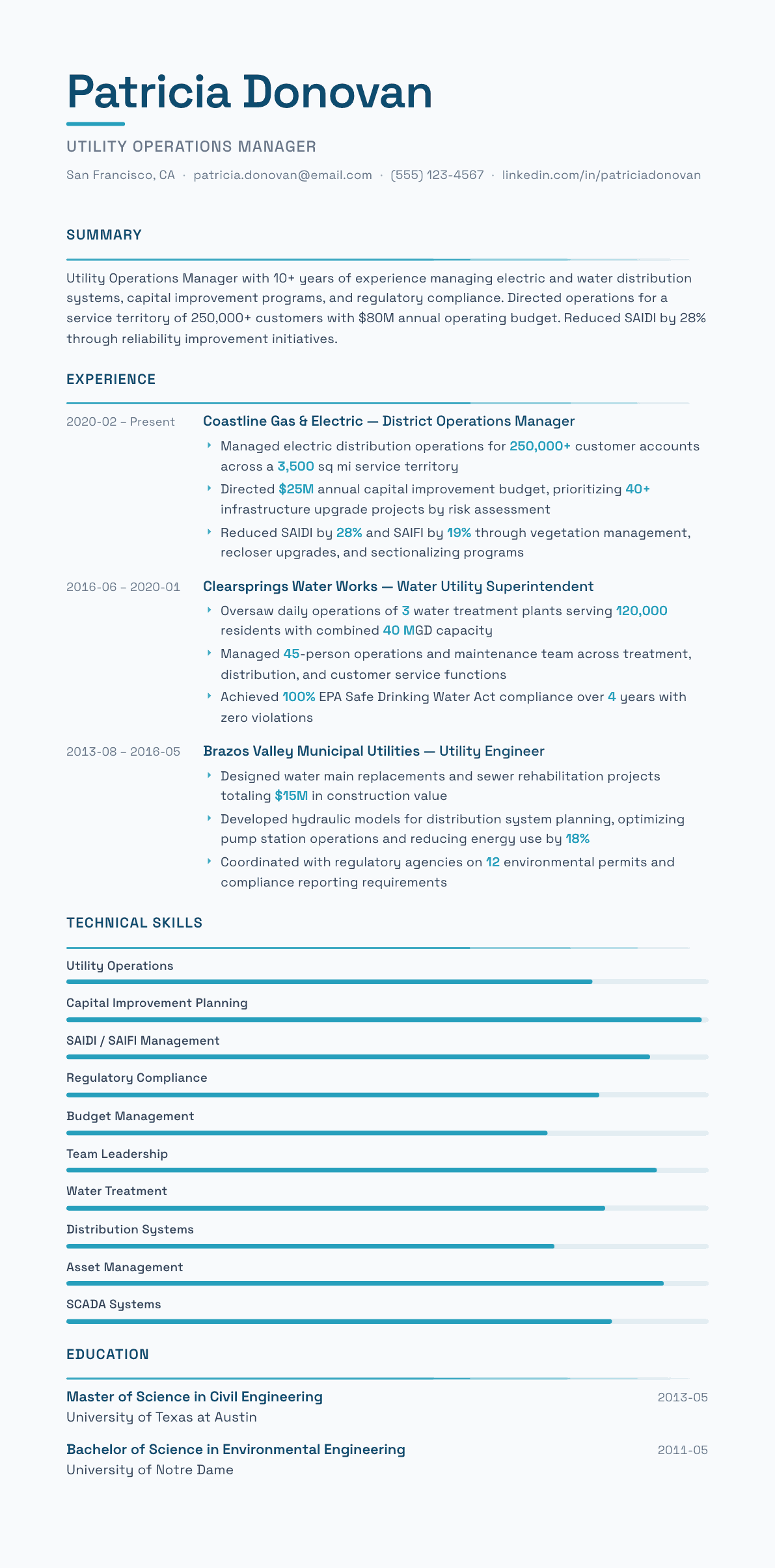
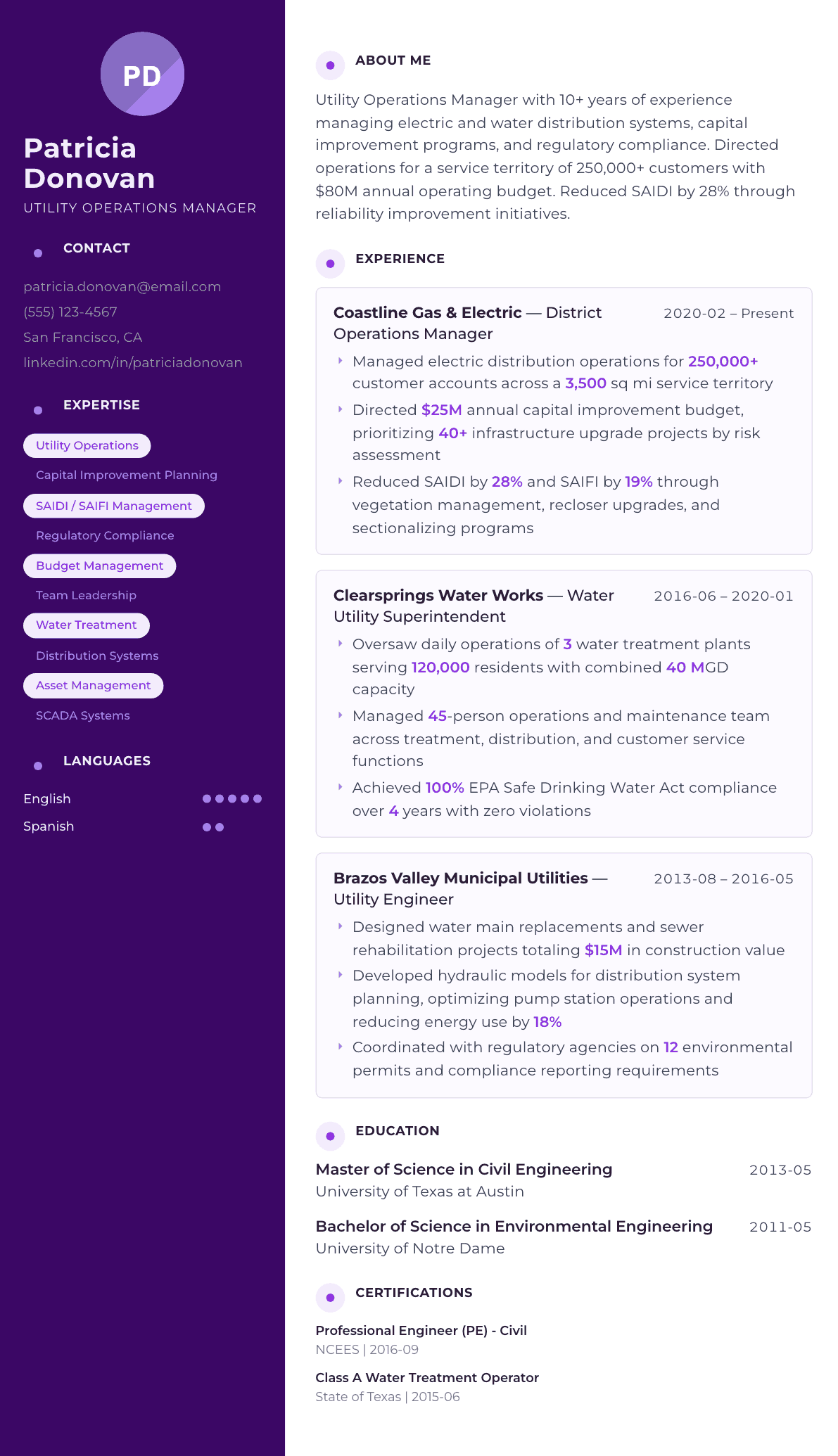
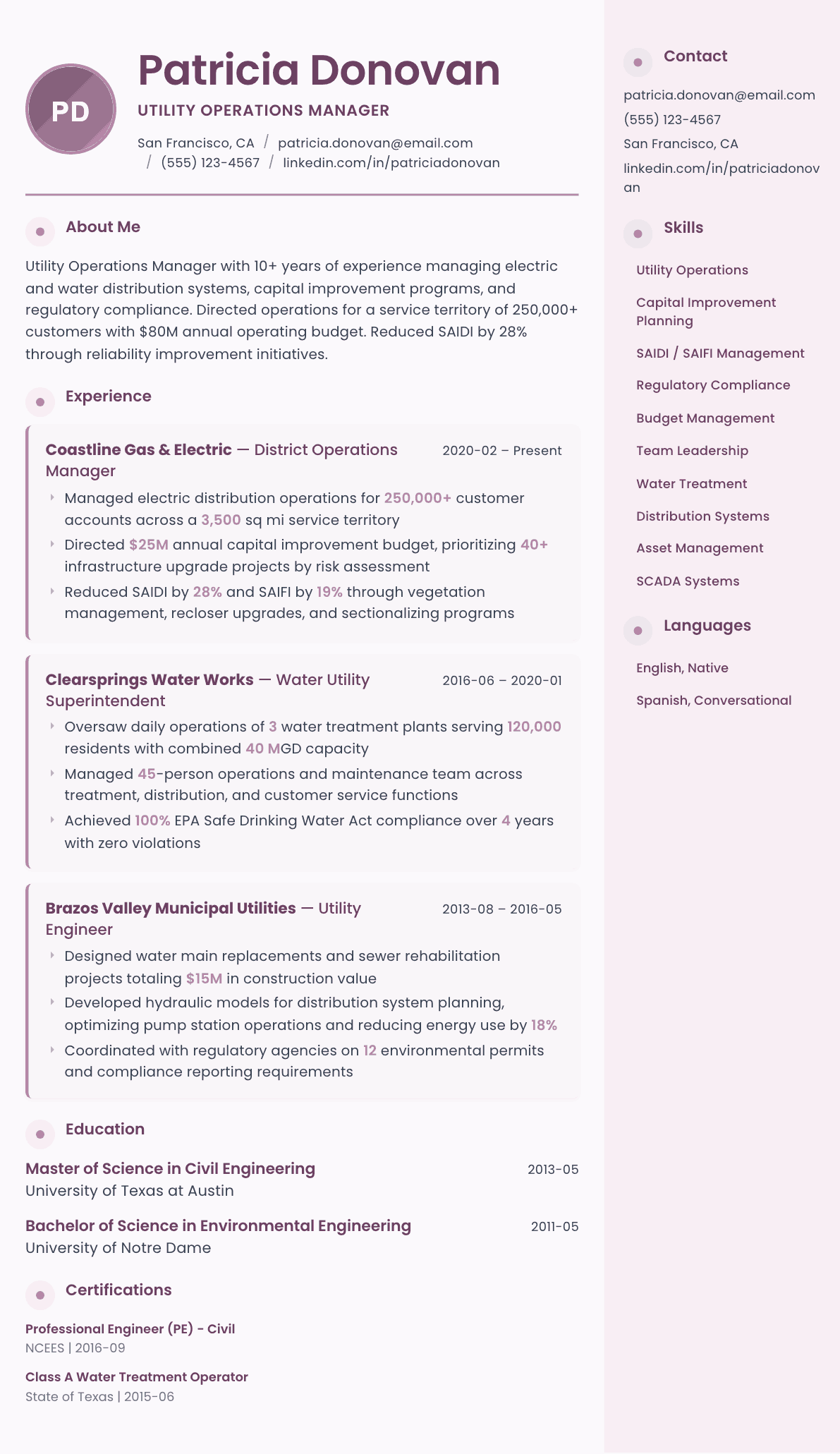
Example Utility Manager summary
PE-licensed Utility Operations Manager with 10+ years managing electric and water distribution systems for 250,000+ customers. Reduced SAIDI by 28% through targeted reliability programs. Directed $80M operating budget and $25M annual capital improvement program. 100% EPA compliance with zero violations.
Skills to list on a Utility Manager resume
- Utility Operations
- Capital Improvement Planning
- SAIDI / SAIFI / CAIDI
- Regulatory Compliance
- Budget Management ($50M+)
- Team Leadership
- Asset Management
- Distribution Systems
- SCADA / OMS
- Water / Wastewater Treatment
- Customer Service
- Emergency Response
What actually gets this resume read
- Quantify service territory: customers served, miles of infrastructure, and system capacity.
- Highlight reliability metrics: SAIDI, SAIFI, CAIDI improvements with specific percentages.
- Include budget management experience: operating budgets, capital programs, and cost reductions.
- Mention regulatory compliance: EPA, PUC, FERC, NERC, or state-level utility commission experience.
- Describe workforce management: team size, safety performance, and union/labor relations experience.
How to write a utility manager resume
A utility manager resume is judged against a set of numbers the reader already has in front of her. Whoever screens you runs an electric, water, wastewater or gas system with a known customer count, a known reliability record and a known rate case calendar. She is trying to place your experience next to hers and see whether the scale matches.
That is why generic operations language fails so completely here. A director of operations at a municipal water utility wants to know whether you have signed a consumer confidence report, whether you have carried a treatment operator license, how many miles of main you have replaced and what your unaccounted for water rate did while you were responsible for it.
This guide sets out the section order utility hiring panels expect, how to express reliability and compliance history without inflating it, how to handle the regulated versus municipal distinction, and the questions operators ask when they step up from supervisor to manager.
Format: two pages, system profile before duties
Two pages is standard and expected for anyone with supervisory history. Utility panels read slowly and often score against a rubric drawn from the posting, so the resume needs a predictable structure with headings that match the announcement language rather than a designed layout.
Lead each role with a short system profile line before any bullets. Customers or connections served, miles of distribution or collection main, treatment or generation capacity, substations, lift stations, pump stations, staff count, and the operating and capital budgets by scale rather than by figure. A panel cannot score you without that context, and most candidates leave it out entirely.
- Header: name, city and state, phone, email, and your operator license class and state.
- Order: summary, licenses and certifications, professional experience, capital projects, education, technical systems.
- Applying to a regulated investor owned utility: add a compliance block naming the commission, FERC or NERC standards you have worked under.
Summary: the system you ran, not the title you held
Open with the utility type and the system scale, because the title utility manager covers a rural water district of a few thousand connections and a metropolitan electric distribution division equally. Then name the license you hold, the discipline you specialize in, and one measurable outcome the panel will recognize.
If you are crossing from one utility type to another, or from contracting into utility ownership, address it directly. Distribution system hydraulics, SCADA telemetry, asset management and regulatory reporting travel between water and electric far better than most candidates admit, but you have to name the transferable part rather than leaving the panel to guess.
Experience: reliability, compliance and the capital program
Reliability is the first thing an electric panel checks, so give the indices by name and say what moved them. SAIDI, SAIFI and CAIDI mean nothing without the driver behind the change: a feeder automation build, a vegetation management cycle restored to schedule, reclosers added, an aging cable replacement program. On the water side the equivalents are unaccounted for water, main break frequency per mile, and treatment compliance history.
Compliance belongs in the experience section rather than hidden in a certifications list. Say plainly whether your system operated without a notice of violation, how you handled a consent order if you inherited one, and what you did about a lead and copper inventory, a sanitary sewer overflow program or a NERC audit. Panels respect a candidate who names an inherited problem and describes the remedy.
Capital work is the third leg. Name the program size in scope rather than dollars: number of projects, miles replaced, treatment plant expansion capacity, a meter replacement rollout across the service territory. Add the delivery detail, such as the engineering procurement route, the bid process and the schedule outcome.
Workforce, safety and labor: the part managers are actually hired for
Most utility manager postings exist because a crew needs leadership, not because a spreadsheet needs an owner. Give the number of direct and indirect reports, the crew structure, whether the workforce is represented, and which agreement governs it. Grievance handling, shift bidding, storm callout rosters and apprenticeship programs are all worth a line each.
Safety belongs next to it. Recordable incident trends, a lockout and tagout program rebuilt, confined space entry procedures, arc flash studies refreshed, mutual aid deployments led during a storm restoration. Utility leadership is measured on whether crews go home intact, and a resume that never mentions safety looks like it was written by someone who has not run a crew.
Systems and keywords a utility screener scans for
Name the operational technology by product rather than by category. The SCADA platform, the outage management system, the geographic information system, the computerized maintenance management system, the customer information and billing system, the advanced metering infrastructure vendor. These terms are how utility recruiters filter, and they also tell an operations director how much retraining you need.
Recurring posting vocabulary includes asset management, capital improvement plan, rate case support, cost of service, emergency response plan, mutual aid, hydraulic modeling, load forecasting, and regulatory reporting. Use the posting wording once near the top and once where you prove it.
Utility Manager resume summary examples
Supervisor moving up
Water distribution supervisor with six years at a system serving roughly 18 thousand connections and 240 miles of main, holding a Grade III distribution operator license. Led a valve exercising and hydrant maintenance program and cut main break response time by a third. Ready for a utility manager role.
Ten years in
Utility manager for a municipal electric division serving 41 thousand meters across 9 substations and 620 line miles, with 38 staff and a represented line crew. Reduced SAIFI by 22% through feeder automation and a restored vegetation cycle, and delivered a full advanced metering rollout on schedule.
Director of utilities
Director of utilities overseeing combined water, wastewater and stormwater operations for a city of 130 thousand people: two treatment plants, 46 lift stations, 118 employees and a multi year capital improvement plan. Closed an inherited consent order, held zero treatment violations for four consecutive years and led two rate case filings.
Work experience bullets: before and after
Before: Managed daily utility operations and staff.
After: Directed a 38 person electric operations division across 9 substations and 620 line miles, including a represented line crew, a meter shop and a storm callout roster.
The panel can now size your span of control and the type of workforce you have actually supervised.
Before: Improved system reliability.
After: Reduced SAIFI by 22% and SAIDI by 17% over two years by automating 14 feeders, adding reclosers and restoring the vegetation management cycle to its four year interval.
Named indices with the driver behind them let a reader judge whether the improvement was structural or weather luck.
Before: Oversaw capital projects and budgets.
After: Delivered a five year capital improvement plan covering 22 miles of main replacement, a pump station rebuild and an advanced metering rollout, all bid competitively and completed within approved schedule.
Scope, delivery route and schedule outcome replace an abstract claim of budget oversight.
Before: Ensured regulatory compliance.
After: Closed an inherited sanitary sewer overflow consent order two quarters early and maintained clean discharge monitoring reports through four consecutive state inspections.
Naming the specific regulatory instrument and the inspection record makes compliance a verifiable record rather than an assertion.
Before: Focused on safety in the workplace.
After: Rebuilt the lockout and tagout and confined space entry programs, added quarterly arc flash refreshers, and led two mutual aid restoration deployments with no recordable injuries.
Concrete programs and a deployment record prove safety leadership that a general statement cannot.
Hard skills
- Electric distribution operations
- Water treatment and distribution operations
- Wastewater collection and treatment
- SCADA and telemetry systems
- Outage management systems
- GIS asset mapping
- Computerized maintenance management systems
- Advanced metering infrastructure
- Capital improvement planning
- Rate case and cost of service support
- NERC and state commission compliance
- Hydraulic modeling
- Emergency response and mutual aid coordination
- Vegetation management programs
Soft skills
- Crew leadership
- Labor relations and grievance handling
- Council and commission presentation
- Storm restoration decision making
- Contractor oversight
- Ratepayer communication
Certifications worth listing
- Water Distribution and Water Treatment Operator Certification (Association of Boards of Certification)
- Wastewater Treatment Operator Certification (Association of Boards of Certification)
- Certified Energy Manager (CEM) (Association of Energy Engineers)
- Project Management Professional (PMP) (Project Management Institute)
- Certified Public Manager (National Certified Public Manager Consortium)
- Certified Six Sigma Green Belt (CSSGB) (American Society for Quality)
Mistakes that cost utility manager candidates the interview
- Omitting the system profile, so a panel cannot tell whether you ran a rural district or a metropolitan division.
- Quoting reliability indices with no explanation of what changed, which reads as a favorable weather year rather than management.
- Hiding the operator license class and state at the bottom, when it is often a pass or fail screening item.
- Ignoring the represented workforce entirely, which signals to the panel that you have never handled a grievance or a contract.
- Listing software categories such as asset management software instead of the actual platform names screeners filter on.
- Treating a consent order or violation history as something to conceal rather than a remediation story you led.
Utility Manager resume questions
Do I need an operator license to apply for a utility manager job?
It depends on the utility type. Water and wastewater systems usually require a specific operator grade for the responsible charge position, and the posting will say so. Electric and gas roles more often ask for engineering or supervisory background instead, so read the announcement before assuming.
How do I show budget responsibility without naming figures?
Describe scale in operational terms: the number of cost centers you owned, the size of the capital program in projects and miles, the headcount funded, the number of purchase authorities you held. Panels understand scale from scope, and many public postings prefer that framing anyway.
Can I move between water and electric utility management?
Yes, and it happens regularly at the management level. Say the crossing plainly and lead with what carries over: asset management, SCADA, capital planning, regulatory reporting, crew leadership and emergency response. Then acknowledge the technical gap and name any training you have taken toward it.
How should a municipal candidate write for an investor owned utility?
Add the commercial vocabulary the private side uses. Rate case support, cost of service studies, commission filings, FERC or NERC standards, and performance based metrics. Keep your public sector accountability record, because governance experience under public scrutiny is a genuine advantage.
Should I include storm restoration and mutual aid deployments?
Yes. Restoration leadership is one of the clearest signals of readiness for a manager role. Say which storms or events, what role you held in the incident structure, how many crews you coordinated and how long restoration took relative to the estimate you published.
Related resume examples
- Power Plant Operator Resume example
- Electrical Power Engineer Resume example
- Energy Consultant Resume example
- Chief Engineer Resume example
- Facilities Engineer Resume example
- Plant Engineer Resume example