Power Plant Operator Resume Examples: what gets the call
Power Up Your Power Plant Operator Resume
By Mustafa Tarabya, founder of CVBooster · Published · Updated
Create a power plant operator resume highlighting operational excellence, safety compliance, and control room expertise with ATS-friendly templates for energy and utility employers.
Sample resumes for a power plant operator
The same power plant operator content laid out in three CVBooster templates, so you can see what the finished document looks like before you write a word.
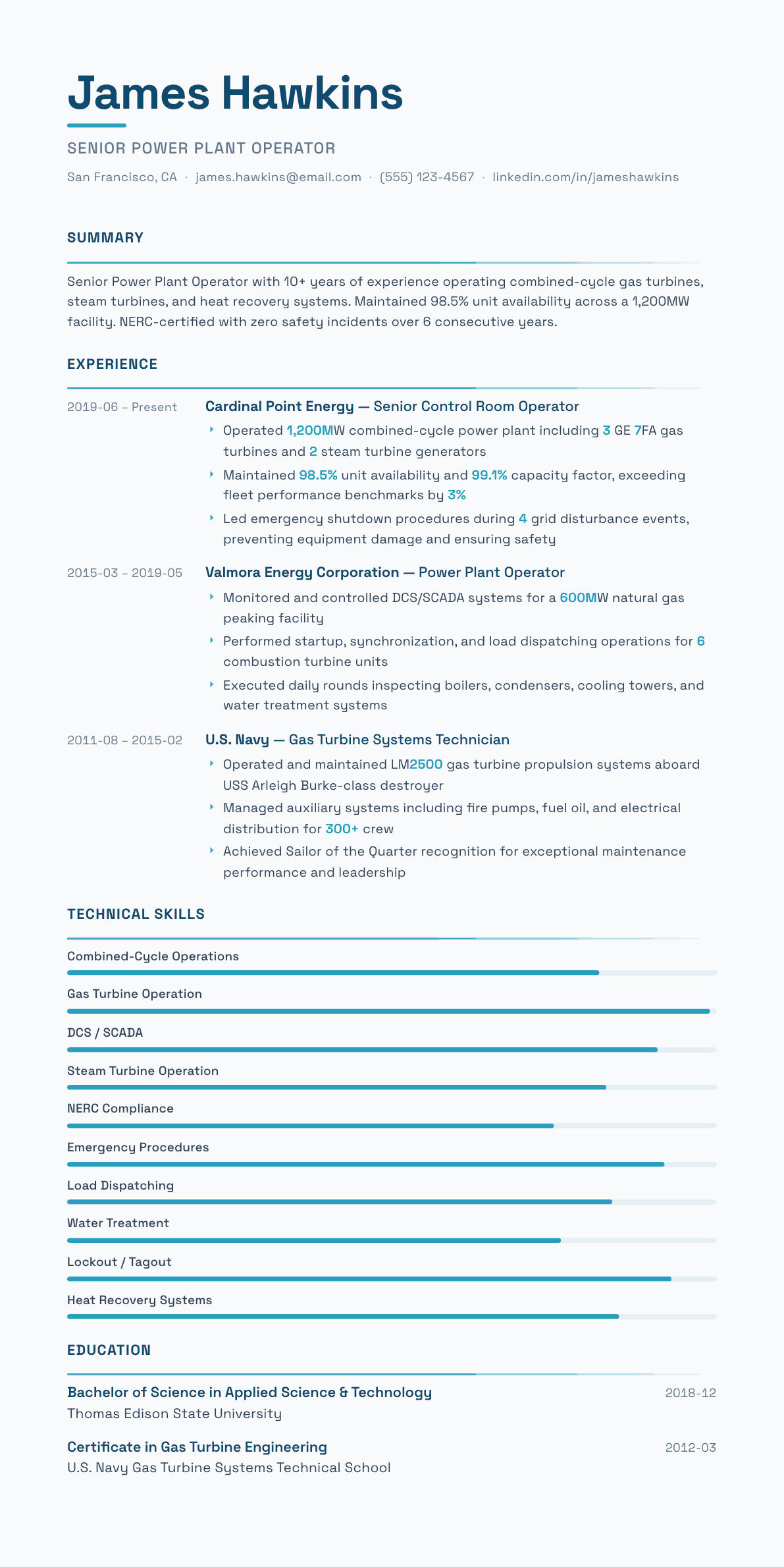
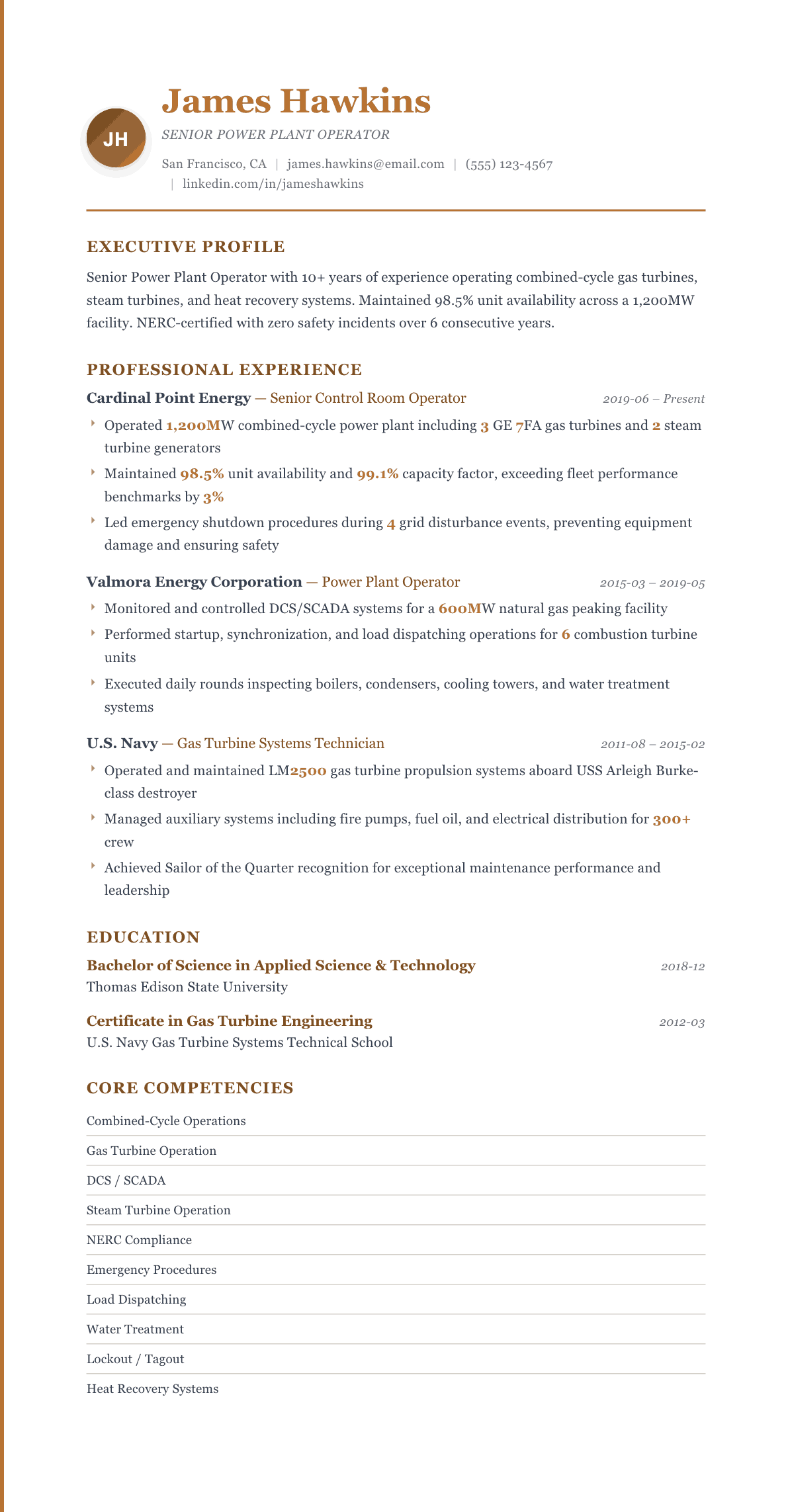
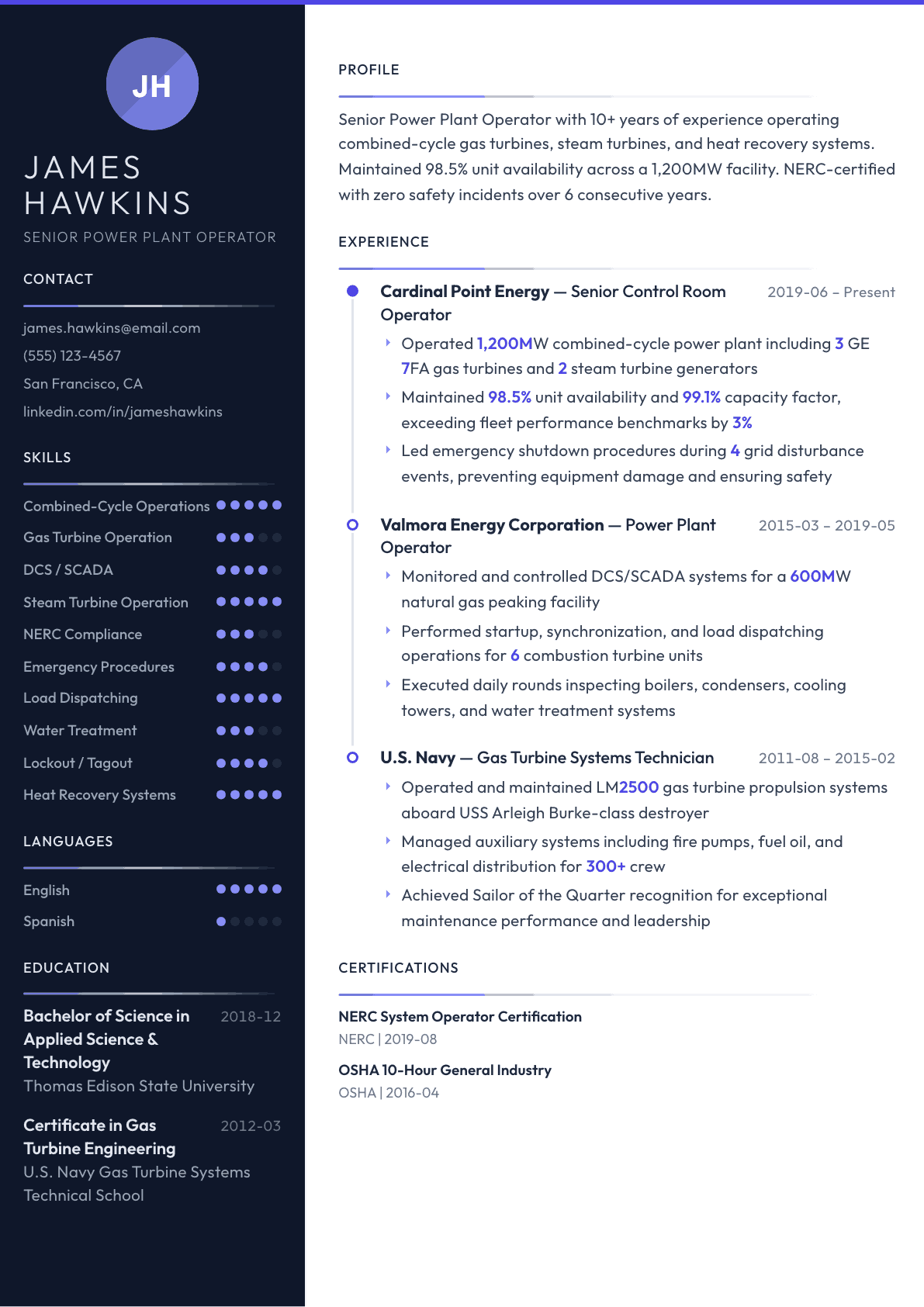
Example Power Plant Operator summary
NERC-certified Senior Power Plant Operator with 10+ years operating combined-cycle and simple-cycle gas turbine facilities up to 1,200MW. Maintained 98.5% unit availability with zero safety incidents over 6 years. Fluent in DCS/SCADA, emergency procedures, and load dispatching for competitive energy markets.
Skills to list on a Power Plant Operator resume
- Combined-Cycle Operations
- Gas Turbine Operation
- Steam Turbine Operation
- DCS / SCADA
- NERC Certification
- Load Dispatching
- Emergency Procedures
- Water Treatment
- Heat Recovery Systems
- Lockout / Tagout
- Environmental Compliance
- Preventive Maintenance
What actually gets this resume read
- List plant types and capacities you have operated: combined-cycle, simple-cycle, coal, nuclear, or hydro.
- Quantify availability, capacity factor, and heat rate performance against industry benchmarks.
- Highlight NERC certification, operator licenses, and safety certifications prominently.
- Include control system experience: DCS, SCADA, Emerson Ovation, or Honeywell Experion.
- Describe emergency response experience: forced outages, grid events, and environmental exceedances.
How to write a power plant operator resume
A power plant operator resume is read by an operations superintendent who has one question in mind: can this person stand a shift on my unit without being watched. That judgment is made from the plant type, the megawatt rating, the control system, the licenses and the safety record. Everything else on the page is secondary.
Generation is a licensed, procedure-driven trade, so specifics carry the file. Combined cycle is not the same as coal, and a nuclear control room is a different world from a peaking facility. A resume that says "operated power generation equipment" forces the reader to guess, and superintendents do not guess, they move on to the next file.
This guide covers the header block that gets an operator past screening, how to write experience around units, systems and abnormal events, summaries for an auxiliary operator, a control room operator and a shift supervisor, and how to translate military or industrial experience into utility language.
Format: one to two pages, plant details up front
Keep it reverse-chronological and plain. Utilities and independent power producers screen through applicant tracking systems that key on plant type, control system names and license terms, so avoid columns, icons and graphics that a parser will scramble.
Under the summary, put a short plant profile block: fuel and cycle type, generating capacity, control system, and any licenses held with their status. An operations manager staffing a combined cycle plant wants to see a gas turbine and heat recovery steam generator in the first six lines.
- Header: name, city and state, phone, email, and willingness to work rotating shifts.
- Order: summary, plant and systems profile, licenses and certifications, operating experience, training, education.
- Name the plant type precisely: combined cycle, simple cycle peaker, subcritical coal, biomass, hydroelectric, geothermal, nuclear.
Experience: units, systems, and what you did when things went wrong
Open each job with the facility, the total station capacity, the unit configuration and your position on the shift crew. A line such as senior control room operator at a two-on-one combined cycle station with two combustion turbines, two heat recovery steam generators and one steam turbine tells a reader more than a paragraph of duties.
Then write bullets on the operating work that varies between operators: cold, warm and hot starts, synchronizing to the grid, load following and dispatch response, unit trips and recovery, switching orders, clearance and tagging, and startup or commissioning of new equipment. Anyone can walk rounds, so rounds is not a bullet unless it caught something.
Abnormal events are your strongest material. An operator who has taken a unit through a trip, a load rejection, a boiler or turbine protection actuation, or a grid disturbance and can describe the response calmly is exactly who the superintendent wants on nights.
Licenses, certifications and clearance authority
This section belongs high on the page and needs status and dates. Reliability certification for system and generation operators, nuclear reactor operator or senior reactor operator licensing, state or municipal boiler and stationary engineer licenses, and safety training all filter candidates before a human reads the resume.
Say plainly whether you are qualified to issue and hold clearances, act as a competent person for confined space or hot work, or serve as switching authority. Those qualifications take a plant a year or more to build in a new hire, which makes them the most valuable lines on the page.
Control systems, equipment and the terms that get matched
Name the distributed control system and the human machine interface you have run: the vendor and the platform, not just the words control system. Add the auxiliary systems you have operated and troubleshot: feedwater and condensate, circulating water and cooling towers, fuel gas conditioning, lube oil, air compressors, water treatment and demineralization, emissions control and continuous emissions monitoring.
Include the operational metrics your plant tracked and you influenced: unit availability, forced outage rate, starting reliability, heat rate and auxiliary power use. Operators who talk in these terms read as people who understand the business behind the switchgear.
- Control systems: name the platform and how many years on it.
- Turbine and boiler models where you know them, because staffing decisions are made on familiarity.
- Outage work: what you performed during planned overhauls and returns to service.
Coming from the military or from another trade
Navy machinist mates, gas turbine technicians, electricians and nuclear-trained personnel move into generation constantly, but the resume has to translate. Replace rate and billet titles with plant language: propulsion plant watchstanding becomes shift operations, engineering officer of the watch becomes shift supervision, and casualty control becomes emergency and abnormal operating procedures.
The same applies to refinery, paper mill or industrial boiler operators. Lead with the equipment overlap: steam generation, rotating equipment, permit-to-work systems, and procedure discipline. Say directly that you are moving into utility generation so the reader is not left assembling the story.
Power Plant Operator resume summary examples
Auxiliary operator
Auxiliary operator with 2 years at a natural gas combined cycle station, performing rounds, valve lineups, equipment isolations and water chemistry sampling. Completed the site operator training program through the second qualification level and holds current safety and confined space training.
Control room operator
Control room operator with 7 years at a 620 MW combined cycle plant, running cold and hot starts, grid synchronization and load dispatch from an Ovation distributed control system. Qualified to issue clearances and served as acting shift supervisor on 30 shifts.
Shift supervisor
Shift supervisor with 15 years across coal and combined cycle generation, leading a crew of 6 across rotating 12-hour shifts. Owns switching authority, clearance issuance and abnormal event response, and led the return to service of a steam turbine after a major overhaul.
Work experience bullets: before and after
Before: Operated power plant equipment and monitored systems.
After: Operated a 620 MW two-on-one combined cycle unit from the control room, covering cold starts, grid synchronization and automatic generation control response across 12-hour rotating shifts.
Capacity, configuration and the specific operating evolutions let a superintendent match you to his unit immediately.
Before: Responded to plant emergencies.
After: Recovered the unit from 3 turbine trips and one full load rejection, executing the abnormal operating procedure and returning to synchronization within 4 hours without equipment damage.
Event type, count and outcome show composure under pressure instead of a general claim about emergencies.
Before: Performed daily rounds and inspections.
After: Identified a rising bearing vibration trend on a boiler feed pump during rounds and initiated a work order that avoided an unplanned outage during peak season.
A round only becomes a bullet when it caught something, and the avoided outage is the value the reader cares about.
Before: Followed safety procedures at all times.
After: Issued and held 200 clearances under the station tagging program with no lockout violations, and acted as confined space attendant for condenser and cooling tower entries.
Clearance volume and named authority prove safety qualification rather than asserting good intentions.
Before: Helped train new operators.
After: Wrote 8 auxiliary system qualification checkouts and signed off 5 operators through the water treatment and fuel gas modules of the site training program.
Naming the training artifacts and the people qualified turns informal help into documented plant contribution.
Hard skills
- Control room operations
- Distributed control systems
- SCADA monitoring
- Gas and steam turbine startup and synchronization
- Heat recovery steam generator operation
- Boiler operation and water chemistry
- Clearance and tagging authority
- Abnormal and emergency operating procedures
- Switching and grid dispatch response
- Auxiliary systems troubleshooting
- Outage support and return to service
- Emissions monitoring compliance
Soft skills
- Shift handover discipline
- Composure during abnormal events
- Crew coordination
- Procedure adherence
- Clear radio and log communication
Certifications worth listing
- System Operator Certification (North American Electric Reliability Corporation)
- Reactor Operator and Senior Reactor Operator License (U.S. Nuclear Regulatory Commission)
- OSHA 30-Hour General Industry (OSHA Training Institute Education Centers)
- Stationary Engineer and Boiler Operator License (State and municipal licensing authorities)
- Power Engineer Certification (National Institute for Uniform Licensing of Power Engineers)
Mistakes that cost power plant operator candidates the interview
- Writing generic duty lists that would fit any plant, when the superintendent is hiring for one specific unit configuration.
- Leaving out the megawatt rating and fuel type, so the reader cannot tell a peaker from a baseload station.
- Hiding the control system name inside a paragraph instead of putting it where a keyword filter will find it.
- Omitting license status and expiry, which turns a qualified operator into a file the recruiter has to chase.
- Keeping military rates and billet titles untranslated, so a civilian reader cannot map the watchstanding experience.
- Claiming a perfect safety record without naming the program you worked under, such as clearance issuance or confined space entry.
Power Plant Operator resume questions
What should a power plant operator resume list first?
The plant profile and the licenses. Fuel and cycle type, station capacity, unit configuration, control system and license status answer the first question an operations manager has, and they are the terms the screening software is matching against.
How do I move from Navy engineering into a civilian plant operator job?
Translate every title and duty into utility vocabulary. Watchstanding becomes shift operations, casualty control becomes emergency operating procedures, and propulsion plant systems become steam, lube oil and feedwater systems. Keep the qualification record, since it proves formal training discipline.
Do I list every unit trip and outage I worked?
No. Group them by count and type, then describe one or two in detail where your action mattered. A reader wants evidence of judgment under abnormal conditions, not a chronological log of every event during your career.
Is a degree required for a power plant operator resume?
Usually not. Completed operator training programs, apprenticeships, military technical schools and licenses carry more weight than a general degree. List the training programs with the qualification levels reached, and put any associate or bachelor degree below them.
How do I show shift work availability?
State it in the summary in one clause: available for rotating 12-hour shifts including nights, weekends and holidays. Plants staff around the clock, and hiring managers screen out candidates whose availability is unclear before the interview stage.
Related resume examples
- Electrical Power Engineer Resume example
- Nuclear Technician Resume example
- Utility Manager Resume example
- Chief Engineer Resume example
- Wind Energy Technician Resume example
- Facilities Engineer Resume example