Nuclear Engineer Resume Examples: the lines they read
Power Up Your Nuclear Engineer Resume for Critical Roles
By Mustafa Tarabya, founder of CVBooster · Published · Updated
Create a nuclear engineer resume showcasing reactor design, radiation safety, and NRC regulatory expertise with precision and technical authority.
Sample resumes for a nuclear engineer
The same nuclear engineer content laid out in three CVBooster templates, so you can see what the finished document looks like before you write a word.
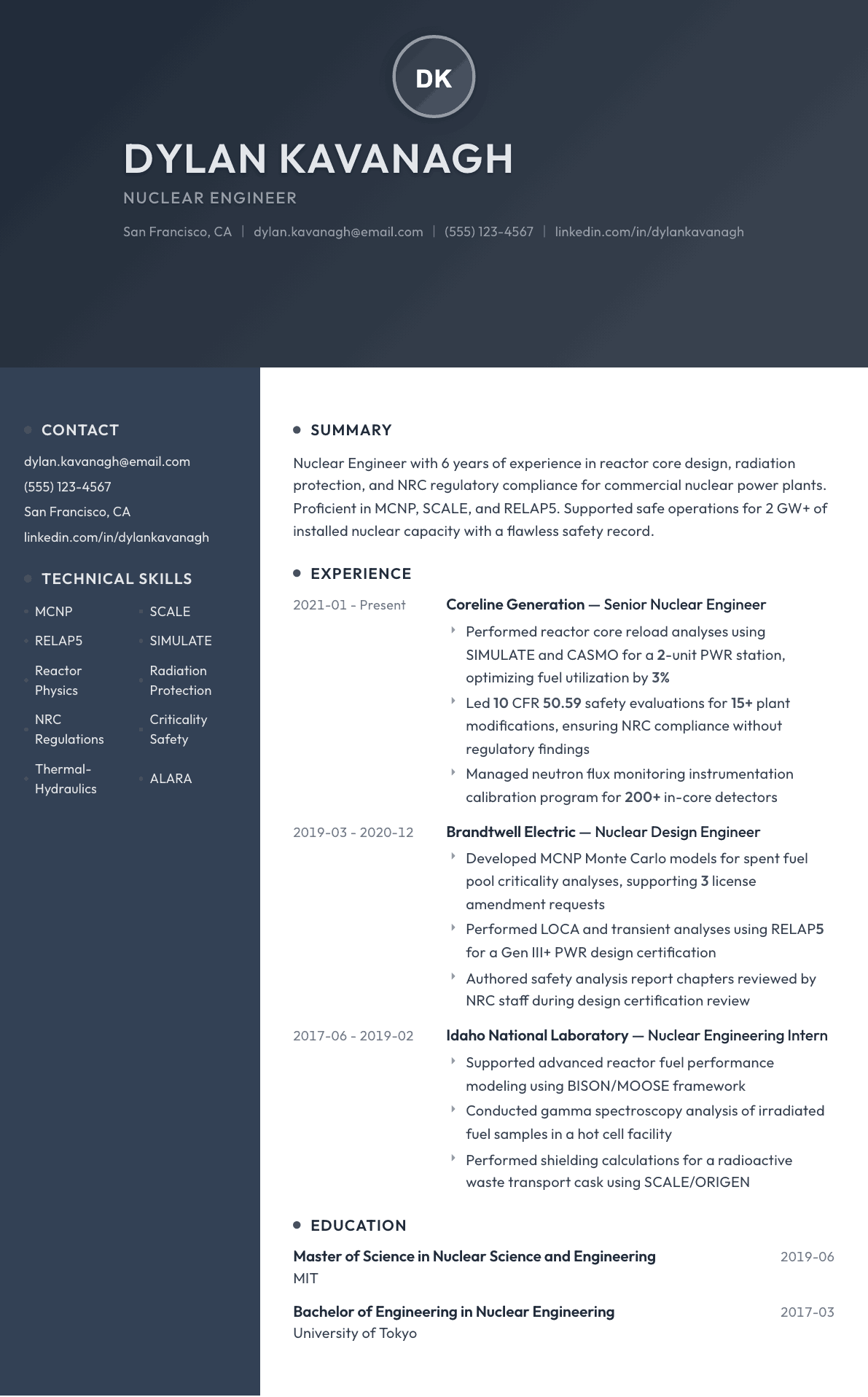
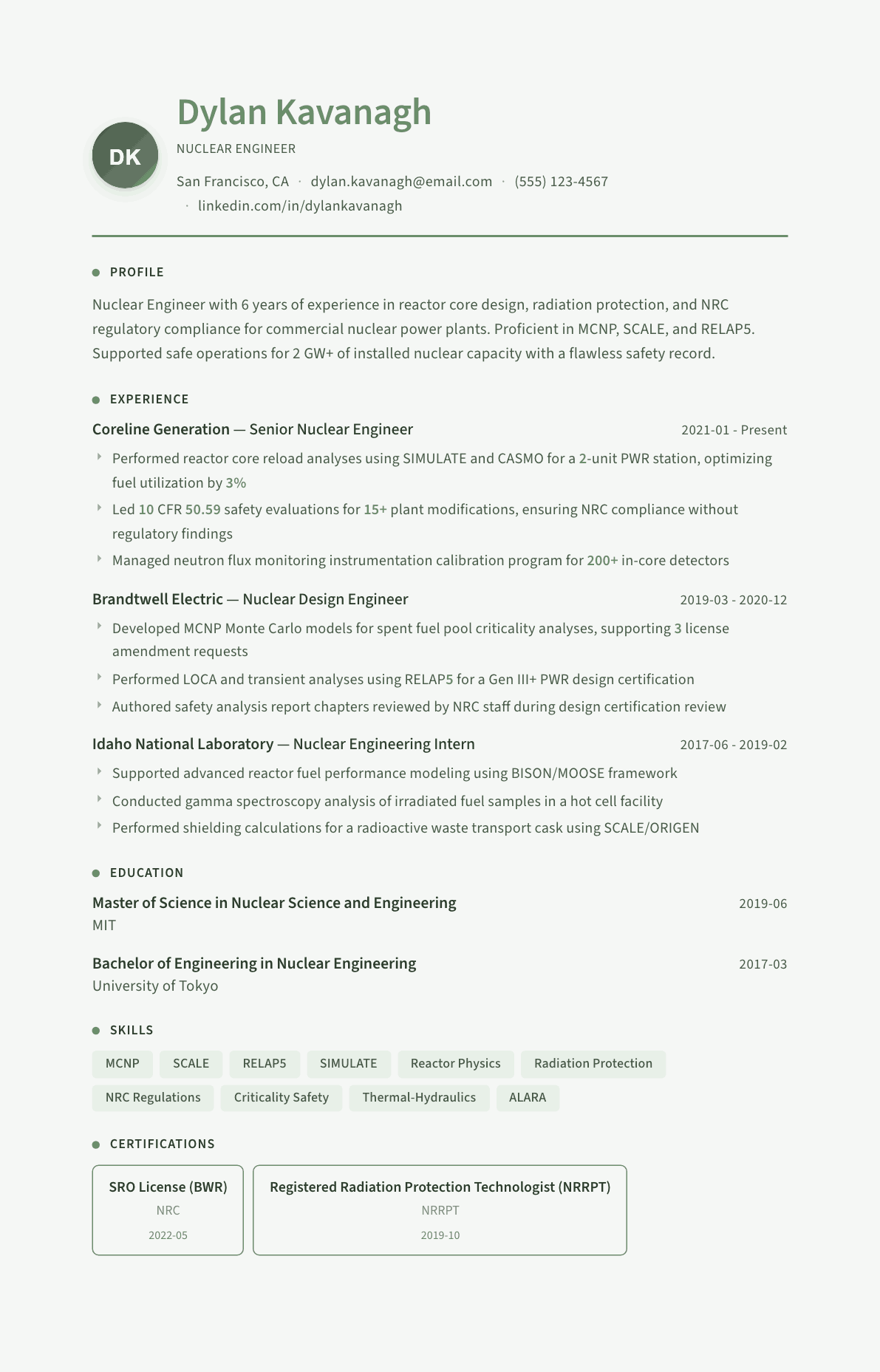
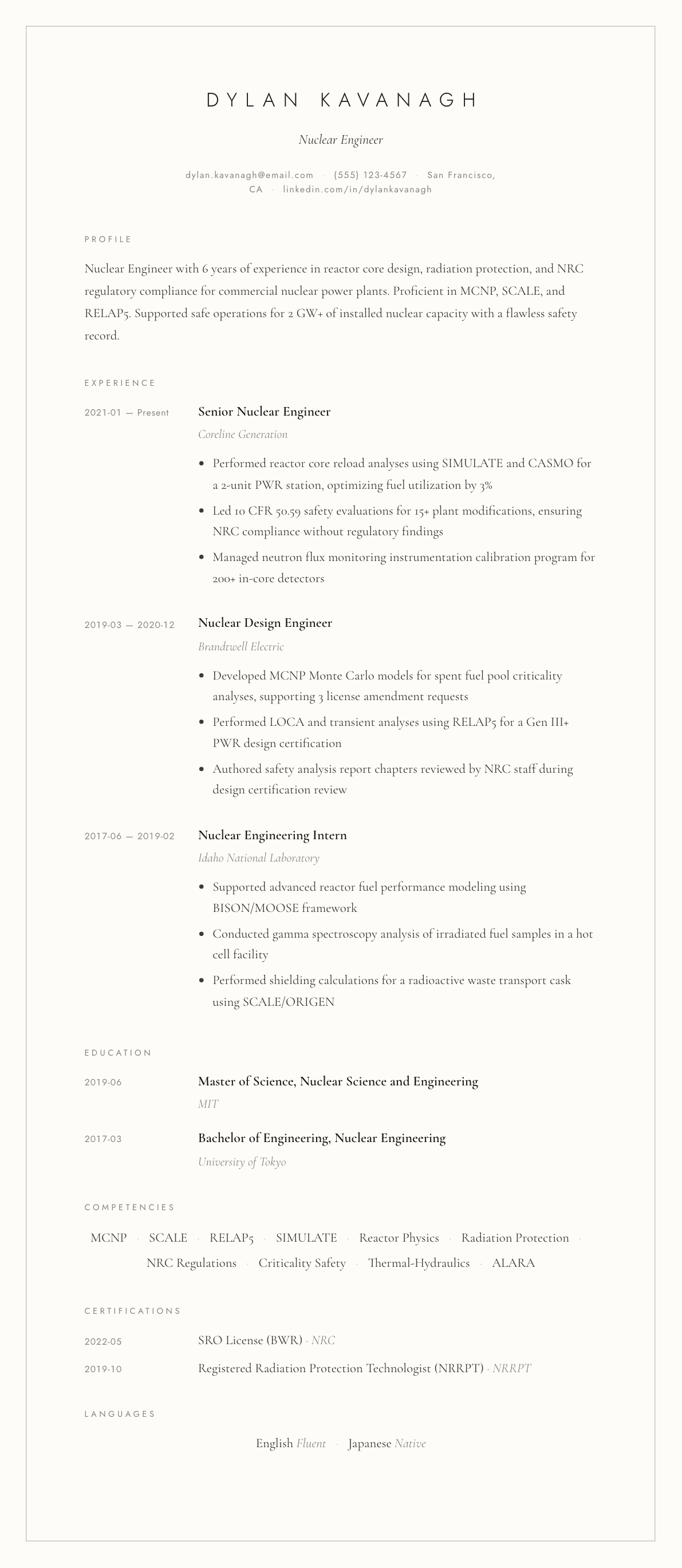
Example Nuclear Engineer summary
Nuclear Engineer with 6 years of experience in reactor core design, safety analysis, and NRC regulatory compliance. Expert in MCNP, SCALE, and RELAP5 with hands-on experience in PWR and BWR operations. Supported safe operations for 2 GW+ of installed capacity with zero regulatory findings.
Skills to list on a Nuclear Engineer resume
- MCNP
- SCALE / ORIGEN
- RELAP5 / TRACE
- SIMULATE / CASMO
- Reactor Physics
- Thermal-Hydraulics
- Criticality Safety
- Radiation Protection
- NRC Regulations
- ALARA
- Shielding Analysis
- Fuel Management
- Safety Analysis
- Decommissioning
- Neutronics
What actually gets this resume read
- Highlight nuclear analysis codes: MCNP, SCALE, RELAP5, TRACE, SIMULATE, CASMO, PARCS.
- Reference NRC regulations: 10 CFR 50, 10 CFR 20, 10 CFR 72, Regulatory Guides.
- Include security clearance or NRC access authorization if applicable.
- Specify reactor types: PWR, BWR, advanced reactors (SMR, MSR, HTGR).
- Quantify safety and efficiency contributions: fuel savings, capacity factor, dose reduction.
- Mention ALARA program experience and radiation protection competencies.
How to write a nuclear engineer resume
Nuclear engineering hiring runs on evidence and eligibility. The evidence is the analysis you have performed and the licensing basis documents your work has supported. The eligibility is unescorted access, background screening and, for national laboratory and defense work, a security clearance. A resume that is vague about either one stalls, because the reviewer cannot start an access process on a maybe.
The field also splits sharply. Commercial power plant engineering, reactor design and vendor work, fuel cycle and waste management, national laboratory research, naval propulsion and radiological engineering all use the title. Each has its own codes, its own analysis tools and its own regulator facing paperwork, and a reader identifies your branch within the first two lines or gives up trying.
This guide covers the section order nuclear employers expect, how to write analysis and licensing bullets that a lead engineer trusts, summaries at three career stages, and the questions that come up around clearances, licensing exams and moving between the commercial fleet, vendors and the laboratories.
Format: clearance and access status visible, codes named
A plain single column, reverse chronological document of one to two pages. If you hold or have held a security clearance, or have held unescorted access at a commercial plant, put it in the header area with the status and whether it is current. That single line moves a file through screening faster than any achievement bullet.
Group your analysis codes and methods into a visible technical block. A lead engineer scanning for someone who can pick up a criticality analysis or a transient calculation is looking for code names, and will not read three jobs deep to find them.
- Header: name, city and state, phone, email, clearance or unescorted access status, professional registration.
- Order: summary, technical codes and methods, experience, education, licenses and certifications, publications if applicable.
- Name the reactor technology in each job: pressurized water, boiling water, small modular, research reactor, advanced non-light water.
Summary: branch of the industry, technology, analysis specialty
Say which part of the industry you work in and on what technology. Core design and fuel management, thermal hydraulics and transient analysis, criticality safety, radiation transport and shielding, probabilistic risk assessment, materials and component engineering, or licensing and regulatory affairs are separate specialties that are hired separately.
Then name the operating environment. Supporting an operating fleet with outage schedules and technical specification deadlines is a different professional life from vendor design certification work or laboratory research, and the summary should signal which rhythm you are used to.
Experience: the calculation, the basis, the regulatory outcome
The strongest nuclear engineering bullets follow the analysis to its consequence. State what you calculated, in which code, against which acceptance criterion, and what it allowed the plant or the program to do. A reload analysis that let a cycle extend, a criticality analysis that supported a storage rack change, a shielding calculation that reduced dose during an outage task, each of these is a complete story.
Name the regulatory instrument. Screenings and evaluations under the change process rule, license amendment requests, technical specification changes, relief requests, exemption requests, and safety analysis report chapter revisions are the currency of licensing work. Say whether the submittal cleared review, and whether requests for additional information came back, because that is how the quality of the work is judged.
Quality assurance and configuration control deserve their own bullets. Working to the nuclear quality assurance program, calculation preparation and independent verification, design change packages, and corrective action program entries are the discipline that makes an engineer employable inside a plant. Sloppiness here is fatal, and demonstrated rigor is a genuine differentiator.
Operations facing work should be visible too. Outage support, engineering on shift, operability determinations, equipment reliability and component engineering, and interfaces with operations and maintenance show that you can work at plant tempo rather than only at study tempo.
Skills: codes, standards, and the analysis you can defend
List the analysis codes you have actually run and can defend in an interview. Radiation transport and depletion codes, core physics and fuel management codes, system thermal hydraulic and transient codes, containment analysis codes, and risk assessment software each imply a different training path, and claiming one you only watched somebody else use is quickly exposed.
Then the standards and regulatory framework. Federal regulation parts covering radiation protection, plant licensing and quality assurance, the boiler and pressure vessel code sections relevant to nuclear components, and industry standards for design and testing. Add radiation protection practice, dose assessment and shielding design if you do that work.
General engineering tools still matter. Scripting for automation of case setups and result extraction, statistical analysis, and computer aided design or drafting for design change packages all get used more than newcomers expect.
Education, licenses and the clearance question
A degree in nuclear engineering, mechanical engineering with a nuclear option, or health physics is the common entry. Naval nuclear propulsion training and operating experience is highly valued in the commercial fleet, so describe it plainly with the plant type, the watch stations qualified and the responsibilities held.
For licenses, professional registration in nuclear engineering exists and is worth listing where held. A senior reactor operator license, or having completed an operator license class, is a strong credential for plant engineering and training roles. Be precise about clearance status: the level, whether it is active, and the approximate date of the last investigation, without adding any detail you are not permitted to disclose.
Nuclear Engineer resume summary examples
New graduate
Nuclear engineering graduate with an internship at a national laboratory performing shielding calculations for a transport cask and a senior project on fuel depletion modeling. Trained in Monte Carlo radiation transport and reactor physics fundamentals, and eligible for a security clearance investigation.
Five years in the fleet
Nuclear engineer supporting a two-unit pressurized water station, performing reload safety evaluations and core follow. Completed 14 evaluations under the plant change process with no regulatory findings, and improved fuel utilization on one cycle by 3% through a revised loading pattern. Holds current unescorted access.
Principal or licensing lead
Principal nuclear engineer with 13 years spanning vendor design analysis and fleet licensing. Led 5 license amendment requests through regulator review, owns the criticality safety analysis basis for spent fuel storage, and mentors four analysts on calculation preparation and independent verification.
Work experience bullets: before and after
Before: Performed reactor core analysis using industry codes.
After: Performed reload core physics analysis for two cycles using the site lattice and nodal code suite, confirmed peaking factors and shutdown margin against technical specification limits, and issued the cycle-specific safety evaluation.
Named acceptance criteria and the resulting document show a completed analysis rather than familiarity with a code.
Before: Supported NRC licensing activities.
After: Wrote a license amendment request to revise a surveillance interval, prepared the supporting technical basis and no significant hazards determination, and answered two rounds of requests for additional information through approval.
The specific submittal and its path through review demonstrate ownership of the regulatory process end to end.
Before: Did shielding calculations for radiation protection.
After: Built a Monte Carlo model of a valve gallery to plan an outage task, identified a temporary shielding arrangement that lowered projected collective dose by 40%, and documented the calculation for the radiation work permit.
Tying the transport model to a dose reduction and a work permit makes the calculation operationally real.
Before: Wrote safety evaluations for plant modifications.
After: Screened 30 plant modifications under the change process rule and prepared 6 full evaluations, including a heat exchanger replacement where the analysis established that no prior regulator approval was required.
Volume plus one worked example shows both throughput and the judgment the screening process demands.
Before: Participated in probabilistic risk assessment work.
After: Updated the internal events fault tree model for a service water modification, requantified core damage frequency, and supported the risk-informed justification for an extended allowed outage time.
Model scope, the requantification and the decision it supported turn participation into a defensible contribution.
Hard skills
- Reactor physics and core design
- Monte Carlo radiation transport
- Depletion and source term analysis
- Thermal hydraulic and transient analysis
- Criticality safety analysis
- Shielding design and dose assessment
- Probabilistic risk assessment
- Safety analysis report preparation
- Change process screening and evaluation
- License amendment and technical specification work
- Nuclear quality assurance and calculation control
- Design change package preparation
- Fuel management and loading pattern optimization
- Scripting for case setup and data reduction
Soft skills
- Procedural discipline
- Independent verification mindset
- Precise technical writing
- Questioning attitude
- Working under outage schedule pressure
- Regulator-facing communication
Certifications worth listing
- Professional Engineer, Nuclear (State licensing board, NCEES examination)
- Fundamentals of Engineering (FE) (NCEES)
- Senior Reactor Operator License (United States Nuclear Regulatory Commission)
- Certified Health Physicist (CHP) (American Board of Health Physics)
- Nuclear Quality Assurance Lead Auditor (Employer program qualified to the ASME NQA-1 standard)
Mistakes that cost nuclear engineer candidates the interview
- Omitting clearance or unescorted access status, which is often the first thing a nuclear recruiter needs before a file can move.
- Listing analysis codes you have not personally run. Technical screens in this field go straight to inputs, assumptions and acceptance criteria.
- Describing analysis without the criterion it was measured against, which leaves the reader unable to judge whether the work was meaningful.
- Ignoring the quality assurance side. Calculation control, independent verification and corrective action entries are core competence, not administration.
- Publishing anything export controlled, proprietary or safeguards related. Describe the class of work and leave out the parameters you are not free to share.
- Using one resume for the operating fleet, a vendor and a national laboratory when each expects a different balance of licensing, design and research evidence.
Nuclear Engineer resume questions
How should I list a security clearance on a nuclear engineer resume?
State the level and whether it is currently active or when it lapsed, along with the approximate date of the last investigation. Do not include agency detail, program names or anything else you are not authorized to disclose, since discretion is itself part of the assessment.
Is a PE license useful for nuclear engineers?
It is useful and not universal. Professional registration matters most for consulting, design authority and some vendor work, while much fleet and laboratory engineering does not require it. Passing the Fundamentals of Engineering examination early keeps the option open.
How do I move from naval nuclear experience into a commercial plant?
Translate watch qualifications and maintenance responsibility into commercial vocabulary: systems knowledge, procedural compliance, plant chemistry, casualty response and supervision of qualified teams. Fleet employers actively recruit this background, so make the plant type and qualifications explicit.
What should a nuclear engineering resume say about codes and standards?
Name the specific analysis codes you have run and the regulatory and design standards your work was performed against. Vague references to industry codes tell a reviewer nothing, while a precise list lets them map you directly onto an open analysis assignment.
Do I need an operator license to work in plant engineering?
No, but holding one or having completed a license class is a meaningful advantage for engineering roles that interface with operations, and it is often a prerequisite for training and management paths. List it with the plant type and the year of issue if you hold it.
Related resume examples
- Mechanical Engineer Resume example
- Electrical Engineer Resume example
- Safety Engineer Resume example
- Nuclear Technician Resume example
- Pipeline Engineer Resume example
- Chemical Engineer Resume example