School Nurse Resume Examples: free ATS score and gap list
Write a School Nurse Resume for a District Hiring Panel
By Mustafa Tarabya, founder of CVBooster · Published · Updated
School nurse resume examples covering care plans, medication delegation, immunization compliance and the keywords district panels screen for.
Sample resumes for a school nurse
The same school nurse content laid out in three CVBooster templates, so you can see what the finished document looks like before you write a word.
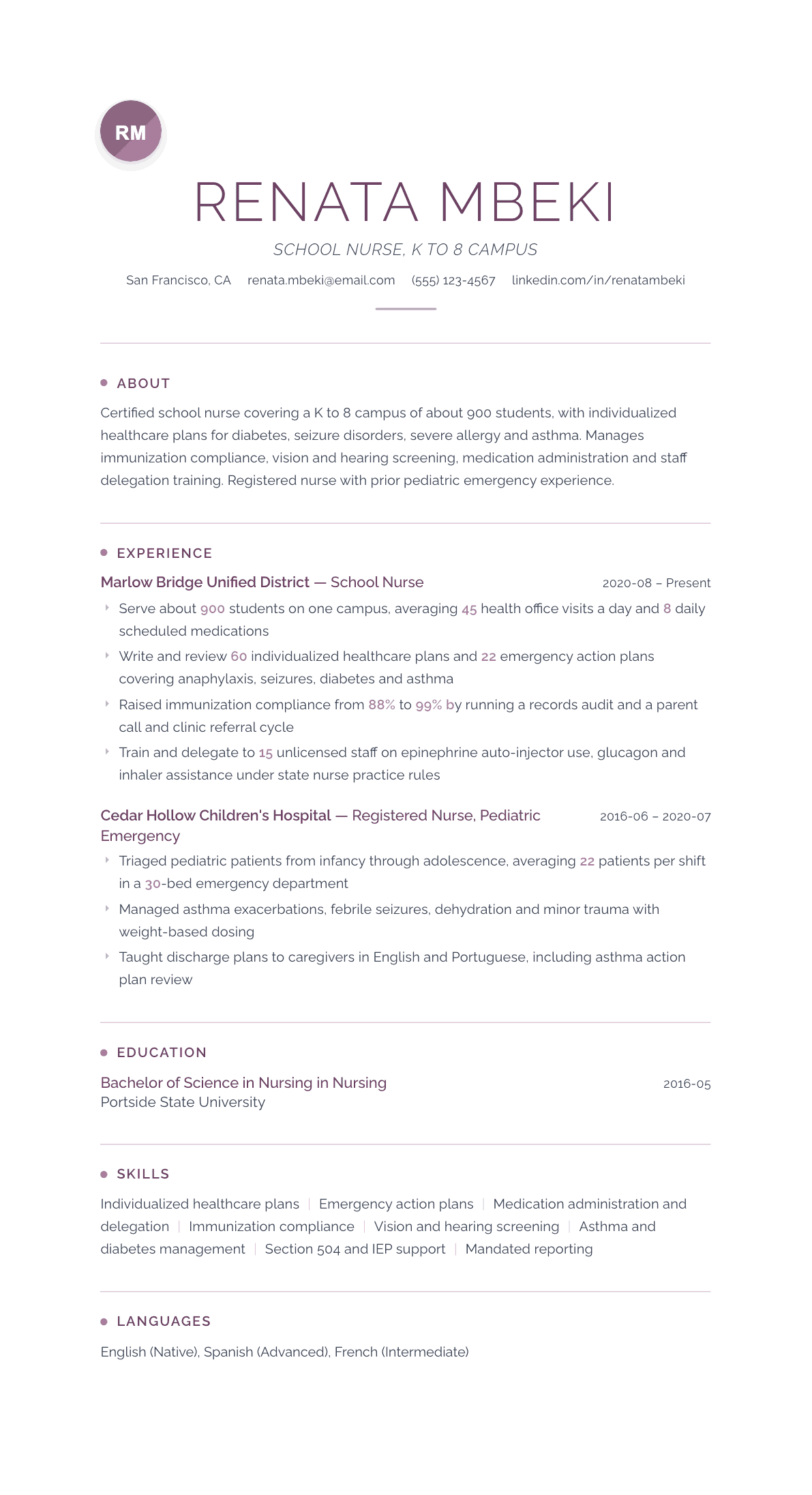
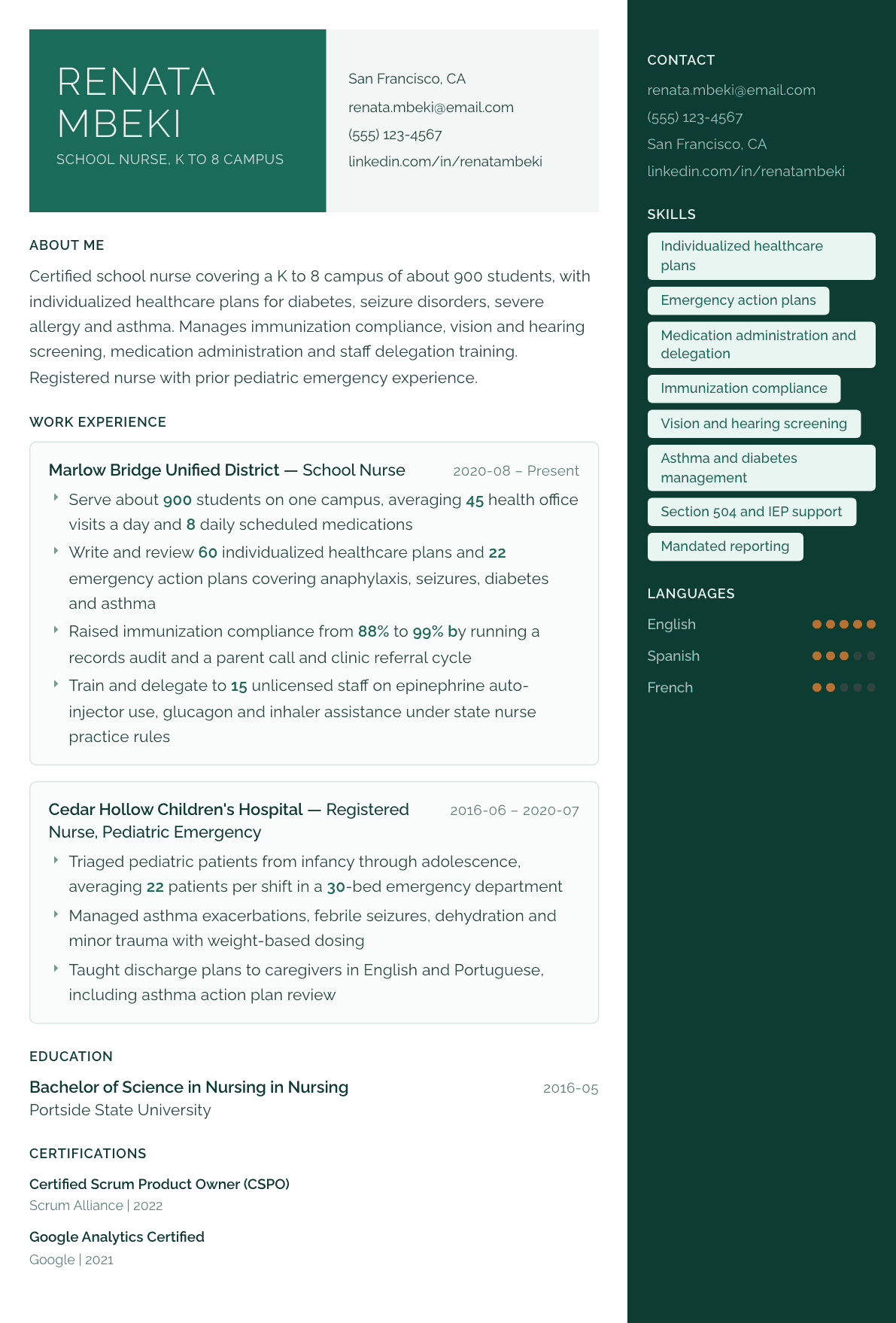
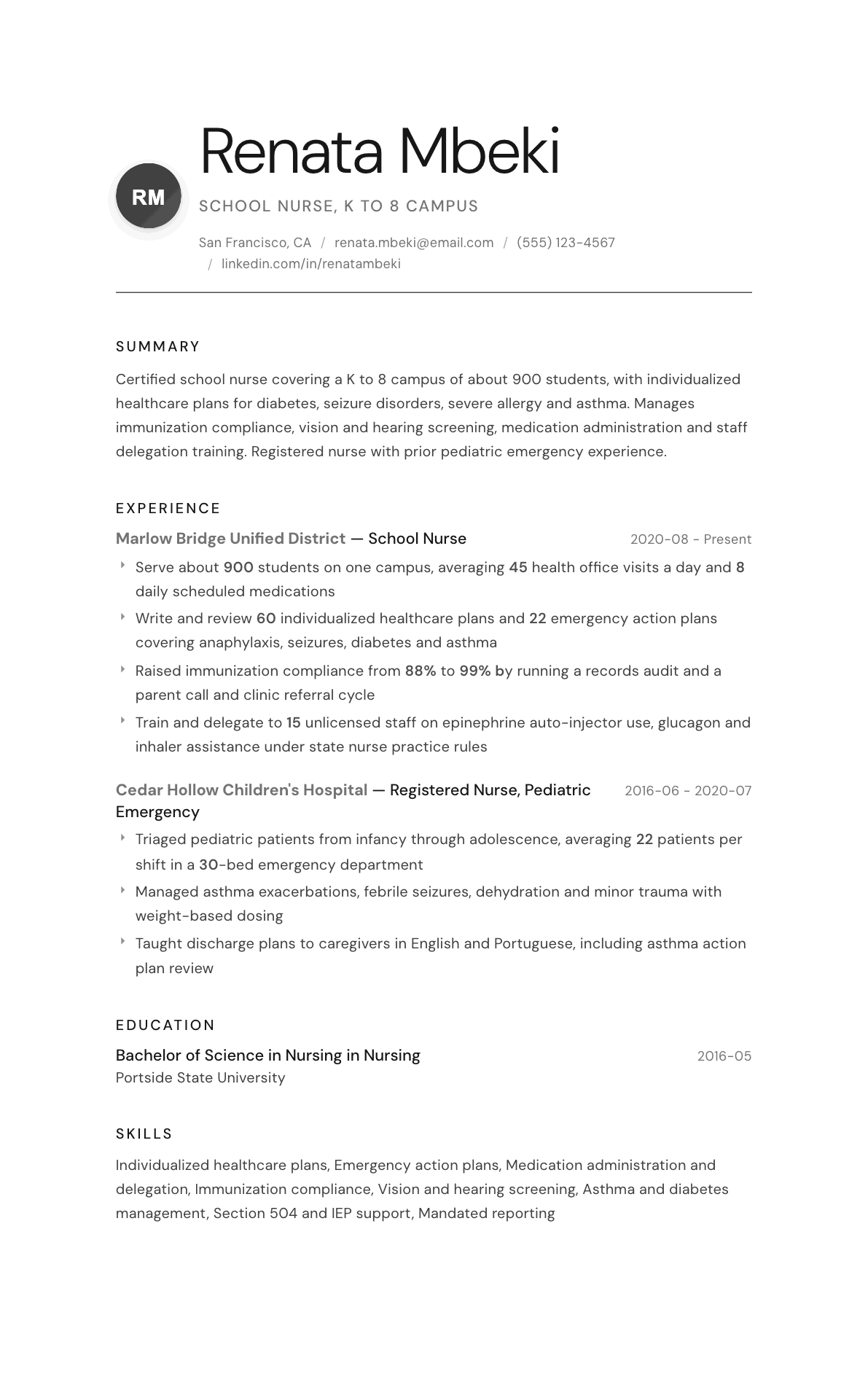
Example School Nurse summary
Certified school nurse covering a K to 8 campus of about 900 students, averaging 45 health office visits a day. Writes individualized healthcare plans and emergency action plans for diabetes, seizure, asthma and severe allergy, and trains unlicensed staff on epinephrine and glucagon. Led an immunization audit that brought compliance close to full. Four years of pediatric emergency nursing before the district.
Skills to list on a School Nurse resume
- Individualized healthcare plans
- Emergency action plans
- Medication administration
- Delegation to unlicensed staff
- Immunization record compliance
- Vision and hearing screening
- Scoliosis screening
- Diabetes and insulin pump support
- Seizure and epilepsy care
- Anaphylaxis and epinephrine training
- Asthma action plans
- Section 504 and IEP participation
- Mandated reporting
- Communicable disease tracking
What actually gets this resume read
- State the student enrollment you cover and whether you serve one campus or float across several buildings.
- Name the chronic conditions you manage daily, since panels hire for diabetes, seizure and anaphylaxis confidence.
- Show the paperwork side: individualized healthcare plans written, emergency action plans, 504 and IEP meetings attended.
- Give immunization and screening compliance numbers, because those are the metrics a district reports to the state.
- Describe delegation and training of unlicensed staff, which is the legal skill that separates school nursing from clinic work.
- List your state school nurse certification and any pediatric experience above general acute care history.
How to write a school nurse resume
School nurse hiring does not run through a hospital recruiter. It runs through a district human resources office and a panel that usually includes a lead nurse, a principal and sometimes a special education director. They are hiring one licensed clinician to sit alone in a health office with several hundred children, so they read for autonomy, documentation discipline and comfort with the legal side of delegation.
The clinical content they care about is narrow and deep: diabetes with pumps and continuous monitors, seizure disorders and rescue medication, anaphylaxis and epinephrine, asthma, complex feeding tubes and catheterization, plus mental health crises and the daily flood of stomachaches. What they do not care about is a long list of adult acute care skills with no bridge to a campus.
This guide covers the section order a district panel expects, how to write enrollment, care plans and delegation so they read as competence rather than duty, three summaries across a school nursing career, and the questions nurses ask when they move from the hospital to a school.
Format: build it for a district panel, not a hospital recruiter
Two pages is normal here because the panel wants care plan work, screening compliance, training records and committee participation, none of which fit alongside clinical bullets on one page. Reverse chronological, plain single column, and no icons, since many district systems still parse resumes into a text field.
Put licensure and certification in their own block right under the summary: registered nurse license with the state, school nurse certification or endorsement where your state issues one, and any teaching credential. Districts have to verify all of it before an offer, so making it easy is worth a section.
- Header: name, credentials, city and state, phone, email, license state.
- Order: summary, licenses and certifications, school experience, clinical experience, education, skills, professional service.
- Add languages spoken with families, because a bilingual health office is a genuine district need.
Summary: enrollment, grade levels, and the conditions you manage
State the enrollment you cover and whether it is one campus or a float assignment across several buildings, then the grade band, then the chronic conditions you manage daily. A panel can size your job instantly from those three facts, and enrollment per nurse is the number districts benchmark themselves on.
If you are coming from the hospital, use the summary to bridge. A pediatric emergency nurse moving to a campus should name the pediatric assessment and family teaching experience and say plainly that the target is school health, rather than leaving the panel to work out why an acute care resume arrived.
Experience: care plans, delegation, screening and compliance
Lead each school job with the campus profile: enrollment, grade levels, average daily health office visits, number of scheduled medications, and the number of students with individualized healthcare plans. That single block does more work than any bullet you could write.
Then write the four pillars. Individualized healthcare plans and emergency action plans you author and review. Delegation and training of unlicensed staff on epinephrine auto-injectors, glucagon, inhalers, seizure rescue medication and blood glucose checks, always under your state nurse practice act. Mandated screenings for vision, hearing, scoliosis and body mass index with the compliance figures your state reports. Immunization record auditing and the exclusion process.
Add the meetings. Section 504 planning, individualized education program teams, threat assessment and attendance review committees are where a school nurse contributes clinical judgment to a group of educators, and panels weigh that heavily because it predicts whether you will work well inside a building.
Emergency response and public health duties
Describe what happens on your campus when something goes wrong: the response you lead for anaphylaxis, seizure, diabetic emergency, head injury, asthma attack or a mental health crisis, and how the staff around you are trained to act before you arrive. Include drills you have written or run.
Communicable disease work belongs here too: outbreak tracking, exclusion criteria, head lice and rash protocols, reporting to the county health department, and any pandemic-era screening or clinic coordination you led. Districts learned the value of that work the hard way and now hire for it.
Skills and keywords a district application form scans
The vocabulary recurs across postings: individualized healthcare plan, emergency action plan, medication administration, delegation, unlicensed assistive personnel, immunization compliance, vision and hearing screening, Section 504, individualized education program, mandated reporter, communicable disease. Put these in the skills block using the district wording and demonstrate each once inside a bullet.
Name the student information and health record system you have used, such as PowerSchool, Infinite Campus, Skyward, Aeries or SNAP Health Center. Districts run on one of them, and a nurse who already knows theirs starts contributing in week one.
School Nurse resume summary examples
Hospital nurse moving to a campus
Registered nurse with four years of pediatric emergency experience moving into school health. Skilled in pediatric assessment, asthma and diabetic emergency management, weight-based dosing and caregiver teaching in English and Spanish. Completing state school nurse certification and seeking a single campus elementary assignment.
Five years on a campus
Certified school nurse covering a K to 8 campus of about 900 students with roughly 45 health office visits a day. Authors individualized healthcare plans and emergency action plans for diabetes, seizure, anaphylaxis and asthma, trains unlicensed staff on rescue medication, and runs mandated vision, hearing and scoliosis screening.
Lead nurse for a district
Lead school nurse supporting eleven campuses and the health aides staffing them, with responsibility for district health protocols, delegation training and immunization compliance reporting. Coordinates the medically fragile student caseload with special education, and represents health services on the district crisis response team.
Work experience bullets: before and after
Before: Provided nursing care to students at an elementary school.
After: Served a K to 5 campus of about 620 students, managing roughly 35 health office visits and 9 scheduled medication administrations each day as the only licensed staff on site.
Enrollment, visit volume and the fact that you are alone define the job in a way that care does not.
Before: Wrote care plans for students with medical needs.
After: Authored and reviewed 60 individualized healthcare plans and 22 emergency action plans covering diabetes, seizure disorders, anaphylaxis and asthma, updating each at annual re-enrollment.
Counts and conditions show scope, and the review cycle shows the documentation discipline panels test for.
Before: Trained staff on how to use an epinephrine auto-injector.
After: Delegated to and trained fifteen unlicensed staff annually on epinephrine auto-injector use, glucagon and inhaler assistance, documenting competency under the state nurse practice act.
Delegation is the legal skill of school nursing, so naming the statute frame matters more than the topic.
Before: Kept immunization records up to date.
After: Audited immunization records for the full campus, ran a parent contact and clinic referral cycle for noncompliant students, and brought the campus close to full compliance before the state reporting deadline.
The process and the deadline turn a filing task into the compliance work a district is judged on.
Before: Attended special education meetings.
After: Contributed nursing assessment to 40 Section 504 and individualized education program meetings a year, writing the health accommodations for feeding tube, catheterization and seizure students.
Volume plus the specific accommodations proves clinical contribution rather than attendance.
Hard skills
- Individualized healthcare plans
- Emergency action plans
- Medication administration and documentation
- Delegation to unlicensed assistive personnel
- Immunization compliance auditing
- Vision, hearing and scoliosis screening
- Diabetes, insulin pump and glucose monitor support
- Seizure and rescue medication protocols
- Anaphylaxis and epinephrine response
- Asthma action plans and nebulizer treatment
- Gastrostomy tube feeding and clean intermittent catheterization
- Communicable disease tracking and reporting
- Section 504 and individualized education program participation
- Student health record systems
Soft skills
- Working autonomously without a nurse colleague on site
- Family communication across languages
- Calm handling of a health office queue
- Teaching teachers and aides
- Boundary setting with staff requests
Certifications worth listing
- Nationally Certified School Nurse (NCSN) (National Board for Certification of School Nurses)
- Basic Life Support (BLS) (American Heart Association)
- Pediatric Advanced Life Support (PALS) (American Heart Association)
- Pediatric Nursing Certification (CPN) (Pediatric Nursing Certification Board)
Mistakes that cost school nurse candidates the interview
- Sending an acute care resume unchanged, so the panel has to guess how ventilator experience helps on a campus.
- Leaving out enrollment and daily visit volume, which are the only numbers that size a school health office.
- Writing nothing about delegation, even though training unlicensed staff is the legal core of the role.
- Ignoring screening and immunization compliance, the two areas the state actually audits a district on.
- Treating Section 504 and individualized education program meetings as administrative noise rather than clinical work.
- Using hospital abbreviations throughout when a principal and a human resources reviewer are also reading the page.
School Nurse resume questions
Do I need a school nurse certification to apply?
It depends entirely on the state and sometimes on the district. Many states require a school nurse certificate or endorsement beyond the registered nurse license, others hire on the license alone. Name your state status on the resume so the panel is not left guessing.
How do I move from hospital nursing to school nursing?
Bridge in the summary, then rewrite your hospital bullets around pediatric assessment, family teaching, chronic disease management and independent triage decisions. Add any camp nursing, clinic or volunteer work with children, and drop adult-only acute care detail to a single line.
How long should a school nurse resume be?
Two pages is normal and expected. Districts want the care plan volume, screening compliance, delegation training records, committee participation and professional service, and compressing all of that to one page usually means cutting the evidence the panel wants.
What numbers should a school nurse resume include?
Student enrollment covered, campuses served, average daily health office visits, scheduled medications per day, individualized healthcare plans authored, staff trained under delegation, and screening or immunization compliance figures. Those give a panel your whole workload in one block.
Should I list mental health work in the health office?
Yes. Crisis de-escalation, suicide risk screening handoffs to the counselor, and support for students with anxiety and self-harm histories are a real and growing part of the job, and districts hire for demonstrated comfort with it rather than avoidance.