Operations Assistant Resume Examples: what gets the call
Create an Operations Assistant Resume That Shows Real Throughput
By Mustafa Tarabya, founder of CVBooster · Published · Updated
Operations assistant resume sample, bullets that quantify daily workload, ATS keywords, and a guide to every section.
Sample resumes for a operations assistant
The same operations assistant content laid out in three CVBooster templates, so you can see what the finished document looks like before you write a word.
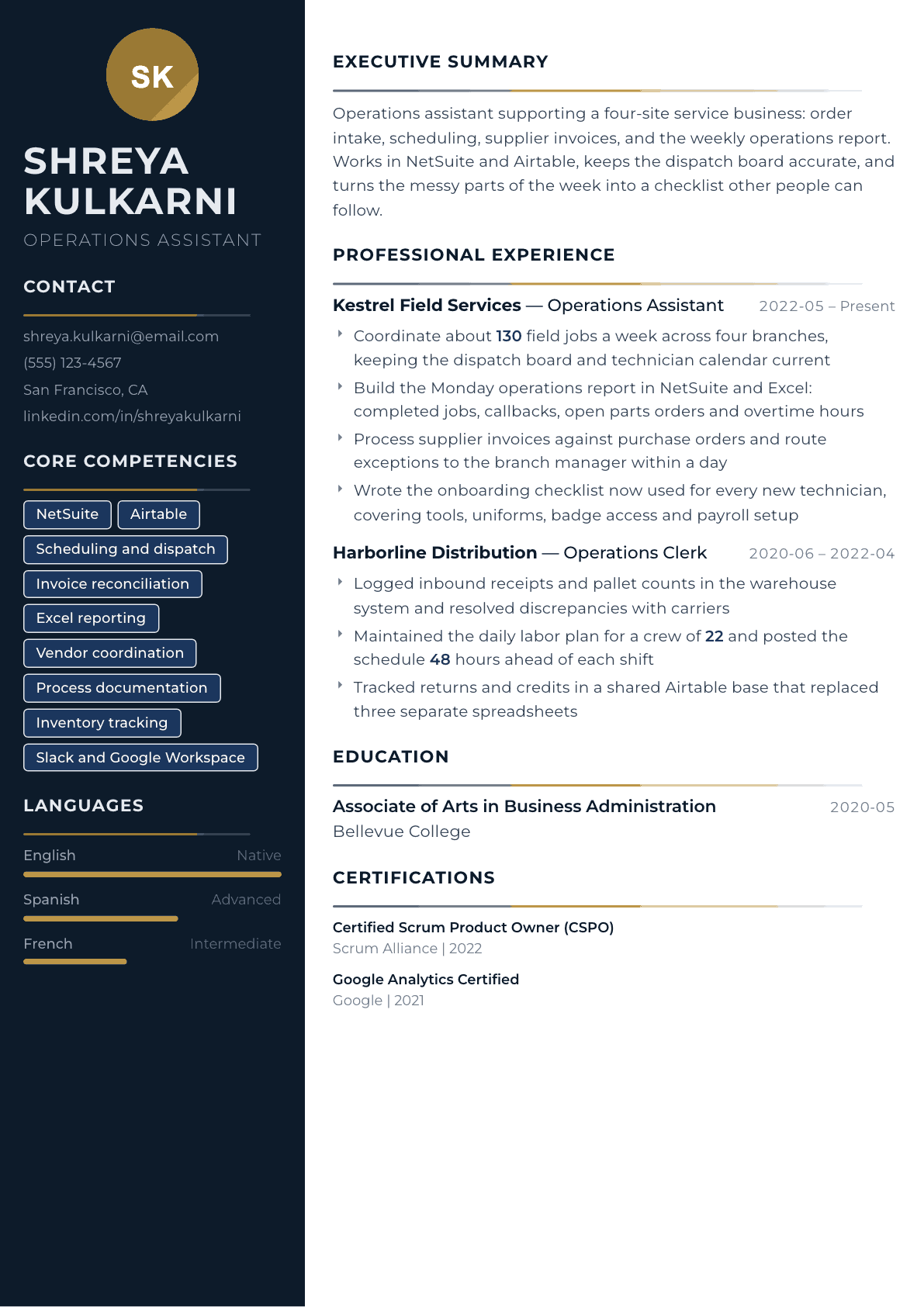
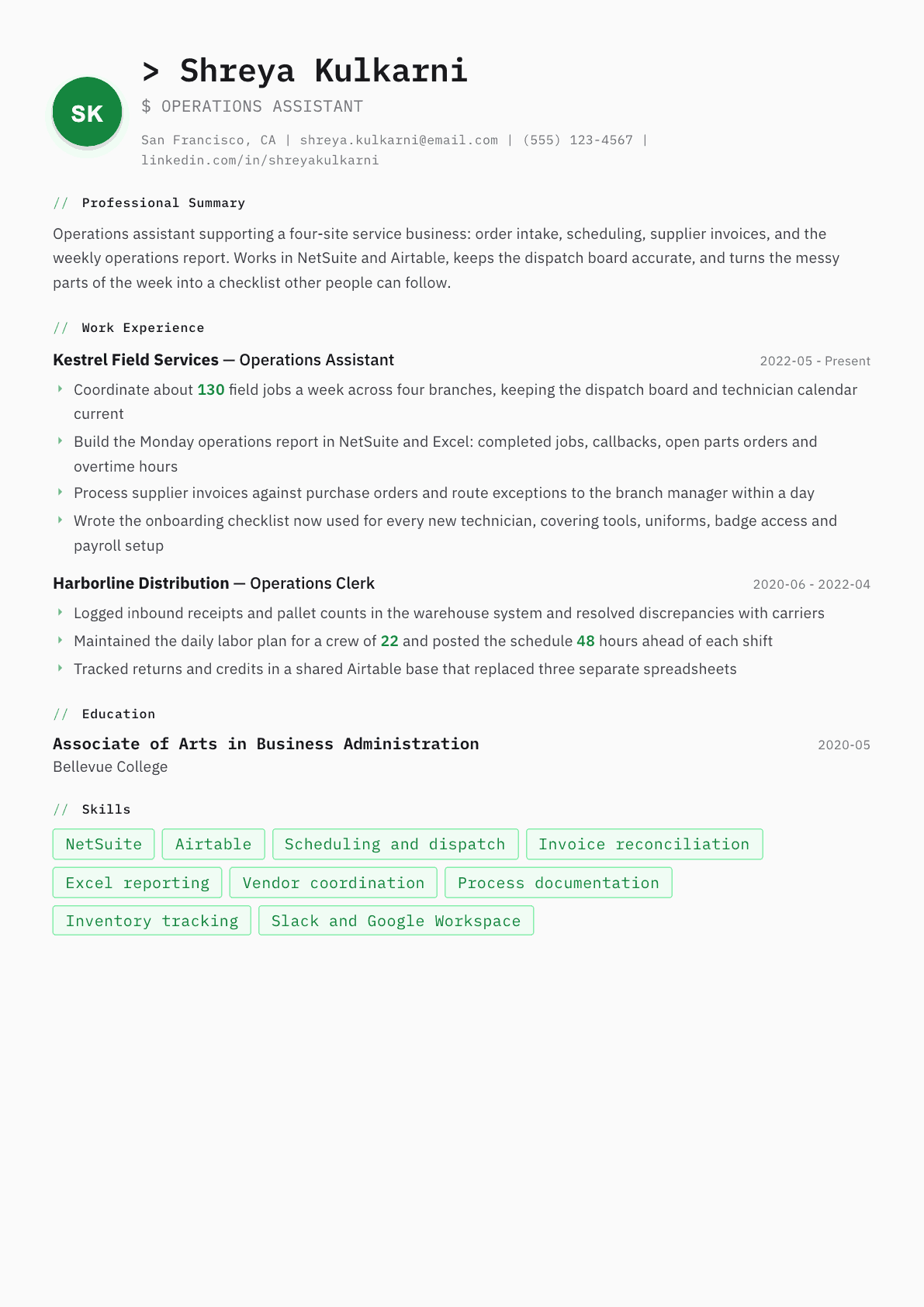
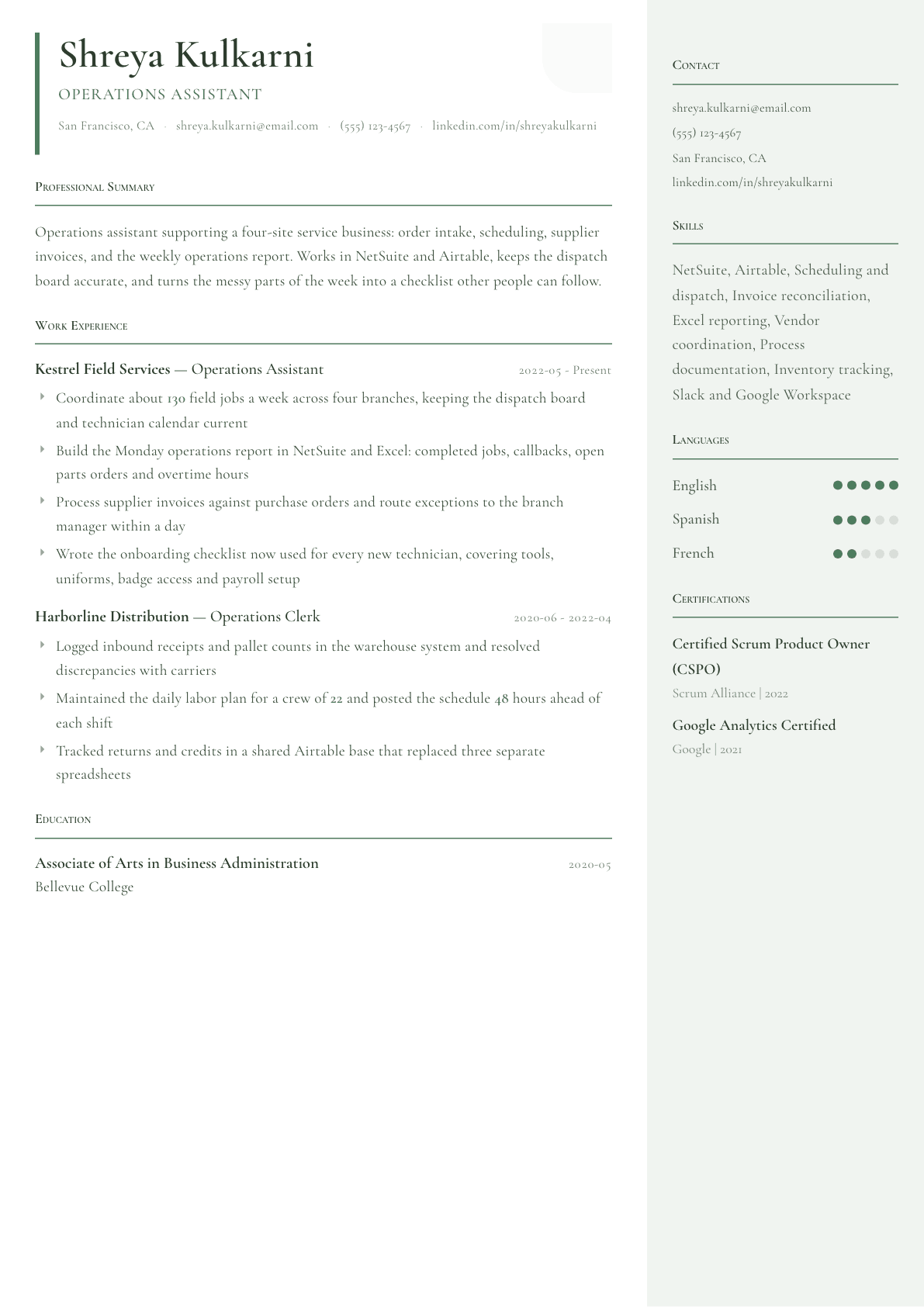
Example Operations Assistant summary
Operations assistant with four years supporting multi-site service and distribution teams. Coordinates about 130 field jobs a week, reconciles supplier invoices against purchase orders in NetSuite, and produces the weekly operations report managers use for staffing decisions. Documented the technician onboarding checklist now used company wide. Associate degree in business administration.
Skills to list on a Operations Assistant resume
- Scheduling and dispatch
- Order intake
- Invoice reconciliation
- Vendor coordination
- NetSuite
- Airtable
- Excel and pivot tables
- Google Workspace
- Process documentation
- Inventory tracking
- Operations reporting
- Cross-team communication
- Purchase order tracking
- Onboarding coordination
What actually gets this resume read
- Anchor every bullet in throughput: jobs coordinated, invoices processed, sites supported, or people scheduled each week.
- Name the operating system of the business, such as NetSuite, Monday, Airtable or ServiceTitan, not just Microsoft Office.
- Show one process you documented or simplified, because operations managers hire assistants who reduce their own inbox.
- Describe the industry setting, since field service, warehouse and agency operations reward different instincts.
- Keep the summary about coordination and follow through rather than generic reliability that any applicant can claim.
- Put reporting work in its own bullet: what report, how often, and who read it before making a decision.
How to write a operations assistant resume
An operations assistant resume is read by an operations manager who is behind on her own inbox. She is not hiring a general helper. She is hiring the person who will own the dispatch board, the invoice exception pile and the weekly report so she can stop touching them. The resume that gets a call shows throughput, names the operating system the business runs on, and proves at least one thing the candidate simplified.
The common failure is writing the job in the language of administration when it is really the language of flow. Assisted with daily operations tells a manager nothing. Coordinated about a hundred and thirty field jobs a week across four branches tells her the size of the desk you can hold, which is the only measure she has time to compare across a stack of applications.
This guide covers how to structure the page, how to quantify a support role that nobody formally measured, three summary examples, before and after bullets, and the questions operations assistants ask when they move between industries.
Format: one page, throughput visible above the fold
Keep it to one page until you are close to a coordinator or supervisor title. Reverse chronological, plain sections, dates on the right. The single most useful formatting decision is putting a systems line directly under your contact block, because operations postings filter hard on the platform the business runs in and a manager scanning on her phone will not scroll to find it.
Describe the operating setting in a short parenthetical after each employer. Field service, warehouse and distribution, agency and professional services all call the role operations assistant, and the daily work is different in each. Telling the reader which one you came from lets her judge how quickly you would be useful.
- Header: name, city and state, phone, email, then a systems strip such as NetSuite, Airtable, Excel, Slack.
- Section order: summary, systems and skills, experience, one process improvement item, education.
- Anchor each employer with setting and scale: four branches, a crew of twenty two, seventy staff.
Summary: how much work moves through you each week
Open with the unit of work your role moves. Jobs coordinated, orders intaken, invoices processed, sites supported or people scheduled per week. Then the platform, then the reporting you produce, then the one process you standardized. Four facts, three or four lines, and a manager can already picture you at a desk in her business.
Avoid the reliability adjectives. Organized, dependable and detail oriented are claimed by every applicant and disproved by none of them, so they contribute nothing to a ranking. Replace them with the sentence that only you can write, the one about the specific mess you keep in order.
Experience: coordination, reconciliation, reporting, documentation
Most operations assistant work falls into four buckets, and a strong job block has one bullet from each. Coordination is the dispatch board, the schedule, the intake queue. Reconciliation is invoices against purchase orders, receipts against pallet counts, credits against returns. Reporting is the recurring pack somebody uses to make a decision. Documentation is the checklist or runbook you wrote that made a recurring task teachable.
For the reporting bullet, name the report, the frequency, the fields, and who read it. The Monday operations report covering completed jobs, callbacks, open parts orders and overtime hours, used by branch managers for staffing, is far stronger than prepared weekly reports, because it shows you understand what the numbers were for.
For the documentation bullet, show the artifact and its afterlife. A technician onboarding checklist now used for every new hire proves you reduced your manager workload permanently, which is the outcome she is actually buying. One improvement described well beats five improvements listed as nouns.
- Give exception handling explicitly: what you resolved yourself and what you escalated, and how fast.
- Include cross-team work with the other function named: dispatch, warehouse, finance, sales.
- Show scheduling lead time, for example posting a shift schedule two days ahead of the crew.
Systems and skills: name the platform, not the office suite
Split the block into business systems and spreadsheet ability. Under systems, name the enterprise or workflow platform: NetSuite, Airtable, ServiceTitan, Monday, an order management tool or the warehouse system, and say what you did in each rather than listing them bare. Under spreadsheets, claim something specific, such as pivot tables on a job export or lookups reconciling two source files, because that is the difference between a person who reads a report and a person who can build one.
Google Workspace, Microsoft 365 and Slack belong at the end of the line, not the front. They are assumed, and putting them first signals that you have nothing heavier to declare.
Quantifying a job nobody measured, and the keywords to mirror
If your employer tracked nothing, reconstruct honestly from artifacts you remember: rows in the weekly schedule, jobs on the board, invoices in a normal month, headcount you scheduled, sites you covered. Round the number and write about in front of it. An approximate figure you can defend in an interview is worth far more than a precise sounding one you cannot.
Operations postings recycle a predictable vocabulary: scheduling, dispatch coordination, order intake, invoice reconciliation, purchase order tracking, vendor coordination, inventory tracking, process documentation and weekly reporting. Mirror the ones that are true of you, once in the skills block and once inside the bullet where you did the work, using your own sentence rather than the posting sentence.
Operations Assistant resume summary examples
First operations role
Business administration graduate with a year of warehouse clerical work: inbound receipt logging, pallet count reconciliation and daily labor plan updates for a crew of 22. Comfortable in Excel with pivot tables and lookups. Seeking an operations assistant seat in a field service or distribution team.
Four years in
Operations assistant supporting a four-branch field service business. Coordinates about 130 jobs a week on the dispatch board, reconciles supplier invoices against purchase orders in NetSuite, and builds the Monday operations report managers use for staffing. Wrote the technician onboarding checklist now used company wide.
Moving toward coordinator
Senior operations assistant with seven years across distribution and multi-site services. Owns intake, dispatch and invoice exception handling for four locations, trains new coordinators on the scheduling standard, and rebuilt returns tracking from three spreadsheets into one shared base the finance team now reconciles against.
Work experience bullets: before and after
Before: Assisted with daily operations for the company.
After: Coordinated about 130 field jobs a week across four branches, keeping the dispatch board and technician calendar accurate through same-day reschedules and callbacks.
Job volume, branch count and the reschedule reality turn an empty phrase into the size of a real desk.
Before: Prepared weekly reports for management.
After: Built the Monday operations report in NetSuite and Excel covering completed jobs, callbacks, open parts orders and overtime hours, which branch managers used to set the following week staffing.
Naming the fields and the decision the report drove shows you understood the purpose, not just the deadline.
Before: Handled invoices from suppliers.
After: Matched supplier invoices to purchase orders and receipts, cleared routine variances myself and routed unresolved exceptions to the branch manager within one business day.
The match logic and the escalation rule show a process rather than a pile of paper.
Before: Helped with new employee onboarding.
After: Wrote the technician onboarding checklist covering tools, uniforms, badge access and payroll setup, and it became the standard for every new field hire across the four branches.
An artifact that outlived the task is the clearest evidence that you reduce a manager workload permanently.
Before: Used spreadsheets to track information.
After: Replaced three separate returns spreadsheets with one shared Airtable base that tracked credit status by carrier, cutting the weekly reconciliation from an afternoon to under an hour.
The before state, the tool and the time recovered make the improvement checkable instead of decorative.
Hard skills
- Scheduling and dispatch coordination
- Order intake and processing
- Invoice and purchase order reconciliation
- Vendor coordination
- NetSuite
- Airtable
- Excel pivot tables and lookups
- Inventory and stock tracking
- Operations reporting
- Process documentation and runbooks
- Google Workspace
- Returns and credit tracking
- Onboarding coordination
- Exception escalation workflows
Soft skills
- Prioritization across competing sites
- Calm handling of same-day changes
- Clear written handoffs
- Follow through without reminders
- Working across dispatch and finance
- Question asking before assuming
Certifications worth listing
- Certified in Planning and Inventory Management (CPIM) (ASCM)
- Certified Supply Chain Professional (CSCP) (ASCM)
- Microsoft Office Specialist: Excel Associate (Microsoft)
- Certified Associate in Project Management (CAPM) (Project Management Institute)
Mistakes that cost operations assistant candidates the interview
- Describing the role as general support with no unit of work attached, which makes the desk impossible to size.
- Listing Microsoft Office where the business platform belongs, so a filter searching for the real system misses the file.
- Skipping the process you documented, when that artifact is the single most persuasive item an assistant can show.
- Leaving out the industry setting, so a reader cannot tell warehouse operations from agency operations.
- Claiming a manager level outcome such as cost reduction without naming your part in it.
- Filling the skills block with reliability adjectives that every applicant claims and no reader can verify.
Operations Assistant resume questions
What is the difference between an operations assistant and an operations coordinator?
An assistant executes an existing process: intake, scheduling, reconciliation and reporting. A coordinator owns the process and makes calls inside it, including resource tradeoffs. If you have started making those calls, show the decisions on the page and the title move becomes an easy argument.
How do I quantify my work if my employer tracked no metrics?
Reconstruct from artifacts you handled: rows in the weekly schedule, jobs on the board, invoices in a normal month, headcount you scheduled, sites covered. Use about with a rounded number and be ready to explain the estimate. An honest approximation is far more useful than a vague sentence.
Which systems should I put on an operations assistant resume?
The platform the business actually ran on and what you did inside it, then the spreadsheet skills you can demonstrate. A tool you clicked through twice does not belong in the skills strip, because an interviewer will ask you to walk through a screen and the gap will show.
Can I move into operations from retail or hospitality?
Yes, and the bridge is scheduling, inventory, vendor deliveries and shift coverage, which are operations work under a different label. Rewrite those duties with volume and system names attached, and add one example where you documented or simplified a recurring task.
Should an operations assistant resume include a summary section?
Yes, because the hiring manager needs the size of your desk before she reads the details. Four facts do the job: unit of work per week, the platform, the recurring report you produce, and the process you standardized. Skip adjectives and it will read faster than the resumes around it.
Related resume examples
- Office Manager Resume example
- Logistics Coordinator Resume example
- Operations Coordinator Resume example
- Administrative Coordinator Resume example
- Administrative Assistant Resume example
- Team Assistant Resume example