Park Ranger Resume Examples: free ATS score and gap list
Write a Park Ranger Resume That Clears Federal Screening
By Mustafa Tarabya, founder of CVBooster · Published · Updated
Park ranger resume example with interpretation, resource protection and search and rescue keywords, plus a guide to federal resume length and detail.
Sample resumes for a park ranger
The same park ranger content laid out in three CVBooster templates, so you can see what the finished document looks like before you write a word.
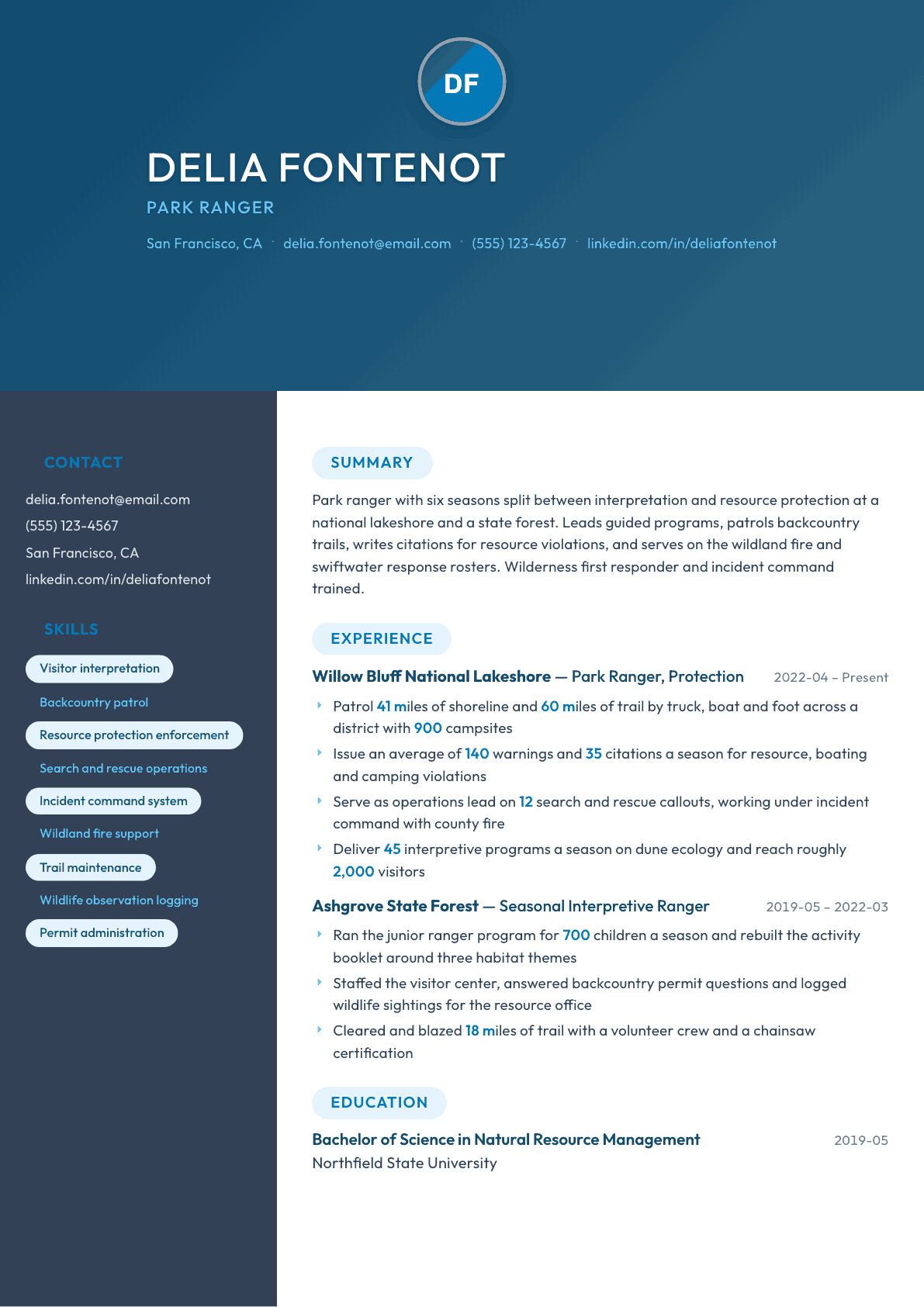
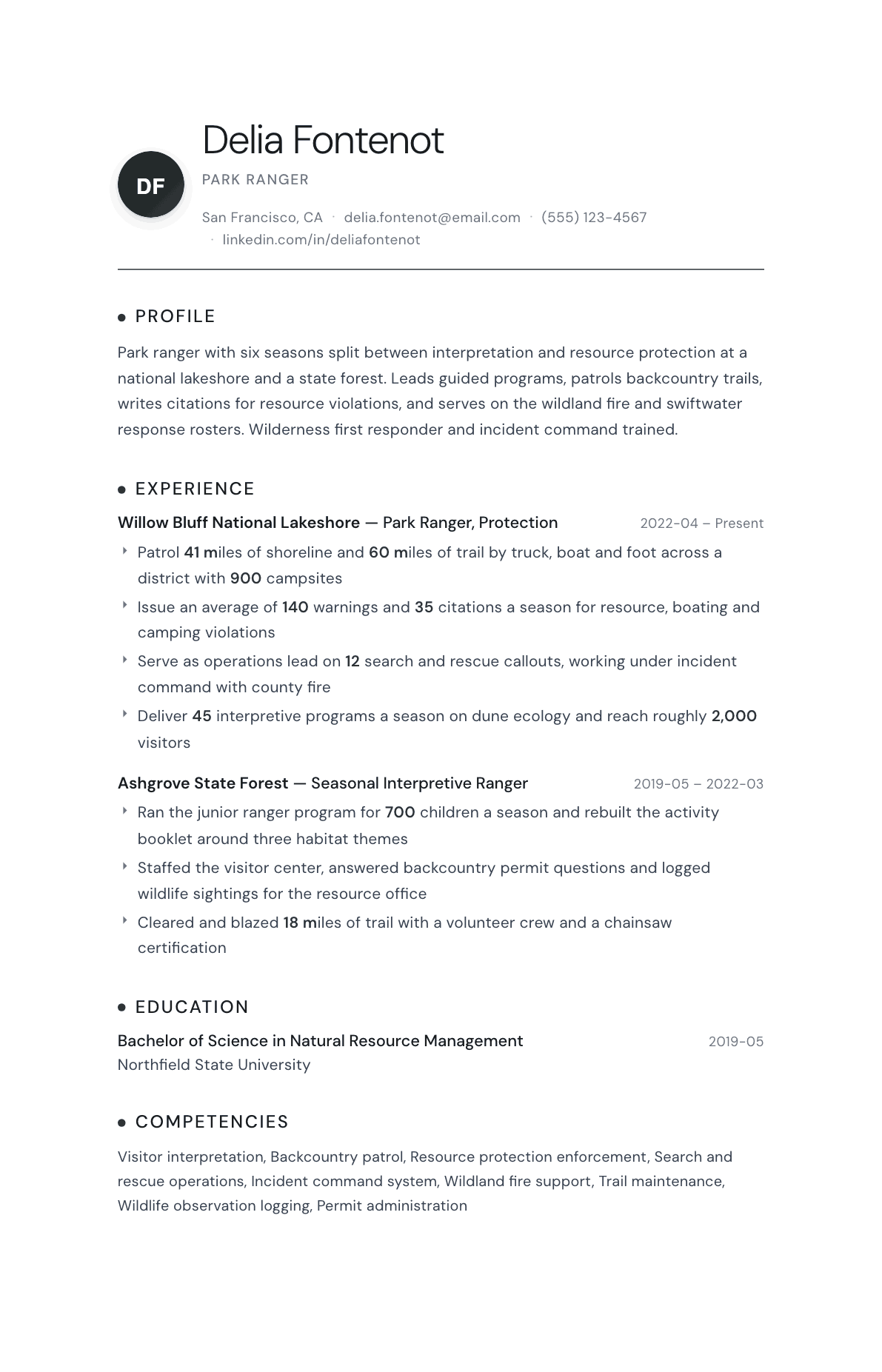
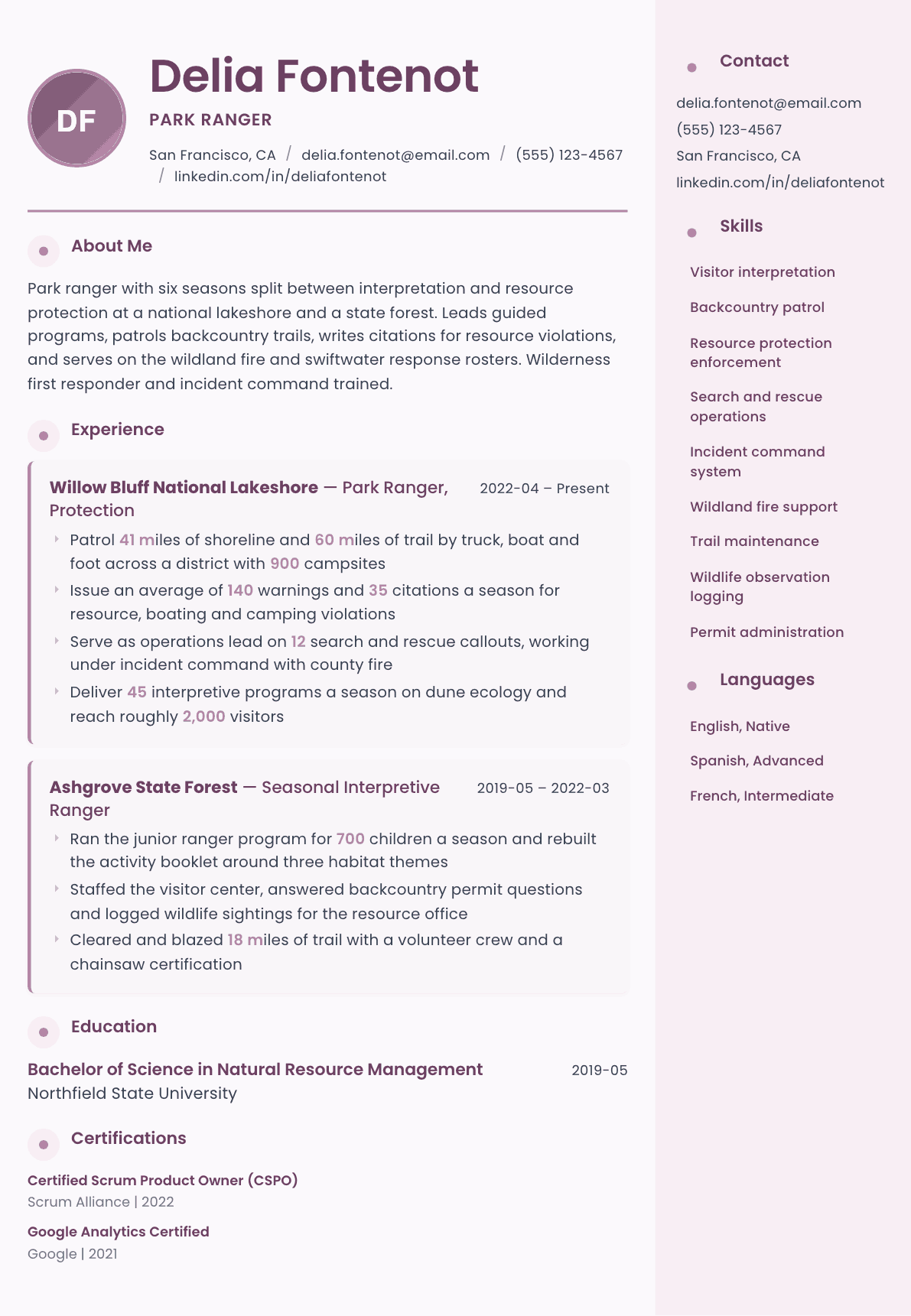
Example Park Ranger summary
Park ranger with six seasons across a national lakeshore and a state forest, splitting time between interpretation and protection. Patrols shoreline and backcountry by truck, boat and foot, issues resource and boating citations, leads operations on search and rescue callouts under incident command, and delivers interpretive programs to thousands of visitors a season. Wilderness first responder with chainsaw and boat operator certification.
Skills to list on a Park Ranger resume
- Interpretive program delivery
- Visitor contact and education
- Backcountry and shoreline patrol
- Resource protection enforcement
- Citation and warning documentation
- Search and rescue
- Incident command system
- Wildland fire support
- Trail construction and maintenance
- Chainsaw operation
- Boat and off road vehicle operation
- Permit and reservation systems
- Wildlife and vegetation monitoring
- Volunteer crew supervision
What actually gets this resume read
- Write a federal style resume for agency jobs, with hours per week and supervisor details on every seasonal position.
- Separate interpretation from protection experience, because the two career tracks are hired against different criteria.
- Give the acreage, trail miles or campsite count of every unit you patrolled so a hiring panel can size the work.
- List your incident command training by course number and your wildland fire red card status if you hold one.
- Count your interpretive programs and your visitor contacts per season rather than saying you educated the public.
- Name every certification that lets you work alone in the field: wilderness medicine, swiftwater, chainsaw and boat operator.
How to write a park ranger resume
Park ranger applications fail for a reason that has nothing to do with the applicant loving the outdoors. Most of these jobs sit inside a federal, state or county hiring system that scores a resume against a written set of qualifications before a human ever sees it. If your document does not carry hours per week, dates by month and year, and the specific duties the announcement lists, a panel never gets the chance to like you.
The second problem is that a ranger is really two jobs sharing a hat. Interpretation is about programs, visitor contacts and turning a dune or a battlefield into something a family remembers. Protection is about patrol, resource violations, citations, emergency medical response and search and rescue. A resume that blurs the two reads as unfocused to a chief ranger who is filling one of them.
This guide covers how to build a ranger resume that survives a qualifications review and then wins a panel, with summaries for a first season, a returning seasonal and a permanent ranger, before and after bullets from patrol and interpretive work, and the questions seasonals ask when they try to convert to a permanent appointment.
Format: long is correct for agency applications
The one page rule does not apply to a federal or state agency resume. A human resources specialist has to confirm that you meet a written qualification standard, and she can only do that from detail: the employer, the exact start and end month, hours worked per week, the supervisor and whether he may be contacted, and a full description of duties in your own words.
Write two documents if you are applying widely. The long agency version carries every required field. A shorter version, closer to two pages, goes to concessioners, land trusts, county parks and nonprofit conservancies who hire the way ordinary employers do. Never send the short one into an agency system, because missing hours per week can disqualify an otherwise strong file.
- Every position needs month and year for start and end, hours per week, and whether the appointment was seasonal, term or permanent.
- Split the experience into interpretation and protection headings when you have both, so a panel can see the track you are applying for.
- A training block listing incident command courses by number, wildland fire qualifications, medical certificates and operator cards.
- Field skills that let you work alone: chainsaw, boat, off road vehicle, radio, navigation, pack stock and swiftwater.
Summary: unit type, track, seasons and the certificates that unlock assignments
Name the kind of unit you have worked, because a coastal lakeshore, a desert monument, a battlefield and an urban regional park produce different rangers. Then say how many seasons, which track you are applying for, and the certificates that decide what a supervisor is allowed to send you to do alone.
Rangers underrate the certificate line badly. Wilderness medicine, a chainsaw qualification, a boat operator card and an incident command course are the difference between a ranger who can be dispatched and one who has to be accompanied. Put them where they will be read, not in a footer.
Interpretation experience: programs, contacts and the material you built
Interpretive work is measurable and applicants leave the measurements out. Give the number of programs delivered in a season, the audience size, the program types and the themes. Guided walks, campfire programs, junior ranger sessions, school field trips, roving contacts at an overlook and visitor center desk time are all distinct, and a supervisor staffs each of them differently.
Then say what you built rather than only what you delivered. A rewritten junior ranger booklet, a new interpretive theme for a habitat, a bilingual sign draft, a social media series for a park page or a training session for volunteers all show that you can produce material and not just perform it.
Protection experience: patrol area, contacts and enforcement
Size the unit for the reader: acreage, trail miles, shoreline miles, campsites, boat ramps and annual visitation range. Then describe how you covered it, by truck, boat, foot, horse, bicycle or off road vehicle, and how often you were the only ranger on duty in a district.
Write enforcement honestly and precisely. Warnings and citations issued in a season, the violation types they covered, and whether you hold a commission or work under a supervisory ranger. Add emergency response: search and rescue callouts with your role, medical responses, wildland fire assignments with the qualification you held, and boating or water incidents.
Search and rescue deserves its own bullet because it is where a panel looks for judgment. Say the number of callouts, the role you filled under incident command, the terrain, and one outcome that shows you can operate in a system rather than as a lone hero.
Keywords and the announcement language you must mirror
Agency announcements are written from qualification standards, so the phrases repeat: visitor services, resource protection, interpretation, natural and cultural resources, public contact, incident command system, emergency response, permits and reservations, volunteer coordination. Use the announcement wording once in your skills area and once inside a duty description where the work is proven.
If the announcement names a specific duty, address it directly somewhere in the document. Panels score against the list in front of them, and a ranger who never mentions permit administration will lose points on it no matter how many permits she has actually written.
- Program counts and visitor contact numbers per season, split by program type.
- Patrol area described in acres, trail miles or shoreline miles, plus the vehicles you operated.
- Citations and warnings by count and violation category, with your commission status stated plainly.
- Emergency response: search and rescue callouts, medical responses and fire assignments with the qualification held.
Park Ranger resume summary examples
First seasonal appointment
Natural resource management graduate seeking a first seasonal ranger appointment. Completed 400 hours of volunteer trail and visitor center work at a state forest, holds wilderness first aid and a chainsaw qualification, and has delivered guided walks to school groups. Comfortable working alone in remote terrain.
Returning seasonal, interpretation
Interpretive park ranger with three seasons at a national lakeshore, delivering 45 programs a season on dune ecology and reaching roughly two thousand visitors. Rebuilt the junior ranger booklet around three habitat themes, staffs the visitor center desk, and trains volunteers on roving contact technique.
Permanent protection ranger
Protection ranger with six seasons patrolling 41 miles of shoreline and 60 miles of trail by truck, boat and foot. Issues about 140 warnings and 35 citations a season, serves as operations lead on search and rescue callouts under incident command, and carries a wildland fire qualification.
Work experience bullets: before and after
Before: Educated visitors about the park.
After: Delivered 45 interpretive programs a season on dune ecology and shoreline geology, reaching roughly two thousand visitors through guided walks, campfire talks and roving contacts at two overlooks.
Program counts, themes and delivery formats let a supervisor match you to an actual interpretive schedule.
Before: Patrolled the park and enforced rules.
After: Patrolled 41 miles of shoreline and 60 miles of trail by truck, boat and foot across a district with 900 campsites, often as the only ranger on duty after dark.
Distances, methods and solo duty describe the real scope where enforced rules describes nothing.
Before: Helped with search and rescue.
After: Served as operations lead on 12 search and rescue callouts, coordinating county fire and volunteer teams under incident command across dune and cold water terrain.
A role inside the command system plus callout count and terrain is what a panel scores for judgment.
Before: Worked on trails with volunteers.
After: Cleared and blazed 18 miles of trail with a volunteer crew of up to nine, running the tool talk and holding a chainsaw qualification for storm blowdown removal.
Crew size, mileage and the safety briefing show supervision and a field certificate at the same time.
Before: Issued tickets for violations.
After: Issued about 140 warnings and 35 citations a season covering camping outside designated sites, boating equipment violations and removal of protected plants.
Violation categories tell a chief ranger what enforcement you have actually practiced, not just that you can write.
Hard skills
- Interpretive program design and delivery
- Visitor contact and public information
- Backcountry and shoreline patrol
- Resource protection enforcement
- Citation and warning documentation
- Search and rescue operations
- Incident command system roles
- Wildland fire support
- Trail construction and maintenance
- Chainsaw and hand tool operation
- Boat and off road vehicle operation
- Permit and reservation administration
- Wildlife and vegetation monitoring
- Volunteer crew supervision
Soft skills
- Explaining a closure to a visitor who drove five hours to see it
- Working alone for a full shift without losing radio discipline
- Switching from friendly contact to enforcement in one conversation
- Teaching a volunteer crew without slowing the work
- Writing clearly enough that a case file stands up months later
Certifications worth listing
- Wilderness First Responder (NOLS Wilderness Medicine)
- Certified Interpretive Guide (National Association for Interpretation)
- ICS-300 Intermediate Incident Command System (FEMA Emergency Management Institute)
Mistakes that cost park ranger candidates the interview
- Sending a one page private sector resume into an agency system that requires hours per week and month level dates.
- Mixing interpretation and protection duties into one undifferentiated list when the announcement is for a single track.
- Describing a park in adjectives instead of acreage, trail miles, campsite count and visitation range.
- Leaving field certificates in a footer, when a chainsaw card or a wilderness medicine certificate decides your assignments.
- Writing about a love of the outdoors instead of program counts, patrol coverage and enforcement categories.
- Failing to mirror the duty language in the announcement, which costs points at the qualifications review before any panel reads it.
Park Ranger resume questions
How long should a park ranger resume be for a federal job?
As long as it takes to prove the qualification standard, which is usually three to five pages. Human resources needs hours per week, month and year dates and full duty descriptions. A short document reads as incomplete and is often screened out before a panel sees it.
Should I apply for interpretation or protection roles?
Pick one per application and shape the document to it. Interpretation panels score program counts, themes and audience work. Protection panels score patrol coverage, enforcement, emergency response and field certificates. A page that hedges between both is weaker than one that commits.
Does volunteer work count as ranger experience?
Yes, if you present it with the same rigor as paid work: the unit, the hours per week, the duties and a supervisor. Trail crews, campground hosting, visitor center desk shifts and citizen science monitoring all count toward qualification standards when documented properly.
How do I turn a seasonal appointment into a permanent one?
Collect the certificates and the incident command courses that permanent positions require, take on collateral duties such as volunteer coordination or search and rescue rostering, and document every season with numbers. Then apply to announcements as they open rather than waiting to be noticed.
What should I include about law enforcement authority?
State your commission status plainly, including the level and the issuing agency, or say clearly that you work under a commissioned supervisor. Panels need to know whether you can issue citations independently, and ambiguity on that point stalls an otherwise strong application.
Related resume examples
- Environmental Scientist Resume example
- Animal Control Officer Resume example
- Environmental Consultant Resume example
- Safety Officer Resume example
- Fire Inspector Resume example
- Wildland Firefighter Resume example