Fire Inspector Resume Examples: the lines they read
Write a Fire Inspector Resume That Proves Code Authority
By Mustafa Tarabya, founder of CVBooster · Published · Updated
Fire inspector resume example, keyword list and writing guide covering IFC code citations, plan review, occupancy loads and violation follow up.
Sample resumes for a fire inspector
The same fire inspector content laid out in three CVBooster templates, so you can see what the finished document looks like before you write a word.
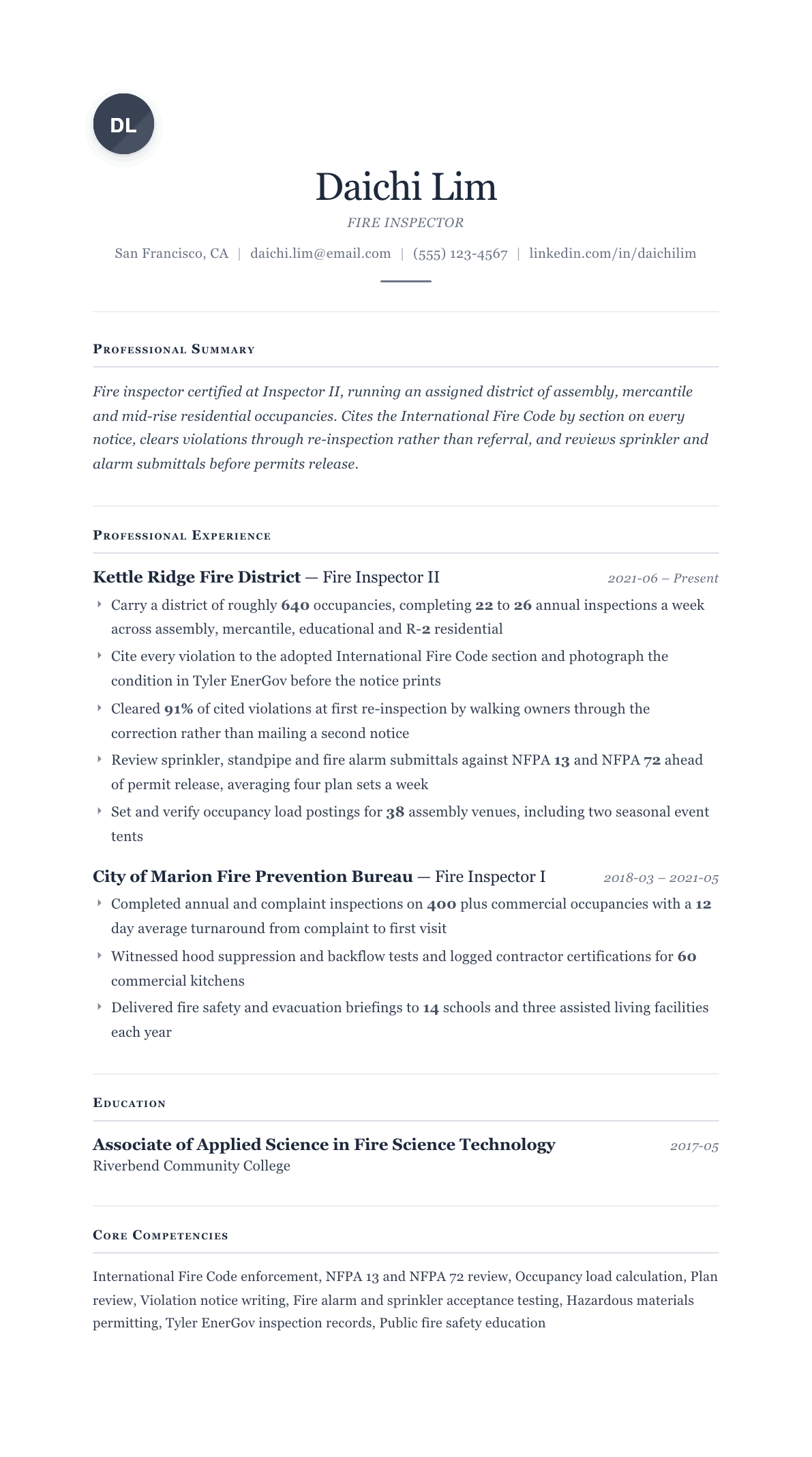
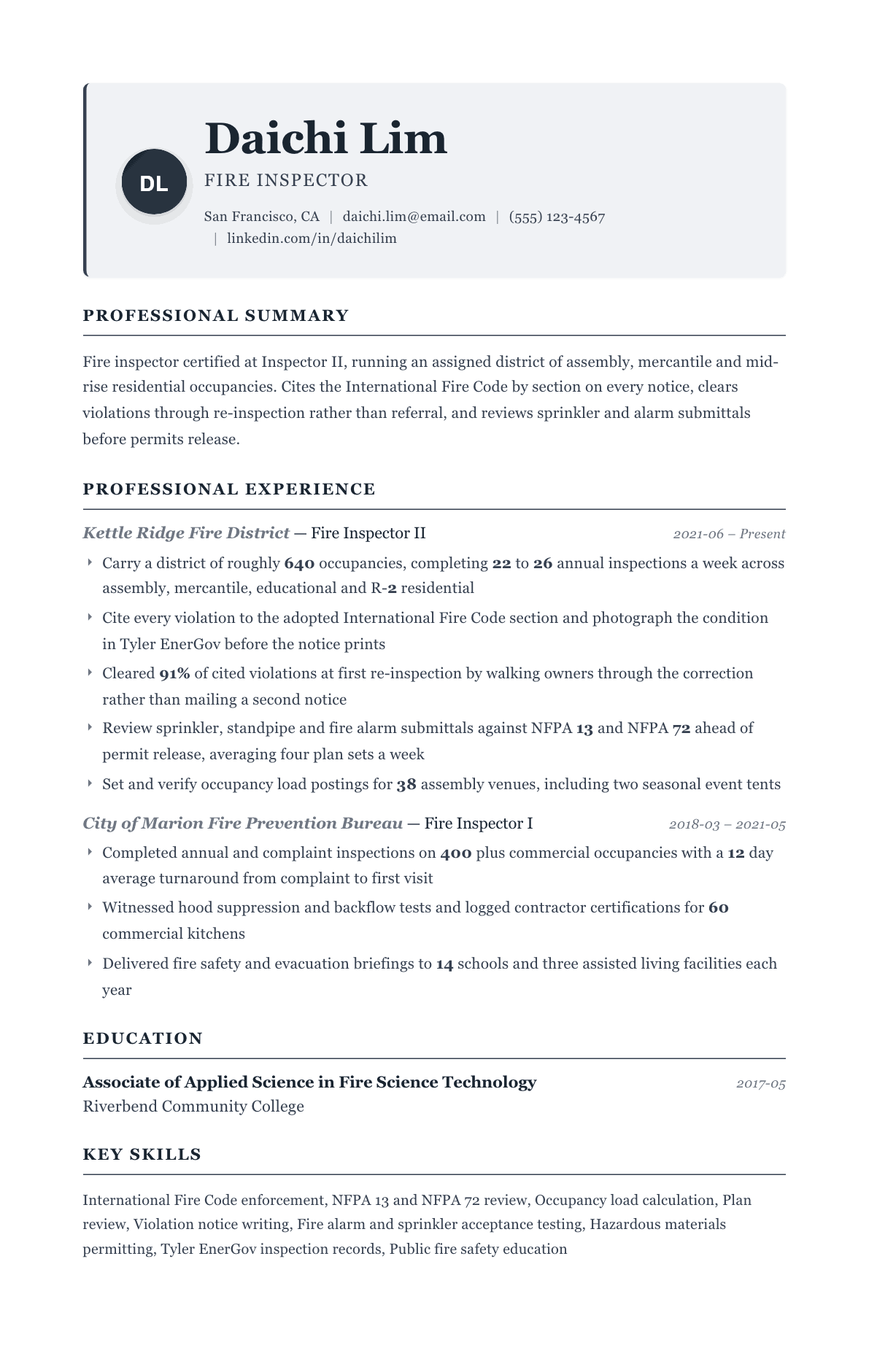
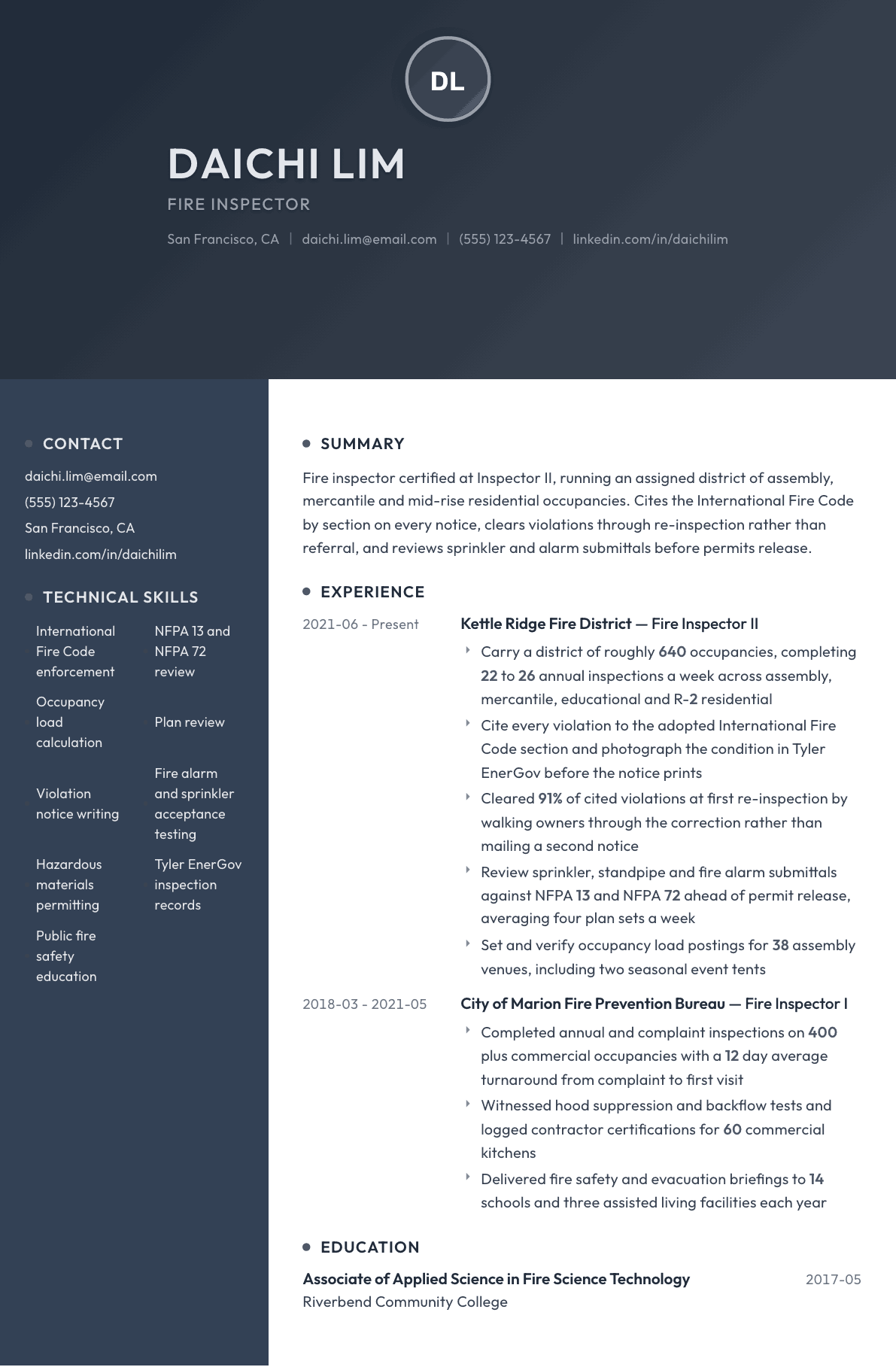
Example Fire Inspector summary
Fire inspector certified at Inspector II with seven years in a municipal prevention bureau, running a district of assembly, mercantile and mid-rise residential occupancies. Cites the adopted International Fire Code by section, reviews sprinkler and alarm submittals against NFPA 13 and NFPA 72, and clears most violations at first re-inspection by correcting owners in person. Comfortable testifying at code appeal hearings.
Skills to list on a Fire Inspector resume
- International Fire Code
- NFPA 1 and NFPA 101 application
- Sprinkler system plan review
- Fire alarm plan review
- Occupancy classification
- Occupancy load posting
- Means of egress evaluation
- Hood suppression acceptance testing
- Fire pump and standpipe testing
- Hazardous materials permits
- Violation notice and citation writing
- Re-inspection and abatement tracking
- Fire investigation origin support
- Public education presentations
- Inspection records software
- Testimony at code appeal hearings
What actually gets this resume read
- Name the code edition your jurisdiction adopted, because a bureau hiring you wants to know how little retraining you need.
- Give your inspection volume per week and the occupancy types, since assembly work is nothing like warehouse work.
- List your Inspector I or Inspector II certification with the accrediting body and the year it was awarded.
- Show your first re-inspection clearance rate, which tells a fire marshal whether your notices actually get read.
- State whether you perform plan review as well as field inspection, because many bureaus need both from one hire.
- Name the records system you work in, since a bureau on the same platform can put you in the field far sooner.
- Add any acceptance testing you witness yourself, from hood suppression to fire pump churn tests, with the standard applied.
How to write a fire inspector resume
A fire marshal reading applications for an inspector opening is asking one narrow question: can this person walk into an occupancy tomorrow, find the violations that matter, cite them to the correct code section, and write a notice that survives an appeal. Everything else on the page is context for that.
The applications that get set aside describe the job in the abstract. They say the candidate performed inspections, ensured compliance and promoted fire safety. A bureau chief cannot tell from that whether you have ever posted an occupancy load for an assembly space, whether you can read a sprinkler submittal, or whether your notices come back with the owner arguing that the section you cited does not apply.
This guide covers what a prevention bureau reads in order: your certification level, the code edition you enforce, the occupancy mix you have carried, your inspection volume, and what happens after the violation is written. It includes three summaries at different career points, before and after bullets, and the questions inspectors ask when they move between jurisdictions.
Format: certifications block near the top, then district, then volume
Use reverse chronological order and keep it to one page for under a decade of service, two once you have carried plan review and investigation duties alongside field inspection. A prevention bureau reads credentials before narrative, so the certification block belongs on the first screen, not below education at the bottom.
Fire inspector hiring is one of the few places where a certification list carries as much weight as a job history. Put your Inspector I or Inspector II certification, the accrediting body and the award year in one block, and add plan examiner or investigator credentials to the same block so the marshal can see the whole picture without hunting.
- Certification block: inspector level, plan examiner, investigator, and any hazardous materials or life safety credential, each with the issuing body.
- Each job line names the jurisdiction type first: municipal bureau, fire district, county fire marshal office, state agency or private third party inspection firm.
- Under each job, state the code edition adopted while you were there, because an inspector trained on one cycle adapts quickly but a marshal wants to know the starting point.
- Give district size in occupancy count and the mix by use group rather than saying you inspected commercial buildings.
- Applicants coming from the fire line put suppression years second and any acting inspector assignments first.
Summary: certification level, occupancy mix, volume, plan review
Four facts belong in your first three lines: your certification level, the occupancy types you handle without supervision, your weekly inspection volume, and whether you also review plans. Those four decide whether the marshal reads on, because they map directly onto the vacancy she is trying to fill.
If you have appeal hearing or court testimony experience, put it in the summary. Inspectors who can hold up under cross examination are rare, and a bureau that has lost a case on a poorly written notice will read that line twice.
Experience: what you inspected, what you cited, what got fixed
A strong inspector bullet has three parts: the condition you found, the code section you cited, and the correction that closed it. That structure is the daily work of the job written down, and it is impossible to fake. An inspector who writes about blocked exit access at an assembly occupancy, cited to the egress chapter and corrected before a weekend event, has demonstrated more than any adjective could.
Include the volume figures a bureau tracks: annual inspections completed, complaint response turnaround, re-inspections required, and the share of violations cleared at first re-inspection. That last number is the one prevention chiefs care about most, because an inspector whose notices are ignored generates work for everyone above him.
Acceptance testing deserves its own bullets. Witnessing a hood suppression discharge, a fire pump churn and flow test, a standpipe hydrostatic test or an alarm device by device walkthrough are all distinct competencies, and a bureau short on testing coverage will hire specifically for them.
Do not bury plan review inside a general duty line. If you have marked up sprinkler layouts against hydraulic calculations or checked alarm device spacing against coverage requirements, say how many plan sets a week and what disciplines you cover.
The parts of the job candidates leave off
Three areas are consistently missing from inspector resumes and consistently asked about in the interview. The first is enforcement escalation: what you do when an owner will not correct. Naming your path from notice to re-inspection to administrative citation to legal referral, and how often you actually get to the last step, tells a marshal you understand that the goal is compliance, not paperwork.
The second is public interaction. Inspectors deliver school assemblies, brief assisted living staff on evacuation, and stand in front of a business owner who has just been told the event is not happening tonight. Say what you have presented and to whom.
The third is the records system. Bureaus run inspection programs on software, and the migration or clean up of a records backlog is a real project. If you have loaded an occupancy inventory, built inspection schedules or cleaned duplicate records, that is worth a bullet.
- Escalation path from courtesy notice through administrative citation, with an example that ended in compliance.
- Fire and life safety education delivered to schools, care facilities or business groups, with the audience count.
- Records system work: occupancy inventory building, schedule construction, backlog reduction.
- Coordination with building department, health department and the state fire marshal office on shared jurisdiction issues.
- Support to origin and cause investigation, including scene security and evidence documentation.
Skills and keywords a prevention bureau screens on
Postings for this role recycle a tight vocabulary: adopted code edition, occupancy classification, means of egress, occupant load, fire protection systems, plan review, violation notice, re-inspection, hazardous materials permits. Use the exact terms from the posting once in your skills block and once inside a bullet where the work is visible.
Standard numbers matter as keywords too. Naming the sprinkler installation standard, the alarm and signaling standard and the life safety code you apply signals technical depth, but only put them on the page if you can talk through a submittal you reviewed against them.
Fire Inspector resume summary examples
New to prevention
Firefighter with four years on an engine company, newly certified as Fire Inspector I, completing acting inspector rotations covering 60 annual inspections in mercantile and business occupancies. Trained on the 2021 International Fire Code and hood suppression witnessing. Seeking a full time prevention bureau assignment.
Five years in the bureau
Fire Inspector II carrying a district of roughly 600 occupancies across assembly, mercantile and residential use groups, completing 22 to 26 inspections a week. Cites every violation to the adopted code section, clears 91% at first re-inspection, and reviews four sprinkler and alarm plan sets weekly.
Senior inspector and plan examiner
Senior fire inspector and certified plan examiner with eleven years in a municipal bureau, leading the commercial plan review queue and mentoring three inspectors. Testifies at code appeal hearings, witnesses fire pump and alarm acceptance testing, and rebuilt the occupancy inventory covering more than 2000 records.
Work experience bullets: before and after
Before: Conducted fire safety inspections of commercial buildings.
After: Carried a district of roughly 640 occupancies across assembly, mercantile, educational and R-2 residential, completing 22 to 26 annual inspections a week with photographic documentation on every citation.
The occupancy mix and the weekly volume let a marshal size your real workload instead of guessing at it.
Before: Wrote violation notices and followed up with owners.
After: Cited every violation to the adopted International Fire Code section, then cleared 91% at first re-inspection by walking the owner through the correction on site rather than mailing a second notice.
A clearance rate plus the method behind it shows enforcement that ends in compliance, not a paper trail.
Before: Reviewed building plans for fire code compliance.
After: Reviewed an average of four sprinkler, standpipe and fire alarm submittals a week against NFPA 13 and NFPA 72, returning comments before permit release and cutting field corrections at acceptance testing.
Naming the standards, the volume and the downstream effect turns a duty statement into demonstrated technical work.
Before: Checked occupancy limits at events.
After: Calculated and posted occupant loads for 38 assembly venues including two seasonal event tents, and shut down one overcrowded venue on a Saturday night before reopening it at the posted load.
A calculation, a venue count and a real enforcement decision prove you will act when the room is full.
Before: Helped with fire safety education in the community.
After: Delivered evacuation and extinguisher briefings to 14 schools and three assisted living facilities each year, rewriting the care facility drill script after two drills ran past the target evacuation time.
The audience, the frequency and the fix show public education as a job function rather than a good intention.
Hard skills
- International Fire Code enforcement
- Life safety code application
- Occupancy classification and use groups
- Occupant load calculation and posting
- Means of egress evaluation
- Sprinkler and standpipe plan review
- Fire alarm plan review and device spacing
- Hood suppression acceptance testing
- Fire pump churn and flow testing
- Hazardous materials permit review
- Violation notice and administrative citation writing
- Re-inspection and abatement tracking
- Inspection records software administration
- Code appeal hearing testimony
Soft skills
- Holding a position with an owner who is losing revenue over the finding
- Explaining a code requirement in language a business operator can act on
- Consistency across a district so two owners get the same answer
- Working alongside a building department without turf disputes
- Composure under cross examination
Certifications worth listing
- Fire Inspector I (International Code Council)
- Fire Inspector II (International Code Council)
- Certified Fire Inspector I (CFI-I) (National Fire Protection Association)
- Fire Plans Examiner (International Code Council)
- Adult CPR and AED (American Red Cross)
Mistakes that cost fire inspector candidates the interview
- Writing that you ensured code compliance without naming a single code section, standard or occupancy type you enforce.
- Leaving the certification level buried at the bottom when it is the first filter a fire marshal applies.
- Omitting the adopted code edition, which makes a hiring bureau guess how much re-training your first month needs.
- Counting inspections without saying what share of violations actually cleared, which is the number prevention chiefs track.
- Treating plan review as an afterthought when many bureaus are hiring specifically to cover the submittal queue.
- Describing enforcement only as issuing notices, with nothing about escalation when an owner refuses to correct.
- Copying a suppression resume across without translating engine company duties into prevention competencies.
Fire Inspector resume questions
How do I move from suppression into a fire inspector job?
Get the Inspector I certification first, then volunteer for acting inspector rotations and pre-incident survey work so you can show real occupancy time. Lead the resume with those rotations and your certification, and place engine company years underneath as supporting background.
Should I list the code edition my jurisdiction adopted?
Yes, under each job. A bureau on a different edition is not put off by a mismatch, but it wants to know your baseline so it can plan your first weeks. Leaving it out reads as though you never paid attention to which cycle you were enforcing.
How much detail should I give about violations I have written?
Enough to prove the pattern without turning the page into a case file. One or two examples with the condition, the chapter you cited and the correction achieved are worth more than a list of every notice type you have ever issued.
Does plan review experience matter if the posting is for field inspection?
It does, because small bureaus rotate inspectors through the submittal queue and larger ones promote from inspectors who already understand system design. Even a modest amount of review work makes you cheaper to develop than an applicant with none.
What if I have never testified at a hearing?
Say nothing about testimony rather than implying it. Instead show the quality of your documentation: photographs attached to citations, notices written to a specific section, and a re-inspection record that shows follow through. Those are the things testimony rests on anyway.
Related resume examples
- Fire Chief Resume example
- Safety Engineer Resume example
- Firefighter Resume example
- Fire Protection Engineer Resume example
- Park Ranger Resume example
- Security Consultant Resume example