Pastor Resume Examples: what a hiring manager reads first
Pastor Resume: Preacher and Pastoral Resume Samples Committees Trust
By Mustafa Tarabya, founder of CVBooster · Published · Updated
Pastor and preacher resume guide with sample pastoral resumes for an associate, solo and senior pastor, covering preaching, discipleship, staff and stewardship.
Sample resumes for a pastor
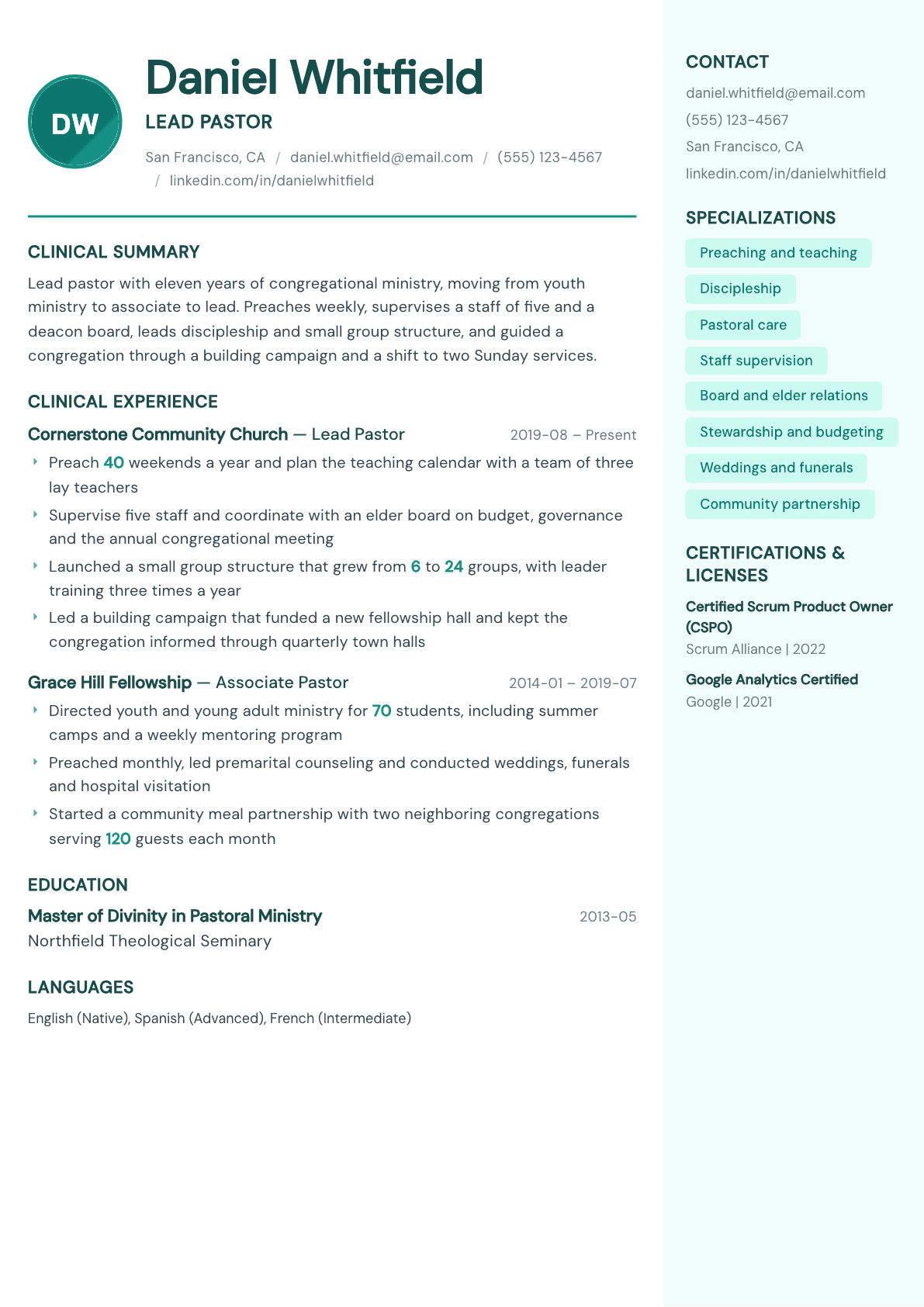
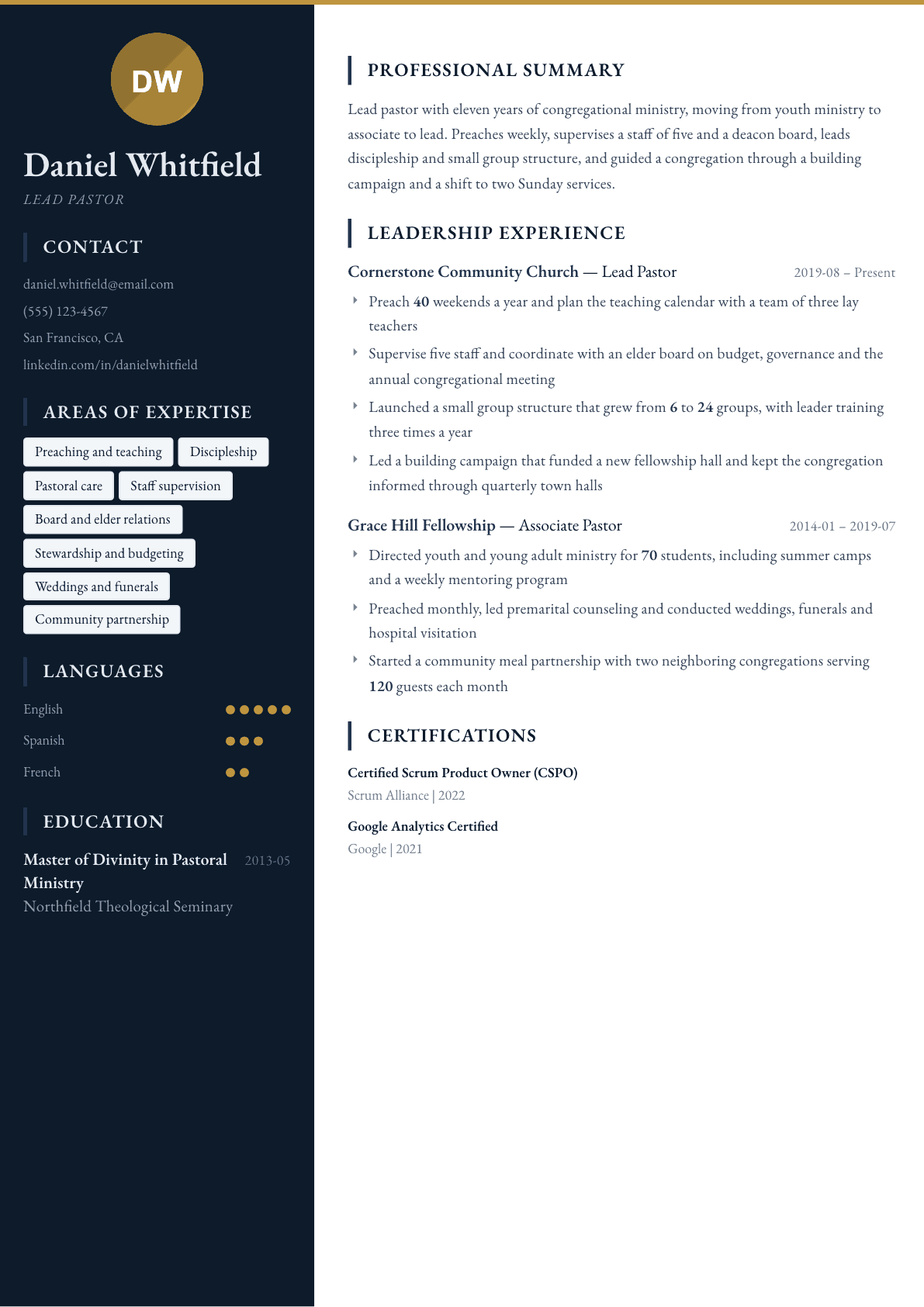
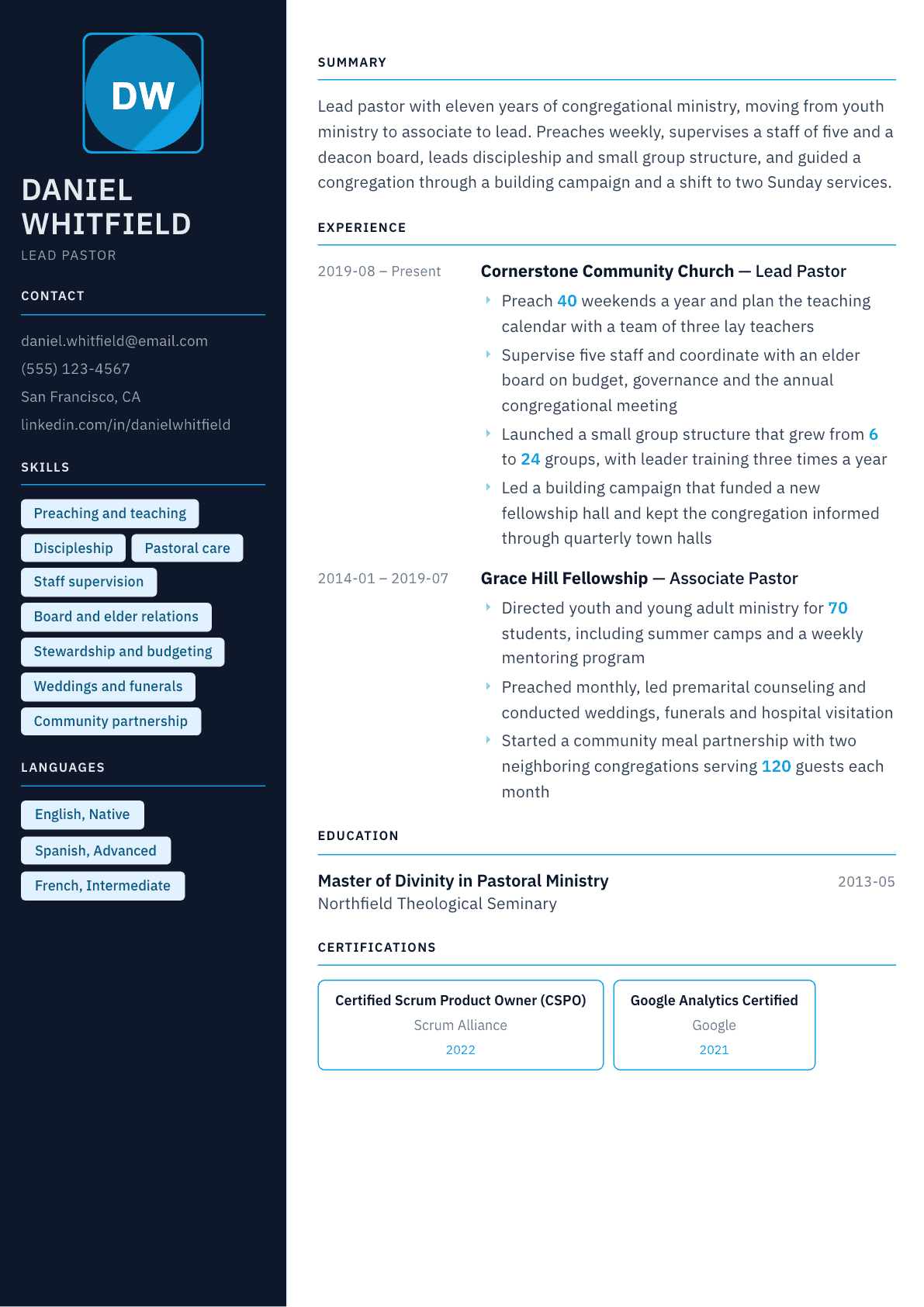
The same pastor content laid out in three CVBooster templates, so you can see what the finished document looks like before you write a word.
Example Pastor summary
Lead pastor with eleven years of congregational ministry across youth, associate and lead roles. Preaches weekly, supervises a staff of five, and rebuilt the discipleship structure from six small groups to twenty four with regular leader training. Led a capital campaign and a move to two Sunday services without losing volunteer strength. Seeking a lead role in a congregation ready to grow its community partnerships.
Skills to list on a Pastor resume
- Preaching and sermon preparation
- Discipleship and small groups
- Pastoral counseling
- Staff leadership
- Elder and board governance
- Stewardship and budgeting
- Capital campaigns
- Weddings and funerals
- Hospital and home visitation
- Worship planning
- Volunteer development
- Conflict resolution
- Community outreach
- Membership formation
What actually gets this resume read
- Name your ordination and the denomination or association that holds it, because search committees check standing first.
- Give congregation size and worship attendance for each church so the committee can judge scope honestly.
- Separate preaching from administration: how often you preach, and how many staff and volunteers you supervise.
- Show discipleship structure, such as small groups, membership classes or leadership pipelines, and how it grew.
- Mention stewardship work plainly, including budget responsibility, capital campaigns and annual giving communication.
- Include a link free list of community partnerships, because committees want a pastor who is known outside the building.
How to write a pastor resume
A pastor resume is read by a committee, not a recruiter, and that changes everything. Eight or ten lay people are sitting around a table with a stack of profiles, most of them have never hired anyone before, and they are trying to work out from paper whether you can preach, whether you can lead volunteers, whether you will stay, and whether you will fit a congregation they love and find hard to describe.
Committees look for three things they can verify. Standing: your ordination, the body that holds it, and whether it is current. Scope: the size of the congregations you have served and what you were actually responsible for. Stability: your dates, and a coherent story if there is a gap or a short tenure in the middle of them.
This guide walks through the sections in the order a search committee reads them, how to describe preaching load and staff responsibility without inflating either, three summaries from associate to lead, better ways to write the bullets committees see most often, and the questions pastors ask when they prepare a profile. A preacher resume follows the same rules: whether the posting says preacher, pulpit minister or pastor, the committee wants your standing, how often you preach, the congregations you served and the people you led, so move the preaching block up under the summary when preaching is the main job.
Format: two pages, standing and scope on the first
Two pages is normal here and one is often too thin, because a committee wants the whole ministry arc. Reverse chronological. Put a standing block under your contact details: ordination, the denomination, association or network holding it, the year of ordination without needing a full date, and your current standing status.
Give each congregation a scope line before the bullets: the church, the town size or setting, average worship attendance, staff and volunteer count under you, and your title. Committees compare congregations by attendance and setting, and leaving it out forces them to guess low.
- Standing block: ordination, holding body, current status, and any regional or denominational service.
- Scope line per church: attendance, setting, budget responsibility, staff and volunteer leadership.
- A short section on preaching: how often, and whether you plan the teaching calendar.
Summary: role arc, congregation size, and what you built
Three lines that give the arc. Where you started in ministry, where you are now, the size of the congregation you currently serve, and one thing you built that outlasted your attention. Committees remember the built thing more than any adjective.
Do not use the summary for a doctrinal statement. Most search processes ask for that separately and at length, and a compressed version on a resume reads as either a slogan or a fence. Keep the resume to the work.
Experience: preaching, care, leadership, stewardship
Divide bullets across four areas, because committees quietly score all four. Preaching and teaching: how many weekends a year, whether you plan series, who else teaches and how you develop them. Pastoral care: visitation, weddings, funerals, premarital and crisis care, and how the load is shared with lay caregivers.
Leadership: staff supervised, board or elder relationship, governance work, and how you handled a change that people resisted. Committees are alert to conflict because most churches have had some, and a candidate who can describe leading through disagreement calmly is rare and valuable.
Stewardship: budget responsibility, capital campaigns, annual giving communication, and any period where you had to reduce spending. Money handled honestly is a strong signal and most profiles avoid it entirely.
- Preaching: weekends preached per year, series planning, development of other teachers.
- Care: visitation pattern, weddings and funerals, premarital and crisis support, lay care structure.
- Leadership: staff supervised, board relationship, a specific change led and how it was received.
- Stewardship: budget owned, campaigns run, giving communication, and honest handling of lean periods.
Discipleship structure: the part committees test in interview
Almost every posting asks for discipleship or spiritual formation and almost every profile answers it vaguely. Describe the structure you built or ran: small groups and how many, membership or new believer classes, leader training cycles, mentoring pairs, a ministry pathway that moves someone from attender to serving to leading.
Attach movement to it. Groups growing from six to twenty four, or a leader pipeline that now fills most volunteer roles internally, tells a committee that formation is a system in your hands rather than a hope.
Community presence and references committees trust
Congregations increasingly want a pastor known outside the building. List community partnerships plainly: a school mentoring agreement, a shared meal with neighboring congregations, a food pantry board seat, chaplaincy to a fire department or a sports club. Say what your involvement produced.
Keep a references line simple and give people the committee will actually call: a denominational official, a board chair from a previous church, and a staff member who reported to you. A staff reference matters most, because how you treat people you supervise is what a committee cannot see on paper.
Sample pastoral resumes: three written out
Pastoral resumes cover more than the senior pulpit: associate and youth pastors, solo pastors in small congregations and pastoral care ministers all send a profile to a committee. The three sample pastoral resumes below show the summary and the first two lines of the current role for each, written the way a search committee reads them.
Each sample names the standing, the congregation size and one thing the pastor built or changed, because those are the three facts a committee member underlines before the interview.
- Sample one, associate pastor: Associate Pastor for Youth and Families, ordained in the denomination, at a congregation of about four hundred in worship. Leads a weekly youth gathering of forty students, recruits and trains twelve adult volunteers, and preaches six to eight Sundays a year.
- Sample one, second line: Started a parents' evening each term after families asked for help with phones and social media, now one of the best attended events in the church calendar.
- Sample two, solo pastor: Pastor of a rural congregation of about ninety in worship, sole staff member with a part time administrator. Preaches weekly, leads the session or church council, provides pastoral care to homebound members and oversees a food pantry run with two neighboring churches.
- Sample two, second line: Rebuilt the visitation list with deacons so every homebound member receives a visit or call each month.
- Sample three, senior pastor: Senior Pastor of a congregation of about one thousand across two services, leading a staff team of nine and a budget approved by the board each year. Preaches most Sundays, chairs the staff meeting and leads the elders in long range planning.
- Sample three, second line: Led a building renewal campaign and a two year discipleship plan that moved small group participation from a handful of groups to one in most neighborhoods the church serves.
Pastor resume summary examples
First solo or associate call
Master of Divinity graduate ordained in my denomination, with three years as a youth and family director for a congregation of about 200 in worship. Preaches monthly, leads a mentoring program for 40 students, and conducts hospital visitation. Seeking a first associate pastor call.
Associate moving to lead
Associate pastor with six years in a congregation of about 350, preaching monthly, supervising two part-time staff, and leading discipleship across 18 small groups. Started a community meal partnership with two neighboring congregations. Seeking a lead pastor role in a congregation ready to grow its neighborhood presence.
Lead pastor
Lead pastor with eleven years of congregational ministry, currently serving a church of about 500 in worship with a staff of five and an elder board. Preaches most weekends, rebuilt the small group and leader training structure, and led a capital campaign through a full building project.
Work experience bullets: before and after
Before: Preached regularly and led worship services.
After: Preached 40 weekends a year and planned the annual teaching calendar with three lay teachers, developing two of them into regular preaching rotation.
A weekend count plus development of other teachers shows both workload and a habit of raising up leaders.
Before: Provided pastoral care to the congregation.
After: Carried hospital and home visitation for a congregation of about 350, conducted weddings and funerals, and trained twelve lay caregivers to share ongoing visits.
Congregation size and a lay care team turn an unmeasurable duty into a described and sustainable system.
Before: Grew the small group ministry.
After: Grew the small group structure from 6 to 24 groups over four years, running leader training three times a year and adding a coaching layer for every eight groups.
The growth, the training cycle and the coaching layer describe the structure, which is what a committee will probe.
Before: Managed the church budget and finances.
After: Held budget responsibility with the treasurer and finance team, led a capital campaign for a new fellowship hall, and kept the congregation informed through quarterly town halls.
Shared responsibility, a named project and open communication address the trust question behind every money bullet.
Before: Worked with community organizations.
After: Built a mentoring partnership with the neighborhood elementary school and served on the local food pantry board, bringing 30 volunteers from the congregation into regular service.
Named partners and volunteer movement show community presence that produced something measurable.
Hard skills
- Sermon preparation and preaching
- Teaching calendar and series planning
- Discipleship and small group systems
- Pastoral counseling and crisis care
- Weddings, funerals and sacramental duties
- Staff supervision and development
- Board and elder governance
- Budget and stewardship leadership
- Capital campaign management
- Worship planning
- Volunteer leadership pipelines
- Community partnership building
Soft skills
- Conflict resolution across factions
- Confidentiality under social pressure
- Public communication in tense seasons
- Delegation without abandoning quality
- Self-differentiation in an anxious system
Mistakes that cost pastor candidates the interview
- Leaving ordination status and the holding body off the page, which is the first thing a committee verifies.
- Giving no attendance figures, so a committee cannot tell whether you have led a congregation the size of theirs.
- Writing a doctrinal paragraph in the summary when the search process asks for that document separately.
- Listing every conference attended while omitting the staff and volunteers you actually supervised.
- Avoiding money entirely, when budget and campaign responsibility is exactly what a lead role carries.
- Explaining a short tenure with vague language, which invites the committee to imagine something worse than the truth.
- Skipping community involvement, which many congregations now weigh as heavily as preaching.
Pastor resume questions
How long should a pastor resume or ministry profile be?
Two pages is standard and expected. A search committee reviews the whole ministry arc rather than a single role, so compressing a decade into one page usually removes the scope details that let them compare you with other candidates.
How is a preacher resume different from a pastor resume?
The structure is the same: standing, a scope line per congregation, preaching, care, leadership and education. A preacher or pulpit minister resume puts more weight on preaching, so state the weekends you preach each year, whether you plan the series, any revival or guest pulpit work, and where a committee can hear a recent sermon.
How do I explain a short tenure or a time out of ministry?
Name it in one plain line with a factual reason such as a congregational merger, a spouse relocation, a completed interim assignment or a season of rest. Vagueness makes committees speculate, and speculation is worse than any ordinary explanation.
What should a pastoral resume include?
Your ordination and the body that holds it, each congregation with its approximate worship attendance and your role, preaching frequency, staff and volunteers you lead, pastoral care and community work, and your seminary degree with the graduation year. Add a thesis or concentration only if it fits the role, such as preaching or church planting.
What references should a pastoral candidate provide?
Offer a denominational or association official, a board or elder chair from a previous congregation, and someone who reported to you directly. That last reference tells a committee how you lead people, which no other part of the process reveals.
Related resume examples
- Chaplain Resume example
- Community Organizer Resume example
- Program Coordinator Resume example
- Youth Worker Resume example
- Social Services Manager Resume example
- Volunteer Coordinator Resume example