Chaplain Resume Examples: free score, then the gap list
Write a Chaplain Resume for Hospital, Hospice and Corrections Settings
By Mustafa Tarabya, founder of CVBooster · Published · Updated
Chaplain resume example with clinical pastoral education, endorsement and interfaith care keywords, plus a guide to every resume section.
Sample resumes for a chaplain
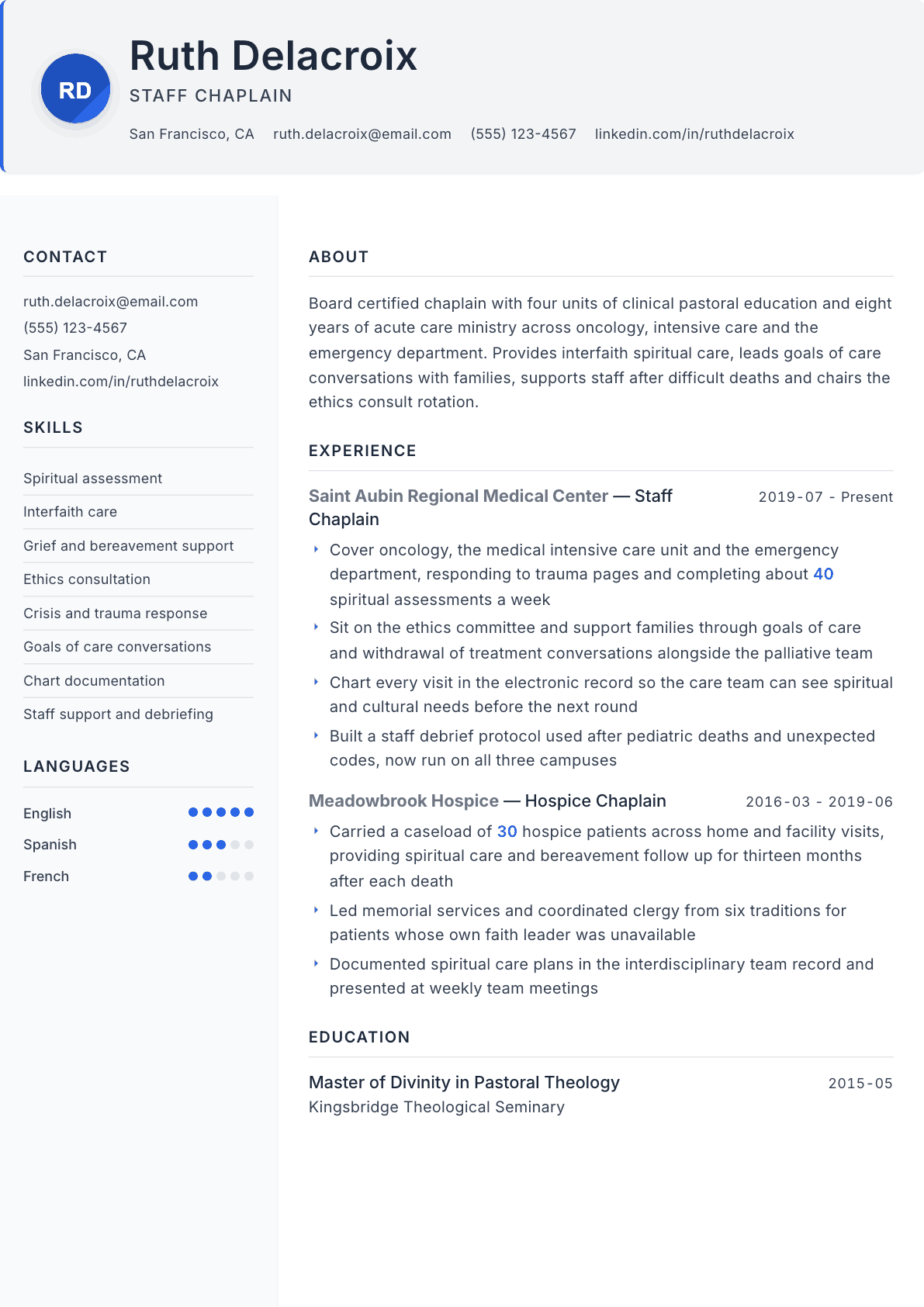
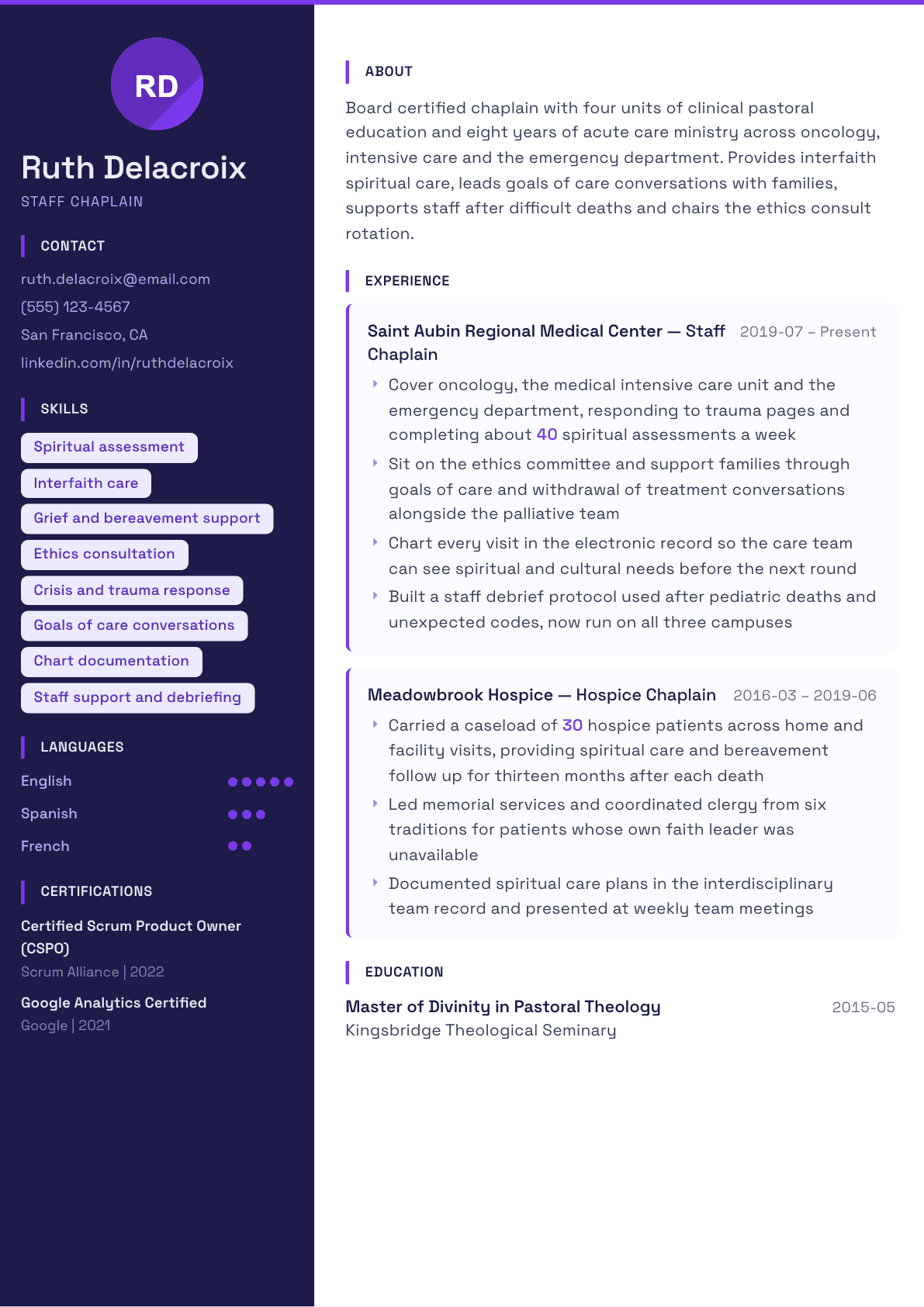
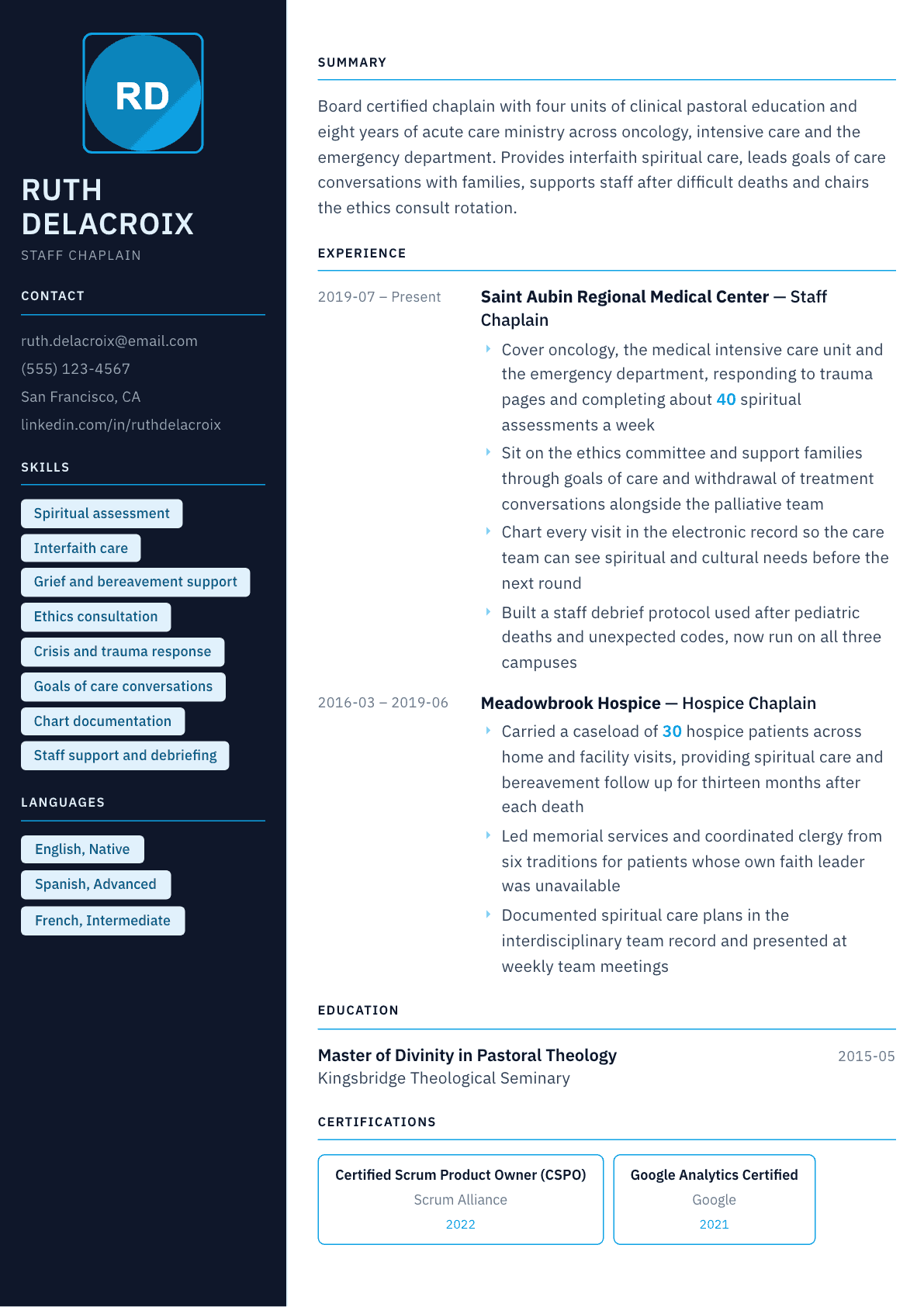
The same chaplain content laid out in three CVBooster templates, so you can see what the finished document looks like before you write a word.
Example Chaplain summary
Board certified chaplain with four units of clinical pastoral education and eight years across acute care and hospice. Provides interfaith spiritual assessment, supports families through goals of care decisions, charts in the electronic record for the whole team, and leads staff debriefs after traumatic deaths. Seeking a lead chaplain role in a teaching hospital with a clinical pastoral education program.
Skills to list on a Chaplain resume
- Spiritual assessment
- Interfaith and multifaith care
- Grief and bereavement counseling
- Crisis and trauma response
- Ethics consultation
- Goals of care facilitation
- End of life care
- Ritual and sacramental ministry
- Interdisciplinary team collaboration
- Electronic charting
- Staff debriefing
- Volunteer clergy coordination
- Cultural humility
- On call coverage
What actually gets this resume read
- State your units of clinical pastoral education and the accrediting center, because chaplain postings screen on that count first.
- Name your endorsing body and board certification status near the top, since most hospital roles require both.
- Give the units you cover: oncology, intensive care, emergency department, behavioral health, corrections or hospice.
- Show interfaith competence by naming traditions you have served rather than claiming openness in the abstract.
- Include on call and trauma page duty, because coverage patterns tell a manager what your week actually looked like.
- Describe staff support work separately from patient care, since debriefs and moral distress rounds are their own skill.
How to write a chaplain resume
Chaplaincy hiring has a hard gate and a soft one. The hard gate is countable: units of clinical pastoral education, a graduate theological degree, endorsement from your faith group, and board certification or eligibility for it. A recruiter or credentialing office checks those before your resume reaches the department. Miss them on the page and the file stops, however good the ministry behind it.
The soft gate is the director of spiritual care reading your experience section. She wants to know which units you covered, whether you have been paged to a trauma bay at two in the morning, whether you can sit in an ethics consult and speak usefully, and whether you chart in a way the rest of the care team can use. Spiritual care that never reaches the record is invisible to the hospital.
This guide covers the credentials block, how to write about presence and ritual without vagueness, how to describe interfaith work honestly, three summaries across career stages, and the questions chaplains ask when they move between hospital, hospice, corrections and military-adjacent settings.
Format: credentials block first, then units covered
One page early in a career, two once you have several settings and a supervisory or teaching record. Put a credentials block immediately under your contact line: graduate degree, number of clinical pastoral education units and the accrediting body, ordination or commissioning, endorsing body, and board certification status including whether an application is pending.
Then list the clinical areas you have covered as a short line rather than burying them in bullets. Oncology, medical intensive care, surgical intensive care, emergency, neonatal, behavioral health, palliative and hospice each carry different demands, and a director staffing a rotation is matching your list against her gaps.
- Credentials block: degree, units of clinical pastoral education, ordination, endorsement, board certification status.
- Coverage line: the specific units, plus on-call and trauma page responsibility.
- Setting history: acute hospital, hospice, long-term care, corrections, higher education or workplace chaplaincy.
Summary: units of training, setting, and the population you know
Lead with the training count and the setting, then the population. A chaplain with four units and eight years in a Level I trauma center is a different hire from one with one unit and a decade in long-term care, and both are right for different postings.
Resist the language of calling in the summary. It is true and it is universal, so it does not distinguish you. Save the theological register for the interview and use the resume line to say what you have carried.
Experience: the page, the visit, the chart, the family meeting
Give each job a scope line: the facility type, bed count if relevant, the units covered, and your call pattern. Then bullets on the four things a spiritual care director evaluates. First, volume and type of contact: spiritual assessments completed, trauma pages answered, deaths attended. Second, family work, especially goals of care conversations, withdrawal of treatment and organ donation approaches.
Third, documentation. Say where you chart, what a spiritual care note from you contains, and how the team uses it. A chaplain who records a patient religious observance and dietary need so nursing can act on it is doing clinical work, not adjacent work.
Fourth, the institutional layer: ethics committee membership, staff debriefs, memorial services, student supervision, volunteer clergy coordination and policy work on end of life or religious accommodation. This is what separates a staff chaplain from a lead chaplain application.
- Contact volume: assessments per week, trauma pages, deaths attended, on-call nights covered.
- Family work: goals of care meetings, withdrawal of treatment support, bereavement follow-up.
- Charting: where you document, what your note contains, how the team acts on it.
- Institutional work: ethics committee, staff debriefs, memorials, student supervision, policy input.
Interfaith competence: name traditions, not openness
Every chaplain claims respect for all traditions. Show it instead. Name the traditions you have served and the concrete accommodations you arranged: coordinating an imam for a dying patient, arranging last rites when a priest was unavailable, honoring a family request for a body not to be left alone, arranging kosher or halal meals through food services.
If you serve in a religiously specific role, such as a Catholic sacramental chaplain or a rabbi in a Jewish setting, say so plainly and also say how you cover patients outside your tradition, because a hospital serves everyone in its catchment.
Keywords a credentialing office and a director both scan
The recurring terms are spiritual assessment, spiritual care plan, clinical pastoral education, endorsement, board certification, interdisciplinary team, goals of care, bereavement, ethics consultation, crisis response and on-call. Mirror them once in your skills section and once in a bullet where the work sits.
Include the electronic record system by name if you charted in one, because a chaplain who is already comfortable in the record is faster to onboard than one who is not.
Chaplain resume summary examples
Residency completed
Master of Divinity with four units of clinical pastoral education completed in a residency covering oncology, the surgical intensive care unit and the emergency department. Endorsed by my denomination and eligible for board certification. Charts spiritual assessments in the electronic record and has covered overnight trauma call.
Staff chaplain, five years
Board certified chaplain with five years of acute care ministry across critical care and the emergency department, completing about 40 spiritual assessments a week. Supports families through goals of care and withdrawal decisions with the palliative team, and runs staff debriefs after unexpected deaths.
Lead or director of spiritual care
Director of spiritual care with twelve years across hospital and hospice, supervising four staff chaplains and a volunteer clergy roster. Sits on the ethics committee, built the moral distress debrief protocol used system wide, and precepts clinical pastoral education students each rotation.
Work experience bullets: before and after
Before: Provided spiritual care to patients and families.
After: Completed about 40 spiritual assessments a week across oncology, the medical intensive care unit and the emergency department, documenting each in the electronic record for the care team.
Volume, units and documentation turn an unmeasurable claim into something a spiritual care director can staff against.
Before: Supported families during end of life decisions.
After: Sat with families through goals of care and withdrawal of treatment conversations alongside the palliative team, and followed up with bereavement contact after each death on my units.
Naming the specific conversations and the follow-up shows the hardest part of the job rather than gesturing at it.
Before: Responded to emergencies and codes.
After: Carried the overnight trauma pager, responding to codes, unexpected deaths and family notification in the emergency department, and stayed with staff for a debrief afterward.
The call pattern and the staff debrief show both availability and the institutional maturity a director looks for.
Before: Worked with people of different faiths.
After: Coordinated visiting clergy from six traditions for patients whose own faith leader was unavailable, and arranged dietary and ritual accommodations through food services and nursing.
Named traditions and concrete accommodations prove interfaith competence that a statement of openness cannot.
Before: Participated in hospital committees.
After: Served on the ethics committee, presenting the patient and family perspective in consults, and helped rewrite the policy on religious accommodation for inpatient stays.
Committee membership plus a policy outcome shows influence, which is what separates a lead chaplain from a staff one.
Hard skills
- Spiritual assessment and care planning
- Crisis and trauma response
- Goals of care facilitation
- Bereavement and grief support
- Ethics consultation
- Ritual, sacrament and blessing
- Memorial and funeral leadership
- Electronic health record documentation
- Interdisciplinary team rounding
- Volunteer clergy coordination
- Clinical pastoral education supervision
- On-call and pager coverage
Soft skills
- Non-anxious presence
- Deep listening without fixing
- Cultural humility across traditions
- Boundaries in prolonged grief work
- Advocacy inside a clinical hierarchy
Certifications worth listing
- Board Certified Chaplain (BCC) (Board of Chaplaincy Certification Inc.)
- Clinical Pastoral Education units (ACPE: The Standard for Spiritual Care and Education)
- Board Certification (National Association of Catholic Chaplains)
- Board Certification (Neshama: Association of Jewish Chaplains)
Mistakes that cost chaplain candidates the interview
- Burying the number of clinical pastoral education units in the education section where a credentialing screen misses it.
- Leaving endorsement status off entirely, which stalls the file because a hospital cannot hire without it.
- Writing about ministry in devotional language that gives a clinical reader nothing to evaluate.
- Failing to name the units covered, so a director cannot tell whether you have worked in critical care at all.
- Omitting charting and the record system, which makes your care look invisible to the interdisciplinary team.
- Retelling a patient encounter with identifying detail, which any spiritual care department reads as a privacy failure.
Chaplain resume questions
How many units of clinical pastoral education do hospital chaplain jobs require?
Most staff positions ask for four units, which is typically one internship plus a residency year, and some entry roles accept one or two. Board certification pathways expect four, so state your exact count and where you completed them.
Do I need endorsement to apply for a chaplain position?
Nearly always. Endorsement is your faith group formal statement that it supports your ministry in this setting, and hospitals treat it as part of credentialing. Put the endorsing body on the resume and note the date it was granted.
How do I write a chaplain resume when moving from congregational ministry?
Translate pastoral work into clinical vocabulary: hospital visitation becomes spiritual assessment, funerals become bereavement care, counsel becomes crisis support. Then be honest about your training count and name the clinical pastoral education you are enrolled in.
Should a chaplain resume include a theology of care statement?
Not on the resume. Many applications ask for a separate reflection or spiritual care philosophy document, which is where that belongs. Keep the resume clinical and factual so credentialing and the department can both use it quickly.
What makes a corrections or hospice chaplain resume different?
Corrections work needs security clearance, group facilitation and religious accommodation grievance handling on the page. Hospice needs caseload size, home visiting, interdisciplinary team meetings and bereavement follow-up over a defined period after each death.
Related resume examples
- Social Worker Resume example
- Case Manager Resume example
- Crisis Counselor Resume example
- Pastor Resume example
- Counselor Resume example
- Hospital Social Worker Resume example