Pest Control Technician Resume Examples: free ATS score
Build a Pest Control Technician Resume Around Your Applicator License
By Mustafa Tarabya, founder of CVBooster · Published · Updated
Pest control technician resume example plus keywords and a writing guide covering applicator licensing, termite work, routes and inspection reports.
Sample resumes for a pest control technician
The same pest control technician content laid out in three CVBooster templates, so you can see what the finished document looks like before you write a word.
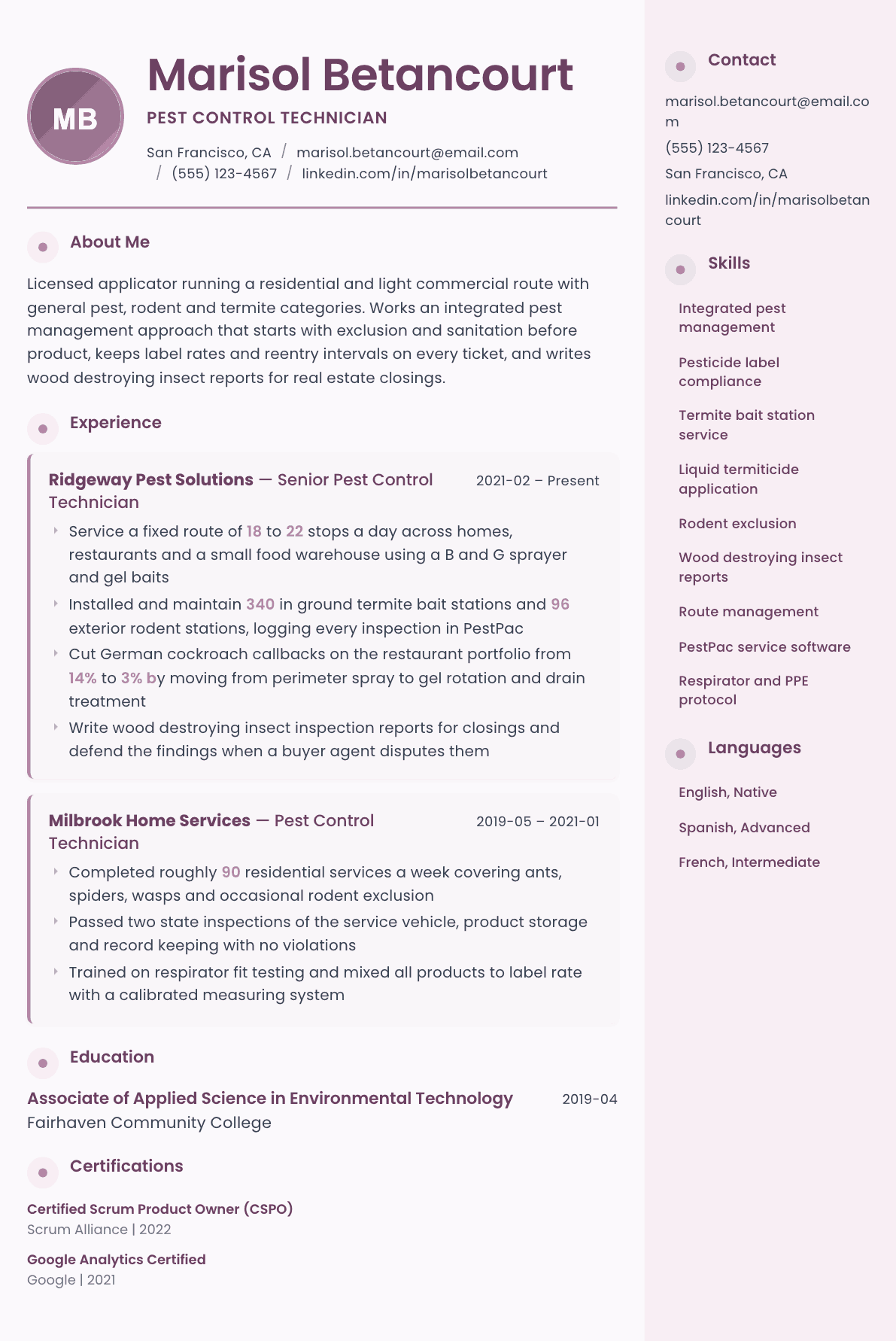
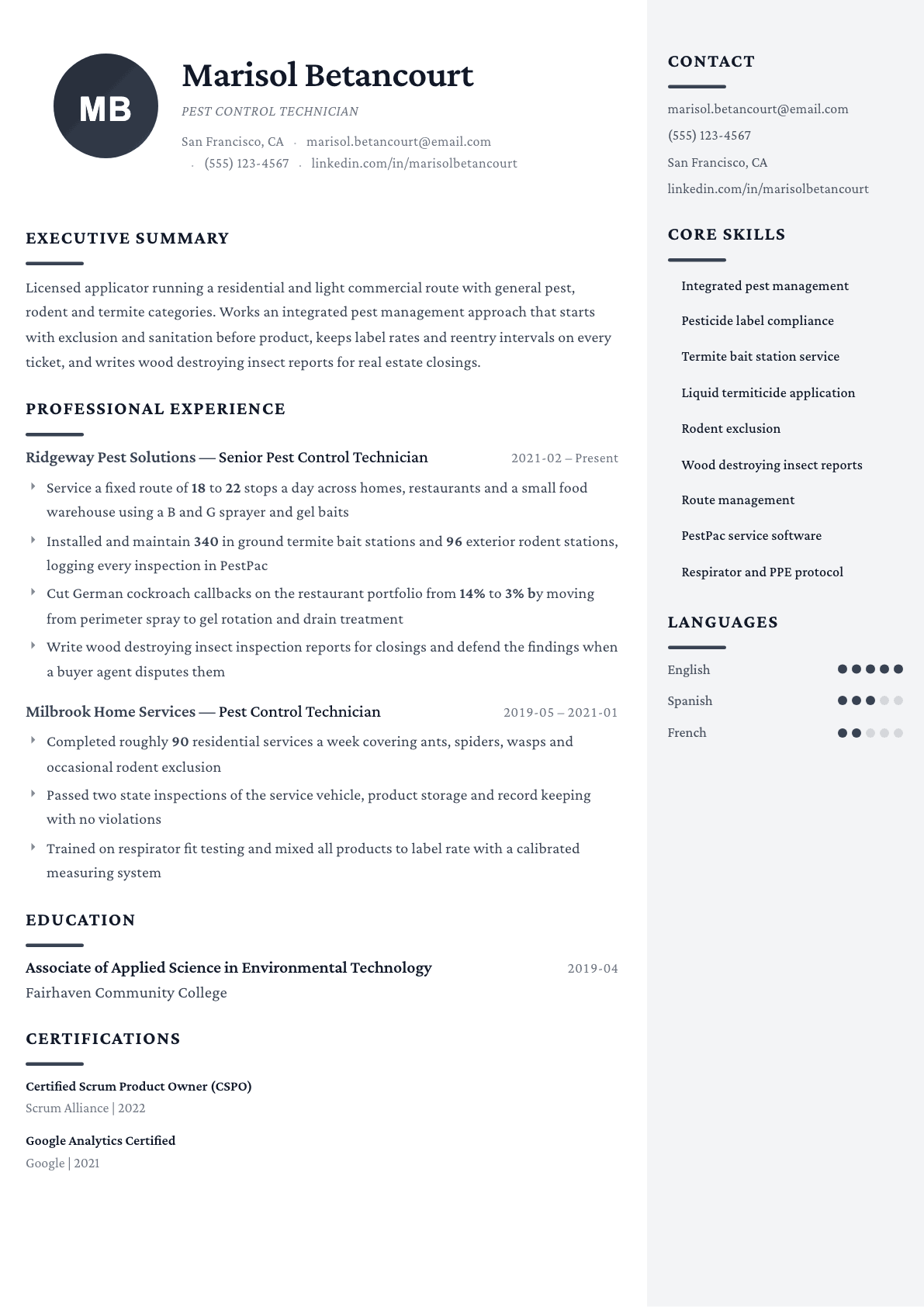
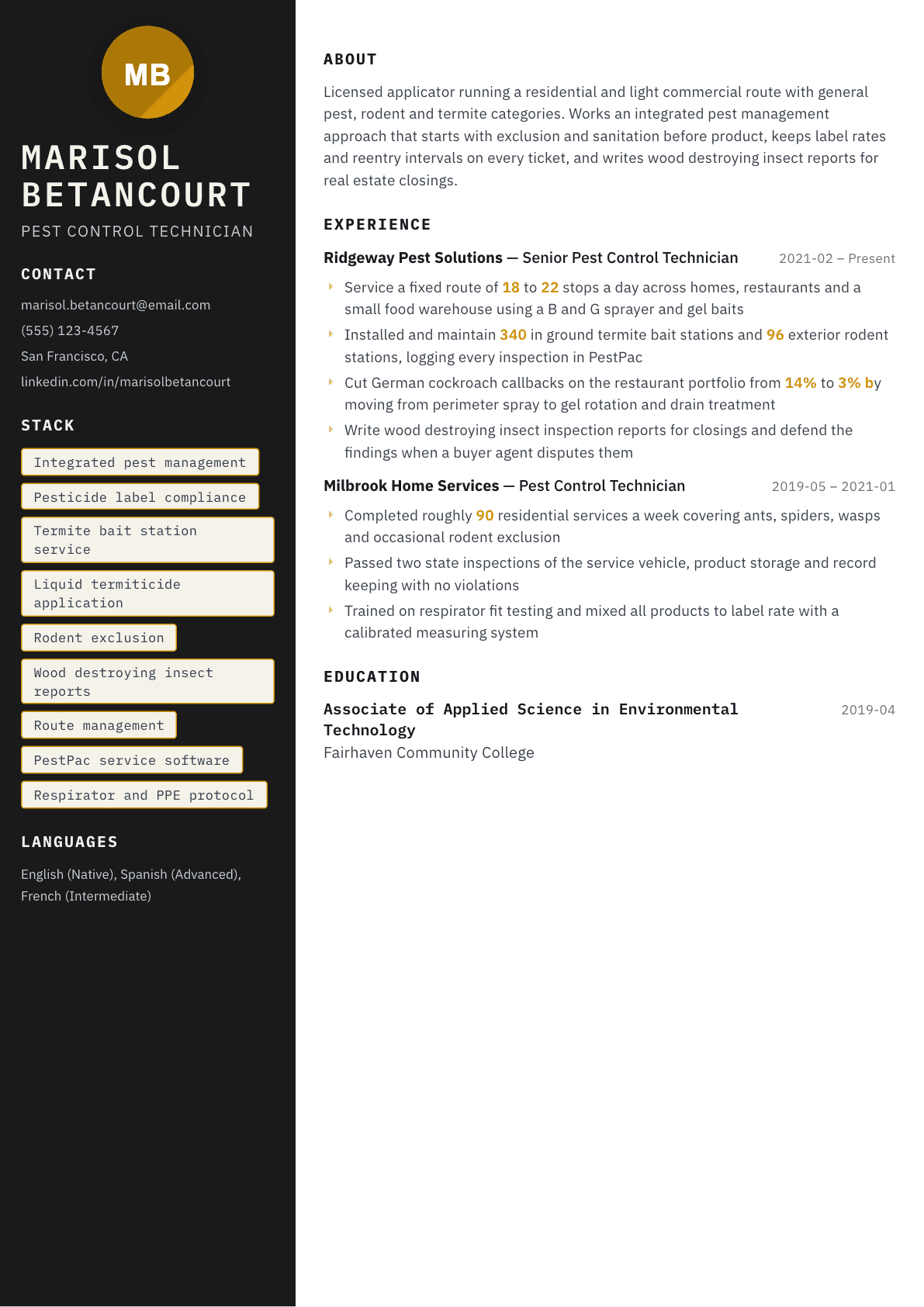
Example Pest Control Technician summary
Licensed pest control technician with six years on residential and food service routes, holding general pest, rodent and termite categories. Runs an inspection first program that fixes harborage and entry points before product goes down, keeps every application inside label rate, and maintains a low retreat rate on accounts that were previously chronic. Writes wood destroying insect reports and handles audit visits at food accounts without prep time.
Skills to list on a Pest Control Technician resume
- State applicator licensing
- Integrated pest management
- Label and reentry interval compliance
- General household pest treatment
- German cockroach gel baiting
- Bed bug inspection and heat treatment
- Rodent baiting and exclusion
- Termite bait station systems
- Liquid termiticide trenching
- Wood destroying insect inspection
- Mosquito and tick barrier treatment
- Route scheduling
- Service documentation software
- Respirator fit and personal protective equipment
- Customer education and reporting
What actually gets this resume read
- Lead with your state applicator license and the exact categories on it, since the categories decide what you may treat.
- Give the size of your route in stops per day and the mix of residential, commercial and food service accounts.
- Show the callback or retreat rate you hold, because that number is how a branch manager grades a technician.
- Name the equipment you run, from a compressed air sprayer to a rodenticide station key and a termite rig.
- Say whether you write wood destroying insect reports, which is a separate skill many technicians never learn.
- Describe your integrated pest management sequence so the reader sees inspection and exclusion before product.
How to write a pest control technician resume
A branch manager reading pest control technician resumes is solving a scheduling problem with a regulatory constraint bolted to it. She has routes that must be covered, accounts that will cancel after a second failed visit, and a state file that has to show every applicator on the truck is licensed for the categories they treat. Your resume either resolves both of those or it goes in the maybe pile.
The trap most candidates fall into is writing about spraying. Spraying is the smallest part of the job. The work is inspection, identification, exclusion, product selection at label rate, documentation, and the conversation on the doorstep that decides whether the customer prepares the unit before the next visit. A resume that only mentions treatment reads like someone who has never had to solve a chronic account.
What follows is the structure a pest control branch reads, the numbers that make a route history credible, summaries for three stages of the career, before and after bullets, and the questions technicians ask when they move from residential into commercial food accounts or into termite work.
Format: applicator license and categories above everything else
One page, reverse chronological. The license block goes at the top with the issuing state, the license or certification number, the expiration and every category it covers. Categories are not decoration. They decide legally what you may treat, and a branch that needs a termite category cannot use a technician who holds only general pest, no matter how good the rest of the page is.
Underneath that, describe the accounts you have carried rather than the tasks you have performed. Residential routes, apartment portfolios, restaurants, food processing plants, schools and hospitals all behave differently, and a manager staffing a food account wants someone who has already stood through a third party audit.
- License block: state, applicator number, categories, expiration and continuing education status.
- Account mix stated as a share of the route: homes, multifamily, food service, commercial and industrial.
- Equipment line covering compressed air sprayers, backpacks, dusters, foggers, bait guns and termite rigs.
- A short line on the documentation software you have used to close tickets and log station inspections.
Summary: license, route size, account types, the pest you are strongest on
Four lines at most. Open with the license and categories, give the route size in stops a day, name the account types, and finish with the pest problem you are best at solving. Managers hire specialists more often than they admit, and cockroaches in a commercial kitchen, bed bugs in multifamily and subterranean termites are three different reputations.
Avoid the phrase eliminate pests. Nobody eliminates anything permanently in this trade, and a technician who says so signals inexperience. Say that you bring an account back under threshold and hold it there, which is what the contract actually promises.
Experience: route load, callbacks, and how you fixed a chronic account
Give the stops per day and the route type for every job. A technician doing 20 residential exteriors is doing volume work. A technician doing 6 commercial kitchens with detailed reports is doing depth work. Both are respectable and they hire differently, so let the reader see which one you are.
Then put the callback or retreat rate on the page. In pest control this is the whole grade. Every branch tracks it, every manager knows their own number, and a candidate who quotes theirs is speaking the language of the office. Pair it with the method that produced it, because a low rate without an explanation reads as luck.
The strongest bullet on most pest control resumes is a chronic account turned around. Describe the account type, what the previous approach was, what you changed, and how long it took to get under threshold. That single story proves inspection skill, product knowledge and customer management at once.
Termite work, inspections and reports
Termite work sits apart from general pest and should get its own block if you hold the category. Say whether you install and service bait stations, whether you have trenched and rodded liquid termiticide, and whether you have drilled slabs. Those are different skill levels and different physical jobs, and a branch buying a termite technician is buying one of them specifically.
Inspection reporting for real estate closings deserves a line of its own. Writing a wood destroying insect report puts your name on a document that a buyer, a seller and two agents may all dispute. A technician who has written them, defended the findings and been through a reinspection is worth more to a branch than one who has only treated.
- State the station count you service and how inspection intervals are tracked and evidenced.
- Say whether you have done pretreatment on new construction as well as post construction remedial work.
- Note moisture meter and borescope use, since conducive conditions drive most of the argument on an inspection.
- Mention any structural repair coordination you handled after a report identified active damage.
Safety, records and the words a screener searches
Label compliance is the safety story in this trade, and it is worth two concrete lines: mixing to label rate with a measuring system rather than by eye, and honoring reentry intervals in occupied buildings. Add respirator fit testing, product storage on the vehicle and how you handle a spill. State inspections of a service truck are routine, and a technician who has passed them cleanly should say so.
Screeners search for a short list of terms: integrated pest management, applicator license, general pest, rodent exclusion, termite, bed bug, wood destroying insect report, food safety audit, route management and service documentation. Put those in naturally where the work supports them, and skip the ones you cannot back up in an interview.
Pest Control Technician resume summary examples
First license, first route
Newly licensed pest control technician with 10 months on a residential route of about 15 stops a day, treating ants, spiders, wasps and occasional rodent activity. Trained in integrated pest management, label rate mixing and respirator use. Seeking a route with commercial accounts and a path into the termite category.
Five years, mixed route
Licensed applicator holding general pest, rodent and termite categories, running 18 to 22 stops a day across homes, restaurants and light industrial accounts. Brought a restaurant portfolio from 14% callbacks to 3% by moving from perimeter spray to gel rotation and drain treatment, and writes wood destroying insect reports for closings.
Route lead and trainer
Senior pest control technician with 11 years across residential, food service and food processing accounts. Holds general pest, rodent, termite and fumigation adjacent categories, leads third party audit visits without prep time, trains new technicians on inspection sequence and documentation, and covers the branch termite work.
Work experience bullets: before and after
Before: Treated homes and businesses for pests.
After: Serviced a fixed route of 18 to 22 stops a day across single family homes, six restaurants and a food warehouse, covering general pest, rodent stations and quarterly termite station inspections.
The stop count and the account mix let a branch manager drop you onto a real route instead of guessing.
Before: Reduced customer complaints about roaches.
After: Cut German cockroach callbacks across the restaurant portfolio from 14% to 3% over two quarters by replacing perimeter spray with a gel bait rotation, drain treatment and a written sanitation list for each kitchen.
It names the pest, the metric, the timeframe and the actual change in method rather than claiming improvement.
Before: Installed and checked termite bait stations.
After: Installed and maintain 340 in ground termite bait stations across 60 properties, logging every inspection with date, station number and activity so the warranty file survives a transfer to a new owner.
Station and property counts plus the record keeping show the part of termite work that protects the branch.
Before: Followed all safety rules when applying pesticides.
After: Mixed every product to label rate with a calibrated measuring system, honored reentry intervals in occupied units, and passed two state inspections of vehicle storage and application records with no violations.
Three checkable behaviors replace a claim that every applicant makes and no manager can verify.
Before: Did inspections for home sales.
After: Wrote wood destroying insect reports for real estate closings, documenting active infestation, prior treatment evidence and conducive conditions with moisture readings, and defended findings on reinspection when disputed.
It shows the reporting and the pressure that comes after it, which is what a branch actually worries about.
Hard skills
- State applicator licensing and categories
- Integrated pest management inspection sequence
- Pest and rodent species identification
- Label rate mixing and calibration
- German cockroach gel baiting
- Bed bug inspection, heat and residual treatment
- Rodent baiting, trapping and exclusion
- Termite bait station installation and service
- Liquid termiticide trenching and rodding
- Wood destroying insect report writing
- Mosquito and tick barrier application
- Fly and stored product pest management
- Route scheduling and stop sequencing
- Service documentation software
Soft skills
- Telling a customer their sanitation is the problem without losing the account
- Holding an inspection sequence when the schedule is behind
- Staying calm during a third party food audit
- Writing findings that a stranger can read six months later
- Working crawl spaces and attics in bad weather
Certifications worth listing
- Associate Certified Entomologist (ACE) (Entomological Society of America)
- Board Certified Entomologist (BCE) (Entomological Society of America)
- QualityPro Certified Technician (National Pest Management Association)
Mistakes that cost pest control technician candidates the interview
- Naming a state license without listing the categories, which is the only part that tells a branch what you may treat.
- Writing about spraying and leaving out inspection, identification and exclusion, which are the bulk of the work.
- Promising to eliminate pests instead of bringing an account under threshold and holding it there.
- Omitting the callback or retreat rate, the single number every branch manager uses to grade a route.
- Treating termite work as an afterthought when the category is often the reason a branch is hiring at all.
- Skipping documentation habits, even though a missing service record is what turns a complaint into a liability.
Pest Control Technician resume questions
How do I write a pest control resume before I have my own license?
Show the training and the supervised work honestly. Say how many hours you have run under a licensed applicator, which categories you are studying for, and when you sit the exam. Branches hire unlicensed helpers regularly, but only when the timeline to licensing is on the page.
Does route size really matter that much?
It matters because it tells the manager what kind of technician you are. High stop counts prove speed and route discipline. Low counts with detailed commercial reports prove depth and audit readiness. Give the number and the account mix so the reader is not left guessing which one they are getting.
Should I list the products I use by name?
List classes and methods rather than reciting a shelf. Gel baits, non repellent liquids, dusts, insect growth regulators and rodenticide station types tell a manager how you think. A long brand list without any method behind it reads as a catalog someone copied.
How do I move from residential to commercial food accounts?
Emphasize documentation, sanitation conversations and anything audit adjacent you have done. Food accounts are won and lost on paperwork and on the ability to tell a kitchen manager what to change. Mention any restaurant stops already on your route, even a small number.
What belongs in the education section for this role?
Continuing education credits and the courses behind them, because the license depends on them and a lapsed technician is unusable. Any biology, entomology or environmental coursework belongs there too, along with the training academy your previous employer ran if it had one.
Related resume examples
- Maintenance Technician Resume example
- Building Maintenance Worker Resume example
- Apartment Maintenance Technician Resume example
- Pool Technician Resume example
- Medical Equipment Technician Resume example
- Appliance Repair Technician Resume example