Petroleum Geologist Resume Examples: what gets the call
Drill Down to a Petroleum Geologist Resume That Delivers
By Mustafa Tarabya, founder of CVBooster · Published · Updated
Build a petroleum geologist resume showcasing reservoir characterization, seismic interpretation, and exploration expertise with ATS-friendly templates for oil & gas companies.
Sample resumes for a petroleum geologist
The same petroleum geologist content laid out in three CVBooster templates, so you can see what the finished document looks like before you write a word.
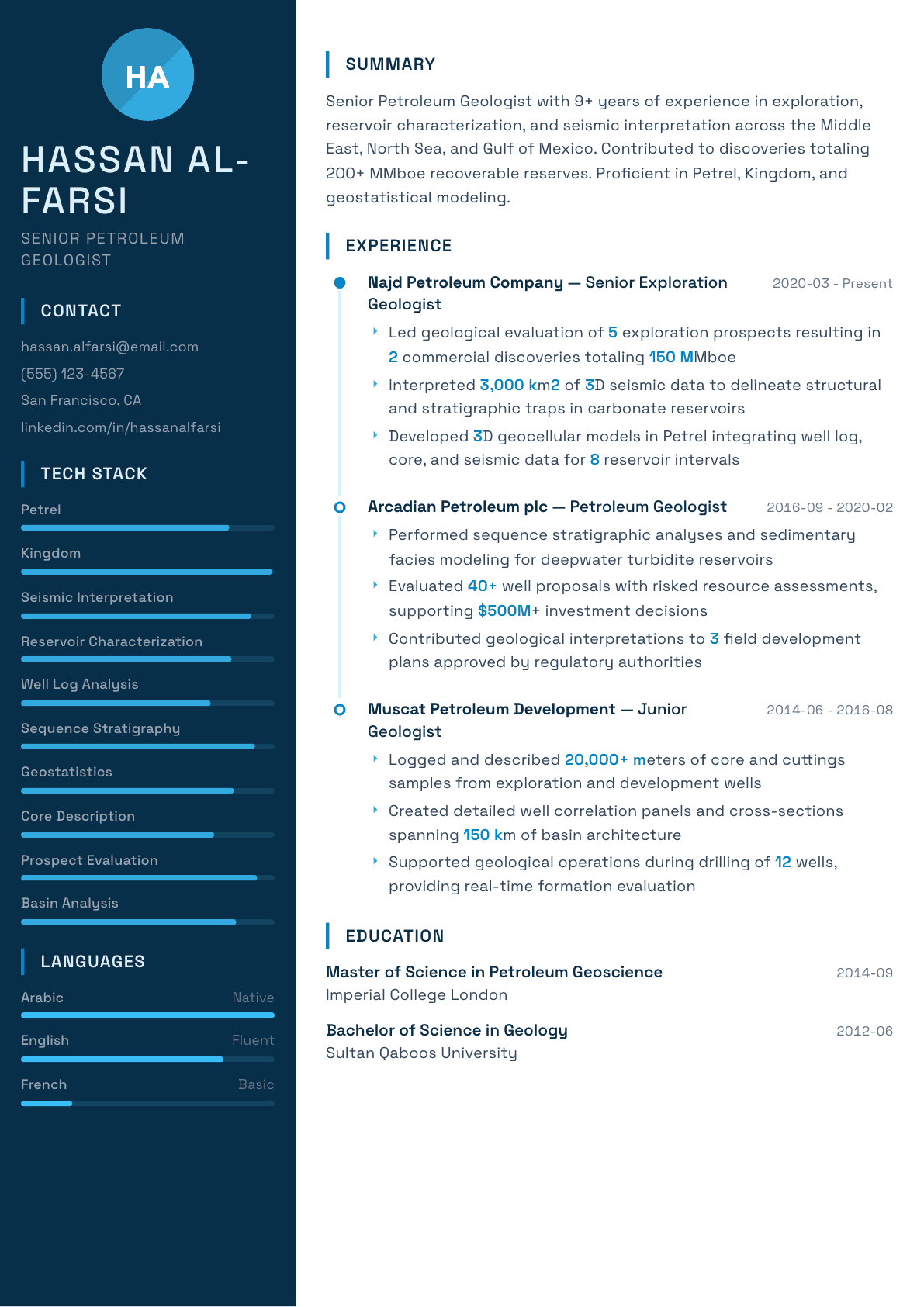
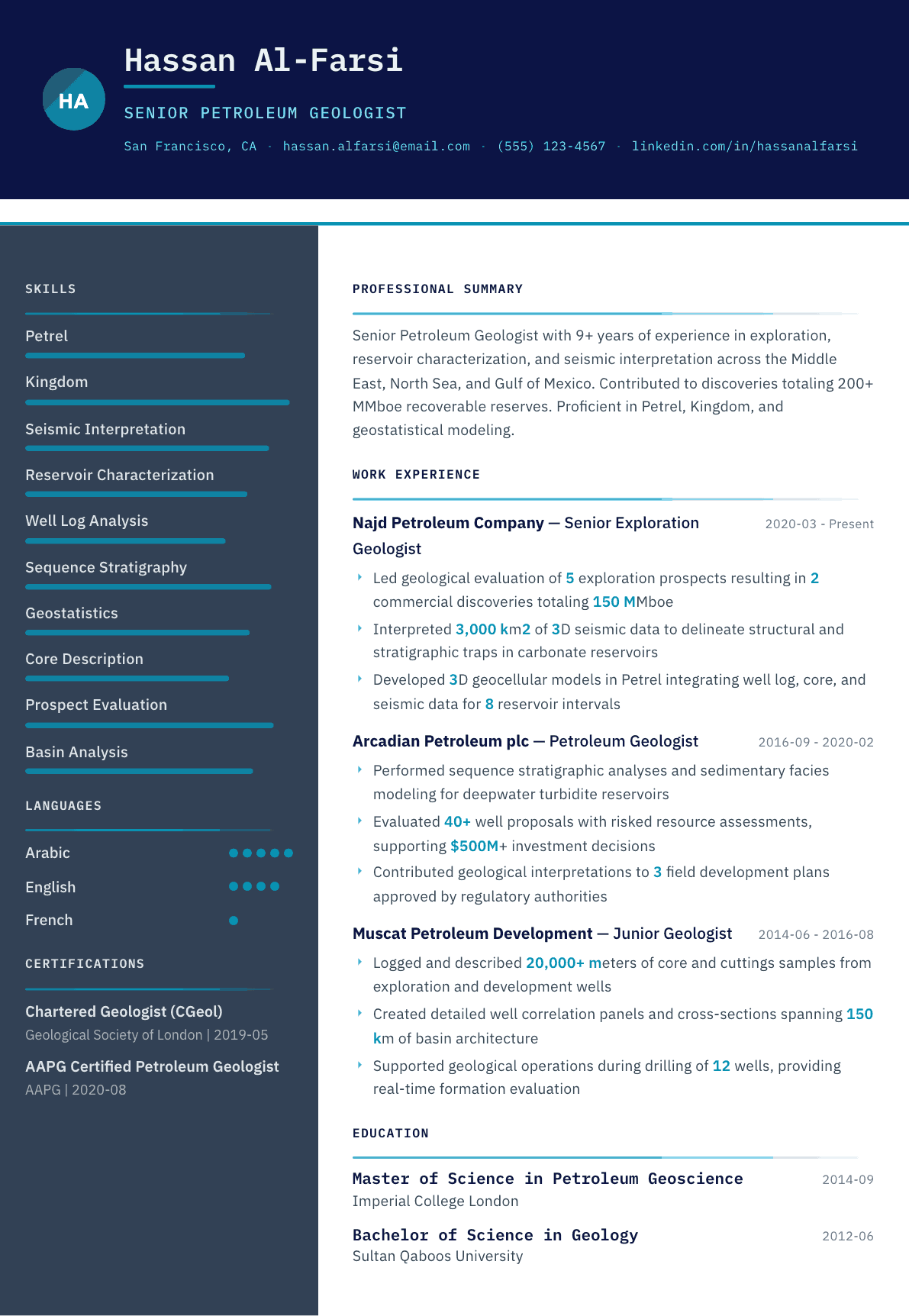
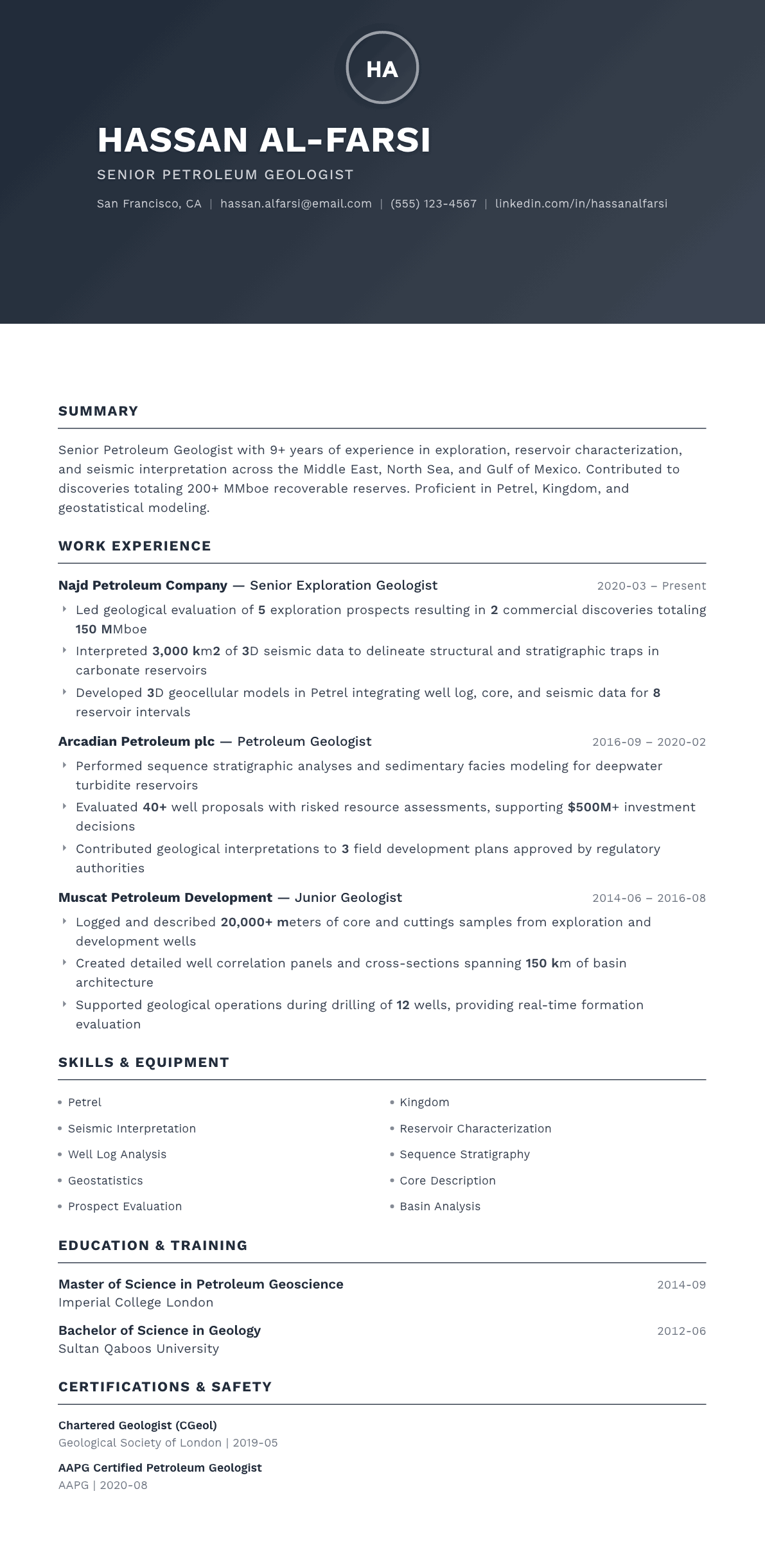
Example Petroleum Geologist summary
AAPG-certified Petroleum Geologist with 9+ years in exploration and reservoir characterization. Contributed to discoveries totaling 200+ MMboe across the Middle East, North Sea, and Gulf of Mexico. Expert in Petrel, 3D seismic interpretation, and geostatistical modeling. Chartered Geologist with carbonate and clastic reservoir expertise.
Skills to list on a Petroleum Geologist resume
- Petrel
- Kingdom
- Seismic Interpretation
- Reservoir Characterization
- Well Log Analysis
- Sequence Stratigraphy
- Geostatistics
- Core Analysis
- Prospect Evaluation
- Basin Modeling
- Formation Evaluation
- Petrophysics
What actually gets this resume read
- List petroleum software prominently: Petrel, Kingdom, OpendTect, Techlog, GeoFrame.
- Quantify discoveries and reserves: MMboe, well success rates, and investment decisions supported.
- Highlight seismic interpretation volumes: km2 or km3 of 3D data interpreted.
- Include professional registrations: CGeol, CPG, AAPG Certified, or PGeo designations.
- Describe the geological settings and play types you have experience with.
How to write a petroleum geologist resume
A petroleum geologist resume is screened by an exploration or subsurface manager who wants to know three things before the second page: which basins and plays you have worked, whether you have taken a prospect from idea to a drilled well, and which interpretation software you can open on Monday without training. Everything else is supporting evidence.
The trap most candidates fall into is describing the asset instead of their own contribution. A field can be world class while your role in it was picking tops on offset wells. Subsurface teams are small, so the reader assumes you can name the wells you sat on, the volumes you booked and the seismic volumes you interpreted yourself.
This guide covers the section order the oil and gas industry expects, how to write a basin and play line that survives a keyword filter, summaries for a wellsite geologist, a development geologist and an exploration lead, and the reserve and prospect language that a technical reviewer trusts.
Format: two pages, with a technical inventory on page one
Reverse-chronological, two pages once you have more than a few years of subsurface work. Operators and service companies both use applicant tracking systems that key on software names and basin names, so those belong in plain text, not in a graphic or a skills wheel that a parser will drop.
Put a short technical block directly under the summary: interpretation software, basins and plays, well types, and any professional licensure. A geoscience hiring manager checks that block before reading a single bullet, because it tells him whether you can be staffed on the asset he is hiring for.
- Header: name, city, phone, email, work authorization for the countries you are targeting.
- Order: summary, technical profile, experience, education, publications and presentations, licenses.
- Name every basin explicitly, onshore and offshore, along with the play type: carbonate, clastic, deepwater turbidite, unconventional shale.
Experience: the prospect, the data, the decision it fed
Each role needs the operator, the asset or region, your position in the subsurface team, and the type of work: exploration, appraisal, development or operations geology. A reader wants to place you on the value chain immediately, because a development geologist writing a resume for an exploration seat has to explain the jump.
Then write bullets that trace a loop: what data you had, what you interpreted, what decision it supported. Seismic square kilometers, well counts, core meters described, log suites analyzed and mapped horizons give the technical reviewer something to check. Volumetric work should say whether it was deterministic or probabilistic and which parameters you owned.
If you sat wells, say so with the well count, the environment, and whether you called casing points or picked coring points. Wellsite experience is a hiring signal in its own right because it proves you can defend a call in real time with incomplete data.
Software and workflows: name the version of reality you work in
Petrel, Kingdom, DecisionSpace, Techlog, Interactive Petrophysics, Geolog, GeoGraphix and Move all appear in postings by name. List the ones you have actually used to deliver work, and group them by what they do: seismic interpretation, petrophysics, geocellular modeling, mapping, structural restoration.
Go one level deeper than the tool. Depth conversion, well tie and synthetic seismogram generation, attribute analysis, facies modeling with sequential indicator simulation, property population, upscaling to the simulation grid: these workflow names tell a reader what you can do unsupervised. Add scripting if you have it, since Python for log conditioning and batch mapping is increasingly asked for.
Volumes, risk and the language a reviewer trusts
Prospect and resource work is where credibility is won or lost. Use the industry vocabulary correctly: gross rock volume, net to gross, chance of success broken into source, reservoir, trap and seal, P90 to P10 ranges, contingent versus prospective resources, and reserve categories under the recognized reporting rules. A resume that says "found lots of oil" reads as someone who has never been through a reserve audit.
Attribute honestly. "Contributed the reservoir presence and quality risk element to a peer-reviewed prospect inventory" is stronger than an implied claim on a whole discovery, because the reader knows exactly what a geologist owns inside a team.
- Say whether volumes were peer reviewed internally or audited by a third party.
- Give the well outcome when you can: commercial, non-commercial, plugged and abandoned, or still under evaluation.
- Separate what you mapped from what the team mapped.
Education, publications and licensure
A master's degree in geology or petroleum geoscience is the working standard, so name the thesis topic and the field area when they connect to the job. A doctorate belongs on the resume with the dissertation subject in one line, not with a full publication list unless the role is research oriented.
Conference abstracts and papers are worth a short section, listed by venue rather than in full citation form. Professional licensure or certification carries real weight in some jurisdictions and in expert witness or regulatory-facing work, so give the state or country and the status.
Petroleum Geologist resume summary examples
Recent MSc
Geologist with an MSc in petroleum geoscience and two summers of wellsite experience across 14 development wells. Trained in Petrel seismic interpretation, well correlation and core description, with a thesis on carbonate diagenesis in a Middle East reservoir analog. Seeking an operations geology position.
Six years in
Development geologist with 6 years across clastic and carbonate reservoirs, responsible for well correlation, geocellular model building and well placement on a producing asset. Interpreted 1,800 square kilometers of 3D seismic and delivered static models for 4 reservoir units feeding the field simulation.
Exploration lead
Senior petroleum geologist with 12 years in exploration and appraisal across the North Sea and West Africa. Led play fairway and prospect maturation work that took 9 prospects to drill-or-drop decisions, and owns the probabilistic volumetric and chance-of-success workflow used by the subsurface team.
Work experience bullets: before and after
Before: Worked on seismic interpretation for exploration projects.
After: Interpreted 2,400 square kilometers of 3D seismic, mapping 6 horizons and 3 fault families to define a stratigraphic trap that entered the drillable prospect inventory in 2022.
Volume, horizon count and the downstream decision let a reviewer judge the scale and the outcome of the work.
Before: Built reservoir models in Petrel.
After: Built a 4-million-cell geocellular model in Petrel from 32 wells, populating porosity and permeability by facies and upscaling to the dynamic grid used for a 20-well infill plan.
The cell count, well control and the handoff to simulation show the model was production work, not a training exercise.
Before: Involved in resource estimation for new prospects.
After: Ran probabilistic volumetrics for 7 prospects, owning the net-to-gross and reservoir presence risk elements, and defended the P50 case at internal peer review before the drilling decision.
Naming which risk elements you owned and where you defended them separates real ownership from attendance.
Before: Sat wells as a wellsite geologist.
After: Sat 11 exploration and appraisal wells offshore, calling casing and coring points from cuttings, LWD and mudlog data, and reported formation tops to town on a 12-hour handover cycle.
Well count, data sources and the decisions you called show judgment under time pressure rather than presence on a rig.
Before: Helped younger staff with software.
After: Wrote the team Petrel workflow standard for depth conversion and well ties, and trained 5 graduate geologists on it, cutting model handover queries during peer review.
A named deliverable and the people trained turn informal help into a documented contribution.
Hard skills
- Seismic interpretation
- 3D geocellular modeling
- Sequence stratigraphy
- Well log correlation
- Petrophysical evaluation
- Core description and facies analysis
- Probabilistic volumetrics
- Play fairway analysis
- Depth conversion and well ties
- Petrel
- Techlog
- Kingdom
- Wellsite operations geology
- Basin modeling
Soft skills
- Technical peer review
- Communicating uncertainty
- Cross-discipline collaboration
- Decision support under incomplete data
- Mentoring graduate geoscientists
- Partner and regulator presentations
Certifications worth listing
- Certified Petroleum Geologist (American Association of Petroleum Geologists, Division of Professional Affairs)
- Professional Geologist (PG) licensure (State geology licensing boards, via the ASBOG examinations)
- IWCF Well Control Certification (International Well Control Forum)
- BOSIET offshore safety training (OPITO approved training centers)
Mistakes that cost petroleum geologist candidates the interview
- Listing the field or asset without saying which part of the subsurface work was yours, which reads as borrowed credit to any subsurface manager.
- Leaving basins and play types out, so a recruiter filtering for deepwater or unconventional experience never matches the file.
- Claiming discoveries in the first person when the prospect was matured by a team of geoscientists and engineers.
- Mixing up resource and reserve terminology, which signals to a technical reviewer that you have never been through an audit.
- Burying software under a generic skills line instead of naming the interpretation platforms that appear verbatim in the posting.
- Using a two-column creative template for an industry whose parsers routinely scramble columns and drop the technical block.
Petroleum Geologist resume questions
Should a petroleum geologist resume list every well worked?
No. Give counts and categories instead: exploration, appraisal, development, onshore or offshore, and the environment. Name individual wells only when they are public discoveries you can discuss and they are directly relevant to the job you are applying for.
How do I write a petroleum geologist resume when the industry is between cycles?
Keep the technical block current and add the adjacent work honestly: carbon storage site characterization, geothermal resource assessment, mining or groundwater. The subsurface workflows transfer, so describe them in the vocabulary of the job you want rather than the one you left.
Do publications belong on a petroleum geologist resume?
A short list does, especially conference papers and abstracts from the recognized geoscience meetings. Give venue and year in one line each and cap it at five. Full citation lists belong on an academic curriculum vitae, not on an industry resume.
Is a professional geologist license worth listing?
Yes, with the jurisdiction and status, because some regulatory filings and expert reports must be signed by a licensed geologist. If you are still accumulating experience toward licensure, list the passed fundamentals examination rather than staying silent about it.
How much software detail is too much?
Name the platforms and the workflows you ran inside them, then stop. Listing every plug-in you have opened dilutes the signal. A reviewer wants to know you can build a model, tie a well and condition logs without supervision, not that you clicked through a menu once.
Related resume examples
- Geologist Resume example
- Power Plant Operator Resume example
- Energy Consultant Resume example
- Petroleum Engineer Resume example
- Reservoir Engineer Resume example
- Drilling Engineer Resume example