Reservoir Engineer Resume Examples: the lines they read
Create a Reservoir Engineer Resume That Proves Technical Depth
By Mustafa Tarabya, founder of CVBooster · Published · Updated
Reservoir engineer resume example with simulation and reserves bullets, decline curve keywords, and a section by section writing guide.
Sample resumes for a reservoir engineer
The same reservoir engineer content laid out in three CVBooster templates, so you can see what the finished document looks like before you write a word.
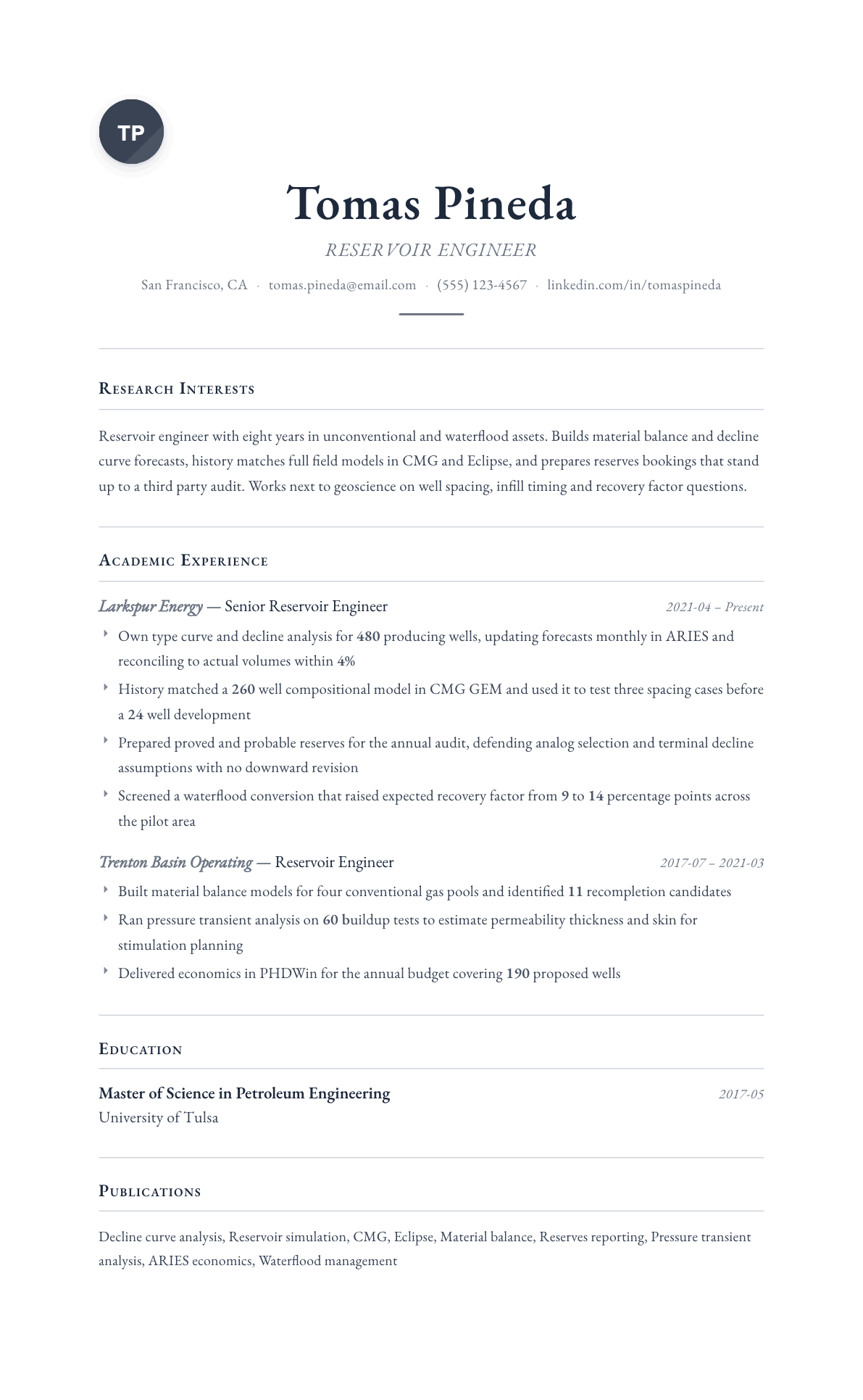
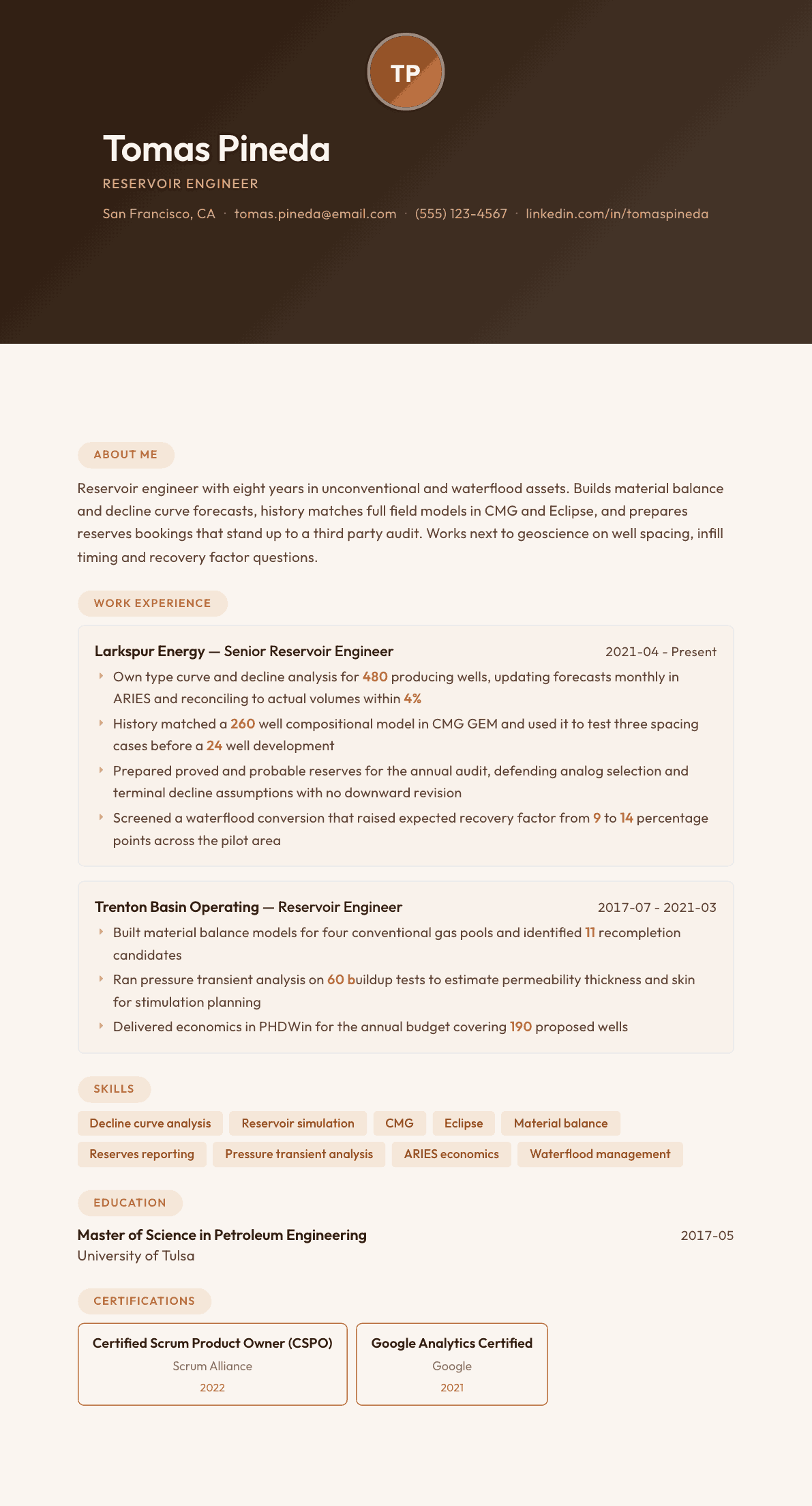
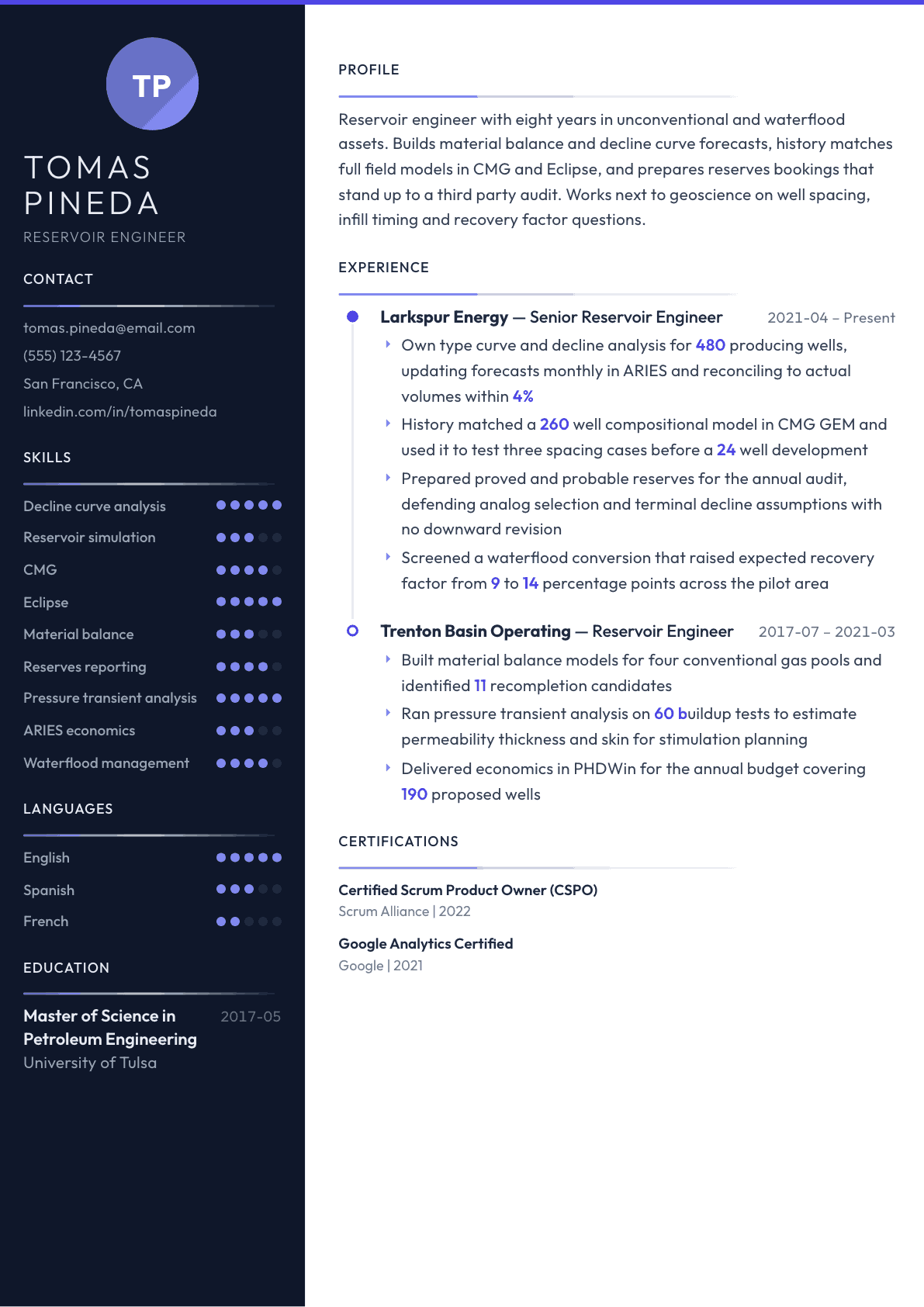
Example Reservoir Engineer summary
Reservoir engineer with eight years across unconventional development and mature waterfloods. Forecasts production with decline and type curve analysis, history matches full field models in CMG and Eclipse, and prepares proved and probable reserves for third party audit. Reconciled monthly forecasts within 4% across 480 wells and screened a waterflood conversion that lifted expected recovery. Looking for a technical lead role on a development asset.
Skills to list on a Reservoir Engineer resume
- Reservoir simulation
- Decline curve analysis
- Material balance
- Type curve construction
- Reserves estimation
- Pressure transient analysis
- Waterflood management
- Enhanced oil recovery
- Well spacing analysis
- CMG IMEX and GEM
- Eclipse
- Petrel
- ARIES
- PHDWin
- Production forecasting
- Economic evaluation
What actually gets this resume read
- State the asset type in every job: unconventional shale, conventional waterflood, carbonate or offshore development.
- Name the simulator and the economics package you used, since screening for CMG, Eclipse or ARIES is common.
- Show reserves work by the audit outcome, not by saying you supported the year end process.
- Quantify forecast accuracy, model size and well counts so a manager can judge the scale you have handled.
- Keep a short line on the geoscience and drilling teams you worked with, because the role is cross functional.
- List conference papers or SPE presentations if you have them, and place them below experience rather than on top.
How to write a reservoir engineer resume
A reservoir engineer is hired to answer three questions for an asset: how much is down there, how fast will it come out, and what should we do next. Everything on the resume should serve those questions. The person screening is usually an asset manager or a chief engineer who will check whether you have forecast production that later matched, whether your reserves survived an audit, and whether you can defend an assumption in front of people who disagree with you.
The technical filter is narrower than in most engineering disciplines. Simulation experience, decline and type curve work, material balance, pressure transient analysis and reserves reporting are each their own hiring pool. An unconventional shale team wants type curves, spacing studies and parent child interference. A mature conventional asset wants material balance, waterflood surveillance and enhanced recovery screening. Saying reservoir engineering without saying which one costs you the call.
This guide sets out how to structure the resume, what to put in each section, three summaries covering a graduate through a technical lead, before and after bullets from forecasting and reserves work, and the questions that come up most when reservoir engineers change assets or move into an evaluation role.
Format: technical resume, one column, two pages at most
Use reverse chronological order with a technical skills block near the top. Reservoir hiring is keyword dense, and the simulator, the economics package and the reserves standard all need to be visible before a reader reaches your second job.
A master degree is common in this discipline and is worth showing in the header line under your name when it is recent. Thesis topics in simulation, geomechanics or unconventional flow behavior are relevant enough to keep for the first few years.
- Header: name, degree, city, phone, email, and any professional society membership.
- Order: summary, technical skills, experience, education, publications if you have them.
- Evaluation and consulting roles add a transactions or projects block with asset type and deal role.
Summary: asset type, method depth, and what you are known for
Say what kind of rock and what kind of drive you have worked. Unconventional shale, conventional solution gas, waterflood, gas storage, carbonate or offshore development each imply a different toolkit. Then name the two methods you are strongest in and the scale of what you have modeled or forecast.
Add one credibility fact: reserves prepared for external audit, a full field history match, a spacing study that changed a development plan, or a field wide surveillance program. That single specific beats three lines about being a detail oriented technical professional.
Experience: forecasts, models, reserves and the decisions they drove
Open each job with the asset: play or field name if it is public, well count, fluid type and whether it was development, surveillance or evaluation work. Then bullets that show method and consequence. A forecast is interesting when you say how many wells, how often it was updated and how close it landed to actual volumes. A simulation is interesting when you say the model size, the history match quality and what the model was used to decide.
Reserves work should be written by outcome. Prepared proved and probable volumes, defended analog selection and terminal decline assumptions, closed the audit with no downward revision. Auditors and regulators are the audience, and a reader who has been through that process knows exactly how much work sits behind a clean audit.
Include the cross discipline half of the job. Reservoir engineers work with geologists on property distribution, with completions on frac design feedback, with facilities on capacity constraints and with the commercial team on economics. Say who you sat with and what you produced together.
Technical skills: simulators, analysis packages and economics
List by product and by method so both a parser and a chief engineer are satisfied. Simulators such as CMG IMEX and GEM, Eclipse or a competing package. Geological and modeling platforms such as Petrel. Decline and economics tools such as ARIES, PHDWin or Spotfire based workflows. Pressure transient packages. Programming in Python or a scripting environment is increasingly expected for handling production databases.
Then the methods themselves: decline curve analysis, rate transient analysis, material balance, type curve construction, pressure transient analysis, volumetric estimation, probabilistic reserves, waterflood surveillance and enhanced recovery screening. Postings are written from that list.
Publications, presentations and keywords
Papers and conference presentations belong after experience, in a short block with title and venue. They matter because reservoir engineering is an argumentative discipline and evidence that you have defended a method publicly reads well.
The recurring keywords in postings are recovery factor, original oil in place, estimated ultimate recovery, history match, well spacing, infill drilling, interference testing, drainage area, reserves booking, production surveillance and economic evaluation. Use the ones that are true of your work, each in a real sentence.
Reservoir Engineer resume summary examples
Graduate reservoir engineer
Petroleum engineering graduate with a thesis on rate transient analysis in tight gas and an internship building decline forecasts for 60 producing wells. Comfortable in CMG IMEX and in Python for production data handling, and looking for a development reservoir engineering role on an unconventional asset.
Five years in
Reservoir engineer with five years on a shale oil development. Owns type curves and monthly forecasts for 300 wells, runs spacing and parent child studies, and prepares reserves inputs for the annual audit. Reconciled forecast volumes to actuals within 5% over the last three cycles.
Technical lead
Senior reservoir engineer with twelve years across unconventional development and mature waterfloods. History matched full field compositional models, led a waterflood conversion study that raised expected recovery, and has defended proved and probable reserves through four external audits without a downward revision.
Work experience bullets: before and after
Before: Performed production forecasting for company assets.
After: Maintained type curve and decline forecasts for 480 producing wells, updating them monthly in ARIES and reconciling to actual volumes within 4% over eight quarters.
Well count, update cadence and forecast accuracy turn routine forecasting into a demonstrated track record.
Before: Built and ran reservoir simulation models.
After: History matched a 260 well compositional model in CMG GEM to pressure and three phase rate data, then tested three spacing cases that set the layout for a 24 well development.
Model size, match targets and the decision the model informed show simulation used for a purpose rather than as an exercise.
Before: Supported the annual reserves process.
After: Prepared proved and probable reserves for the annual audit, defending analog selection and terminal decline rates with the third party engineers and closing with no downward revision.
The audit outcome is the only reserves result a hiring manager can verify against their own experience.
Before: Analyzed well test data.
After: Interpreted 60 pressure buildup tests to estimate permeability thickness and skin, and used the skin trend to justify a refrac program on eleven underperforming wells.
It names the analysis, the parameters extracted and the operational program the interpretation triggered.
Before: Worked with geology and completions teams.
After: Paired with geoscience on property distribution and with completions on cluster spacing feedback, producing a joint recommendation that shortened the appraisal plan by two wells.
Collaboration becomes credible when the joint product and the decision it changed are both stated.
Hard skills
- Decline curve and rate transient analysis
- Type curve construction
- Material balance
- Reservoir simulation history matching
- CMG IMEX and GEM
- Eclipse and Petrel workflows
- Pressure transient analysis
- Reserves estimation and reporting
- Volumetric and probabilistic estimation
- Waterflood surveillance
- Enhanced oil recovery screening
- Well spacing and interference studies
- ARIES and PHDWin economics
- Python for production data analysis
Soft skills
- Defending technical assumptions
- Cross discipline collaboration
- Written technical argument
- Uncertainty communication
- Presenting to management
- Mentoring junior engineers
Certifications worth listing
- Professional Engineer (PE) (State licensing board via NCEES examination)
- Fundamentals of Engineering (FE) (NCEES)
- Petroleum Engineering Certification (SPEC) (Society of Petroleum Engineers)
Mistakes that cost reservoir engineer candidates the interview
- Saying reservoir engineering without naming the asset type, which leaves a hiring team guessing at your toolkit.
- Listing simulators you opened in a class next to ones you history matched, with no way to tell them apart.
- Describing reserves work as participation in the year end process rather than by the audit result.
- Omitting forecast accuracy when it is the one measure of a reservoir engineer that improves with experience.
- Filling the page with geology and completions detail that belongs on a different discipline resume.
- Leaving out economics exposure, since most reservoir recommendations are decided on the economics that follow them.
Reservoir Engineer resume questions
Do I need simulation experience to get a reservoir engineering job?
Not for every role. Many unconventional teams run on decline and rate transient analysis and hire on that alone. Simulation becomes necessary for waterflood, gas storage and enhanced recovery work, so match the emphasis to the asset in the posting.
How do I show reserves experience without disclosing confidential volumes?
Describe the process and the outcome rather than the numbers. Say which categories you prepared, how many wells or fields the estimate covered, which standard applied and whether the third party audit closed without revision.
Is a master degree expected for a reservoir engineer?
It is common and helps for a first role, particularly for simulation work, but experience overtakes it quickly. After about five years an asset manager will care far more about wells forecast and audits closed than about the degree level.
How do I move from unconventional to conventional reservoir work?
Lead with the methods that carry over, which are decline analysis, well test interpretation and economics. Then name the conventional skills you are building, such as material balance and waterflood surveillance, so the gap is visible and deliberate.
Should a reservoir engineer list programming skills?
Yes when they are real. Production database work, automated decline fitting and simulation post processing are increasingly done in Python, and a team drowning in manual spreadsheet updates will read that line as a direct benefit.
Related resume examples
- Petroleum Engineer Resume example
- Petroleum Geologist Resume example
- Drilling Engineer Resume example
- Process Engineer Resume example
- Civil Engineer Resume example
- Mining Engineer Resume example