Petroleum Engineer Resume Examples: the lines they read
Drill Down to a Petroleum Engineer Resume That Strikes Gold
By Mustafa Tarabya, founder of CVBooster · Published · Updated
Build a petroleum engineer resume featuring reservoir simulation, drilling optimization, and production engineering skills with industry-specific metrics.
Sample resumes for a petroleum engineer
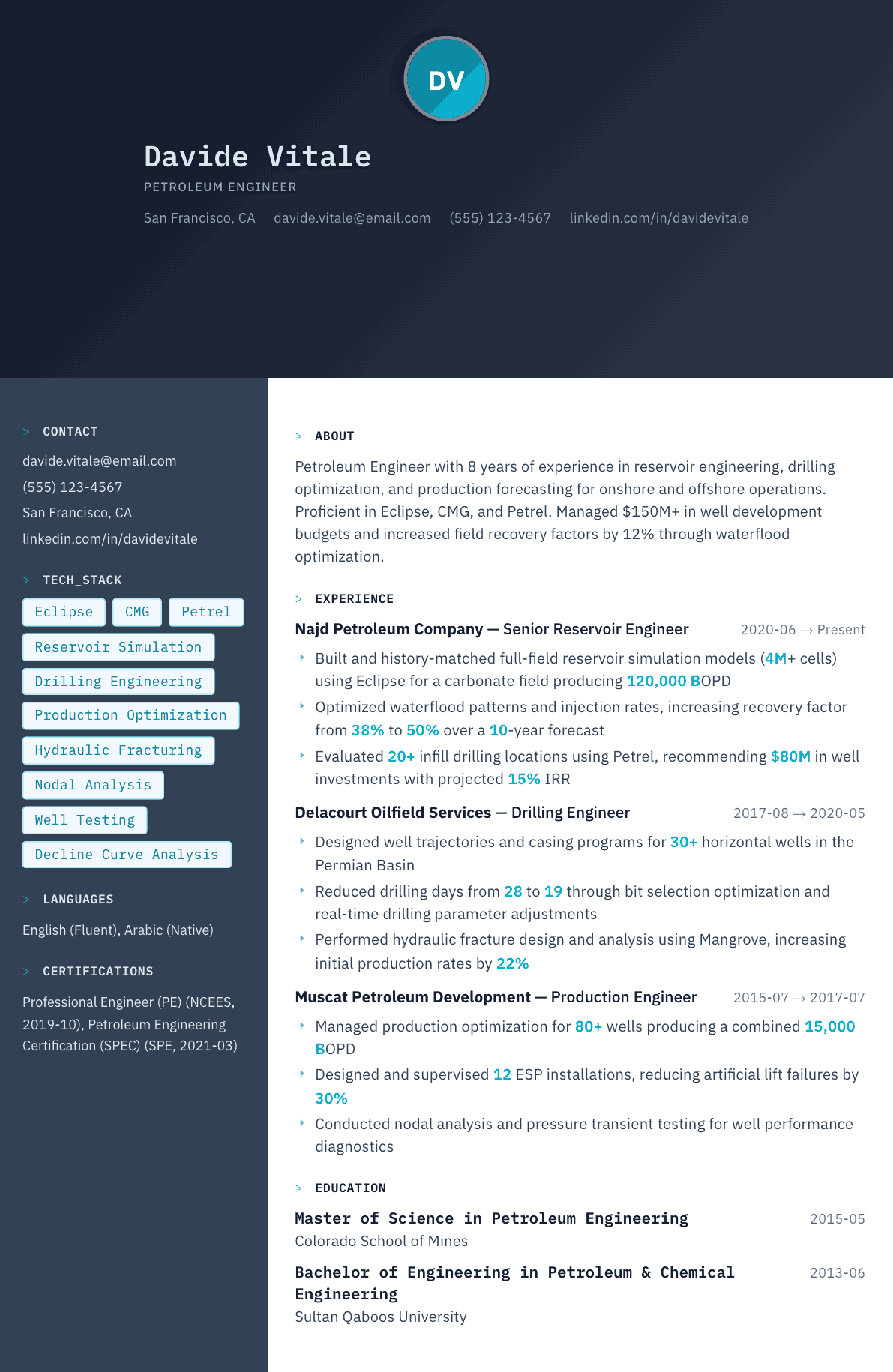
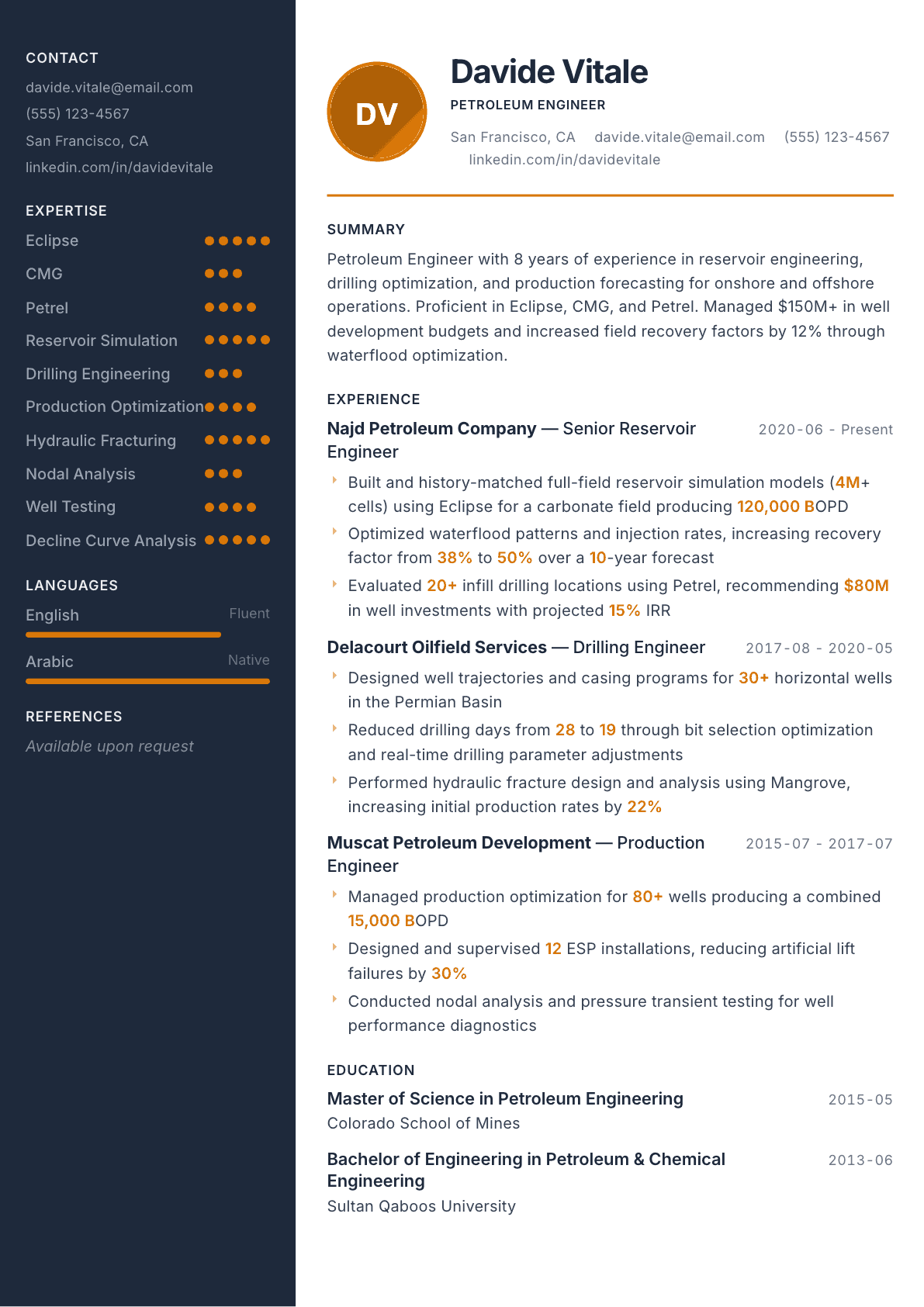
The same petroleum engineer content laid out in three CVBooster templates, so you can see what the finished document looks like before you write a word.

Example Petroleum Engineer summary
Licensed Petroleum Engineer with 8 years of experience in reservoir simulation, drilling optimization, and production engineering for onshore and offshore operations. Expert in Eclipse, CMG, and Petrel. Managed $150M+ in development budgets and increased recovery factors by 12% through waterflood optimization.
Skills to list on a Petroleum Engineer resume
- Eclipse
- CMG
- Petrel
- Reservoir Simulation
- Drilling Engineering
- Completions
- Production Optimization
- Hydraulic Fracturing
- Well Testing
- Decline Curve Analysis
- Nodal Analysis
- Artificial Lift
- Formation Evaluation
- Economic Analysis
- OFM
What actually gets this resume read
- Highlight reservoir and drilling software: Eclipse, CMG, Petrel, OFM, WellFlo, Landmark.
- Quantify production metrics: BOPD, recovery factor improvements, well costs, EUR.
- Specify discipline: reservoir, drilling, completions, production, or facilities engineering.
- Include field types and geologies: carbonate, sandstone, unconventional, deepwater, heavy oil.
- Mention certifications: PE license, SPE Certified Petroleum Engineer.
- Reference economic analysis skills: NPV, IRR, DCF, Monte Carlo simulation.
How to write a petroleum engineer resume
Petroleum engineering is four disciplines wearing one title. Reservoir engineers forecast and manage recovery. Drilling engineers plan and deliver wells. Completions and stimulation engineers decide how the rock is connected to the wellbore. Production engineers keep existing wells flowing and lift them when they stop. A hiring manager belongs to one of these groups and reads your resume looking for their own vocabulary.
The second filter is the play and the environment. Unconventional shale development, conventional carbonate waterflood, heavy oil, deepwater offshore and gas storage each demand different judgment, and a candidate who does not say which one they come from forces the reader to guess. The third filter is software, because the analysis is done in named packages and fluency in the right one shortens ramp up considerably.
This guide covers the section order petroleum employers expect, how to write well and reservoir bullets that stand up to a technical interview, summaries for a graduate through a senior engineer, and the questions engineers ask when moving between disciplines, basins or into adjacent energy work.
Format: discipline first, wells and fields as the portfolio
Use a plain single column, reverse chronological layout, one page early and two pages once you have several assets behind you. Name your discipline in the title line so the reader is not guessing between reservoir, drilling, completions and production.
Treat wells and fields as your project portfolio. Give the play or basin type, the well count, the well architecture, the depth or lateral length range, and the production rates you worked with. Those figures let another engineer size up the difficulty of your work immediately.
- Header: name, city and state, phone, email, professional registration, and offshore or international mobility if relevant.
- Order: summary, technical software and methods, experience, education, certifications and well control training.
- For each role, name the asset type: unconventional shale, conventional waterflood, offshore platform, heavy oil thermal, gas condensate.
Summary: discipline, asset, method, software
The first sentence should carry discipline, asset type and scale. A reservoir engineer running full field simulation on a mature carbonate waterflood is a very different hire from an engineer forecasting shale wells with decline curve and type curve methods, even though both are reservoir engineers.
Then the method and the tools. Simulation and history matching, decline curve and rate transient analysis, material balance, nodal analysis, well control and casing design, hydraulic fracture design, or artificial lift selection and optimization. Follow with the two or three packages you use daily rather than a list of everything installed on your machine.
Experience: the well, the decision, the barrels
Petroleum engineering bullets should end where the money is. Recovery factor, production rate, decline rate, drilling days, cost per foot or per lateral length, uptime and deferment, and failure frequency are the measures the asset team reviews, and they are the right units for your achievements. Avoid claiming credit for reservoir performance you merely observed.
Drilling bullets need the well design and the delivery. Trajectory and casing program, mud weight and pore pressure management, bit and bottom hole assembly selection, real time drilling parameter optimization, and the resulting days on well against the plan. Non productive time reduction is a strong and specific achievement when you can say what caused it and what you changed.
Completions and stimulation bullets need the design logic. Stage count and spacing, cluster design, fluid and proppant selection, diversion strategy, and the production response measured against offset wells. Saying that initial rates improved is weak; saying which design variable you changed and how the offset comparison was set up is strong.
Production and reservoir bullets need the diagnosis. Nodal analysis that found the true bottleneck, a well test interpretation that changed the completion plan, artificial lift changes with the failure frequency before and after, a waterflood pattern rebalance with the injection response, or a surveillance program that caught declining performance early. Add the economics: an authority for expenditure you prepared, an infill program you justified, or an abandonment decision you supported.
Skills: analysis methods, software, and field exposure
Separate methods from packages. Methods include material balance, decline curve and rate transient analysis, pressure transient interpretation, nodal analysis, volumetric and probabilistic reserves estimation, geomechanics and fracture modeling, and reservoir simulation with history matching.
Then the named software for simulation, geological modeling, production surveillance, well and network modeling, drilling engineering and well data management, plus any programming you use for automation and data work. Analytics is increasingly a differentiator, so say if you build your own data pipelines or dashboards for surveillance.
Field exposure deserves a line of its own. Time on the rig floor, wellsite supervision, frac supervision, workover oversight and offshore rotations show that you have seen the operations your calculations assume, which is exactly what a technical manager is trying to determine.
Certification, reserves reporting and transferable framing
Well control certification is a practical requirement for anyone with operational responsibility and should be listed with the issuing body and level. Professional registration matters for reserves certification, consulting and expert work, and is worth listing where held.
If you contribute to reserves reporting, say which classification framework you worked under and what your role was in the process, since that is treated as a specialized skill. Finally, if you are targeting geothermal, carbon storage or underground gas storage work, foreground the subsurface fundamentals that transfer directly: flow in porous media, well integrity, pressure transient analysis and injection performance.
Petroleum Engineer resume summary examples
New graduate
Petroleum engineering graduate with an internship on a shale asset team building type curves and reviewing completion designs, plus a senior project history matching a small reservoir simulation model. Trained in decline curve analysis, nodal analysis and material balance, with a well control certificate.
Five years on an asset
Production engineer on an unconventional oil asset with about 240 producing wells. Owns artificial lift selection, surveillance and workover planning, cut electrical submersible pump failure frequency by 30%, and recovered deferred production through a rod design change on 60 wells.
Senior reservoir engineer
Senior reservoir engineer with 12 years across conventional waterflood and offshore gas condensate. Leads full field simulation and history matching, delivered the depletion plan that raised forecast recovery factor by 4 points, and prepares annual reserves submissions with the third party auditor.
Work experience bullets: before and after
Before: Built reservoir simulation models for the field.
After: Built and history matched a full field model of a carbonate waterflood against 15 years of production and pressure data, then tested 5 injection patterns and recommended the case that added recoverable volume without new wells.
History match scope plus a compared scenario set shows a model that supported a decision rather than one that merely ran.
Before: Worked on drilling operations for horizontal wells.
After: Planned trajectories and casing programs for 22 horizontal wells with laterals near 10 thousand feet, and reduced average spud to total depth from 21 to 15 days by changing bit selection and revising the drilling parameter roadmap.
Well count, architecture and days against a baseline give another drilling engineer everything needed to judge the result.
Before: Helped improve production from existing wells.
After: Ran nodal analysis across 40 underperforming wells, found tubing size was limiting 12 of them, and delivered a rerun program that recovered about 900 barrels per day of deferred production.
The diagnostic method, the wells affected and the recovered volume make the improvement traceable to your analysis.
Before: Designed hydraulic fracture treatments.
After: Redesigned stage spacing and proppant loading on a six-well pad, set up an offset comparison against the prior pad, and delivered first-year cumulative production about 18% higher at similar completion cost.
A controlled comparison and cost context prevent the reader from dismissing the uplift as reservoir quality.
Before: Supported the reserves reporting process.
After: Prepared proved and probable volumes for 3 fields under the resource classification system, reconciled forecasts with the third party auditor, and documented the technical basis for each category change.
Naming the classification work and the auditor interaction demonstrates a specialized skill few applicants can claim credibly.
Hard skills
- Reservoir simulation and history matching
- Decline curve and rate transient analysis
- Material balance analysis
- Pressure transient test interpretation
- Nodal analysis and well performance modeling
- Well trajectory and casing design
- Drilling parameter and bit optimization
- Hydraulic fracture design
- Artificial lift selection and optimization
- Waterflood management and pattern balancing
- Reserves estimation and classification
- Production surveillance and data analytics
- Economics and expenditure justification
- Well integrity and abandonment planning
Soft skills
- Working with geoscience and operations
- Judgment with uncertain data
- Rig site communication
- Presenting to asset management
- Cost discipline
- Adapting across basins and rotations
Certifications worth listing
- WellSharp Well Control Certification (International Association of Drilling Contractors)
- Well Control Certification (International Well Control Forum)
- Petroleum Engineering Certification (Society of Petroleum Engineers)
- Professional Engineer, Petroleum (State licensing board, NCEES examination)
- Basic Offshore Safety Induction and Emergency Training (OPITO-approved training provider)
Mistakes that cost petroleum engineer candidates the interview
- Not naming your discipline. Reservoir, drilling, completions and production hiring managers each want their own language in the first line.
- Claiming field production gains that were driven by new wells or reservoir quality rather than by anything you did.
- Leaving out the play and basin type, which is how petroleum engineers judge whether experience transfers to their asset.
- Listing software packages without a deliverable. A model you built and matched is evidence; a package name is not.
- Omitting field and rig exposure, which many technical managers treat as the difference between an analyst and an engineer.
- Ignoring economics. Volumes without cost context are only half of the decision a petroleum engineer is paid to inform.
Petroleum Engineer resume questions
How do I switch between petroleum engineering disciplines?
Lead with the shared subsurface and well fundamentals, then be explicit about the move in your summary. A production engineer targeting reservoir work should foreground surveillance, well test interpretation and forecasting, since those are the parts of the daily job that already overlap.
What software belongs on a petroleum engineer resume?
Name the simulation, geological modeling, well and network modeling, production surveillance and drilling engineering tools you use regularly, plus any programming you apply to automation and data work. Depth in a few packages reads better than a long unqualified list.
Do petroleum engineers need a PE license?
Most operating company roles do not require one, but it matters for consulting, expert testimony, reserves certification and some regulatory filings. Passing the Fundamentals of Engineering examination early is a low cost way to keep those options available.
How do I show field experience if I have mostly worked in the office?
Include any wellsite time honestly, including rig visits, frac supervision, workover oversight and shadowing assignments, and describe what you did there. If field exposure is genuinely thin, compensate by showing that your analysis changed operational decisions.
How do I move from oil and gas into geothermal or carbon storage?
Rewrite around the transferable physics and operations: flow in porous media, pressure transient analysis, injection performance, well integrity and drilling delivery. Then adopt the target sector vocabulary for permitting, monitoring and containment so the resume does not read as a straight copy.
Related resume examples
- Chemical Engineer Resume example
- Mining Engineer Resume example
- Mechanical Engineer Resume example
- Reservoir Engineer Resume example
- Petroleum Geologist Resume example
- Materials Engineer Resume example