Boiler Technician Resume Examples: the lines they read
Write a Boiler Technician Resume That Proves Plant Readiness
By Mustafa Tarabya, founder of CVBooster · Published · Updated
Boiler technician resume example with keywords and a writing guide covering steam pressure, water treatment, burner tuning and license details.
Sample resumes for a boiler technician
The same boiler technician content laid out in three CVBooster templates, so you can see what the finished document looks like before you write a word.
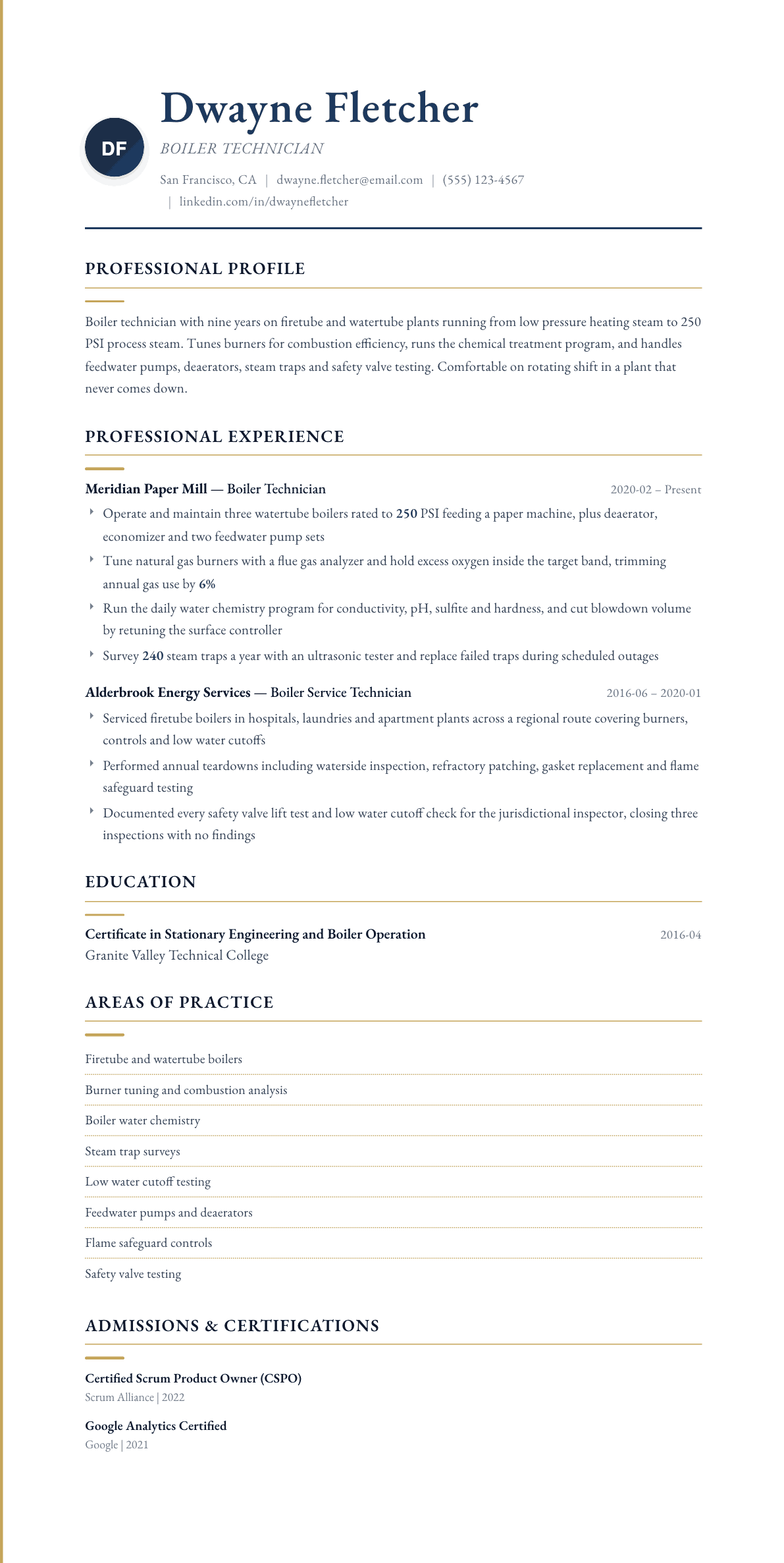
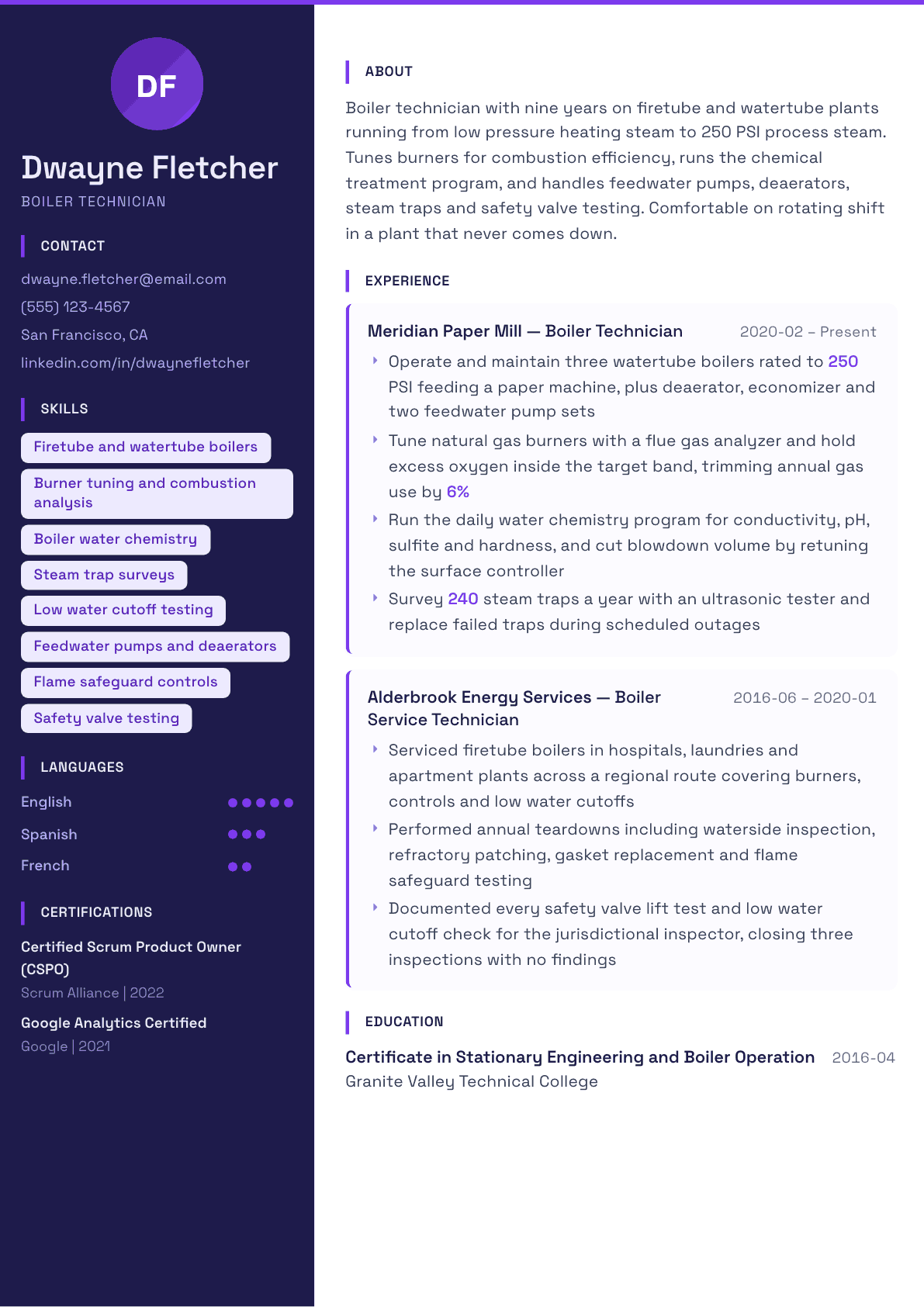
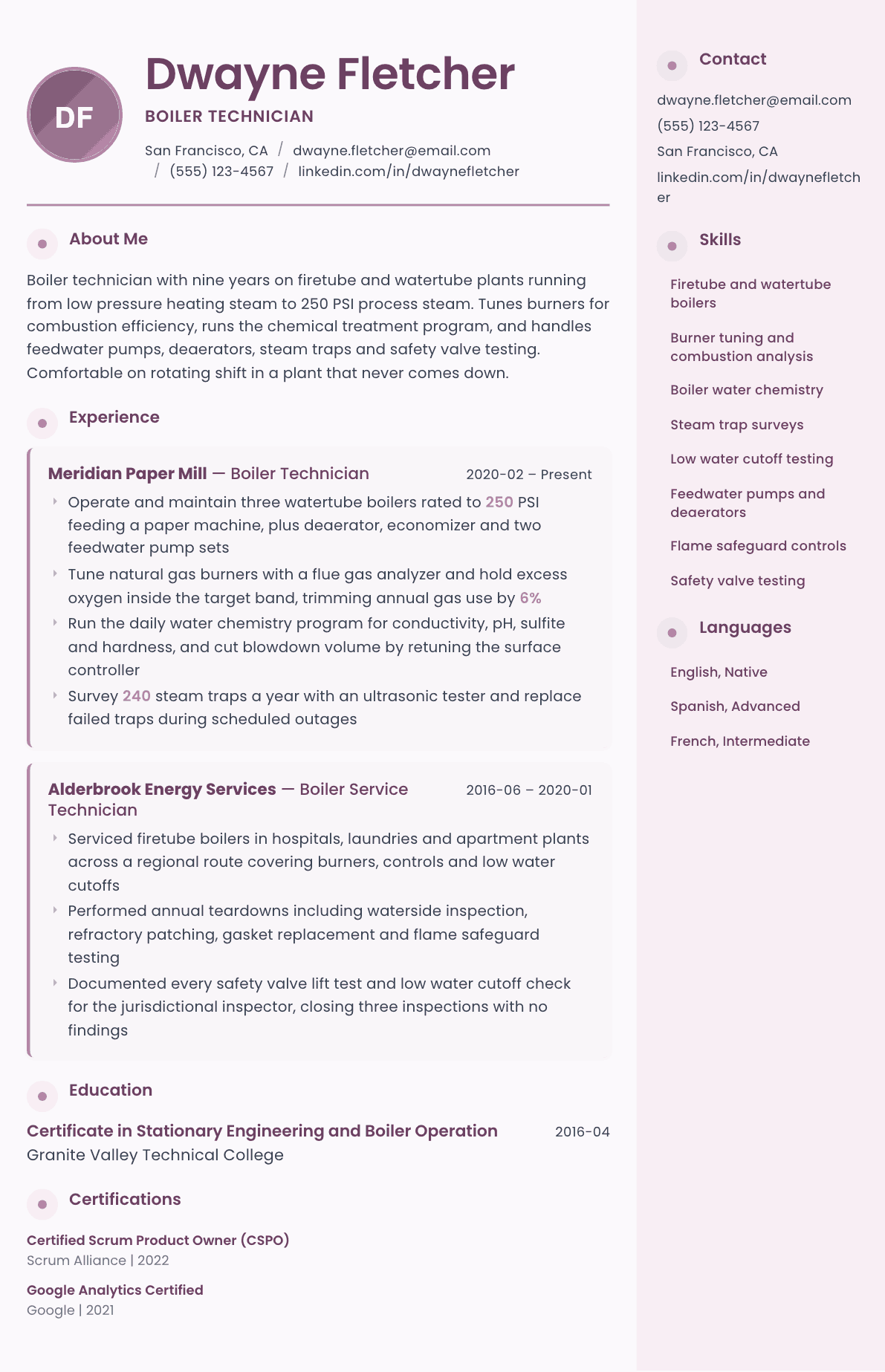
Example Boiler Technician summary
Boiler technician with nine years across firetube plants and 250 PSI watertube plants in paper and healthcare settings. Tunes burners against flue gas readings, runs the daily chemistry program for conductivity and sulfite, surveys steam traps ultrasonically, and keeps low water cutoff and safety valve records ready for the jurisdictional inspector. Holds a state operator license and works rotating shift.
Skills to list on a Boiler Technician resume
- Firetube boiler operation
- Watertube boiler operation
- Burner tuning and combustion analysis
- Flue gas analyzers
- Boiler water chemistry and treatment
- Blowdown control
- Deaerator and feedwater systems
- Steam trap survey and replacement
- Low water cutoff testing
- Flame safeguard controls
- Safety valve lift testing
- Refractory and gasket repair
- Condensate return systems
- Boiler log documentation
- Lockout tagout
- Outage planning and teardown
What actually gets this resume read
- State the boiler types and pressure ratings you have run, because a plant hires for its own equipment.
- Name your operator license class and the jurisdiction that issued it, right under your name in the header.
- Show your water treatment work, since a boiler technician who protects tubes is worth more than one who cleans them.
- Give combustion tuning results in efficiency or gas use rather than saying you adjusted burners.
- List the safety devices you test and log: low water cutoffs, flame safeguards, safety valves and pressure controls.
- Say whether you have worked rotating shift, on-call or outage schedules, because coverage decides many boiler hires.
- Add fuel types you have burned, since gas, oil and dual fuel plants ask different questions at interview.
How to write a boiler technician resume
Boiler work is hired on trust. A plant engineer is handing someone the keys to a vessel that holds enough stored energy to level a building, and the jurisdictional inspector who visits once a year will read the logs that person kept. So the boiler technician resume that gets called is the one that reads like a plant record: what was operated, at what pressure, on what fuel, with what safety devices tested and documented.
The most common failure is vagueness. A page that says operated and maintained boiler systems tells the engineer nothing about whether you have run a 250 PSI watertube unit feeding a paper machine or a low pressure heating plant in an apartment building. Those are different skills, different licenses in many jurisdictions, and different consequences when something goes wrong.
This guide works through the sections a plant engineer reads first, with summaries for a new operator, a settled boiler technician and a lead, before and after bullets drawn from combustion and water treatment work, and the questions technicians ask when they move between service routes and plant seats.
Format: license and pressure ratings before anything else
Reverse chronological, one page for under a decade. This trade is licensed in many cities and states, so your operator license class and the jurisdiction that issued it belong in the header where the screener cannot miss them. If the license is in renewal or you are eligible to sit for the next class, say that plainly rather than leaving a gap.
After the header, give a short plant profile block. Boiler types, pressure ratings, fuels burned, and the auxiliary equipment you own: deaerators, feedwater pumps, economizers, condensate return, water treatment. A plant engineer matches that block against his own equipment list before he reads a single bullet.
- Header: name, boiler operator or power engineer license class with jurisdiction, city and state, phone, email, and shift availability.
- Plant profile block: firetube or watertube, design pressure, capacity, fuel type, and whether the plant runs continuously or seasonally.
- Each job names the facility type first: paper mill, hospital, district heating, food plant, laundry, or a service route covering several sites.
- New operators put stationary engineering coursework, boiler lab hours and any assistant operator time above unrelated jobs.
Summary: pressure, fuel, shift, and the systems you own
Three lines that answer four questions. What class of boiler have you run, at what pressure, on what fuel, and can you hold a rotating shift. Plants that never come down staff for coverage as hard as they staff for skill, so a technician who has worked nights and weekend rotations should say so in the first three lines.
Name one thing you own beyond operation. Combustion tuning, water chemistry, steam trap management and controls work are the four areas where a boiler technician either adds value or simply keeps the burner lit. Pick the one you are strongest in and let the experience section prove it.
Experience: combustion, chemistry, and the safety devices you log
Start each job with the plant. Number of boilers, type, design pressure, capacity and fuel. Then write bullets around the three systems that decide whether a plant runs well: combustion, water and steam distribution. A plant engineer will read those three before he reads anything about teamwork.
Combustion bullets need instruments and outcomes. A flue gas analyzer reading, an excess oxygen target held across the firing range, a linkage or parallel positioning adjustment, and the fuel result that followed. Water bullets need the tests you run and the limits you hold: conductivity, pH, sulfite or oxygen scavenger residual, hardness, and how you set blowdown from those readings.
The safety devices are the part an inspector cares about most. Low water cutoff testing, flame safeguard checks, safety valve lift tests, pressure control settings and the logbook entries behind them. A technician who writes those into the resume is telling the engineer that the records will be ready when the inspector arrives.
- Give the boiler count, type, design pressure and fuel for each employer rather than a generic equipment sentence.
- Name the water treatment tests you run yourself and the limits you hold, not just that you treated boiler water.
- Include steam trap survey volume and method, since failed traps are where plant steam quietly disappears.
- State outage and teardown work: waterside inspection, refractory patching, tube plugging, gasket replacement, and who signed it off.
Service route work versus a plant seat
These are two different resumes built from one career. A service route wants breadth: firetube boilers across hospitals, laundries and apartment plants, burner service across several manufacturers, annual inspections, and the ability to arrive alone and diagnose without site knowledge. A plant seat wants depth: one set of boilers you know cold, shift discipline, and log quality over months.
Decide which job you are applying for before you write, then order the experience section to make that case. A route technician applying to a plant should foreground the depth moments: the long outage, the burner retrofit, the water treatment turnaround. A plant technician applying to a route should foreground the variety of manufacturers and control platforms encountered.
Skills and keywords a boiler posting filters on
The vocabulary is narrow and repeats: firetube, watertube, burner tuning, combustion analysis, excess oxygen, feedwater, deaerator, blowdown, conductivity, low water cutoff, flame safeguard, safety valve, steam trap, condensate return, lockout tagout. Use the posting words once in your skills block and once inside a bullet where the work is visible.
Controls deserve their own line. Modern plants run boiler management systems, parallel positioning burner controls and remote monitoring. If you have configured setpoints, responded to alarms from a monitoring platform or worked with a controls contractor on a burner upgrade, name the platform and the task. That single detail moves you out of the operator-only pile.
Boiler Technician resume summary examples
New boiler operator
Stationary engineering graduate with a fourth class operator license and 12 months as an assistant operator on low pressure heating boilers. Trained on burner startup, water testing, blowdown and low water cutoff checks. Seeking a boiler technician seat in a plant running rotating shift coverage.
Five years in a plant
Boiler technician with 5 years on firetube and watertube plants up to 150 PSI in food processing. Runs the daily water chemistry program, tunes dual fuel burners with a flue gas analyzer, surveys steam traps ultrasonically, and keeps low water cutoff and safety valve records ready for the annual inspection.
Lead boiler technician
Lead boiler technician with 12 years across paper and healthcare plants running 250 PSI process steam. Owns combustion tuning, treatment chemistry and outage planning, has closed multiple jurisdictional inspections without a finding, and trains operators on startup, cutout testing and log discipline across three shifts.
Work experience bullets: before and after
Before: Operated and maintained industrial boilers.
After: Operated three watertube boilers rated to 250 PSI feeding a paper machine, along with the deaerator, economizer and two feedwater pump sets, across a 12-hour rotating shift.
Type, pressure, load and auxiliaries let a plant engineer see whether the experience matches his own equipment.
Before: Adjusted burners for better efficiency.
After: Tuned natural gas burners across the full firing range with a flue gas analyzer, held excess oxygen inside the target band, and cut annual gas use by 6% on the largest unit.
The instrument, the control target and the fuel result turn an adjustment claim into measurable combustion work.
Before: Performed water treatment on boilers.
After: Ran daily conductivity, pH, sulfite and hardness testing, set surface blowdown from the results, and reduced blowdown volume after retuning the controller without losing cycles of concentration.
Naming the tests and the control decision shows chemistry ownership rather than sample collection.
Before: Checked boiler safety devices regularly.
After: Tested low water cutoffs weekly by evaporation, verified flame safeguard response times at each startup, and logged every safety valve lift test for the jurisdictional inspector.
Specific methods and frequencies are what an inspector audits, so they carry far more weight than regularly.
Before: Helped with the annual boiler outage.
After: Led a 9-day outage on a firetube unit covering waterside inspection, refractory patching, gasket replacement, tube cleaning and flame safeguard testing, and returned the boiler to service on schedule.
Duration, scope and the on-time return show outage ownership instead of attendance.
Hard skills
- Firetube boiler operation and service
- Watertube boiler operation and service
- Burner tuning and combustion analysis
- Flue gas analyzer use
- Boiler water chemistry and treatment programs
- Blowdown control and cycles of concentration
- Deaerator and feedwater systems
- Steam trap survey and replacement
- Low water cutoff testing
- Flame safeguard and burner management controls
- Safety valve lift testing
- Refractory patching and tube work
- Condensate return systems
- Lockout tagout and confined space entry
Soft skills
- Log discipline that holds up under an inspector's review
- Calm decision making during a low water or flame failure event
- Handing over a plant cleanly at shift change
- Working alone at night without cutting a step
- Coaching new operators on why a test exists, not just how
Certifications worth listing
- Fourth Class Power Engineer (National Institute for the Uniform Licensing of Power Engineers)
- National Board Commissioned Inspector (National Board of Boiler and Pressure Vessel Inspectors)
- OSHA 30-Hour General Industry (OSHA Training Institute)
Mistakes that cost boiler technician candidates the interview
- Omitting the operator license class and jurisdiction, which many boiler postings screen on before a human reads the page.
- Writing boiler systems without stating firetube or watertube, the design pressure and the fuel burned.
- Treating water treatment as a footnote when tube failures and carryover are what shorten a plant engineer's year.
- Claiming efficiency gains with no analyzer reading, no target band and no fuel figure behind them.
- Leaving out shift availability and on-call history on a page applying to a plant that runs continuously.
- Describing outage work as assisted rather than naming the scope, the duration and what was signed off at the end.
Boiler Technician resume questions
Does my boiler operator license need to be from the state I am applying in?
Not always, but you should list the class and the issuing jurisdiction so the employer can check reciprocity. Many cities license separately from the state. If you would need to sit an exam locally, say you are eligible and give the class you already hold rather than staying silent.
How do I show combustion tuning skill without exact efficiency data?
Describe the method instead. Name the analyzer, the excess oxygen and carbon monoxide targets you worked to, whether the burner used linkage or parallel positioning, and what changed in stack temperature or firing stability afterward. A plant engineer recognizes the process even when the numbers were never published.
Should a service route technician apply for a plant seat?
Yes, and the resume should be reordered for it. Foreground depth over breadth: the longest outage you led, a burner retrofit you saw through, a water treatment program you rebuilt. Then state clearly that you want a single plant and can hold rotating shift, because coverage is the plant engineer's first worry.
What if I have run only low pressure heating boilers?
Say so plainly and build the page around what transfers: burner service, controls, water testing, cutout testing and log discipline all carry upward. Then name any high pressure exposure you have had, even supervised, and note whether you are studying for a higher license class right now.
How much detail belongs on steam traps and distribution?
More than most candidates give. State how many traps you survey, the method you use such as ultrasonic or temperature comparison, the failure rate you find, and what you do with the results. Distribution losses are invisible on a bill, so a technician who manages them is worth naming that work in detail.
Related resume examples
- HVAC Technician Resume example
- Maintenance Technician Resume example
- Power Plant Operator Resume example
- Industrial Maintenance Technician Resume example
- Pool Technician Resume example
- HVAC Service Technician Resume example