Criminal Justice Graduate Resume Examples: free score
Write a Criminal Justice Graduate Resume With No Sworn Time Yet
By Mustafa Tarabya, founder of CVBooster · Published · Updated
Criminal justice graduate resume example, keyword list and writing guide for internships, ride alongs, coursework and first agency applications.
Sample resumes for a criminal justice graduate
The same criminal justice graduate content laid out in three CVBooster templates, so you can see what the finished document looks like before you write a word.
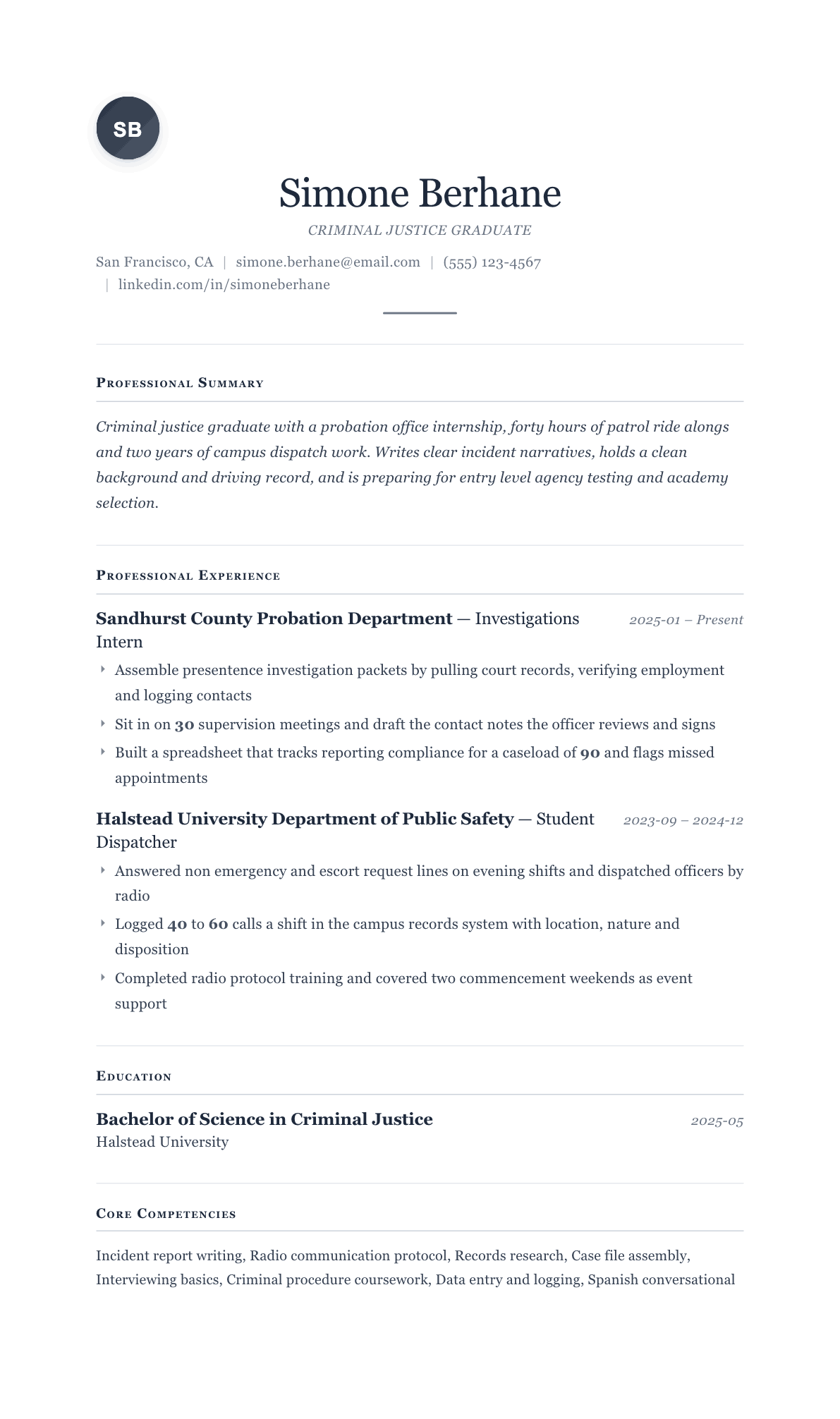
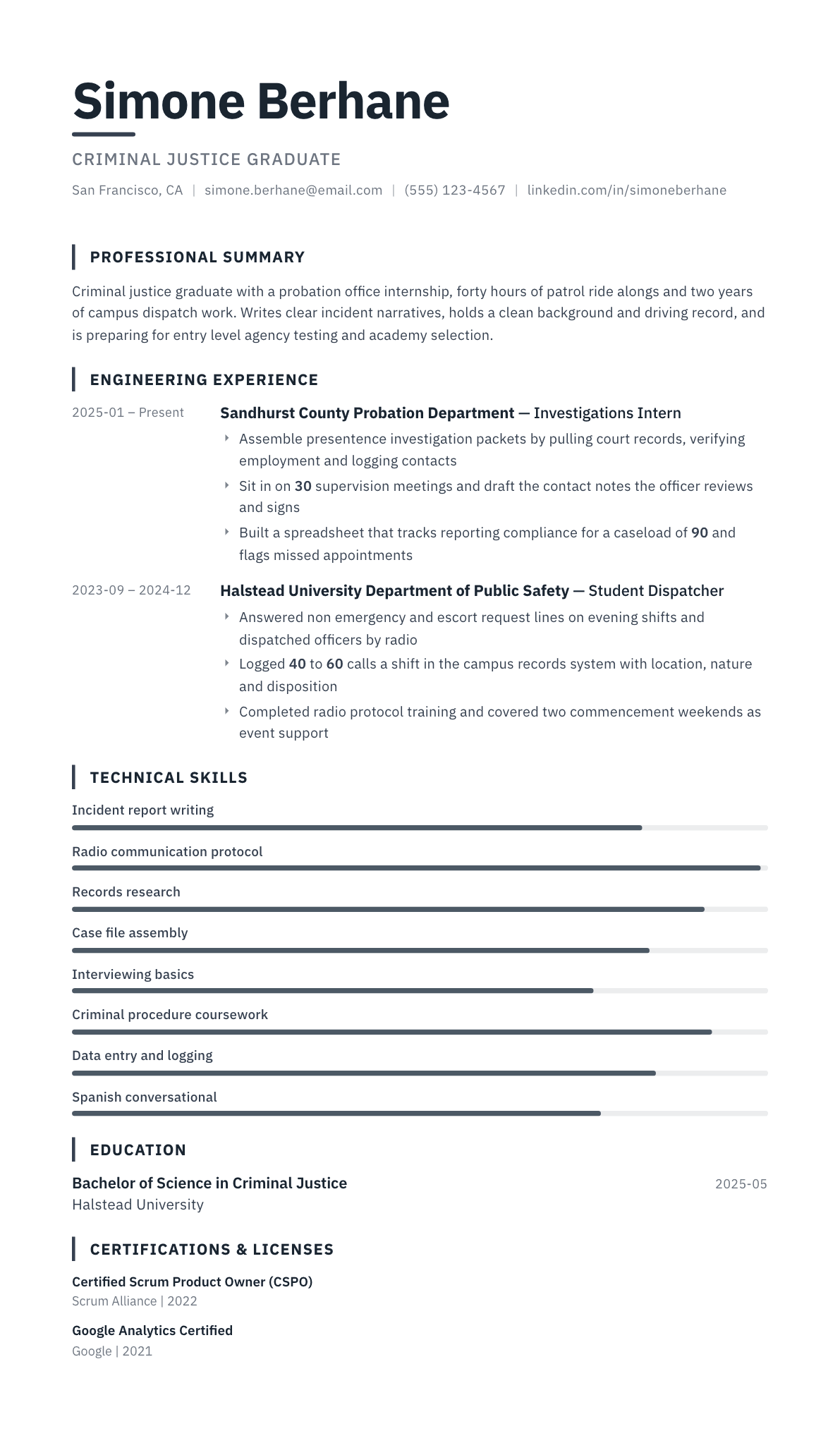
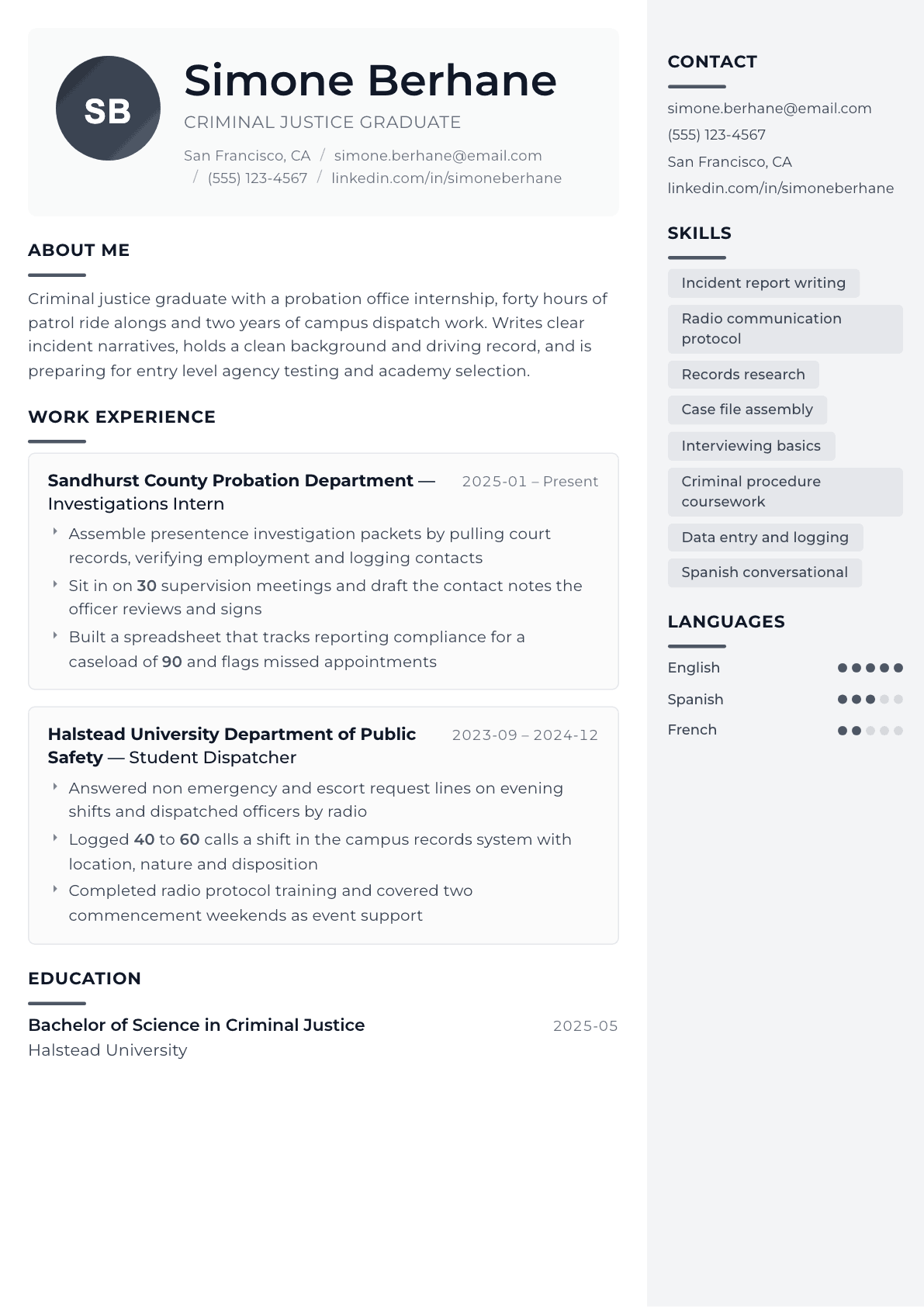
Example Criminal Justice Graduate summary
Criminal justice graduate with a probation office internship, forty hours of patrol ride alongs and sixteen months on a campus dispatch console. Writes incident narratives that supervisors sign without edits, holds a clean background and driving record, and has passed the written and physical agility stages of two agency processes. Looking for an entry level officer, dispatcher or investigative assistant role with a clear academy path.
Skills to list on a Criminal Justice Graduate resume
- Incident and narrative report writing
- Radio communication protocol
- Records and database research
- Case file assembly
- Interviewing fundamentals
- Criminal law and procedure
- Evidence handling basics
- De-escalation training
- Community outreach
- Microsoft Excel logging
- Physical fitness standards
- Court process familiarity
- Second language ability
What actually gets this resume read
- Put internships, ride alongs and reserve time in the experience section, not buried under education.
- Give hours and counts for everything unpaid, because an agency reads volume the same way it reads a job.
- Say early that your background, driving record and physical fitness will clear, since those screen first.
- Name the tests you have passed or booked, whether written exam, physical agility or the state academy.
- List report writing as a skill and prove it with a narrative you actually wrote for a supervisor to sign.
- Add language ability, military service or community work, all three of which agencies weigh in selection.
How to write a criminal justice graduate resume
A recruiter processing entry level applications for an agency has a stack of criminal justice degrees in front of her and very little to separate them. Every applicant studied criminal law and procedure. Every applicant wants to serve. What she is looking for is the handful who have already been near the work and can write about it clearly.
The degree gets you into the pile. Ride alongs, internships, dispatch shifts, reserve time, corrections work, military service, a second language and a background that will clear are what get you out of it. And the writing itself is being assessed the whole time, because report quality is the one skill an agency cannot train around.
This guide covers how to build a criminal justice graduate resume with no sworn time on it, what to put in the experience section, three summaries depending on how much exposure you have, before and after bullets, and the questions graduates ask when they apply to their first agency.
Format: one page, experience above education, screening facts visible
One page, and it stays one page for a while. The instinct for a new graduate is to lead with the degree, but experience comes first even when the experience is unpaid. An internship, a campus dispatch job or forty hours of ride alongs are all closer to the work than a transcript, and a recruiter reads the top third hardest.
Put the screening facts where they cannot be missed, because entry level hiring is an elimination process before it is a selection process. Age eligibility, a valid driver license with a clean record, a background you are confident will clear and your fitness standing all decide whether the rest of the page gets a second look.
- Eligibility line under contact details: driver license status and record, background confidence, and any test stages already passed.
- Experience section first, mixing paid work, internships, reserve or volunteer time, each with hours or call counts.
- Education block: degree, major and any concentration, with relevant coursework only when it is genuinely specific.
- Training block: academy modules, first aid, de-escalation, incident command courses and language ability.
The experience section when nothing on it was a real job
Unpaid exposure counts if you write it the way paid work is written. Give the hours, the volume, the setting and what you personally produced. Forty hours of patrol ride alongs is a fact. Sitting in on thirty supervision meetings and drafting the contact notes an officer reviewed and signed is a contribution, and the second version reads as work.
Do not discard the jobs that look unrelated. Retail, hospitality, warehouse and care work all build the traits agencies screen for: turning up on time, handling conflict in front of an audience, working nights, following a procedure when nobody is watching. Rewrite them for those traits instead of listing till duties, and keep them short.
Proving you can write, because report quality decides careers
Report writing is the skill most likely to fail a probationary officer and the one recruiters can assess directly from your resume. Every sentence you write is a sample. Keep bullets in plain declarative order, put the fact before the adjective, and never use a word you would not use in a narrative a prosecutor will read.
Then evidence it. If you have written incident narratives, contact notes, dispatch logs or case summaries that a supervisor reviewed, say so with the volume. A graduate who can point to hundreds of logged entries in a records system has proof that a classroom essay cannot provide.
Testing, fitness and the process itself
Agency hiring runs through stages, and a candidate who has already cleared some of them is cheaper and faster to onboard. Put on the page which stages you have passed and with which agency: written examination, physical agility, oral board, polygraph, psychological or medical. If a process is in progress, say where it stands rather than leaving it out.
Fitness deserves a plain line. Give the standard you meet or the times you run, not a claim about being physically fit. Recruiters have watched too many candidates fail the agility test to accept an adjective, and a specific number also tells them you have actually attempted it.
Skills, keywords and the paths beyond patrol
Entry level postings reuse a small vocabulary: report writing, radio communication, de-escalation, community policing, records research, evidence handling, court process, physical agility, background investigation. Mirror the terms you can honestly claim and let each appear once inside experience where it carries a count.
Widen the target list while you are at it. A criminal justice degree opens dispatch, corrections, probation, court clerking, investigative assistant, campus safety, loss prevention, insurance claims and regulatory compliance work, and several of those become the strongest path back into sworn service later. Tailor the summary to the specific role rather than sending one page everywhere.
Criminal Justice Graduate resume summary examples
Graduate with limited exposure
Criminal justice graduate with coursework in criminal procedure, evidence and corrections, plus two years of evening retail work covering closing duties and conflict situations. Completed 24 hours of patrol ride alongs in 2024, holds a clean driving record, and is booked for a written examination.
Graduate with internship and dispatch time
Criminal justice graduate with a probation office internship, forty hours of patrol ride alongs and sixteen months on a campus dispatch console logging 40 to 60 calls a shift. Writes incident narratives supervisors sign without edits and has cleared written and physical agility stages with two agencies.
Graduate with corrections or reserve time
Criminal justice graduate with two years as a correctional officer and current reserve deputy status. Has completed a state certified academy, works housing unit posts and transport details, writes disciplinary and incident reports daily, and holds current defensive tactics and first aid certification.
Work experience bullets: before and after
Before: Completed an internship at a probation department.
After: Assembled presentence investigation packets by pulling court records, verifying employment and logging every contact, and drafted the notes for 30 supervision meetings for officer review.
It names what you produced rather than where you sat, which is what turns an internship into experience.
Before: Worked as a student dispatcher on campus.
After: Logged 40 to 60 calls a shift in the campus records system with location, nature and disposition, dispatching officers by radio on evening coverage.
Call volume and the record detail prove documentation habits an agency can test on day one.
Before: Went on ride alongs with local police officers.
After: Completed 40 hours of patrol ride alongs across day and night shifts, observing traffic stops, domestic calls and report writing at the end of each shift.
Hours and shift spread show real exposure instead of a single afternoon in a patrol car.
Before: Physically fit and ready for the academy.
After: Meet the state physical agility standard and passed the agility stage with two agencies in 2024, training five days a week on running, load carry and obstacle work.
A passed test beats a self assessment that recruiters have learned to discount entirely.
Before: Worked part time in retail while studying.
After: Closed a retail store four nights a week alone, handling cash reconciliation, refusals and two aggressive customer incidents that were documented for the store manager.
Reframed for conflict handling and documentation, unrelated work starts arguing for the same traits.
Hard skills
- Incident and narrative report writing
- Radio communication protocol
- Records and database research
- Case file assembly
- Interviewing fundamentals
- Criminal law and procedure
- Evidence handling basics
- De-escalation technique
- Court process and testimony preparation
- Spreadsheet tracking and logging
- Physical agility standards
- Second language ability
Soft skills
- Staying steady the first time somebody shouts at you
- Writing what happened without adding what you assumed
- Turning up for an unpaid shift the way you would a paid one
- Taking correction from a supervisor without defending yourself
- Treating people the same at the end of a night shift as the start
Certifications worth listing
- Incident Command System IS-100 (Federal Emergency Management Agency)
- National Incident Management System IS-700 (Federal Emergency Management Agency)
- Adult First Aid, CPR and AED (American Red Cross)
Mistakes that cost criminal justice graduate candidates the interview
- Putting education first and pushing internships, ride alongs and dispatch work below it.
- Describing unpaid exposure without hours, call counts or anything you personally produced.
- Claiming physical fitness as an adjective instead of naming a standard met or a stage passed.
- Deleting retail, care and warehouse jobs that actually evidence the traits agencies screen for.
- Hiding the eligibility facts, so a recruiter has to guess about the license and the background.
- Sending one identical page to police, corrections, probation and dispatch openings.
Criminal Justice Graduate resume questions
Should my degree go at the top of the resume?
Only if you have almost nothing else. In most cases the experience section belongs first, even when it holds an internship and unpaid ride alongs, because proximity to the work separates candidates whose degrees all look identical on paper.
Do ride alongs count as experience?
They count as exposure, and they belong on the page with hours and shift types attached. Write what you observed and any documentation you saw produced, then let paid work and internships carry the weight of showing you can hold a schedule and a responsibility.
What jobs can I get with a criminal justice degree before an academy?
Dispatch, corrections, probation support, court clerking, campus safety, loss prevention, investigative assistant, insurance claims and compliance roles all take graduates. Several of them build the records, interviewing and report skills that make a later agency application considerably stronger.
How do I show that my background will clear?
Be direct and factual: a clean driving record, no disqualifying history, and any stages you have already passed with a named agency. Do not overexplain. A short honest line reassures a recruiter, while a long defensive paragraph creates the doubt you were trying to remove.
Does military service help on a criminal justice resume?
Considerably, particularly for the discipline, the security clearance if you hold one, and any police, security or investigative duties you performed. Translate the specialty and the duties into civilian terms so a recruiter without military background can read the value straight off the page.
Related resume examples
- Security Guard Resume example
- Paralegal Resume example
- Police Officer Resume example
- Correctional Officer Resume example
- Military Police Resume example
- State Trooper Resume example