Sheriff Deputy Resume Examples: the lines they read
Write a Sheriff Deputy Resume for County Hiring Panels
By Mustafa Tarabya, founder of CVBooster · Published · Updated
Sheriff deputy resume examples covering patrol, detention, civil process and court security, with the keywords county background panels check.
Sample resumes for a sheriff deputy
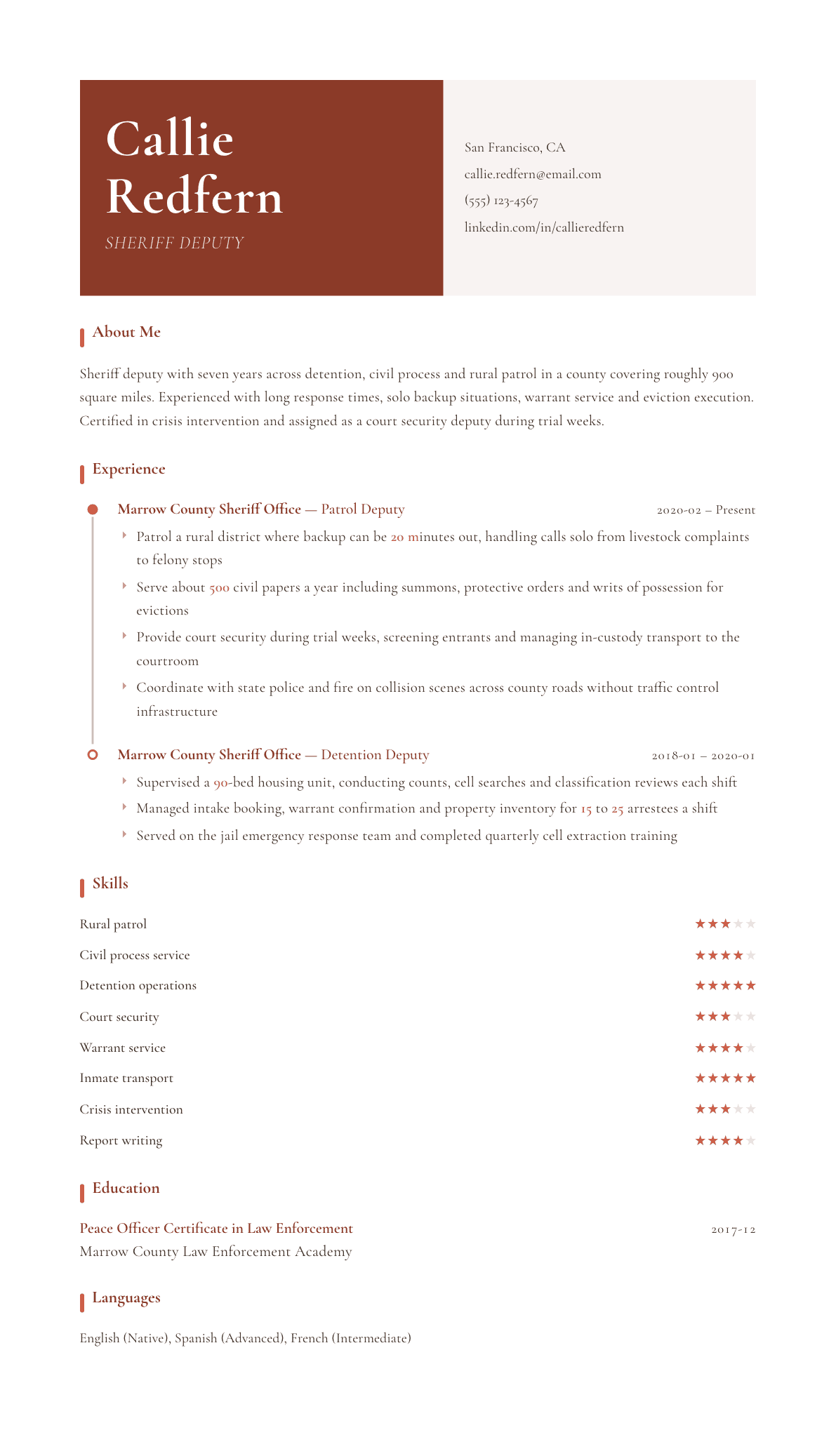
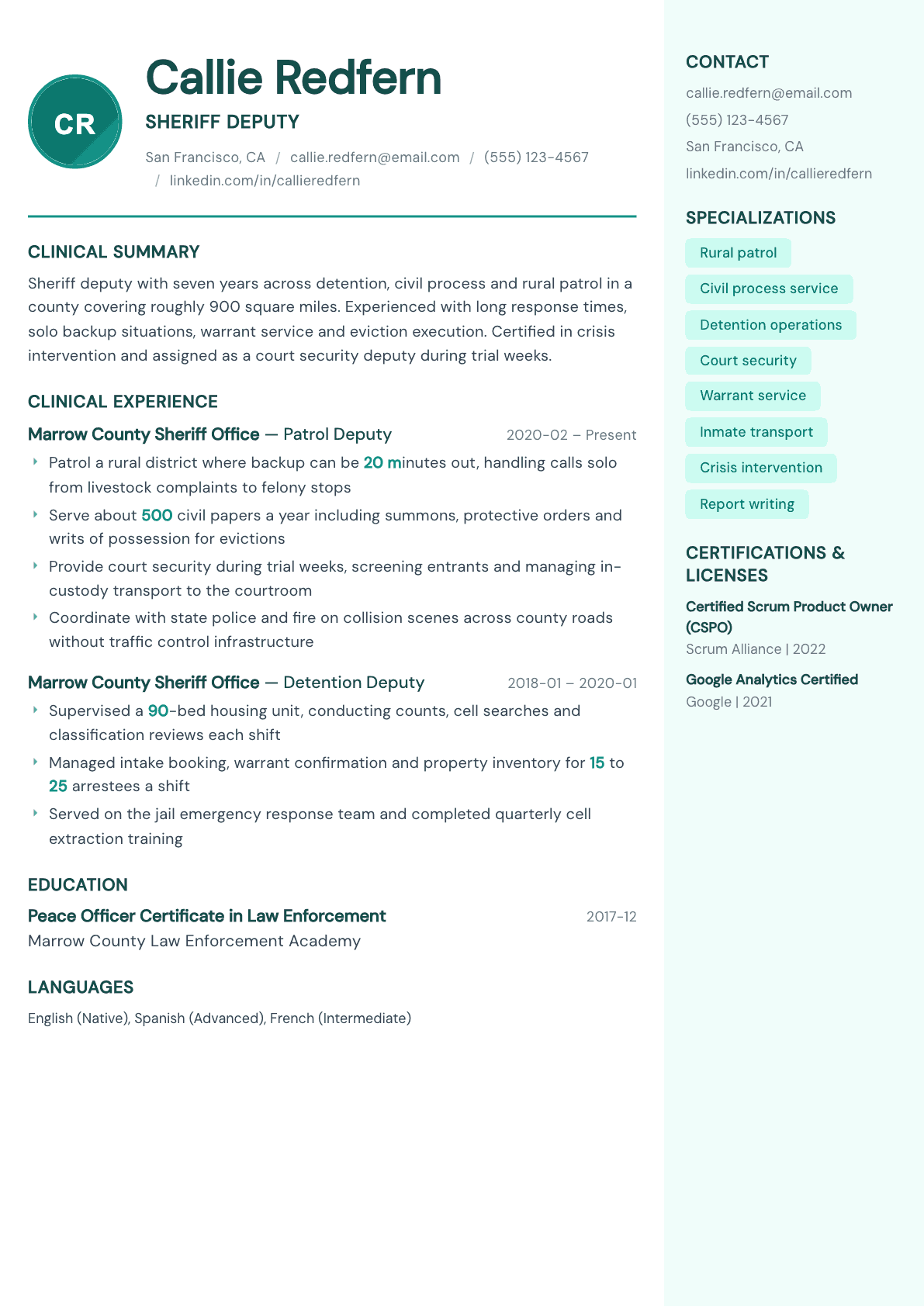
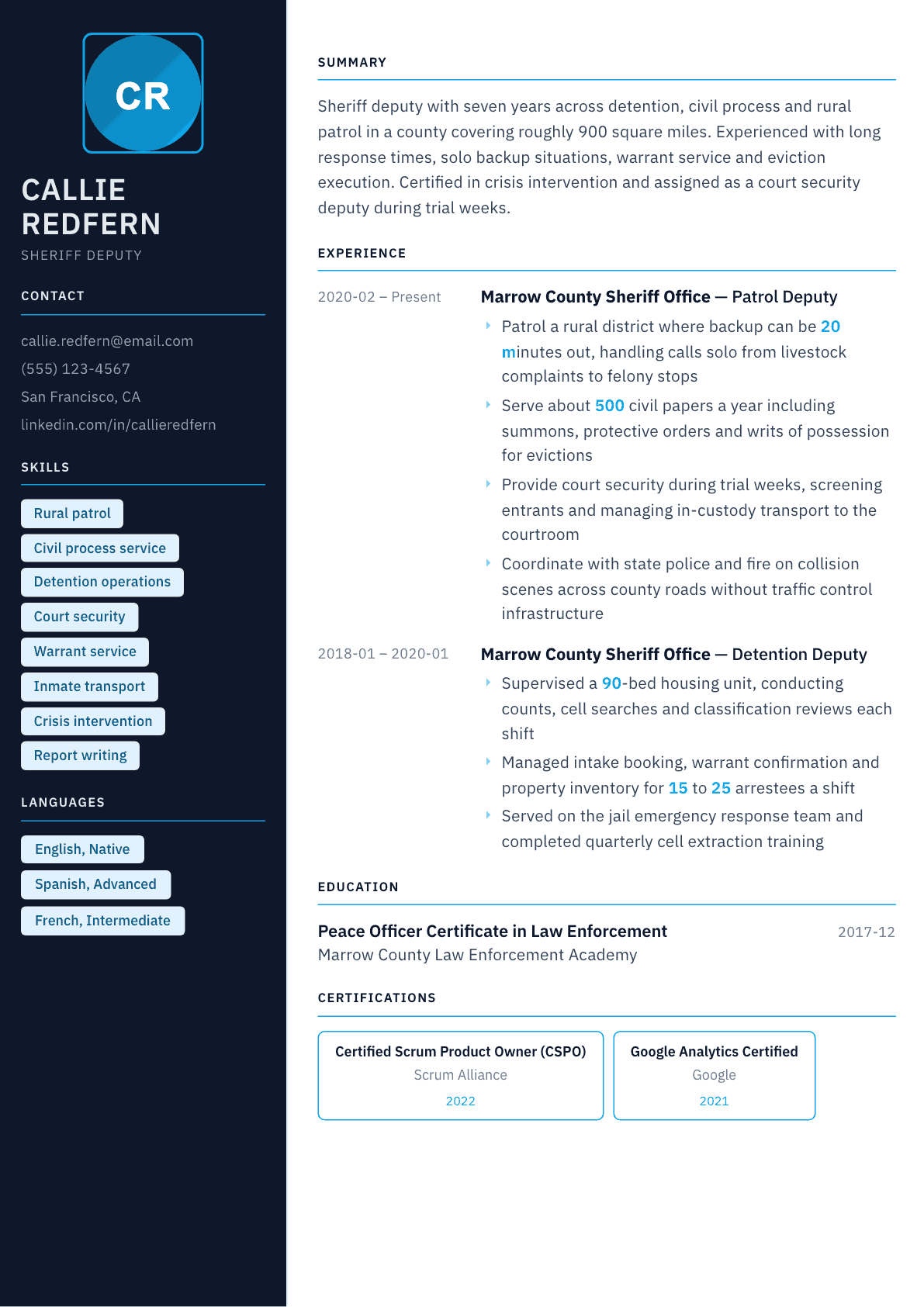
The same sheriff deputy content laid out in three CVBooster templates, so you can see what the finished document looks like before you write a word.
Example Sheriff Deputy summary
Sheriff deputy with seven years across detention, civil process and rural patrol in a county of roughly 900 square miles, where backup often runs twenty minutes out. Serves about 500 civil papers a year, covers court security during trial weeks, and holds crisis intervention certification alongside jail emergency response team experience. Seeking a patrol corporal position.
Skills to list on a Sheriff Deputy resume
- Rural patrol operations
- Civil process service
- Warrant service
- Eviction and writ execution
- Detention and housing unit supervision
- Inmate classification
- Court security screening
- Inmate transport
- Crisis intervention
- Report writing
- Evidence handling
- Collision scene management
- Mutual aid coordination
- Defensive tactics
What actually gets this resume read
- Split your resume by function, because a sheriff office hires for patrol, detention, civil process and court security.
- Describe the geography you patrolled, since a rural county with long backup times is a different job entirely.
- Count the civil papers you served a year and name the types, from summons and subpoenas to writs of possession.
- Include detention experience in full, because most county agencies start deputies in the jail before patrol.
- Name your peace officer certification, the academy and any state basic corrections certificate you also hold.
- Show transport work, including distance, restraint policy and the medical or mental health holds you have moved.
How to write a sheriff deputy resume
A sheriff office is four agencies wearing one uniform. Patrol covers a county rather than a city grid, detention runs a jail around the clock, civil process serves the courts, and court security staffs the courthouse during trial weeks. A sheriff deputy resume that does not say which of those you have done, and how much, forces a hiring panel to guess, and panels do not guess in your favor.
The other thing a county panel reads for is independence. Rural districts mean long response times, single-unit calls and decisions made without a supervisor two blocks away. Detention means standing alone in a housing unit with a count to run. Both reward the candidate who can show sound decisions on paper, in reports a prosecutor and a county attorney can rely on.
This guide lays out how to organize a deputy resume by function rather than by title, what to quantify in each function, three summaries for a new deputy, an experienced deputy and a senior deputy or corporal candidate, before and after bullets, and the questions deputies ask when they move between counties or into municipal policing.
Format: organize by function, not just by job title
Most deputies hold one employer and several assignments, so a strict job-by-job layout hides the range. Keep the agency as the heading, then break the entry into assignment blocks: detention, patrol, civil process, court security and transport, each with its own dates and duties.
Put a certification line above all of it: your peace officer certification, any basic corrections certificate, firearms qualification currency and driver license class. County civil service screening checks those fields before a human reads a bullet.
- Certification line: peace officer certificate, corrections certificate, academy, qualification currency.
- Assignment blocks with dates, so patrol time and jail time are both visible and countable.
- Coverage detail for patrol: district size, population, typical backup distance and shift.
- Housing unit detail for detention: bed count, classification level and shift responsibilities.
Summary: county, assignments held, volume in each
Three lines that name years sworn, the assignments you have held, the county environment and a volume figure for each function. Papers served per year, calls handled, beds supervised and transports completed are the numbers a county panel compares between applicants.
End with what you are known for. Field training, crisis intervention response, court security screening, warrant service or emergency response team membership are all specialties a small agency will hire specifically to fill.
Patrol: rural coverage and decisions made alone
Describe the district properly: square miles, population, road conditions, and how far backup usually is. That context is the difference between a call handled with three units on scene and a call handled by one deputy for twenty minutes, and county panels understand it immediately.
Then give call volume and call types, the collision scenes you have managed without traffic control infrastructure, the agencies you coordinate with such as state police, fire and game wardens, and the reports that followed. Independence is the trait being assessed, so write bullets where independence is visible.
Detention, civil process, court security and transport
Detention should carry bed counts, counts and searches performed, classification interviews, intake and release volume and any emergency response team role. Most county agencies start deputies in the jail, and a panel reads jail experience as proof you can hold a standard under pressure with no radio traffic to hide behind.
Civil process needs paper volume and types: summons, subpoenas, protective orders, garnishments and writs of possession. Evictions are the hardest of them, so say if you execute writs and how you handle contested service.
Court security and transport round it out. Screening volume, in-custody movement through a courthouse, restraint policy, and long-distance transports including medical and mental health holds are all real duties that a sheriff office must staff every week.
- Papers served per year with the types broken out, including writs and protective orders.
- Housing unit bed count, counts run per shift and classification reviews completed.
- Courthouse screening duties and in-custody movement between holding and courtroom.
- Transports completed, distances covered and the restraint and medical protocols followed.
Training and the keywords county postings use
List training with hours and the delivering academy: crisis intervention, defensive tactics, cell extraction, emergency vehicle operations, first aid, and any instructor certification. Small agencies value instructors heavily because they cannot afford to send everyone out for a course.
County postings repeat a recognizable vocabulary: civil process, writ of possession, warrant service, inmate classification, housing unit supervision, court security screening, prisoner transport, rural patrol, mutual aid and report writing. Mirror those phrases where they are true and attach each to the assignment block that proves it.
Sheriff Deputy resume summary examples
New deputy in detention
Deputy in a first two years assigned to detention, supervising a 90-bed housing unit and processing 15 to 25 intakes a shift. Certified through the county academy, trained in cell extraction and defensive tactics, and preparing to test for a patrol assignment.
Seven years, patrol and civil process
Sheriff deputy with seven years across detention, civil process and rural patrol in a county of roughly 900 square miles. Serves about 500 civil papers a year, covers court security during trial weeks, and handles calls solo where backup can be twenty minutes out.
Senior deputy and corporal candidate
Senior deputy with thirteen years sworn, serving as shift lead on nights, field training deputy for six recruits and coordinator of the civil process rotation. Holds crisis intervention certification, instructs defensive tactics, and represents the office on the county emergency response team.
Work experience bullets: before and after
Before: Patrolled the county and answered calls.
After: Patrolled a rural district where backup can be 20 minutes out, handling calls solo from livestock complaints and welfare checks to felony traffic stops.
Backup distance and the call range show the independence a county panel is specifically testing for.
Before: Served court documents.
After: Served about 500 civil papers a year including summons, protective orders and writs of possession, documenting attempts and contested service for the court file.
Volume, document types and the attempt record turn a duty into evidence you can carry the civil docket.
Before: Worked in the county jail.
After: Supervised a 90-bed housing unit, ran counts and cell searches each shift and completed classification interviews that determined housing assignments.
Bed count and the named tasks show the scale and the judgment involved rather than a shift worked.
Before: Provided security at the courthouse.
After: Staffed courthouse screening during trial weeks, moved in-custody defendants between holding and the courtroom and applied restraint policy under judicial direction.
The screening, movement and restraint elements describe the actual court security assignment a panel needs filled.
Before: Transported inmates as needed.
After: Completed long-distance transports including medical appointments and mental health holds, following restraint, meal and documentation protocols on each trip.
Naming the trip types and the protocols shows a deputy who treats transport as a controlled process.
Hard skills
- Rural patrol operations
- Civil process service
- Writ of possession and eviction execution
- Warrant service
- Housing unit supervision
- Inmate classification and intake
- Court security screening
- Prisoner transport
- Collision scene management
- Crisis intervention
- Report writing and case documentation
- Evidence handling and chain of custody
Soft skills
- Independent decision making
- De-escalation in confined spaces
- Consistency in applying rules
- Composure with long response times
- Courtesy at the courthouse counter
- Coordination with outside agencies
Certifications worth listing
- Certified Jail Officer (CJO) (American Jail Association)
- Crisis Intervention Team (CIT) Training (CIT International)
- Standardized Field Sobriety Testing (SFST) (National Highway Traffic Safety Administration)
- Emergency Medical Responder (National Registry of Emergency Medical Technicians)
- ICS-100 Introduction to the Incident Command System (Federal Emergency Management Agency)
Mistakes that cost sheriff deputy candidates the interview
- Merging every assignment into one job entry so detention, patrol and civil process become invisible.
- Leaving out the civil process volume when serving the court docket is a core function of the office.
- Treating jail time as a stepping stone worth one line rather than the supervision experience a panel values.
- Failing to describe the county environment, which is what makes rural deputy work different from city patrol.
- Omitting the corrections certificate or peace officer certificate that county screening checks first.
- Listing transports and court security as extra duties when they are staffed positions with real requirements.
Sheriff Deputy resume questions
How is a sheriff deputy resume different from a municipal police resume?
A county resume has to cover more functions. Detention, civil process, court security and transport are all core duties in a sheriff office, so the page needs assignment blocks with volume in each rather than a single patrol narrative.
Does jail experience help when applying for a patrol position?
Yes. Housing unit supervision, classification interviews and daily de-escalation with no backup nearby are exactly the judgment skills patrol supervisors want, so give detention its own block with bed counts and duties rather than a single line.
How do I show civil process work on a resume?
State papers served per year, break out the types including summons, protective orders, garnishments and writs, and describe how you document attempts and handle contested or hostile service. Courts depend on that record being clean.
What if my county assigns me to several roles in the same week?
Write one agency heading and then list functions rather than dates, giving each function its own volume figures. Panels understand rotating assignments in small offices, but they still need to see how much of each you have carried.
How do I apply to a larger agency after working a rural county?
Lead with independence and volume: solo calls handled, decisions made before backup arrived, reports written and court appearances made. Then confirm your certification status and reciprocity, since larger agencies screen on that before comparing experience.
Related resume examples
- Security Guard Resume example
- Private Investigator Resume example
- Police Officer Resume example
- Correctional Officer Resume example
- Police Sergeant Resume example
- State Trooper Resume example