Security Supervisor Resume Examples: what gets the call
Write a Security Supervisor Resume That Shows You Hold a Shift
By Mustafa Tarabya, founder of CVBooster · Published · Updated
Security supervisor resume example and guide covering shift scheduling, post order enforcement, officer coaching and client account reporting.
Sample resumes for a security supervisor
The same security supervisor content laid out in three CVBooster templates, so you can see what the finished document looks like before you write a word.
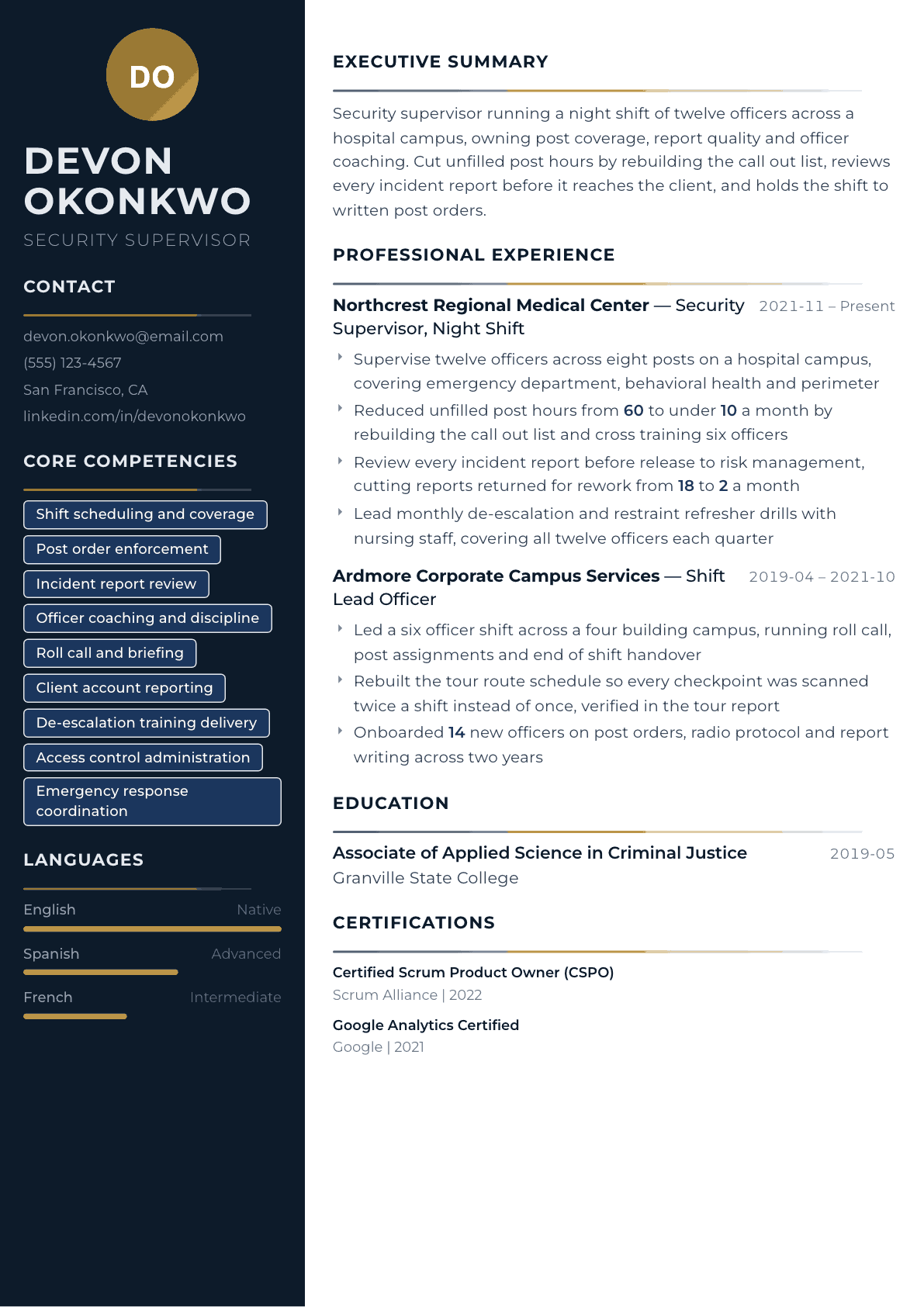
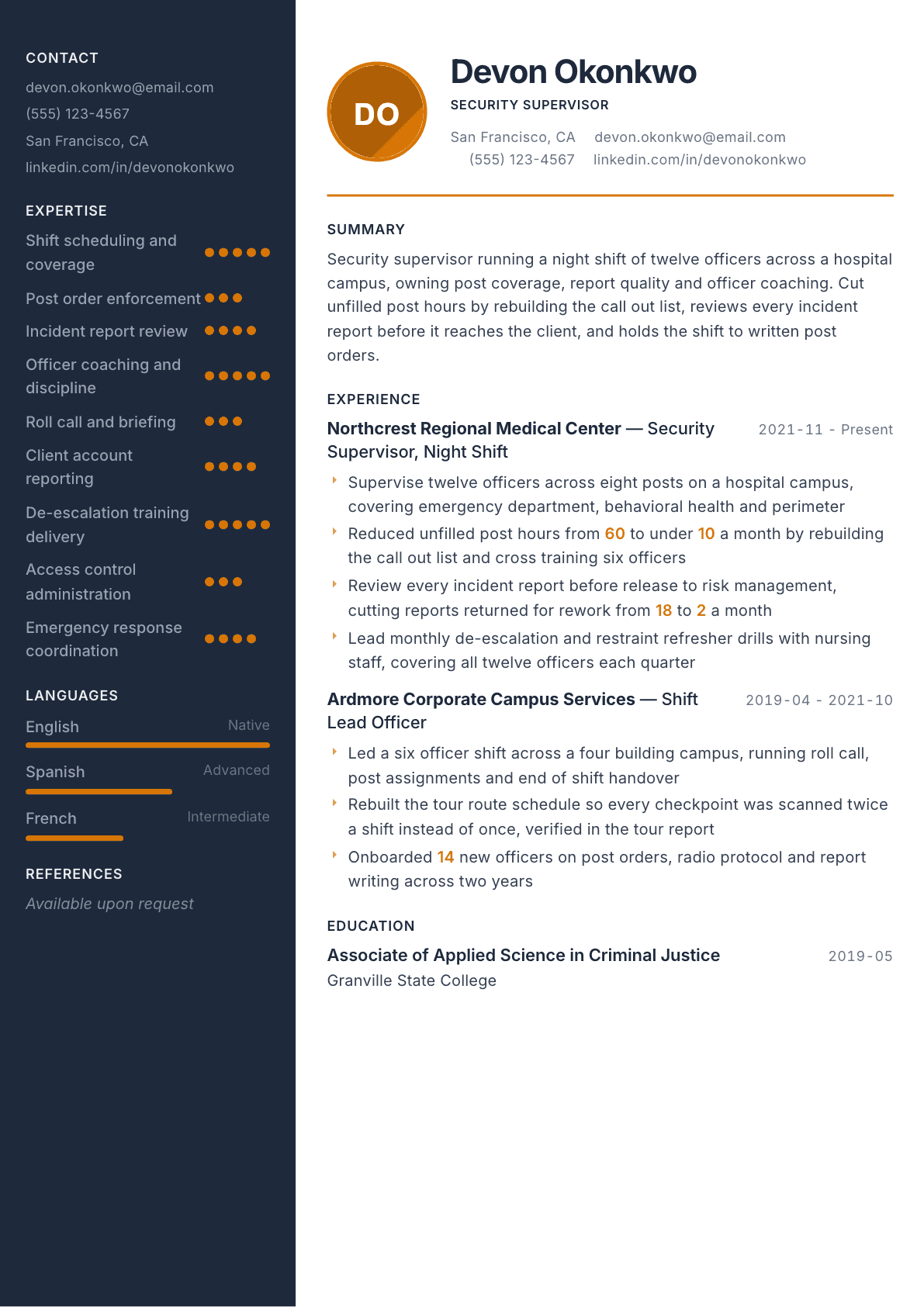
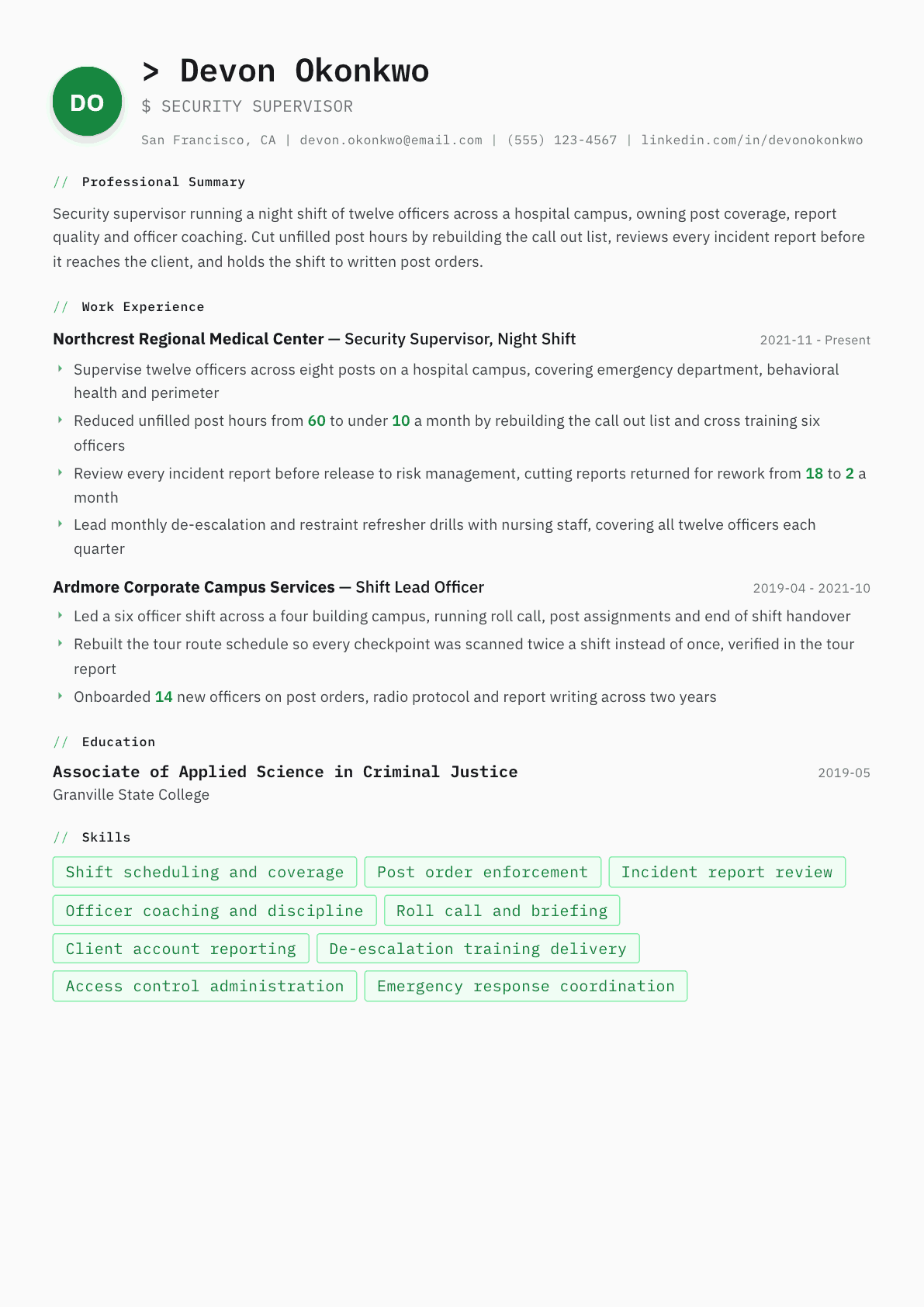
Example Security Supervisor summary
Security supervisor with seven years in contract and in house security, currently running a night shift of twelve officers across eight hospital campus posts. Rebuilt the call out list to close unfilled post hours, reviews every incident report before it reaches risk management, and runs monthly de-escalation refreshers with nursing staff. Comfortable writing post orders and handling corrective action.
Skills to list on a Security Supervisor resume
- Shift scheduling and call out lists
- Post coverage management
- Post order writing and enforcement
- Roll call and shift briefing
- Incident report review and quality control
- Officer coaching and corrective action
- New officer onboarding
- Client account reporting
- Tour system administration
- Access control administration
- Emergency and code response coordination
- De-escalation instruction
- Overtime and payroll approval
- Key and equipment inventory
- Investigation support and statements
What actually gets this resume read
- Give the number of officers and posts you supervise, because span of control is the first thing a manager checks.
- Show your unfilled post hours or coverage rate, since holding a schedule together is the core supervisor problem.
- Say that you review reports before they reach the client, and give the rework number before and after you took over.
- Name the site type, because supervising a behavioral health post is a different job from supervising a warehouse gate.
- List the training you deliver yourself, from radio protocol to restraint refreshers, with how often you run it.
- Include any discipline or performance documentation you handle, since supervisors who avoid it become the problem.
- Mention the scheduling and tour systems you administer, because a new account will hand you the console on day one.
How to write a security supervisor resume
The promotion from officer to security supervisor changes the product completely. An officer is responsible for a post. A supervisor is responsible for whether every post gets filled, whether the reports that leave the site are usable, and whether the client calls the account manager to complain on Monday morning. Hiring managers read supervisor resumes looking for evidence of those three things and very little else.
The applications that stall are officer resumes with the word supervisor added. They still describe patrol rounds and access control, with a line about overseeing other officers tacked on. A director of operations reads that and concludes the candidate has never actually held a schedule together on a holiday weekend with two call outs.
This guide covers how to write the supervisor page around span of control, coverage, report quality and people development, with three summaries at different points in the supervisory track and the questions officers ask when they step up for the first time.
Format: scope line under every job, one page unless you have multiple sites
One page for a single site supervisor, two once you have carried several accounts. Under each job title, put a scope line before the bullets: officers supervised, posts covered, staffed hours, shifts owned and whether the force was contract or in house. That single line is what a reader uses to place you on the ladder.
Keep the officer level detail compressed. You still need to show that you can do the work you supervise, but two lines are enough. The rest of the space belongs to scheduling, quality control, discipline and client communication, because those are what the vacancy is actually for.
- Scope line: officer count, post count, shift pattern, contract or in house, and the reporting line above you.
- Site line: property type and any specialized posts such as emergency department, behavioral health, data center or gatehouse.
- Systems line: scheduling platform, tour system, access control administration rights and the client reporting portal.
- Coverage metric: unfilled post hours, overtime as a share of scheduled hours, or the fill rate you held.
- Development line: officers onboarded, trained or promoted under you.
Summary: span of control, coverage, quality, development
Four numbers make a strong supervisor summary: how many officers, how many posts, what coverage you held, and how many people you have developed. Everything else is elaboration. A reader who sees twelve officers across eight posts on nights with unfilled hours in single digits knows immediately what level you operate at.
Add the site specialty if there is one. Supervising a behavioral health post or an emergency department entrance carries a training and de-escalation burden that a warehouse gate does not, and employers with those posts will pay attention to a candidate who has already carried them.
Experience: the schedule, the reports, the people
Scheduling is the supervisor job that nobody writes about and every hiring manager cares about. Say how you build the roster, how you maintain the call out list, how much notice you typically get, and what your unfilled post hours looked like before and after you took over. Cross training officers so more of them can cover more posts is the single most effective fix, and if you did it, say how many.
Report quality is the second product. A supervisor reviews before release, and the measure is how many come back for rework. Give the number, the review standard you apply and what you coach officers on most often: timelines, subject descriptions, the difference between what was observed and what was assumed.
People development is the third. Onboarding counts, sign off records, corrective action and progressive discipline, and the officers who were promoted from your shift. Supervisors who avoid documenting performance become the problem their manager has to solve, so evidence that you handle it is genuinely valuable.
Finish with client interaction. Say who you brief, how often, and what you have handled directly: a complaint, a post change request, a special event, a coverage request during a construction phase. Supervisors who can talk to a client without escalation are the ones who get more accounts.
Incidents and drills: what a supervisor owns when it goes wrong
On a bad night the supervisor runs the response and writes the account of it. Show what you have led: a fire alarm evacuation, a medical emergency with responders on site, an active threat drill, a severe weather closure, an employee termination escort. Give what you coordinated and who you notified rather than describing the event.
Training you deliver yourself is worth a bullet. De-escalation refreshers, radio protocol, report writing workshops, restraint policy review with clinical staff at healthcare sites, and post order walkthroughs all show a supervisor who raises the standard rather than only enforcing it.
- Emergency responses led, with the coordination steps and the notification chain.
- Drills run or supported, including frequency and who participated.
- Post order revisions you wrote or proposed, and what changed as a result.
- Investigations supported: statements collected, camera footage pulled, evidence handling.
- After action reviews conducted, and one change that came out of them.
Skills and keywords a supervisor posting screens on
Supervisor postings use their own vocabulary: post coverage, roll call, shift briefing, post orders, corrective action, incident review, client reporting, scheduling and overtime control. Mirror those terms exactly, because they distinguish a supervisor application from an officer application in a screening pass.
Avoid loading the skills block with officer competencies. Access control and patrol belong on the page but not at the top of the list. Lead with scheduling, quality control, coaching and client communication, and let the tactical skills sit underneath as the foundation they are.
Security Supervisor resume summary examples
Newly promoted shift lead
Shift lead promoted after three years as an officer, running roll call and post assignments for six officers across a four building campus. Rebuilt the tour route so every checkpoint is scanned twice a shift, and onboarded seven officers on post orders and radio protocol in the first year.
Site supervisor
Security supervisor running a night shift of twelve officers across eight hospital campus posts including the emergency department and behavioral health. Cut unfilled post hours from 60 to under 10 a month by rebuilding the call out list, and reviews every report before it reaches risk management.
Multi account supervisor
Senior security supervisor covering three client accounts with 34 officers across corporate, distribution and healthcare sites. Holds fill rate above 98%, runs monthly de-escalation and report writing sessions, and handles client escalations directly, with two accounts renewed after coverage complaints were closed out.
Work experience bullets: before and after
Before: Supervised security officers on my shift.
After: Supervised twelve officers across eight posts on a hospital campus night shift, covering the emergency department, behavioral health, perimeter patrol and the main entrance, reporting to the security manager.
Officer count, post count and named specialty posts place the candidate on the ladder at a glance.
Before: Made the schedule and covered call outs.
After: Reduced unfilled post hours from 60 to under 10 a month by rebuilding the call out list and cross training six officers so every post could be covered by at least four people.
A before and after coverage number with the mechanism behind it is the clearest proof a supervisor can offer.
Before: Reviewed officer reports before sending them to the client.
After: Reviewed every incident report before release to risk management, cutting reports returned for rework from 18 a month to 2 by coaching officers on timelines and on separating observation from assumption.
The rework figures and the specific coaching points show quality control that actually changed officer behavior.
Before: Trained new officers.
After: Onboarded 14 officers across two years on post orders, radio discipline and report writing, with documented position sign offs and two officers later promoted to shift lead.
Onboarding volume, documented sign offs and promotion outcomes prove development rather than shadowing.
Before: Handled emergencies at the site.
After: Led response to fire alarm evacuations and medical emergencies on the night shift, assigning stairwell coverage, meeting responders at the ambulance bay and completing after action notes within the shift.
Naming the assignments made and the closing paperwork shows command of an incident rather than presence at one.
Hard skills
- Shift scheduling and roster construction
- Call out list and coverage management
- Post order writing and enforcement
- Roll call and shift briefing
- Incident report review and quality control
- Corrective action and progressive discipline
- New officer onboarding and sign offs
- Client account reporting and escalation handling
- Tour system and access control administration
- Overtime control and payroll approval
- Emergency response coordination
- De-escalation instruction delivery
- Investigation support and evidence handling
- Key, radio and equipment inventory control
Soft skills
- Making a schedule work when two people call out an hour before shift
- Correcting an officer without losing the shift
- Telling a client bad news before the client finds it
- Holding the same standard for the officer you like and the one you do not
- Staying on post yourself when the roster leaves no other option
Certifications worth listing
- Certified in Security Supervision and Management (CSSM) (International Foundation for Protection Officers)
- Certified Protection Officer (CPO) (International Foundation for Protection Officers)
- Physical Security Professional (PSP) (ASIS International)
- Basic Life Support (American Heart Association)
Mistakes that cost security supervisor candidates the interview
- Submitting an officer resume with the word supervisor added and no scope line under any job.
- Leaving out officer and post counts, which are the first two numbers a director of operations looks for.
- Saying nothing about coverage or unfilled hours when holding the schedule is the central supervisory task.
- Ignoring report review, so the reader cannot tell whether documentation improved on your shift.
- Avoiding any mention of corrective action, which suggests performance problems were passed upward.
- Listing patrol and access control at the top of the skills block instead of scheduling and quality control.
- Describing emergencies as events you were present for rather than responses you assigned and closed out.
Security Supervisor resume questions
How do I write a supervisor resume when I was only an acting shift lead?
Use the actual title and describe the scope honestly: how many officers, how often you covered the role and what you owned while acting. Acting assignments carry weight when the duties are specific, and inflating a title is the fastest way to lose an offer at the reference stage.
Should I still list my own post work?
Yes, but compress it to two lines. A supervisor who cannot run a console or write a clean report loses credibility with the shift, so the reader wants to see the foundation. What the reader does not want is half a page of patrol duties above the supervisory content.
What coverage number should I use if my site never tracked one?
Use something you can defend: shifts covered on short notice, the number of officers cross trained, consecutive months without a post left unstaffed, or overtime trends. An honest proxy with a clear definition is far better than borrowing an industry figure you cannot explain.
How do I show client relationship work without breaching confidentiality?
Describe the client by type and the interaction by category. Monthly reporting to a hospital risk committee, or handling a tenant complaint about a parking enforcement decision, communicates the skill without naming anyone. Keep specifics about incidents and individuals off the page entirely.
Does a supervisor need a certification to be competitive?
It is not usually required, but a supervision credential from a recognized body separates two otherwise similar candidates and signals that you studied the role rather than absorbed it. Pair it with coverage and report quality numbers, which is what actually gets you the interview.
Related resume examples
- Security Guard Resume example
- Loss Prevention Manager Resume example
- Security Officer Resume example
- Security Manager Resume example
- Police Sergeant Resume example
- Emergency Dispatcher Resume example