Refrigeration Technician Resume Examples: free ATS score
Build a Refrigeration Technician Resume That Names Every System
By Mustafa Tarabya, founder of CVBooster · Published · Updated
Refrigeration technician resume example, keyword list and writing guide covering EPA 608, rack systems, ammonia work and service call volume.
Sample resumes for a refrigeration technician
The same refrigeration technician content laid out in three CVBooster templates, so you can see what the finished document looks like before you write a word.
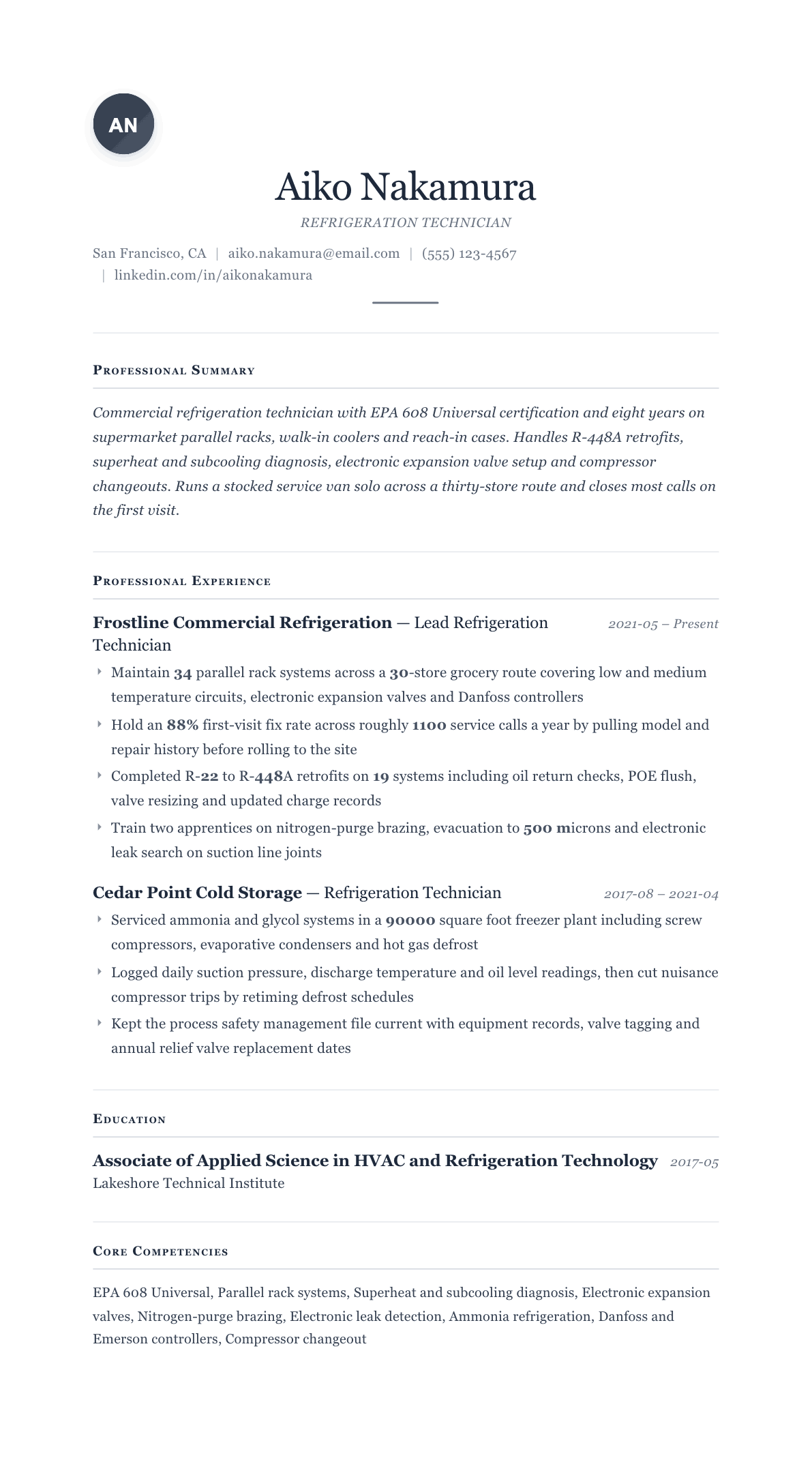
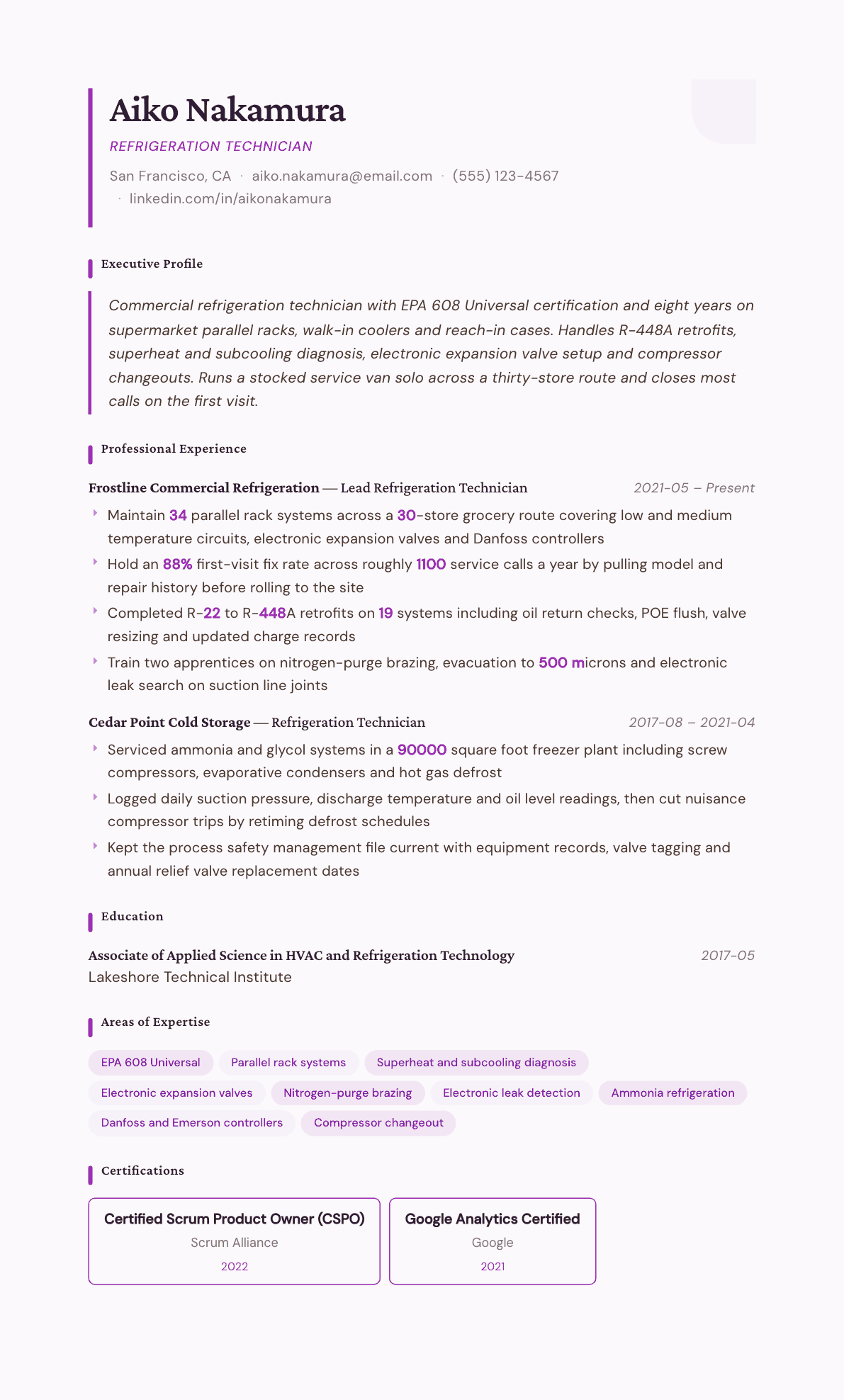
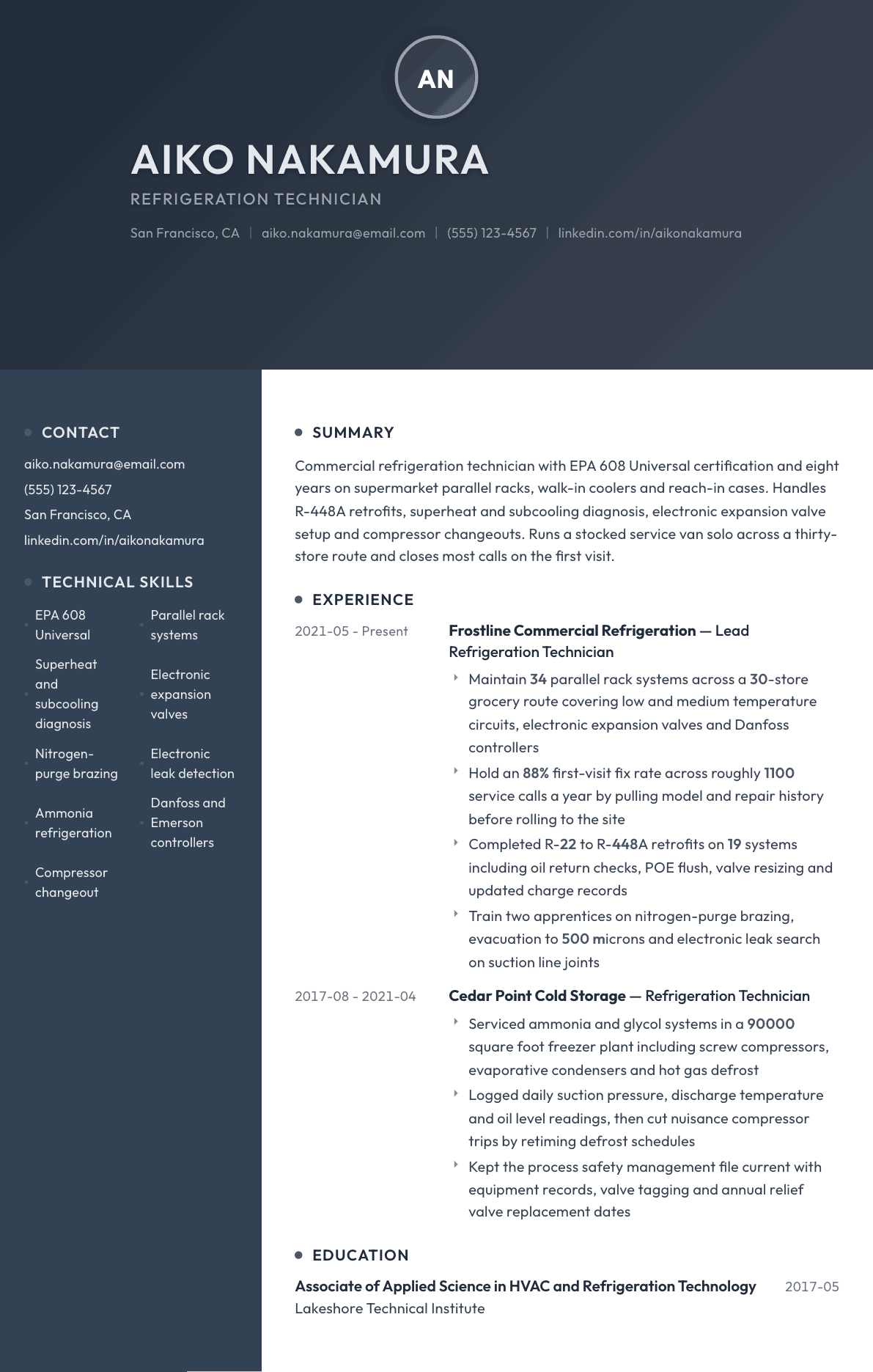
Example Refrigeration Technician summary
EPA 608 Universal refrigeration technician with eight years across supermarket parallel racks, cold storage and ice machines. Diagnoses by superheat and subcooling rather than parts swapping, completes low-GWP retrofits end to end, and programs Danfoss and Emerson rack controllers. Closes most calls on the first visit across a thirty-store route and trains apprentices on brazing and evacuation standards.
Skills to list on a Refrigeration Technician resume
- EPA Section 608 Universal
- Parallel rack refrigeration
- Walk-in and reach-in cases
- Superheat and subcooling
- Electronic expansion valves
- Thermostatic expansion valves
- Compressor changeout and oil management
- Nitrogen-purge brazing
- Deep vacuum evacuation
- Electronic and ultrasonic leak detection
- Refrigerant recovery and record keeping
- Ammonia and glycol systems
- Hot gas and electric defrost
- Rack controller programming
- Electrical troubleshooting on 208V and 480V
- Preventive maintenance scheduling
What actually gets this resume read
- Put your EPA 608 certification level in the header, because a screener will not read further without it.
- Name the refrigerants you have charged and recovered, since R-448A and ammonia work are hired for separately.
- Give your service call volume and first-visit fix rate so a dispatcher can picture you on a route.
- List the controller brands you program, because a chain running Danfoss will not retrain you on it.
- Say whether you have worked supermarket racks, cold storage, ice machines or process cooling, and in what mix.
- Add your evacuation and brazing standards, since micron levels and nitrogen purge separate trained hands from parts changers.
- Include on-call rotation and truck stock responsibility, both of which a service manager checks before an interview.
How to write a refrigeration technician resume
A service manager hiring a refrigeration technician is protecting product. Every hour a rack is down in a grocery store, a case full of dairy moves toward the trash, and the store manager is on the phone. So the manager reading your resume is not looking for a general mechanical background. He is looking for evidence that you have stood in front of the exact equipment his customers own and made it hold temperature again.
That is why the resumes that get calls read almost like an equipment list with results attached. Parallel racks with electronic expansion valves. Walk-in freezers on hot gas defrost. Ice machines. Ammonia in cold storage. Self-contained cases in convenience stores. The technician who names the systems, the refrigerants and the controllers is describing a route he can be dropped onto next Monday.
This guide covers what a refrigeration hiring manager checks in order, with summaries for an apprentice, a settled service technician and a lead, before and after bullets pulled from real diagnostic work, and answers to the questions technicians ask when they move between grocery, cold storage and process cooling.
Format: certification in the header, equipment before adjectives
Reverse chronological, one page for under ten years of field work and two once you have several equipment types and a supervisory stretch behind you. The screener is often a dispatcher or a service manager who reads on a phone between calls, so the first third of the page decides everything.
Your EPA Section 608 certification level belongs in the header line beside your name. A technician who makes a manager hunt for it on page two looks like a technician who might not hold Universal. If you also carry a state mechanical or contractor license, put the issuing state and the class right next to it.
- Header line: name, EPA 608 level, state license class, city and state, phone, email, and whether you hold a clean driving record for a service van.
- Order for a service role: header, equipment and refrigerant summary, work history, certifications, technical skills, education.
- Apprentices flip it: trade school hours, refrigeration lab work, then any helper or install experience.
- Every job line carries the setting first: supermarket chain, cold storage warehouse, restaurant service, process cooling, or convenience retail.
Summary: refrigerants, systems, route size, first-visit fix
Four facts in three lines. What certification you hold, what systems you have run, how big a route or plant you covered, and how often you close a call on the first visit. A manager can build a schedule out of those four and cannot build anything out of "hardworking technician with strong troubleshooting skills".
If you are crossing from residential air conditioning into commercial refrigeration, say so in the summary and name the bridge. Superheat and subcooling logic carries over, compressor work carries over, and rack controls do not. A manager who sees you name the gap honestly reads the rest of the page with more trust, not less.
Experience: diagnosis, not parts replaced
Each job needs the equipment population and the coverage area before the bullets start. Thirty-four racks across thirty stores is a picture. Serviced various refrigeration equipment is not. Then write three to five bullets that show how you found faults rather than what you carried in the van.
The strongest bullets in this trade describe a measurement leading to a decision. Low superheat and a flooded suction line traced to an expansion valve bulb that had come loose. High head pressure traced to a condenser fan cycling on a failed pressure control. A short cycling compressor traced to a defrost termination sensor reading wrong. Those bullets tell a manager you will not throw a compressor at a control problem.
Cut the bullets that describe the trade itself. Repaired refrigeration systems, performed preventive maintenance and responded to service calls are true of every technician who has ever held the job, and they use the space a diagnosis story needs.
- Give the equipment count and store or plant count for each employer, so the route size is visible.
- Name refrigerants by designation, including any low-GWP retrofit work and the recovery records you kept.
- Include one bullet on standards: nitrogen purge while brazing, evacuation to a stated micron level, torque on flare connections.
- Add controller work by brand and what you actually did in it: setpoints, defrost schedules, alarm setup, case discharge tuning.
The numbers a refrigeration service manager actually tracks
Four numbers travel well on this resume: calls completed per week, first-visit fix rate, callback or return rate, and preventive maintenance completion. If you do not have exact figures, give an honest range and say what it was measured against. A range with a source beats a rounded claim with none.
Energy and product loss are the other side of the coin. A technician who retimed defrost schedules and cut the number of nuisance alarms, or who caught a failing condenser fan before the case warmed, has done work a store manager can feel. Write that outcome plainly, with what you changed and what stopped happening as a result.
Skills and keywords that pass a refrigeration screen
Postings recycle a compact vocabulary: EPA 608, parallel rack, walk-in, reach-in, superheat, subcooling, TXV, EEV, hot gas defrost, condensing unit, compressor changeout, leak detection, recovery, brazing, evacuation. Use the exact word the posting used, once in your skills block and once inside a bullet where you clearly did the work.
Ammonia is its own keyword family and its own hiring lane. If you have worked anhydrous ammonia in cold storage, name it explicitly along with any process safety management support, valve tagging and relief valve records. If you have not, do not imply it with vague language about industrial refrigeration.
Refrigeration Technician resume summary examples
Apprentice or recent graduate
HVAC and refrigeration graduate with EPA 608 Universal certification and 900 lab hours across compressors, metering devices, brazing and evacuation. Completed 6 months as a helper on supermarket case installs and walk-in builds. Seeking a service apprentice seat with a commercial refrigeration contractor.
Five years on a route
Commercial refrigeration technician with 5 years on grocery and restaurant accounts covering parallel racks, walk-in coolers, reach-in cases and ice machines. Diagnoses by superheat and subcooling, completes compressor changeouts solo, and holds a first-visit fix rate near 85% across roughly 900 calls a year.
Lead technician
Lead refrigeration technician with 11 years across supermarket racks and ammonia cold storage. Runs low-GWP retrofits end to end, programs Danfoss and Emerson rack controllers, carries the on-call rotation for a regional branch, and trains apprentices on brazing, evacuation and leak search before they touch a customer site.
Work experience bullets: before and after
Before: Repaired walk-in coolers and freezers.
After: Serviced 140 walk-in coolers and freezers across a 30-store grocery route, covering hot gas and electric defrost, evaporator fan motors, door heaters and case controllers.
The count, the route and the subsystems turn a job title into a workload a dispatcher can plan around.
Before: Troubleshot refrigeration systems using gauges.
After: Traced a repeat high head pressure fault on a medium temperature rack to a condenser fan cycling on a failed pressure control, replaced the control and cleared 6 months of nuisance alarms.
A single traced fault with the measurement and the outcome proves diagnostic skill that generic troubleshooting language cannot.
Before: Worked on refrigerant retrofits.
After: Completed R-22 to R-448A retrofits on 19 systems including oil return checks, POE flush, expansion valve resizing and updated charge and recovery records for each unit.
Naming the refrigerants and the full retrofit steps shows the job was done properly rather than just recharged.
Before: Followed proper brazing and evacuation procedures.
After: Brazed every joint under a flowing nitrogen purge and evacuated to 500 microns with a decay check before charging, which held new installs free of moisture-related expansion valve failures.
Stated targets and the failure they prevented make a standards claim verifiable instead of decorative.
Before: Responded to emergency calls after hours.
After: Carried one week in four on the after-hours rotation, averaging 7 night calls a week and stabilizing product temperature before leaving any site with a failed compressor awaiting parts.
The rotation share, call volume and the temporary fix show reliability under the conditions the job is really staffed for.
Hard skills
- EPA Section 608 Universal refrigerant handling
- Parallel rack refrigeration systems
- Superheat and subcooling diagnosis
- Thermostatic and electronic expansion valves
- Compressor changeout and oil management
- Nitrogen-purge brazing
- Deep vacuum evacuation and decay testing
- Electronic and ultrasonic leak detection
- Hot gas and electric defrost control
- Rack controller programming
- Ammonia and glycol system service
- Condensing unit and condenser maintenance
- Electrical troubleshooting on 208V and 480V circuits
Soft skills
- Explaining a product loss risk to a store manager without alarming staff
- Staying methodical on the third call of a hot afternoon
- Writing service tickets a second technician can pick up from
- Deciding when to stabilize now and return with parts
- Teaching an apprentice without slowing the call
Certifications worth listing
- EPA Section 608 Universal Certification (United States Environmental Protection Agency)
- NATE Certification (North American Technician Excellence)
- RSES Certificate Member (CM) (Refrigeration Service Engineers Society)
- Certified Assistant Refrigeration Operator (CARO) (Refrigerating Engineers and Technicians Association)
Mistakes that cost refrigeration technician candidates the interview
- Leaving the EPA 608 level off the header, which makes a dispatcher assume you hold only Type I.
- Writing serviced commercial refrigeration equipment instead of naming racks, cases, walk-ins, ice machines and condensing units.
- Listing refrigerants you have only read about, which collapses in the first technical interview question about oil compatibility.
- Skipping route size and call volume, the two figures a service manager uses to work out whether you can hold territory.
- Describing every fault as a failed part, with no measurement anywhere on the page to show how the part was identified.
- Claiming industrial refrigeration experience when the work was self-contained retail cases, since ammonia is a separate hiring lane.
Refrigeration Technician resume questions
Do I need EPA 608 Universal or is Type II enough?
Type II covers high pressure systems and gets you into much of commercial work, but Universal removes any question about which calls you can take. Put the exact level on the resume rather than writing EPA certified, because a dispatcher assigning work needs to know before the interview.
How do I move from residential HVAC to commercial refrigeration?
Lead with the physics you already own: superheat, subcooling, charging, compressor replacement and electrical troubleshooting all transfer. Then name what you have not done yet, such as rack controls or case discharge tuning, and show any low temperature or restaurant equipment you have touched. Managers hire honest gaps over hidden ones.
Should I list every refrigerant I have worked with?
List the ones you have actually charged, recovered or retrofitted, and group the rest under general familiarity if you must mention them. A retrofit interview will ask about oil types, glide and charging method, so a refrigerant on your page you cannot discuss costs you more than an empty line.
How much detail should I give about controls and rack controllers?
Enough to show you configure rather than just read them. Name the brands, then say what you did inside the software: adjusted defrost schedules, set case discharge targets, built alarm thresholds, or pulled trend data to find a failure. That level of detail separates you from technicians who only work with gauges.
What belongs on the resume if my experience is mostly installs?
Treat install work as evidence of craftsmanship rather than downplaying it. Line sizing, brazing quality, evacuation standards, startup readings and commissioning documentation all show discipline a service manager values. Then state clearly that you are moving into service and name the diagnostic tools and systems you already work with.
Related resume examples
- HVAC Technician Resume example
- Maintenance Technician Resume example
- HVAC Service Technician Resume example
- Boiler Technician Resume example
- Appliance Repair Technician Resume example
- Pool Technician Resume example