Procurement Officer Resume Examples: what gets the call
Write a Procurement Officer Resume That Proves Sourcing Value
By Mustafa Tarabya, founder of CVBooster · Published · Updated
Procurement officer resume example with sourcing keywords, tender process tips and a guide to writing supplier, savings and compliance results.
Sample resumes for a procurement officer
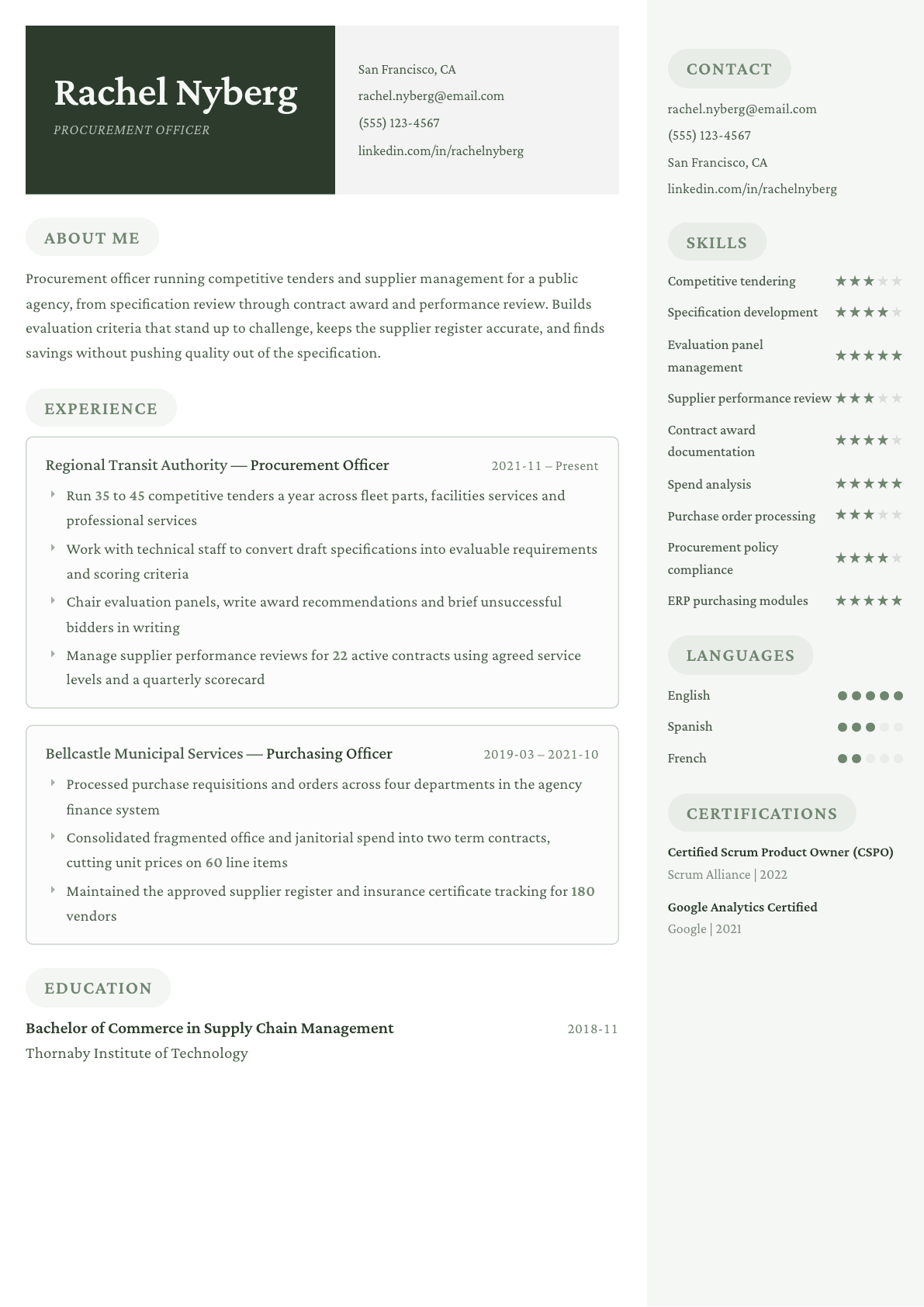
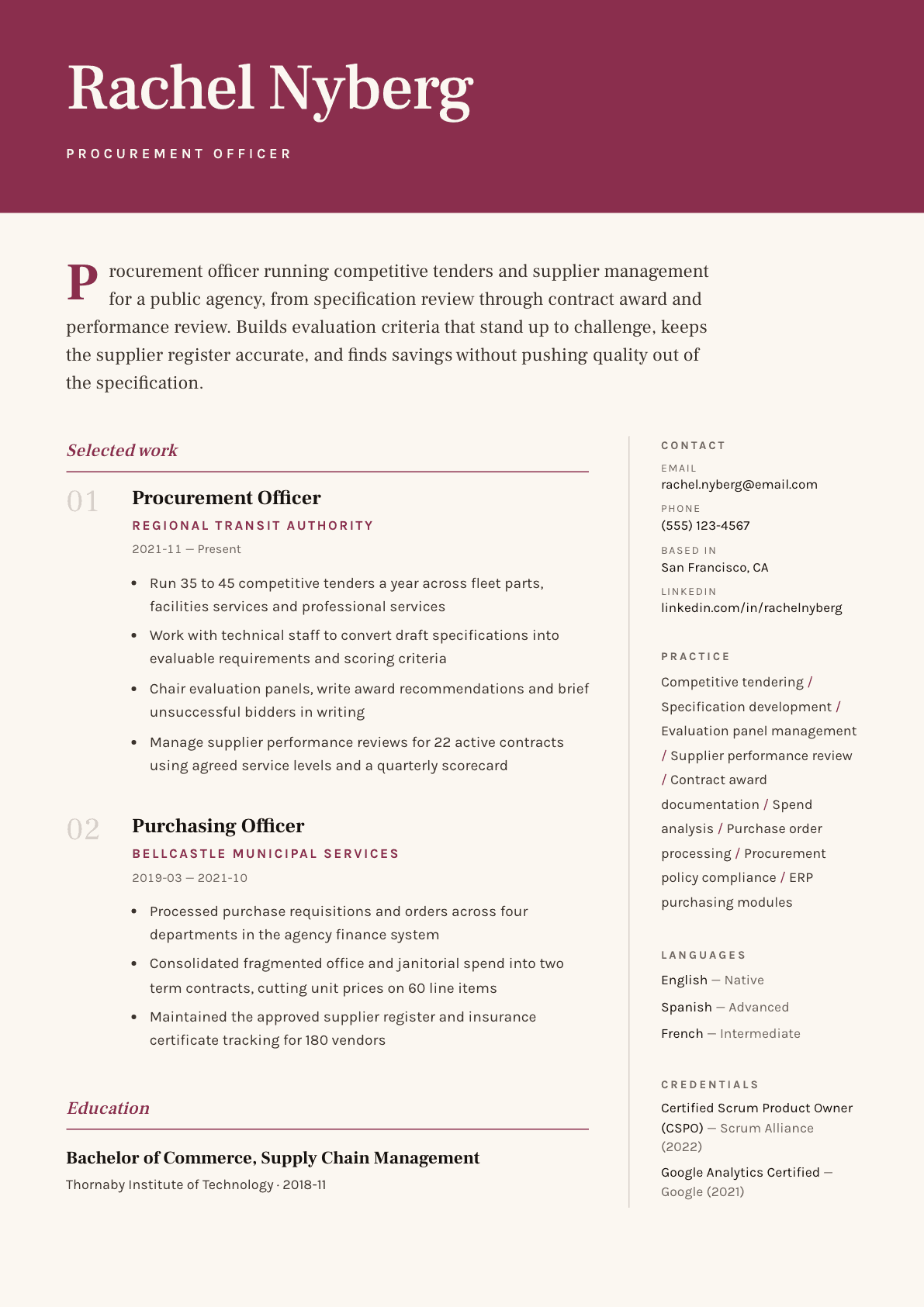
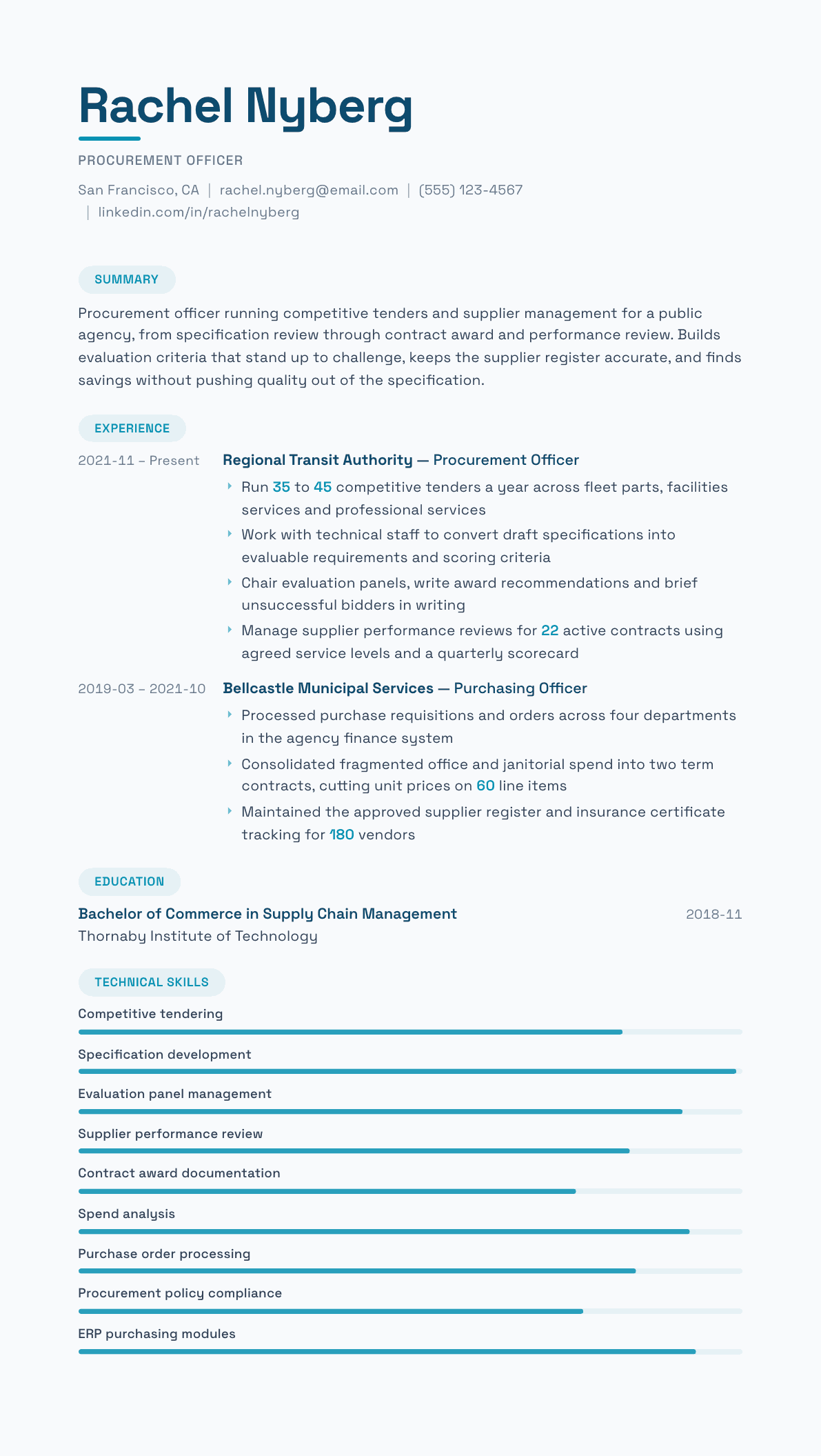
The same procurement officer content laid out in three CVBooster templates, so you can see what the finished document looks like before you write a word.
Example Procurement Officer summary
Procurement officer running competitive tenders for a public transit agency across fleet parts, facilities and professional services. Converts technical specifications into evaluable criteria, chairs evaluation panels, writes award recommendations that hold up under challenge, and manages supplier performance against quarterly scorecards. Consolidated fragmented departmental spend into term contracts that lowered unit prices without changing the specification.
Skills to list on a Procurement Officer resume
- Competitive tendering and bid processes
- Specification and requirement drafting
- Evaluation criteria design
- Panel chairing and award recommendations
- Supplier prequalification
- Contract award and debrief documentation
- Supplier performance scorecards
- Category and spend analysis
- Negotiation and price benchmarking
- Purchase requisition and order processing
- Procurement policy and threshold compliance
- Framework and term contract management
- ERP and sourcing platforms
- Conflict of interest and probity controls
What actually gets this resume read
- Give your annual tender volume and the categories you buy, because category depth is what a manager screens on.
- Explain how you turn a technical specification into evaluation criteria, since that is the skill agencies lack most.
- Report savings with the baseline you measured against and whether the figure was validated by finance.
- Name the procurement thresholds and policy framework you work under without claiming authority you did not hold.
- Show supplier performance work, including scorecards and how you handled a supplier that missed service levels.
- List the purchasing and sourcing systems you have used, because agency finance systems differ more than people expect.
How to write a procurement officer resume
A procurement officer sits between technical staff who know what they want and a rulebook that says how they may buy it. The manager reading your resume wants to know whether you can hold both sides: turn a vague specification into something suppliers can bid against, run a defensible process, and end up with a contract that performs. Enthusiasm for cost savings is not the test.
Most procurement resumes read as a list of duties: raised purchase orders, liaised with suppliers, ensured compliance with policy. None of that separates one officer from another. Tender volume, category coverage, evaluation design, award defensibility and supplier performance results do.
This guide covers what a procurement manager checks on the page, with summaries for a purchasing officer, an officer running her own tenders and a category lead, before and after bullets on sourcing and supplier management, and the questions procurement staff ask when moving between public and private buying.
Format: categories and tender volume in the header
One to two pages, reverse chronological, with each job header naming the employer, the categories you bought, the annual tender or order volume and the value band you operated in. Category coverage is the first filter a procurement manager applies, because buying fleet parts and buying professional services are genuinely different jobs.
If you work in the public sector, name the procurement framework and thresholds you operate under. If you have crossed between public and private buying, separate them clearly, since the process discipline and the commercial freedom are not the same and managers hire for one or the other.
- Header: employer, categories bought, annual tender and order volume, and value band.
- A framework block naming the procurement policy, thresholds and approval routes you work within.
- A systems block for the purchasing and sourcing platforms you have used, with what you did in each.
- A supplier block: number of active contracts managed and how performance is reviewed.
Summary: categories, process ownership, supplier results
Three lines: the categories you know, the parts of the process you own end to end, and what your supplier relationships produce. Ownership is the word to be precise about. Running a tender from specification review through award recommendation is a different job from raising orders against contracts someone else negotiated.
Add one line on where you add value beyond compliance: consolidating fragmented spend, rewriting a specification that only one supplier could meet, or turning a failing contract around through structured performance review. That is the sentence that gets a procurement officer interviewed rather than filed.
Experience: specification, evaluation and the award that holds
Start with the front end. Technical staff usually hand over specifications that cannot be evaluated: brand names, unmeasurable requirements, criteria that quietly exclude competition. Describe how you work with them to convert requirements into evaluable criteria with weightings and a scoring method. This is the skill most procurement teams are short of.
Then the process itself: prequalification, tender documents, clarification handling, evaluation panel chairing, scoring moderation, award recommendation, approval routing and bidder debriefing. Say what you wrote and what you chaired rather than what you participated in.
Finish with what happened after award. A contract that was implemented, a supplier that met service levels, a transition that did not disrupt operations. Procurement teams are often measured only to the award date, so an officer who tracks performance afterwards stands out immediately.
Savings, supplier performance and probity
Savings claims need a baseline or they get discounted. Say what you measured against, whether it was previous contract prices, budget or market benchmark, and whether finance validated the figure. An honest, smaller, validated number beats a large unverified one in every interview.
Supplier performance work is the most credible section on the page. Describe the scorecard, the service levels, the review meeting rhythm and what happened when a supplier missed. Managers know that anyone can award a contract and that far fewer people can hold a supplier to it.
Probity belongs on a public sector resume. Conflict of interest declarations, evaluation panel independence, document retention and the handling of a challenge from an unsuccessful bidder all show that you understand a process can be right and still be lost if it is not documented.
- Give savings with the baseline and say who validated the number.
- Describe the supplier scorecard and the service levels you review against.
- Name a supplier issue you escalated and how the contract ended up.
- State the probity controls you apply during evaluation and how records are kept.
Systems, category work and keywords
Name the purchasing modules and sourcing platforms you have worked in and what you did inside them: requisition approval workflow, catalog management, tender publication, evaluation recording and contract register maintenance. Buyers who already know a system are cheaper to onboard and managers know it.
Category and spend analysis is worth its own line if you have done it. Consolidating fragmented spend across departments, building a category plan, or running a market analysis before going to tender all show a procurement officer who thinks past the next requisition.
Words these postings use: competitive tender, request for quotation, request for proposal, prequalification, evaluation criteria, weighted scoring, award recommendation, debrief, framework agreement, term contract, contract register, supplier performance, spend analysis, category plan and procurement threshold.
Procurement Officer resume summary examples
Purchasing officer
Purchasing officer processing requisitions and orders across four departments in the agency finance system, maintaining the approved supplier register and insurance certificate tracking for 180 vendors. Consolidated fragmented office and janitorial spend into two term contracts in 2021. Ready to run tenders independently.
Running her own tenders
Procurement officer running 35 to 45 competitive tenders a year across fleet parts, facilities services and professional services. Converts draft specifications into evaluable scoring criteria with technical staff, chairs evaluation panels, writes award recommendations and debriefs unsuccessful bidders in writing.
Category lead
Category lead responsible for facilities and professional services spend across a public authority, managing three buyers and 22 active contracts on quarterly scorecards. Built the category plan adopted in 2023, and turned around a failing cleaning contract through structured performance review rather than retendering.
Work experience bullets: before and after
Before: Ran tenders for the organization.
After: Ran 35 to 45 competitive tenders a year across fleet parts, facilities services and professional services, from prequalification through award recommendation and bidder debrief.
Volume, categories and the stages you personally owned show the scope of the role rather than its title.
Before: Worked with departments on their requirements.
After: Rewrote a fleet parts specification that had been brand-restricted, converting it into performance criteria with weighted scoring that attracted five compliant bids instead of the previous two.
A named specification problem and the competition it unlocked is the clearest evidence of procurement value.
Before: Achieved cost savings for the agency.
After: Consolidated fragmented office and janitorial spend across four departments into two term contracts, lowering unit prices on 60 line items against a baseline finance validated before publication.
A validated baseline and a line item count make a savings claim credible where a headline number does not.
Before: Managed supplier relationships.
After: Managed 22 active contracts on quarterly scorecards against agreed service levels, escalating two suppliers into formal improvement plans and closing both without termination.
Contract count, a review mechanism and a real escalation outcome prove supplier management rather than contact.
Before: Made sure procurement followed the rules.
After: Chaired evaluation panels with signed conflict of interest declarations, recorded scoring rationale for every criterion, and defended one award through an unsuccessful bidder challenge without changing the decision.
Documented probity plus a challenge that held is what compliance looks like when it is real.
Hard skills
- Competitive tendering and bid management
- Specification and requirement drafting
- Evaluation criteria design and weighted scoring
- Evaluation panel chairing and moderation
- Supplier prequalification
- Award recommendation and debrief documentation
- Framework and term contract management
- Supplier performance scorecards and service levels
- Category planning and spend analysis
- Negotiation and price benchmarking
- Purchase requisition and order processing
- Contract register maintenance
- Procurement policy and threshold compliance
- Sourcing and purchasing platforms
Soft skills
- Saying no to a department that has already chosen its supplier
- Explaining a scoring outcome to a bidder who lost narrowly
- Keeping an evaluation panel to the criteria they agreed
- Building trust with technical staff who see procurement as delay
- Patience with a process that cannot be shortened
Certifications worth listing
- Certified Professional in Supply Management (CPSM) (Institute for Supply Management)
- Certified Public Procurement Buyer (CPPB) (Universal Public Procurement Certification Council)
- CIPS Level 4 Diploma in Procurement and Supply (Chartered Institute of Procurement and Supply)
Mistakes that cost procurement officer candidates the interview
- Listing duties such as raising orders and liaising with suppliers instead of tender volume and category coverage.
- Claiming savings with no baseline and no validation, which experienced managers discount immediately.
- Skipping the specification stage, which is where a procurement officer contributes the most and is judged the least.
- Ending every story at award and never showing whether the contract actually performed.
- Leaving probity controls off a public sector resume when defensibility is the whole point of the process.
- Blurring public and private buying experience when the two hire for different disciplines.
Procurement Officer resume questions
How do I show value if my role is mostly transactional?
Show volume, accuracy and any improvement you drove inside the transactional work: consolidating spend, cleaning the supplier register, cutting requisition cycle time or fixing a catalog that forced manual orders. Those are the moves that lead to a sourcing role.
What savings figure should I put on my resume?
One you can defend. State the baseline you measured against, the period, and whether finance signed it off. A modest validated figure with a clear method survives an interview, while an impressive number with no baseline invites a question you cannot answer.
Does public sector procurement experience transfer to private companies?
Yes, particularly process discipline, evaluation rigor and documentation. What private buyers will probe is commercial aggressiveness, since public rules constrain negotiation. Show any negotiation you did lead and be direct about the framework you worked within.
How much category knowledge do I need?
Enough to challenge a specification and read a bid critically. Managers hire for two or three categories where you know the supply market, the cost drivers and the common tricks, and treat everything else as adjacent experience you can grow into.
Should I list every system I have used?
List the ones you worked in regularly and say what you did in each, since a buyer who has published tenders in a platform is different from one who only viewed reports. A long list of tools with no verbs attached is treated as noise.
Related resume examples
- Procurement Specialist Resume example
- Purchasing Manager Resume example
- Procurement Manager Resume example
- Contract Specialist Government Resume example
- Government Contractor Resume example
- State Government Employee Resume example