Production Lead Resume Examples: the lines they read
Write a Production Lead Resume That Shows You Run the Shift
By Mustafa Tarabya, founder of CVBooster · Published · Updated
Production lead resume example, keywords and guide covering crew size, line staffing, tier boards, training and hitting the daily schedule.
Sample resumes for a production lead
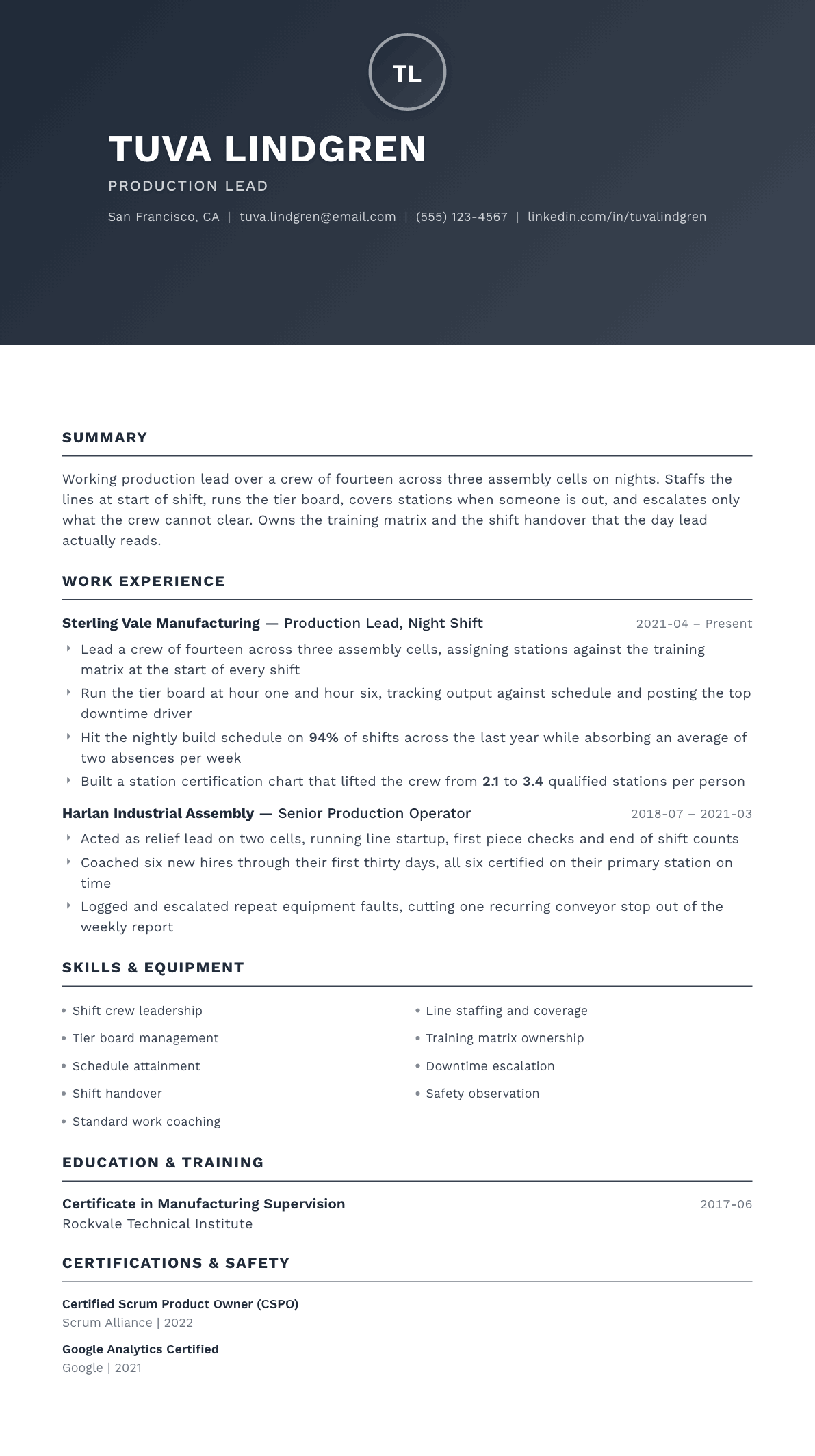
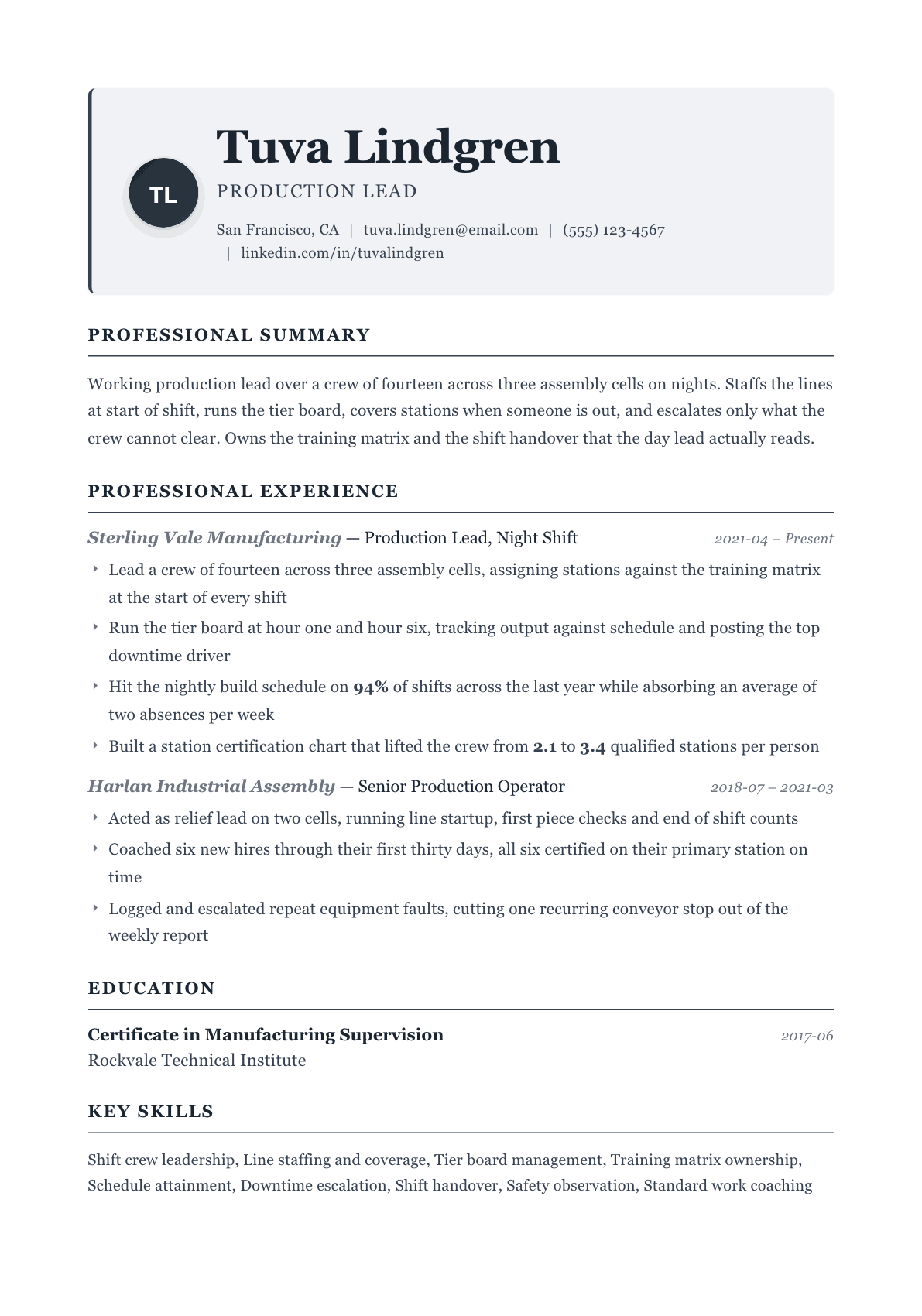
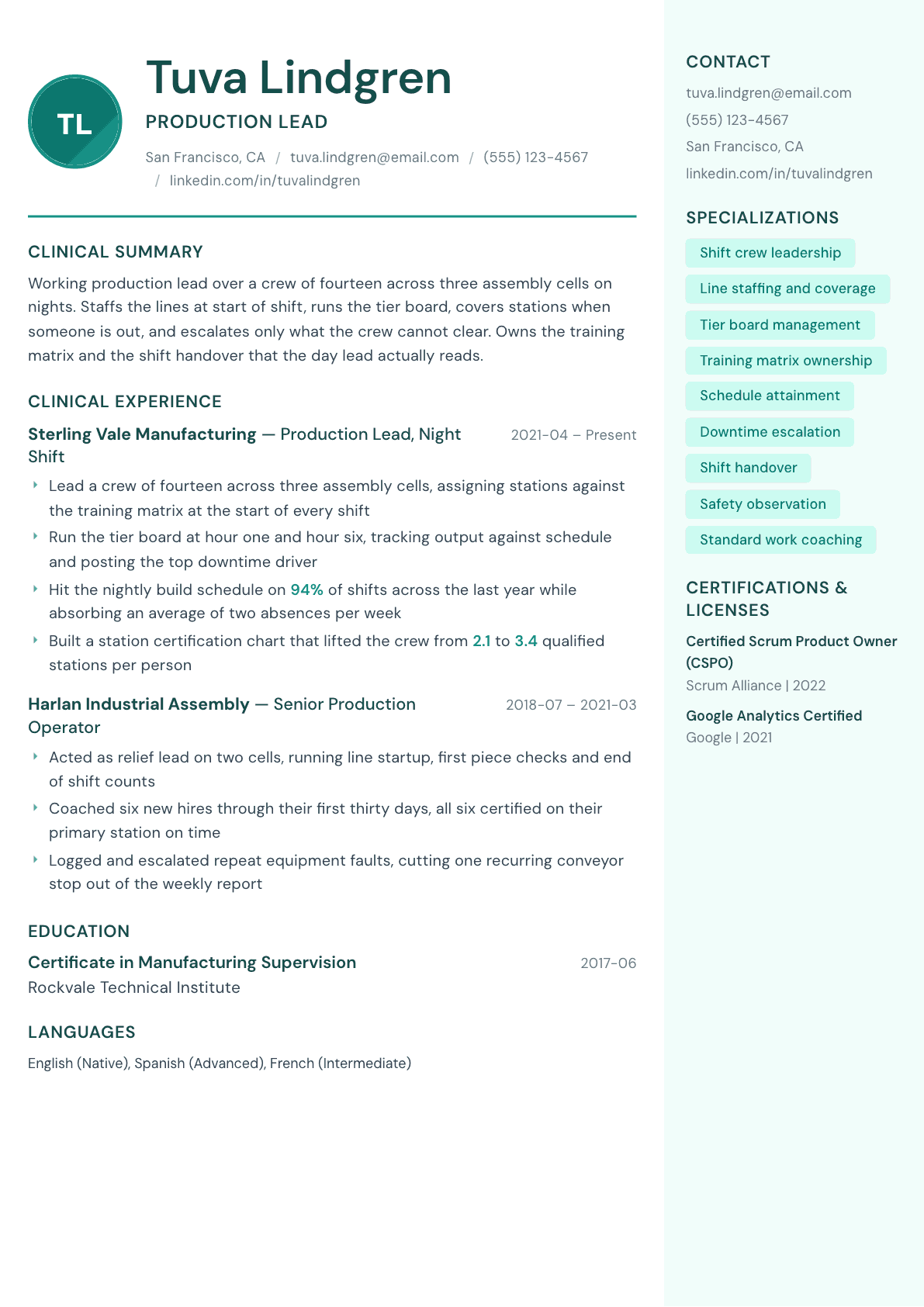
The same production lead content laid out in three CVBooster templates, so you can see what the finished document looks like before you write a word.
Example Production Lead summary
Working production lead over a fourteen person night crew across three assembly cells. Staffs stations against the training matrix, runs the tier board twice a shift, and covers a station personally when coverage is short. Hits the nightly build schedule consistently while absorbing regular absences, owns the cross training chart, and writes a handover the day lead can act on without a phone call.
Skills to list on a Production Lead resume
- Crew leadership
- Line staffing
- Schedule attainment
- Tier board and daily huddle
- Training matrix
- Cross training and certification
- Downtime escalation
- Standard work coaching
- Shift handover reporting
- Safety observations
- Quality hold decisions
- Labor planning
- Continuous improvement events
- Timekeeping and attendance tracking
What actually gets this resume read
- Put the crew size and the number of cells or lines you cover in the first line of every job.
- Show schedule attainment, because a plant manager reads a lead resume looking for whether the build went out.
- Describe how you staff a line when two people call out, since that is the daily test of the job.
- Name the tier board, huddle or daily meeting you run and what you report into it.
- Prove training work with a certification or cross training number, not the phrase trained new employees.
- Keep the working part visible: leads who still run a station should say so, because most postings expect it.
How to write a production lead resume
A production lead is a working supervisor without the title or the disciplinary authority. You still run a station most of the shift, and you are still the person who decides where fourteen people stand when two of them call out at ten minutes to start. The resume has to show both halves, because a plant that hires a lead who cannot cover a station has hired the wrong person.
The reader is usually a production supervisor or an area manager filling a shift. He wants three answers fast: how many people have you led, did the build go out, and what happens on your shift when the plan breaks. Everything else on the page is supporting detail.
This guide covers how to structure a lead resume around crew size and schedule attainment, how to describe daily staffing decisions in a way that reads as skill rather than chaos, and how to prove the training and improvement work that gets a lead promoted into supervision.
Format: one page, with crew size in the first line of every job
Keep it to one page unless you are years into supervision. Reverse chronological, plain headings, no columns. What makes a lead resume different from an operator resume is not length but the opening line of each job, which must carry the span: the number of people, the number of cells or lines, and the shift.
A lead resume also needs an explicit results line or a short block of numbers near the top. Schedule attainment, safety record, turnover on your crew and training completion are the four figures a plant uses to judge a shift, and putting them where they cannot be missed changes how the rest of the page is read.
- Open every job entry with crew size, number of cells or lines, product and shift pattern.
- Keep the working operator half visible, since most lead postings still expect station coverage.
- Group leadership training and safety certification into one block a screener can check at a glance.
Summary: span, schedule and what you still run yourself
Three sentences that answer span, result and hands on capability. A lead who writes that he runs a fourteen person night crew across three assembly cells, hits the build schedule on most shifts while absorbing regular absences, and still covers a station personally has answered every screening question in one paragraph.
Avoid the language of aspiration. Phrases about being a motivated team player who leads by example are filler that every lead resume carries. Replace them with the two or three things you decide every shift, because decisions are what distinguish a lead from a senior operator.
Experience: staffing, the board, and what happens when it breaks
Write one bullet on how you staff. Assigning stations against a training matrix, balancing the cell so the slowest station is not the constraint, and moving people mid shift when a machine goes down are the daily craft of the job. Name the tool you use, because a plant with a certification chart wants a lead who already works from one.
Write one bullet on the daily management routine: the tier board, the startup huddle, the hourly count posting, the end of shift handover. Say what you report into it and who reads it. A handover that the incoming lead can act on without a phone call is a small thing that plants notice.
Write one bullet on the break. Two absences, a down conveyor, a quality hold on the last pallet: describe how you rebalanced and what still went out the door. This is the bullet interviewers ask about, so it may as well already be on the page.
Then attach the schedule number. Attainment against the daily build plan, expressed against the year or the quarter, is the closest thing a lead has to a scoreboard.
- Name the training or certification matrix you staff from.
- Give the daily meeting you run and the metrics you post to it.
- Show one recovery: what broke, how you rebalanced, what still went out.
- State schedule attainment and the absence load you carried while hitting it.
Training and development: the promotion signal
Plants promote leads who build capability rather than leads who cover every gap themselves. Show the cross training work with a number: qualified stations per person, new hires certified on time, or the number of operators you brought from one station to three. That figure predicts how a shift performs after you move up.
Add coaching detail. Walking a new hire through their first thirty days, running a station certification signoff, or correcting a habit that was causing rework are all specific and believable. Trained new employees, on its own, is not.
Safety and quality authority: say where your decision ends
A lead usually has authority to stop a line, place a quality hold, and pull someone off a station for a safety concern, but no authority over discipline or pay. Spell out where your line sits, because a hiring manager needs to know how much judgment you have exercised and how much you have escalated.
On safety, name the observations, the near miss reporting and the toolbox talks you run, and give your crew's record. On quality, name the holds you have placed and what triggered them, since a lead who holds product under pressure from the schedule is the kind a plant wants.
Production Lead resume summary examples
Senior operator stepping up
Senior operator acting as relief lead on two assembly cells, running line startup, first piece checks and end of shift counts when the lead is out. Coached six new hires through their first thirty days with all six certified on time. Ready for a permanent lead seat on nights.
Two years as lead
Production lead over a fourteen person night crew across three assembly cells. Staffs stations from the training matrix, runs the tier board twice a shift, and hit the nightly build schedule on 94% of shifts while absorbing two absences a week. Still covers a station personally when coverage is short.
Lead moving toward supervision
Working production lead with six years running crews of twelve to twenty across assembly and packaging. Lifted the crew from two to more than three qualified stations per person, cut one recurring conveyor stop out of the weekly report, and has run the shift unsupervised through vacation and plant startup coverage.
Work experience bullets: before and after
Before: Supervised a team of production workers.
After: Led a crew of fourteen across three assembly cells on nights, assigning stations against the training matrix at the start of every shift.
Crew size, cell count and the staffing method give the span and the method instead of a title claim.
Before: Made sure production targets were met.
After: Hit the nightly build schedule on 94% of shifts across the year while absorbing an average of two absences a week.
Pairing attainment with the absence load shows the result was earned under real staffing pressure.
Before: Ran daily meetings with the team.
After: Ran the tier board at hour one and hour six, posting output against schedule and naming the top downtime driver for the day shift to pick up.
The timing and the content turn a meeting into a management routine a plant can recognize.
Before: Trained employees on their jobs.
After: Built a station certification chart and moved the crew from 2.1 to 3.4 qualified stations per person over eighteen months.
A capability number is the clearest evidence that the training changed how the shift runs.
Before: Handled problems on the line.
After: Logged and escalated repeat equipment faults with run data attached, removing one recurring conveyor stop from the weekly downtime report.
Escalating with evidence and getting a fault permanently closed is a lead skill, not a task.
Hard skills
- Shift crew leadership
- Line staffing and balancing
- Training matrix administration
- Schedule attainment tracking
- Tier board and daily huddle
- Downtime escalation with data
- Quality hold decisions
- Shift handover reporting
- Safety observation and near miss reporting
- Standard work coaching
- Timekeeping and attendance tracking
- Continuous improvement events
Soft skills
- Calm rebalancing under pressure
- Direct feedback
- Fair station rotation
- Escalation judgment
- Handover discipline
Certifications worth listing
- OSHA 30-Hour General Industry (OSHA Outreach Training Program)
- Certified Production Technician 4.0 (CPT 4.0) (Manufacturing Skill Standards Council)
- Certified Six Sigma Green Belt (CSSGB) (American Society for Quality)
Mistakes that cost production lead candidates the interview
- Leaving crew size off the page, so the reader cannot tell whether you led three people or thirty.
- Dropping the operator half of the job, when most lead postings still require station coverage every shift.
- Describing the role in duties when the job is judged on schedule attainment, safety and crew capability.
- Claiming supervisory authority you did not hold, which unravels the moment references are checked.
- Skipping the recovery story, which is the exact scenario an interviewer will ask you to walk through.
- Listing leadership qualities as adjectives instead of naming a decision you make every single shift.
Production Lead resume questions
What is the difference between a production lead and a supervisor on a resume?
A lead runs the shift and still works a station, while a supervisor owns hiring, discipline, pay and formal reviews. Say plainly which authority you held, because overstating it is the fastest way to lose credibility during reference checks.
How do I get schedule attainment numbers for my resume?
They live on the daily production board, the shift report you sign, or the weekly plant review deck. Ask your supervisor for the last quarter of build plan versus actual. Even an honest approximation stated as a range beats leaving the scoreboard blank.
Should a lead resume include the machines I can run?
Yes, in a compact equipment line rather than a long block. A plant hiring a working lead needs to know which stations you can personally cover, and that list is often what decides between two candidates with similar crew experience.
How do I show I am ready for a supervisor role?
Point at the parts of supervision you already do: running the shift unsupervised during vacation coverage, holding product under schedule pressure, building the training matrix, and presenting downtime causes to a plant meeting. Those are the duties, not the title.
Does a production lead resume need a cover letter?
For an internal posting or a smaller plant, a short letter helps because you can name the shift you want and the crew size you have handled. For a large plant job board, put those facts in the resume summary instead.
Related resume examples
- Line Supervisor Resume example
- Production Supervisor Resume example
- Manufacturing Supervisor Resume example
- Production Worker Resume example
- Manufacturing Manager Resume example
- Production Operator Resume example