Quality Assurance Resume Examples: the lines they read
QA Resume and Quality Analyst Resume Samples for Every Industry
By Mustafa Tarabya, founder of CVBooster · Published · Updated
QA resume and quality analyst resume samples for manufacturing, software and food or pharma roles, plus the format, audit bullets and keywords to use.
Sample resumes for a quality assurance
The same quality assurance content laid out in three CVBooster templates, so you can see what the finished document looks like before you write a word.
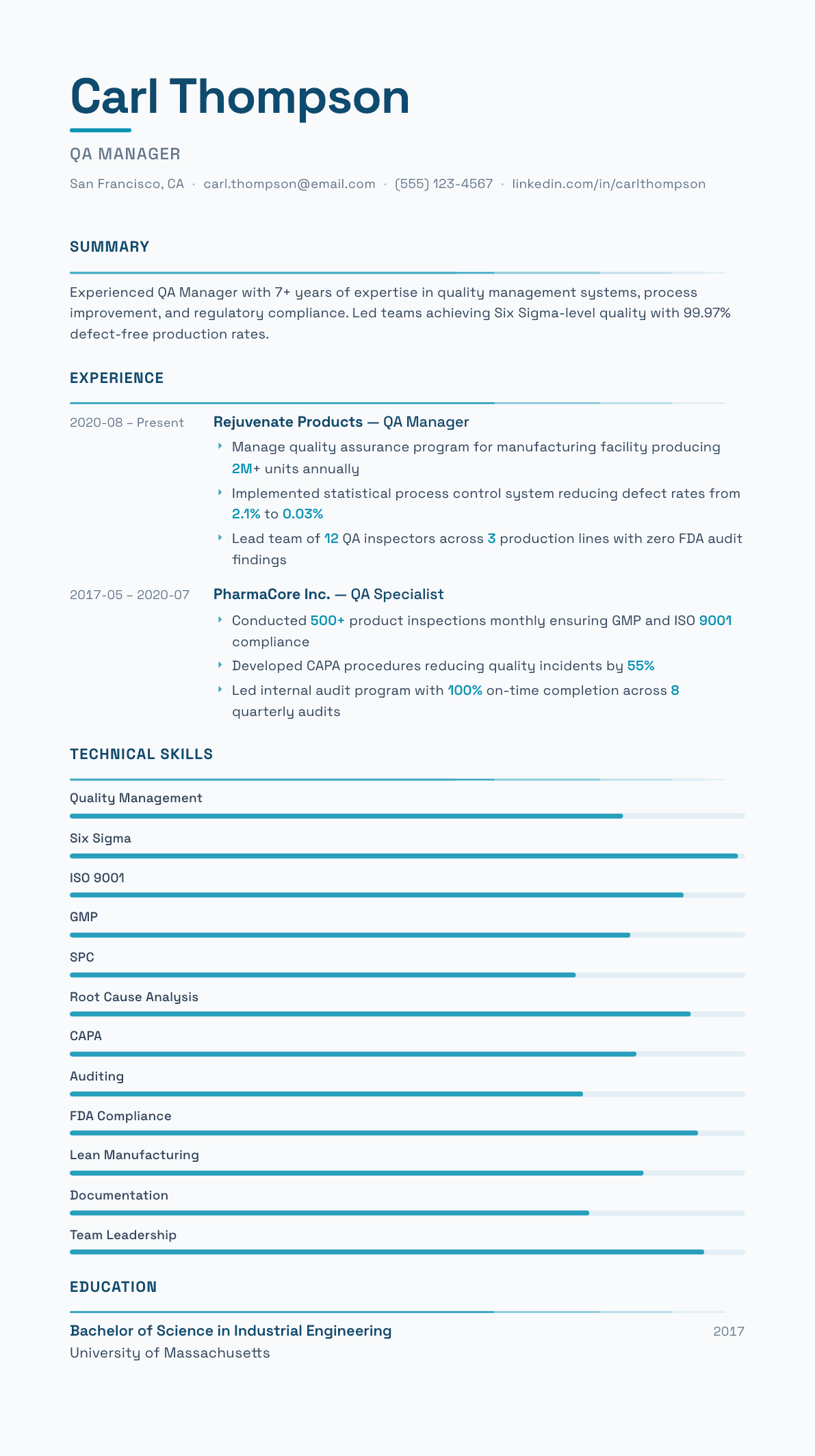
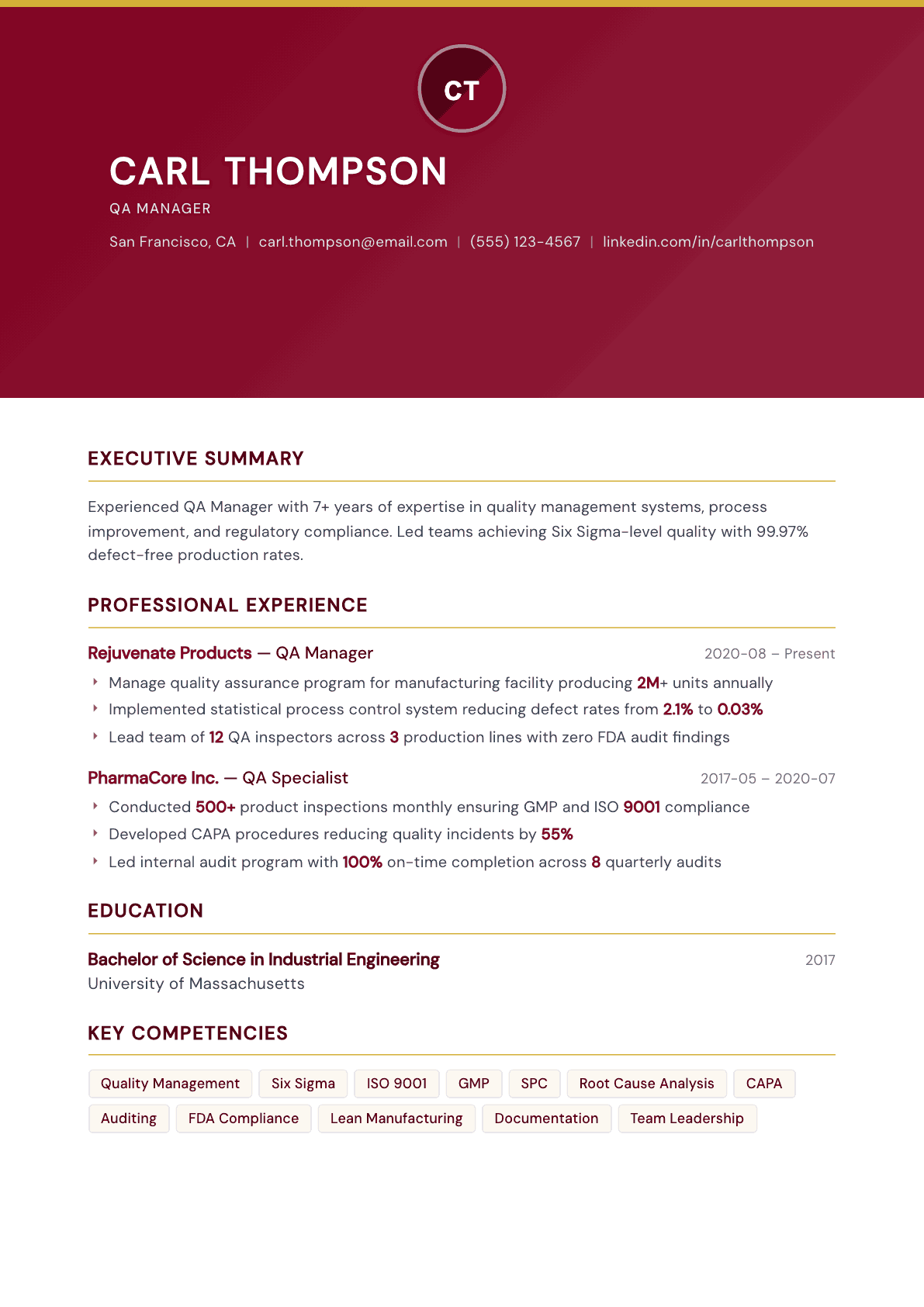
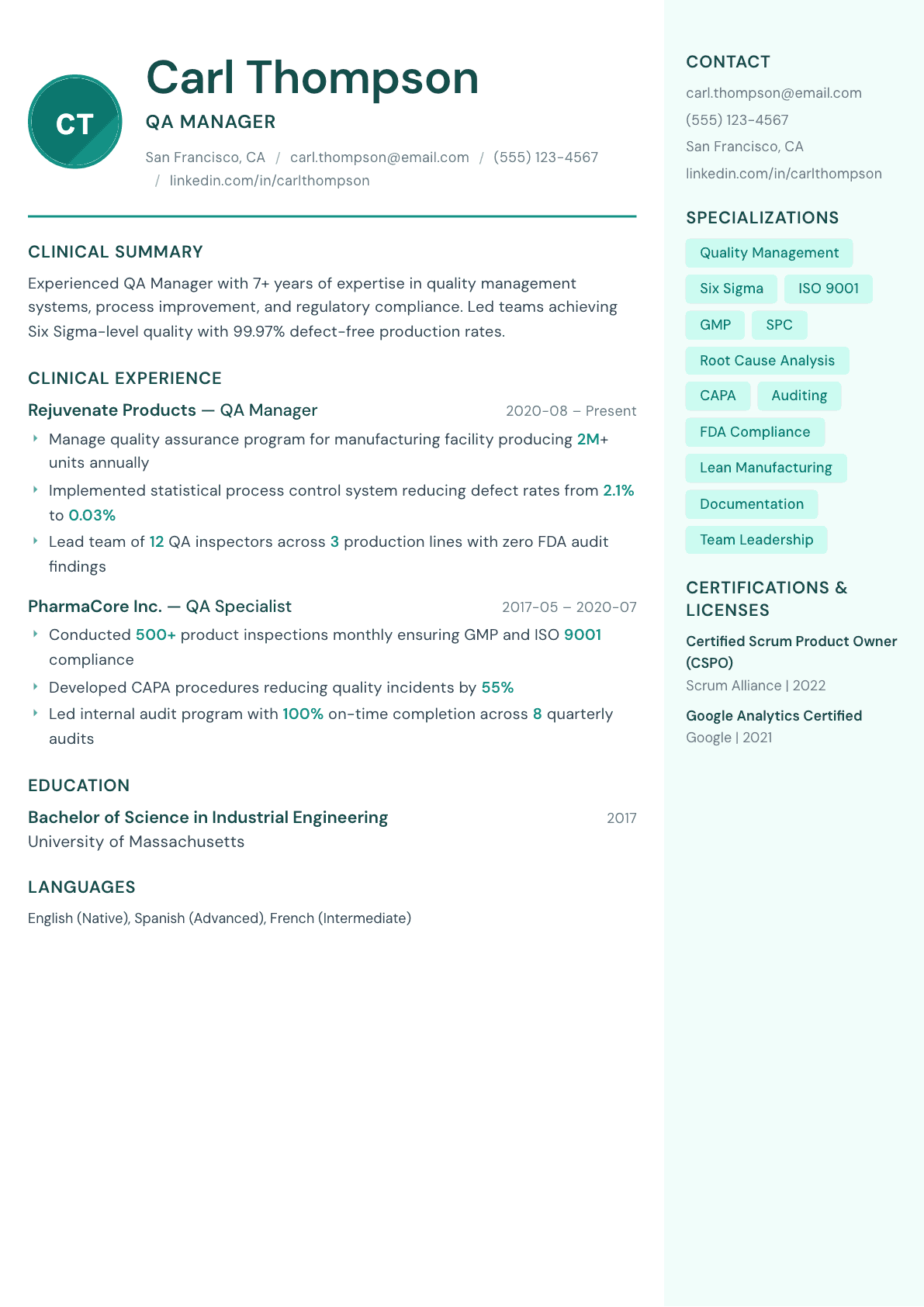
Example Quality Assurance summary
QA manager, 7 years across consumer products and pharmaceutical manufacturing, running quality for a plant making 2M units a year. Took defects from 2.1% to 0.03% with statistical process control, leads 12 inspectors on three lines, and has cleared FDA audits with no findings.
Skills to list on a Quality Assurance resume
- Quality Management
- Six Sigma
- ISO 9001
- GMP
- SPC
- Root Cause Analysis
- CAPA
- Auditing
- FDA Compliance
- Lean Manufacturing
- Documentation
- Team Leadership
What actually gets this resume read
- List certifications (Six Sigma, CQE, CQA, Lead Auditor).
- Quantify: defect rates, compliance scores, audit results.
- Include specific quality standards and regulatory frameworks.
- Show process improvement initiatives and their measurable impact.
- Highlight team leadership and cross-functional collaboration.
How to write a quality assurance resume
A quality assurance resume is read against a regulatory context. The same job title covers an inspector checking dimensions on a machining floor, a systems specialist keeping a plant certified to a quality management standard, and a regulated-industry professional writing deviations under good manufacturing practice. Each one is screened for different evidence, and a resume that never names the standard it worked under gets sorted into the wrong pile or none at all.
The hiring manager, usually a quality manager or a director of quality, is looking for four things. Which standards and regulations you have operated under. Whether you have faced an external auditor and what the findings were. Whether you can write and close a corrective action that survives review. And whether you can read the data, meaning statistical process control charts, capability studies and sampling plans, rather than only filling in forms.
This guide covers the structure quality leaders expect, three summaries from inspector to quality manager, before-and-after bullets built on audits and corrective actions, and the questions quality assurance professionals ask when moving between industries.
Format: standards and industry visible in the first inches
Reverse chronological, one page under seven years and two after that. Directly under the summary put a compliance block: the standards and regulations you have worked to, the audit types you have faced or conducted, and the industry. That block is the fastest possible answer to the screening question and it doubles as the keyword surface.
Under each job add a scope line: the product, the site type, the volume, the size of the quality team, and whether you reported into quality or into operations, because the independence of the quality function matters to anyone hiring in a regulated plant.
- Header: name, city and state, phone, email, plus quality certifications held.
- Order: summary, standards and compliance block, experience, certifications, education, technical skills.
- Inspectors moving into quality assurance should keep the measurement equipment list, which proves technical credibility.
Summary: standard, industry, scope, and the audit record
Name the quality management standard the site is certified to and any regulation that governs the product, then the industry, then the scope of what you owned. Close with the audit line, because that is the sentence a director rereads: hosting a registrar surveillance audit or a regulatory inspection and coming out with no major finding is the strongest single claim in this field.
Do not write detail-oriented. Every quality assurance resume in the stack says it, and the correct way to prove it is a corrective action that closed and stayed closed.
Audits and corrective action: the core of the job
Split the two. For audits, say which side of the table you were on. Internal audits you planned and led, supplier audits you conducted and the escalations that followed, and external audits you hosted, with the registrar or authority named generically and the outcome given as observations, minor findings or major findings.
For corrective action, describe the machinery rather than the acronym. How nonconformances were captured, how you scoped containment, which root cause method you used, whether you verified effectiveness after implementation, and how long the queue took to close. Anyone can write that they managed corrective actions. Very few write the aging of their backlog, which is what a quality manager is actually judged on.
The data: control charts, capability and sampling
Statistical work is what separates a quality assurance professional from an inspector. Name what you have run: control charts by characteristic, process capability studies, gage repeatability and reproducibility studies on the measurement system, sampling plans against a recognized inspection standard, and the analysis software you used, such as Minitab or the statistics module in the quality system.
Then attach the numbers this field measures: defect rate in parts per million, first pass yield, scrap and rework, customer complaint rate, supplier acceptance rate, and cost of poor quality expressed as a share rather than a currency figure.
Documentation, validation and the systems in use
Document control is a large part of the role and it is worth its own bullets: controlled procedures and work instructions you authored, revision control, training records tied to procedure changes, and record retention. In regulated manufacturing add validation work, meaning installation, operational and performance qualification protocols you wrote or executed, plus change control.
Finally, name the systems. The quality management software the site runs, the enterprise resource planning package, the document control platform, and the measurement equipment you are competent on including coordinate measuring machines, optical comparators and calibrated hand gages. Recruiters filter on those names.
QA resume and quality analyst resume samples by industry
Quality assurance analyst is the title used for this job in manufacturing, software and regulated industries, and the resume changes with the setting. A quality assurance analyst resume in a plant leads with the standard and the inspection data; in software it leads with the test types and tools; in pharmaceutical or food production it leads with the regulations and batch records.
A QA resume, a quality analyst resume and a quality assurance analyst resume are the same document under three names. Use the exact title from the posting in your headline, because an applicant tracking system matches the words as written, and keep QA spelled out once as quality assurance so both versions appear on the page.
The three quality assurance analyst resume samples below show the summary and the first two bullets for each setting. Keep the same skeleton as the rest of this guide: standard or method first, then scope, then the audit or defect record.
- Sample one, manufacturing: Quality Assurance Analyst, four years in an automotive parts plant working under IATF 16949. Analyzes inspection and control chart data for three stamping lines, leads corrective action investigations and prepares the monthly supplier quality report.
- Sample one, second bullet: Built a weekly scrap and rework review with production supervisors that cut repeat nonconformances on the highest volume part by a third within two quarters.
- Sample two, software: Quality Assurance Analyst, three years testing web and mobile applications for an insurance company. Writes test plans and cases in Jira and TestRail, runs regression and user acceptance testing for every release and automates core flows in Selenium.
- Sample two, second bullet: Automated the regression suite for the claims portal, so a full regression run now takes one afternoon instead of three days of manual testing.
- Sample three, pharmaceutical or food: Quality Assurance Analyst, five years in a contract food manufacturer under SQF and FDA rules. Reviews batch records before release, maintains the HACCP plan and supports customer and certification audits.
- Sample three, second bullet: Led preparation for the annual SQF audit for two cycles with no major nonconformances, and trained line leads on correct record keeping.
Quality Assurance resume summary examples
Quality inspector
Quality inspector with 3 years in precision machining, performing first article and in-process inspection against drawings using coordinate measuring machines, micrometers and gages. Records nonconformances in the quality system, supports internal audits, and completed a certified inspector credential last year.
Quality engineer or specialist
Quality assurance specialist with 6 years in medical device manufacturing, owning corrective and preventive action, supplier qualification and the internal audit program. Closed a backlog of 40 open actions to a rolling 30-day average and hosted a registrar surveillance audit with no major finding.
Quality manager
Quality manager with 12 years across regulated food and pharmaceutical manufacturing, leading a team of 9 across inspection, documentation and validation. Owns the quality management system for two sites, chairs the management review, and has hosted 5 regulatory inspections without a critical observation.
Work experience bullets: before and after
Before: Responsible for quality assurance at the manufacturing site.
After: Owned the quality management system for a 200-person site, leading a team of 9 across incoming inspection, in-process checks, document control and validation.
Site size, team size and the functions owned define the scope a quality director is hiring against.
Before: Managed corrective actions and investigations.
After: Ran the corrective action queue end to end, cutting a backlog of 40 open items to a rolling 30-day average close time by adding containment triage and effectiveness verification at closure.
Backlog aging and a closure mechanism are the numbers a quality manager is measured on, unlike the phrase managed corrective actions.
Before: Participated in audits.
After: Hosted 3 registrar surveillance audits and 2 customer audits as the primary contact, prepared the evidence packs, and closed all minor findings within the agreed response window.
Naming the audit type, the role and the finding outcome proves audit experience instead of audit attendance.
Before: Used statistical tools to monitor quality.
After: Set control charts on 12 critical characteristics, ran capability studies before release, and completed gage studies that removed a measurement system as the suspected source of variation.
Named studies demonstrate statistical competence rather than familiarity with the vocabulary.
Before: Improved supplier quality.
After: Qualified 8 new suppliers through on-site audits and first article approval, and cut incoming lot rejections by a third by moving 3 recurring defects into supplier corrective actions.
The qualification path and the rejection result connect supplier work to a measurable plant outcome.
Hard skills
- Quality management systems
- Internal and supplier auditing
- Corrective and preventive action
- Root cause analysis methods
- Statistical process control
- Process capability studies
- Gage repeatability and reproducibility
- Sampling plans and inspection standards
- Document and change control
- Validation and qualification protocols
- Nonconformance and deviation handling
- Coordinate measuring machine operation
Soft skills
- Holding a position under production pressure
- Audit interview composure
- Technical writing for procedures
- Cross functional investigation leadership
- Training operators on requirements
- Escalation judgment on a release decision
Certifications worth listing
- Certified Quality Engineer (CQE) (American Society for Quality)
- Certified Quality Auditor (CQA) (American Society for Quality)
- Certified Quality Inspector (CQI) (American Society for Quality)
- Certified Manager of Quality/Organizational Excellence (CMQ/OE) (American Society for Quality)
- Certified Six Sigma Black Belt (CSSBB) (American Society for Quality)
- ISO 9001 Lead Auditor (Exemplar Global)
Mistakes that cost quality assurance candidates the interview
- Never naming the standard or regulation the site operated under, which makes the whole file unreadable to a regulated employer.
- Writing that you managed corrective actions without a single number on volume, aging or closure.
- Claiming audit experience without saying whether you led, hosted or merely attended, and what the findings were.
- Listing statistical tools as keywords with no study, characteristic or decision attached to any of them.
- Using detail-oriented and quality-focused as substitutes for evidence, when both appear on every competing resume.
- Leaving out the measurement equipment and quality software, which are the terms recruiters filter on first.
- Applying a software testing version of a quality assurance resume to a manufacturing posting, or the reverse, without rewriting the vocabulary.
Quality Assurance resume questions
How do I show which quality standards I have worked under?
Put a compliance block under the summary listing every standard and regulation you have operated to, along with the audit types you have faced. Repeat the most relevant one inside a bullet where it is demonstrated so the claim has evidence behind it.
What metrics belong on a quality assurance resume?
Defect rate in parts per million, first pass yield, scrap and rework, customer complaint rate, supplier acceptance rate, corrective action backlog and average close time, and audit findings by severity. Choose the ones your target industry reports on.
Is a QA resume different from a quality analyst resume?
No. QA resume, quality analyst resume and quality assurance analyst resume describe the same job, and the content changes with the industry, not the name. Copy the title the posting uses into your headline, write quality assurance in full once, and lead with the standards or test methods that industry screens for.
What does a quality assurance analyst resume need?
A summary naming the industry, the standard or testing method and your scope, then bullets with the audits you supported, the defects or nonconformances you investigated and what changed as a result. Software analysts list test types and tools; manufacturing and food analysts list standards, inspection methods and batch review. The samples above show one of each.
Does a Six Sigma belt help a quality assurance candidate?
It helps when it comes from a recognized body and carries a documented project. Quality leaders read the project, not the belt, so name the problem, the method, the measurement system work and the sustained result after the change was implemented.
Related resume examples
- Operations Manager Resume example
- Project Manager Resume example
- Production Worker Resume example
- Manufacturing Supervisor Resume example
- Production Supervisor Resume example
- Production Manager Resume example