Real Estate Transaction Coordinator Resume Examples
Write a Transaction Coordinator Resume That Shows Files Closing On Time
By Mustafa Tarabya, founder of CVBooster · Published · Updated
Real estate transaction coordinator resume example, keyword list and writing guide covering file volume, contract to close timelines, compliance and CRM tools.
Sample resumes for a real estate transaction coordinator
The same real estate transaction coordinator content laid out in three CVBooster templates, so you can see what the finished document looks like before you write a word.
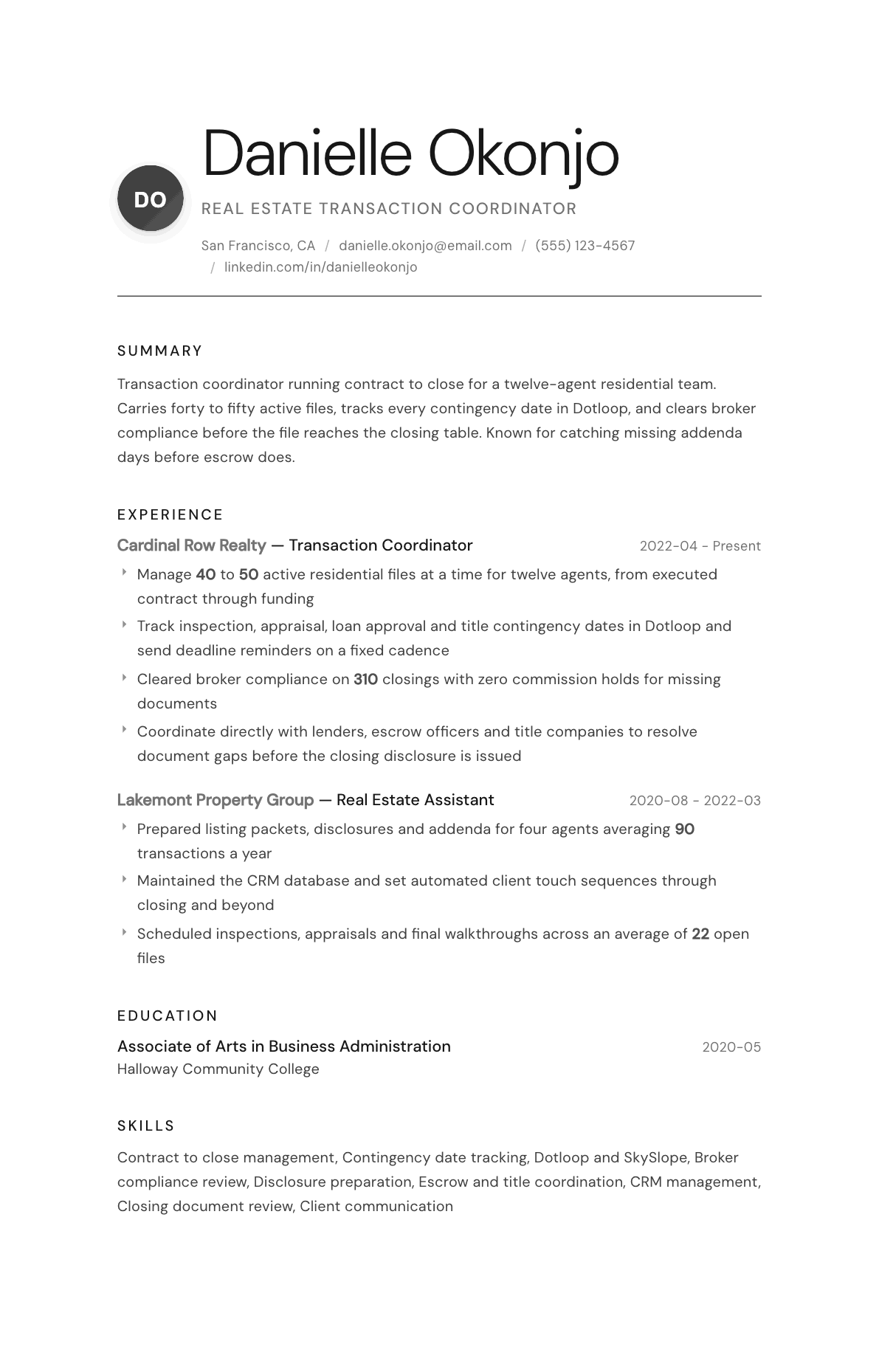
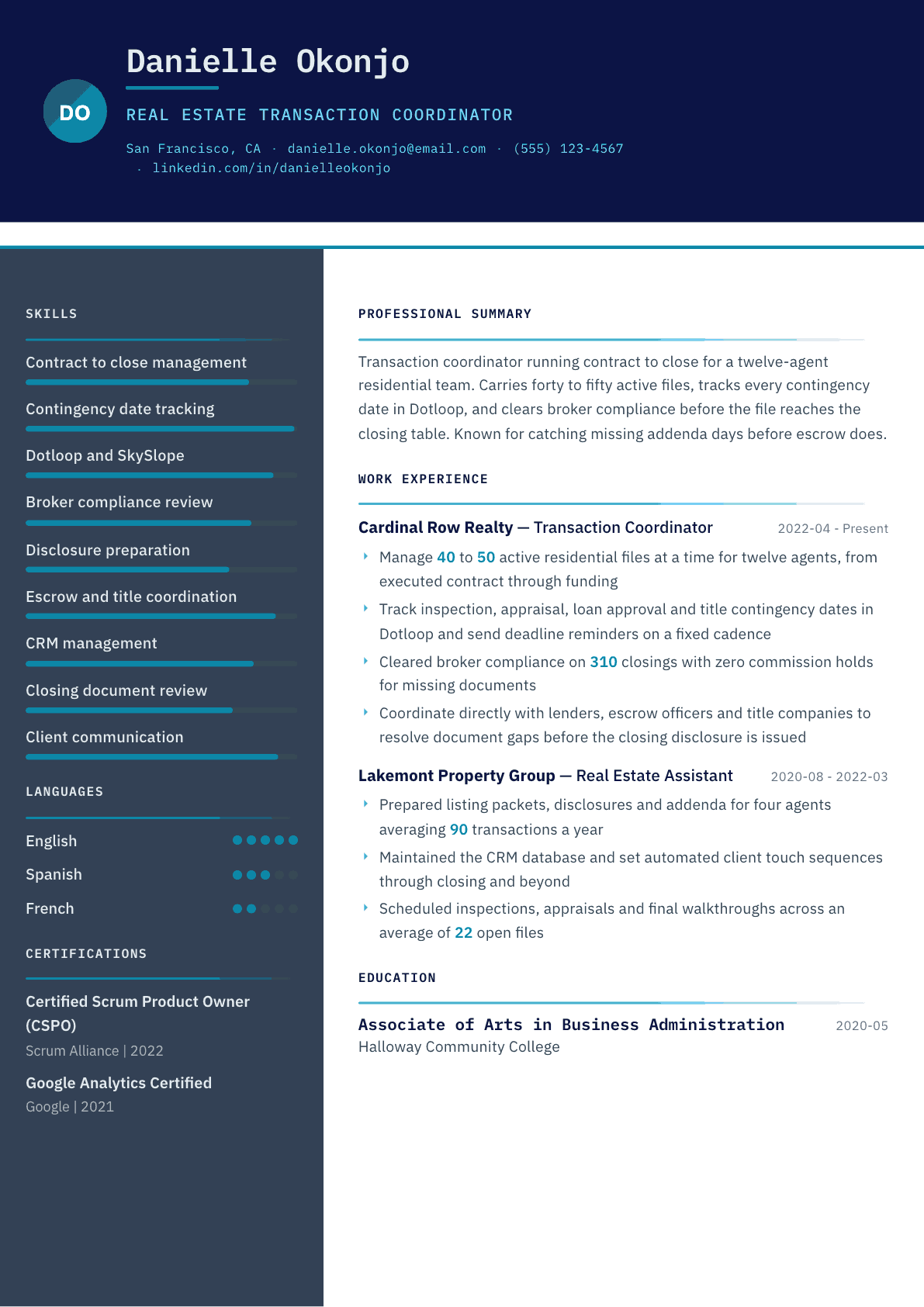
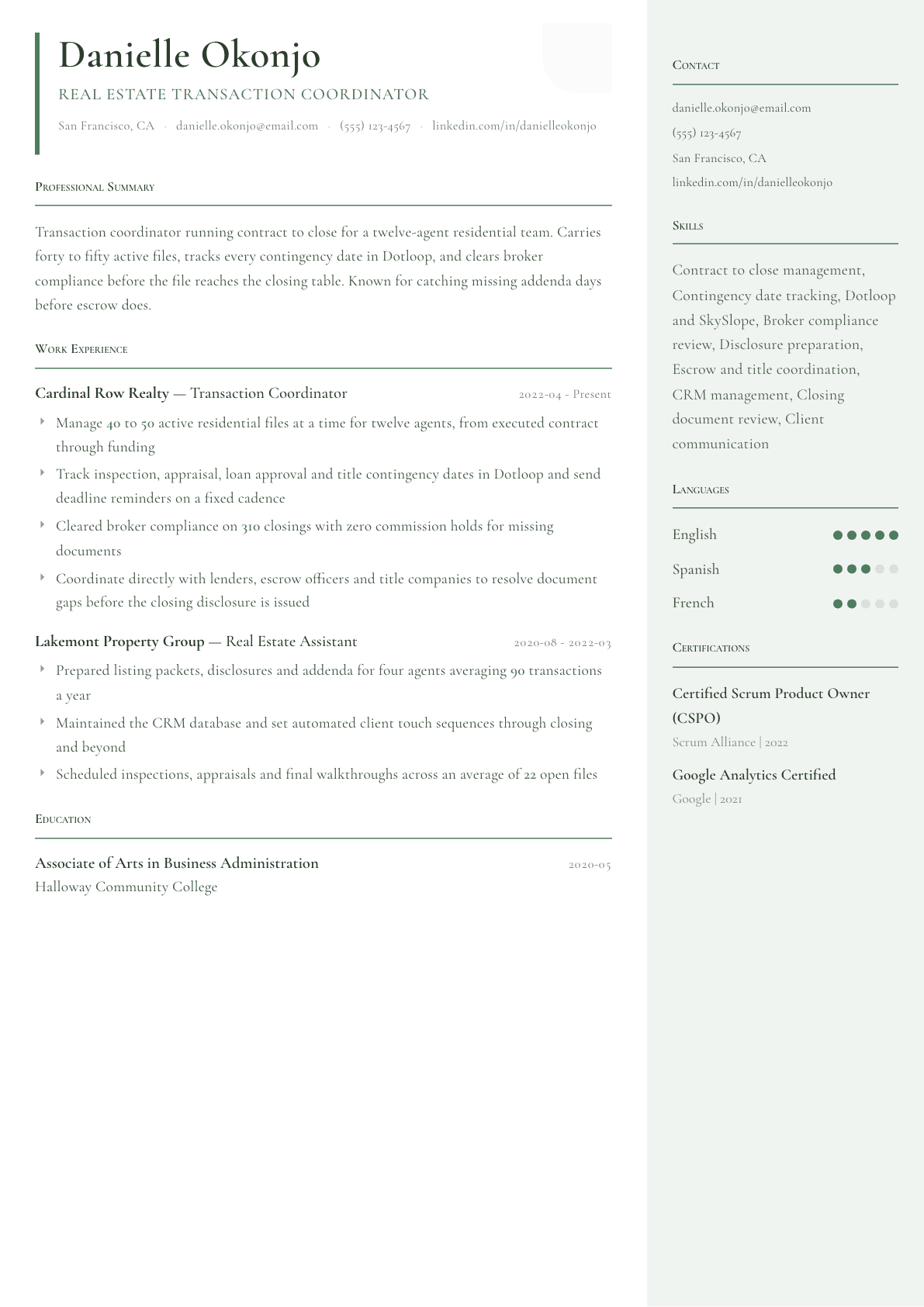
Example Real Estate Transaction Coordinator summary
Transaction coordinator with four years running contract to close for residential teams, currently carrying forty to fifty active files for twelve agents. Tracks every contingency date in Dotloop, prepares disclosures and addenda, and clears broker compliance before funding. Closed more than three hundred files with no commission holds. Coordinates daily with lenders, escrow officers and title companies to keep dates from slipping.
Skills to list on a Real Estate Transaction Coordinator resume
- Contract to close coordination
- Purchase agreement review
- Contingency and deadline tracking
- Addendum and disclosure preparation
- Broker compliance auditing
- Escrow and title coordination
- Lender document follow-up
- Dotloop and SkySlope
- Brokermint
- DocuSign and electronic signature
- MLS listing input
- CRM and pipeline management
- Closing statement review
- Client status reporting
What actually gets this resume read
- Say how many active files you carry at once and how many agents you support, because both define the workload.
- Report closings completed per year and your record on compliance holds, which is the broker's real worry.
- Name the transaction platform you use, whether that is Dotloop, SkySlope, Brokermint or a state association form set.
- Show that you track contingency dates rather than just filing documents, and describe your reminder cadence.
- List the states you have closed in, since disclosure packets and attorney involvement differ from state to state.
- Mention whether you hold a real estate license, because some brokerages require one for contract handling.
- Give one example of a save: a missing addendum or expiring contingency you caught before it delayed funding.
How to write a real estate transaction coordinator resume
A transaction coordinator is hired to make sure nothing falls through the cracks between an accepted offer and a funded closing. The broker or team lead reading your resume is asking one silent question: if I hand you forty files, will any of them blow a contingency date? Everything on the page should answer that.
Most resumes for this role read like general administrative support. They list scheduling, filing, answering calls and helping agents, which describes an assistant rather than someone who owns a file from contract to close. The distinction matters, because the coordinator role carries deadline risk and compliance risk that an assistant does not.
This guide covers how to state your file load, how to write about contingency tracking and broker compliance, which platforms to name, and how to describe the saves you have made, which is the part experienced brokers remember from an interview.
Format: one page, load and volume up top
One page. Coordinators are hired quickly, often to fill a gap, and the reader is scanning for capacity rather than career narrative.
Because many teams and brokerages hire coordinators as contractors, add a line stating whether you work in office, remote or hybrid, and how many agents you can support concurrently. Leaving that out is the most common reason a qualified coordinator gets passed over for a remote posting.
- Header: name, city and state, phone, email, work arrangement, and your real estate license number if you hold one.
- Section order: summary, capacity and file volume, experience, systems and platforms, states closed in, education.
- Give every role a scope line: agents supported, active files carried, transaction types and annual closings.
- Add a short states line, because disclosure packets and attorney involvement change from one state to the next.
Capacity: active files, agents supported, closings a year
Three numbers define this job. How many files you carry at once, how many agents feed you, and how many closings you completed in a year. Forty to fifty active files for twelve agents and three hundred closings is an instantly readable capacity statement, and it is what a team lead will compare against their own volume.
Say what kind of files. Residential resale, new construction with builder addenda, short sale, relocation, and small commercial all carry different document sets and timelines. A coordinator who has only done clean resale files will struggle on a builder contract, and brokers know it.
If your volume was seasonal, give the peak rather than the average and label it. Carrying sixty active files in a spring market is a stronger claim than a flat annual number, provided you say which one you are reporting.
Contingency tracking is the actual job
Write about dates, not documents. Inspection period, appraisal delivery, loan approval, title objection, final walkthrough and funding all have deadlines that create rights and penalties, and a coordinator who tracks them is worth more than one who files paperwork accurately after the fact.
Describe your cadence explicitly. When the reminder goes out relative to the deadline, who receives it, whether it is automated inside the platform or sent by you, and what you do when an agent does not respond. That level of detail tells a broker exactly how the pipeline will feel once you are running it.
Then add the escalation rule. A coordinator who knows when to stop emailing and call the lender, the escrow officer or the listing agent directly is the one who prevents extensions, and extensions are what team leads are trying to avoid when they hire.
Broker compliance and the file that has to close audit
Every brokerage holds commission until the file is complete, so compliance clearance is a measurable achievement. Say how many files you have submitted, how many were returned for corrections, and whether any commission was held. Zero holds across three hundred closings is a hard number and it lands.
Name the compliance elements you handle: signed and initialed pages, agency disclosures, lead-based paint acknowledgments where applicable, wire instruction confirmations, and the addenda that amend original terms. Being specific proves you have read the file rather than uploaded it.
Where your state requires an attorney at closing or has its own association form set, mention that. Coordinators who have worked in an attorney state understand a different closing rhythm and it is a reason to prefer one candidate over another.
Systems, communication and the client experience
Name the transaction platform. Dotloop, SkySlope and Brokermint each structure loops, tasks and audit trails differently, and a brokerage running one of them will favor a coordinator who already knows it. Add the electronic signature tool, the MLS you input listings into, and the customer relationship system where you log client touches.
Client communication is part of the product. A weekly status message to buyer, seller and agent, sent on a fixed day, removes most of the calls a team lead would otherwise take. If you run one, describe it: the day, the format and what it contains.
Finally, describe the handoff points. Introducing yourself to the lender and escrow officer early, confirming the title order, and requesting the closing figures ahead of time are small habits that show you work the file forward rather than react to it.
Real Estate Transaction Coordinator resume summary examples
Moving in from real estate admin
Real estate assistant with two years preparing listing packets, disclosures and addenda for four agents, scheduling inspections and appraisals across an average of 22 open files. Trained on Dotloop and DocuSign, familiar with state association forms, and ready to own contract to close for a producing team.
Coordinator for a producing team
Transaction coordinator carrying 40 to 50 active residential files for twelve agents, tracking every contingency date in Dotloop and clearing broker compliance before funding. Completed 310 closings with no commission held for missing documentation, coordinating directly with lenders, escrow officers and title companies.
Lead coordinator across brokerages
Lead transaction coordinator with seven years across resale, new construction and relocation files, licensed in two states and closing more than four hundred transactions a year. Built the compliance checklist and status reporting cadence now used by two teams, and trains incoming coordinators on contingency management.
Work experience bullets: before and after
Before: Assisted agents with paperwork from contract to closing.
After: Managed 40 to 50 active residential files at a time for twelve agents, owning every step from executed contract through funding and post-closing file submission.
Load and agent count define capacity, and "owning" states responsibility that "assisted" quietly gives away.
Before: Kept track of important dates in each transaction.
After: Tracked inspection, appraisal, loan approval and title contingency dates in Dotloop, sending reminders on a fixed cadence and calling the lender directly when a response was overdue.
Naming the deadlines, the system and the escalation rule shows a process instead of an intention.
Before: Made sure files were complete for the broker.
After: Cleared broker compliance on 310 closings with zero commission holds, checking agency disclosures, initialed pages, amended terms and wire instruction confirmations before submission.
A closing count with a clean hold record is verifiable, and the listed elements prove the review was substantive.
Before: Communicated with clients during the transaction.
After: Sent a fixed Wednesday status message to buyer, seller and agent listing completed milestones, open items and the next deadline, which cut inbound status calls to the team lead.
A named cadence and format shows a system that reduces someone else's workload, which is why the role exists.
Before: Caught mistakes in contracts before closing.
After: Identified a missing financing addendum four days before the contingency expired and had it executed the same afternoon, preventing an extension on a builder contract.
One specific save with a timeline is more persuasive than a general claim of attention to detail.
Hard skills
- Contract to close management
- Purchase agreement and addenda review
- Contingency and deadline tracking
- Broker compliance file submission
- Agency and property disclosure preparation
- Escrow and title coordination
- Lender document follow-up
- Dotloop and SkySlope
- Brokermint
- DocuSign and electronic signature
- MLS listing input and status changes
- CRM and pipeline tracking
- Closing statement review
- Post-closing file archiving
Soft skills
- Deadline discipline
- Chasing without irritating
- Written status clarity
- Working with distracted agents
- Staying calm in the final week
Certifications worth listing
- e-PRO Certification (National Association of REALTORS)
- Certified Real Estate Team Specialist (C-RETS) (Real Estate Business Institute)
Mistakes that cost real estate transaction coordinator candidates the interview
- Writing the resume as general office support, which hides the deadline and compliance responsibility the job carries.
- Leaving out the number of active files carried, the single measure of coordinator capacity.
- Naming a transaction platform without saying whether you built loops, set tasks or only uploaded documents.
- Failing to state the states you have closed in when disclosure and attorney rules differ across them.
- Skipping the commission hold or compliance return record, which is the quality metric a broker cares about.
- Omitting whether you work remotely and how many agents you can support at once.
- Listing only clean resale experience when the team you are applying to sells new construction or relocation.
Real Estate Transaction Coordinator resume questions
Do I need a real estate license to work as a transaction coordinator?
Requirements vary by state and by brokerage. Some states restrict certain contract discussions to licensees, and many brokerages prefer a licensed coordinator for that reason. If you hold a license, put the number in the header; if not, say that you work under broker supervision.
How many files can a transaction coordinator realistically handle?
That depends on transaction complexity, whether the brokerage automates reminders, and how much client communication you own. Rather than guessing at an industry figure, state the load you actually carried and the systems that made it possible, and let the hiring team judge the fit.
Should I list every brokerage I have contracted with as an independent coordinator?
Group them. Create one entry for your coordinating business with the date range, then list the teams or brokerages served as bullets with volume for each. That keeps the page readable and avoids a resume that looks like a series of short jobs.
What is the difference between a transaction coordinator and a real estate assistant on a resume?
A coordinator owns the file from executed contract through compliance clearance and carries the deadlines. An assistant supports the agent across marketing, scheduling and listing preparation. If you have done both, split them into separate roles so the coordinator experience is not diluted.
How do I show value if my brokerage never measured my compliance record?
Reconstruct what you can defend: closings completed, average files open, how many times a closing was delayed for a document issue you owned. If you have none of that, describe your checklist and cadence in detail, since process specificity still separates you from a generic administrative resume.
Related resume examples
- Real Estate Agent Resume example
- Real Estate Assistant Resume example
- Escrow Officer Resume example
- Title Agent Resume example
- Realtor Resume example
- Real Estate Broker Resume example