HVAC Service Technician Resume Examples: free ATS score
Write an HVAC Service Technician Resume That Books Calls
By Mustafa Tarabya, founder of CVBooster · Published · Updated
HVAC service technician resume example with keywords and a guide to writing refrigeration diagnostics, EPA certification and service call experience.
Sample resumes for a hvac service technician
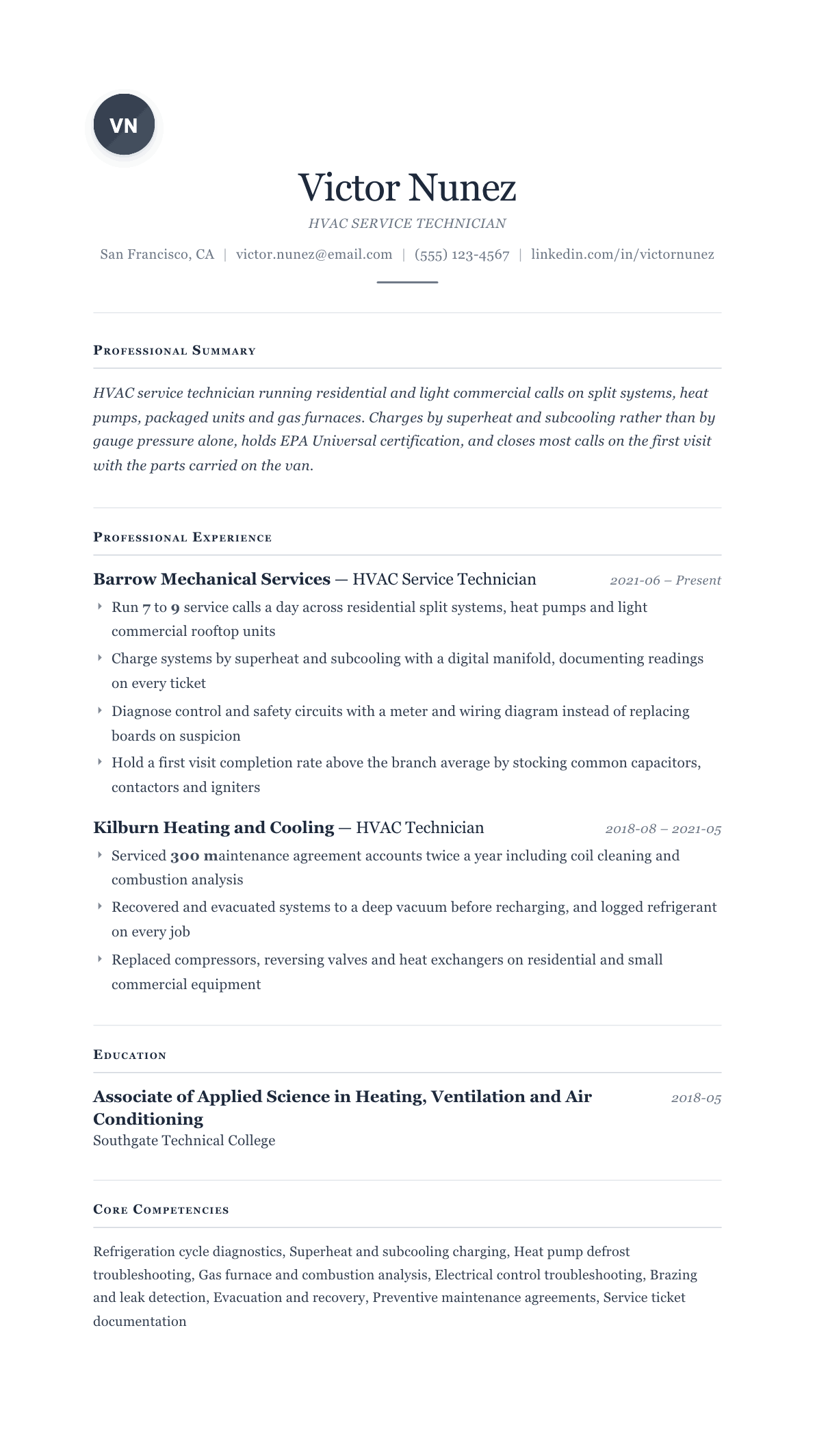
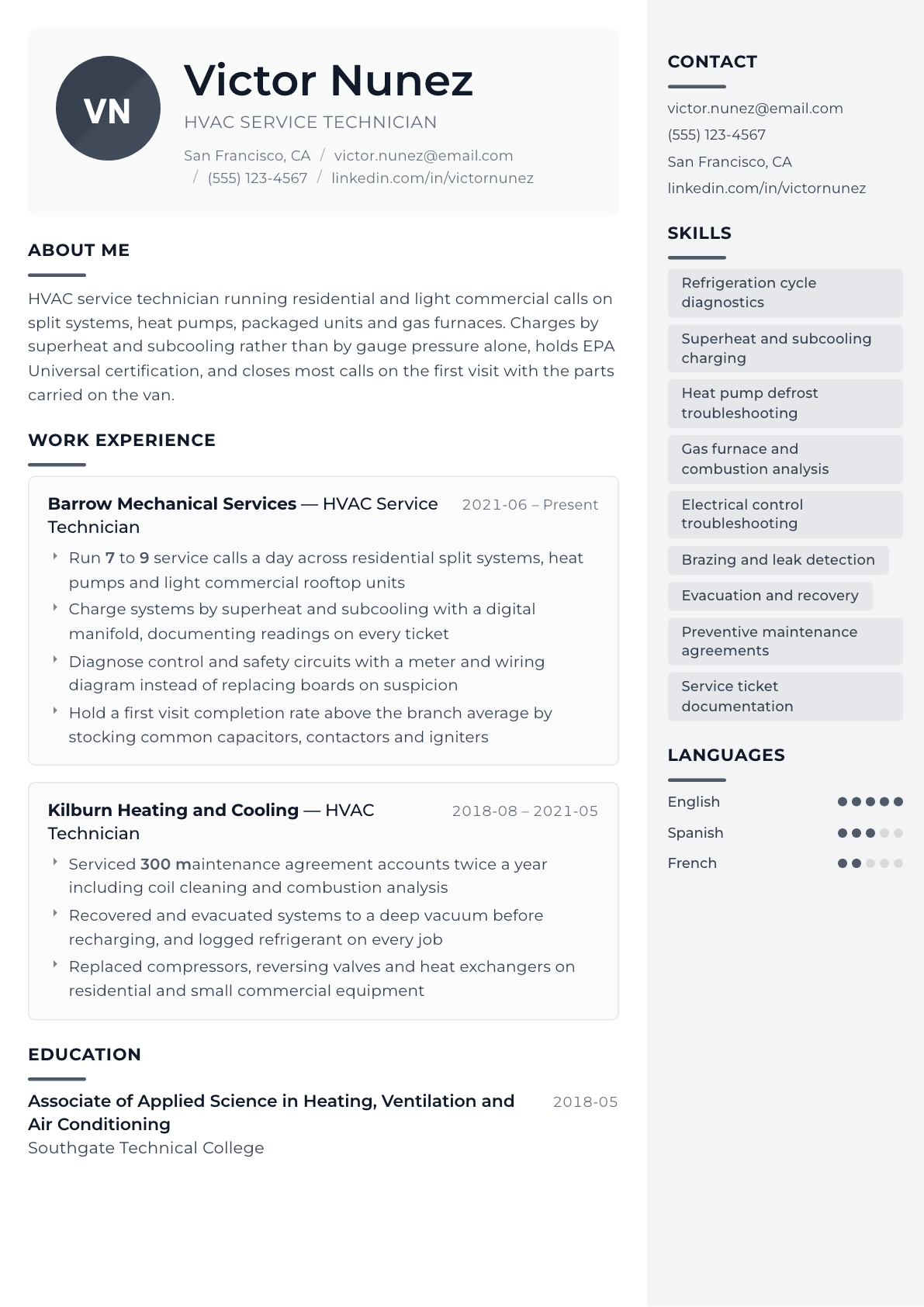
The same hvac service technician content laid out in three CVBooster templates, so you can see what the finished document looks like before you write a word.

Example HVAC Service Technician summary
HVAC service technician with seven years on residential and light commercial calls covering split systems, heat pumps, packaged rooftop units and gas furnaces. Charges by superheat and subcooling with a digital manifold, tests control circuits against the wiring diagram before condemning a board, and documents readings on every ticket. EPA Universal certified, and closes most calls on the first visit from van stock.
Skills to list on a HVAC Service Technician resume
- Refrigeration cycle diagnostics
- Superheat and subcooling charging
- Heat pump and defrost controls
- Gas furnace troubleshooting
- Combustion analysis
- Electrical and control circuit testing
- Compressor replacement
- Brazing and nitrogen purging
- Leak detection and repair
- Evacuation to deep vacuum
- Refrigerant recovery and logging
- Ductwork and airflow measurement
- Preventive maintenance agreements
- Service ticket and invoice documentation
- Customer explanation and quoting
What actually gets this resume read
- Put your EPA certification type in the header area, because a service manager screens for it immediately.
- Split residential from light commercial work, since rooftop units and split systems are booked differently.
- Show calls per day and first visit completion, which are the two numbers a service dispatcher cares about.
- Name the equipment brands and refrigerants you have worked, including newer low global warming blends.
- Describe your charging method rather than writing charged systems, because that reveals real diagnostic habit.
- Mention maintenance agreement work and any sold replacements, as service technicians are judged on both.
How to write a hvac service technician resume
A service manager filling an HVAC seat is trying to answer one question from your resume: can this technician be sent alone to a house with no heat, find the fault, fix it on the first visit and leave the customer willing to renew the maintenance agreement. Installation experience is useful, but service is a different discipline, and the resume has to prove the diagnostic half specifically.
The gap in most HVAC resumes is method. They list equipment worked on and tasks performed, and never show how a fault was found. Two technicians can both write that they repaired a system that was not cooling. Only one of them writes that he took superheat and subcooling readings, compared them against the metering device type, and found a restricted filter drier rather than adding refrigerant to a system that was not short of it.
This guide walks through the sections a service company reads, with summaries for a helper moving into service, a settled residential technician and a senior technician handling light commercial equipment, plus rewritten bullets and the questions technicians ask when changing employers or moving from install to service.
Format: certification visible immediately, equipment listed by type
One page for most technicians, two once you carry a long certification list and commercial refrigeration experience. Put your refrigerant handling certification type in the header area, because a service manager screens for it before anything else and an unlicensed technician cannot be dispatched.
Then list equipment by type rather than by brand alone: split systems, heat pumps, packaged rooftop units, gas furnaces, boilers, mini splits, light commercial refrigeration. A dispatcher builds routes around equipment types, so that block is what places you on a board.
- Header: name, city and state, phone, email, refrigerant handling certification type and driver license status.
- Equipment block: system types, tonnage range, refrigerants worked including newer low global warming blends, and control platforms.
- Tools line: digital manifold, combustion analyzer, recovery machine, micron gauge, meters and any manufacturer diagnostic software.
- Then experience with calls a day and first visit completion, then certifications, then a skills list that keeps electrical and refrigeration terms separate.
Summary: calls a day, equipment range and diagnostic method
Three lines. Give the years, the residential or commercial split, the calls you run a day, and one sentence about how you charge and diagnose. Method is the differentiator: charging by superheat and subcooling with a digital manifold says more about your competence than any list of brands.
Add first visit completion if you know it. A technician who closes most calls without a return trip saves the company a second dispatch and a frustrated customer, and it is the number a service manager most wishes were on every resume in front of him.
Experience: the fault, the reading, the fix
Open each job with the company type, the mix of residential and light commercial work, and the calls you ran a day. Then write bullets that follow a fault from symptom to reading to repair, because that structure is the whole demonstration of a service technician.
Refrigeration side: pressures and temperatures taken, superheat and subcooling compared against the metering device, airflow verified before touching the charge, leak search method used, evacuation to a micron target before recharging, and refrigerant recovered and logged. That sequence, written once in your history, tells a manager you were trained properly.
Electrical side: control voltage tested at the board, safeties and pressure switches checked in circuit, capacitors and contactors measured rather than replaced on suspicion, and wiring diagrams used when a sequence of operation does not match what the equipment is doing. Boards are expensive, and technicians who condemn them without testing are expensive too.
Combustion side: gas pressure set with a manometer, combustion analysis performed, heat exchanger inspected, venting checked, and carbon monoxide readings taken. Heating calls carry the highest safety stakes in the trade, and a technician who documents combustion readings is one a manager can defend.
Maintenance agreements, replacements and the customer half
Service technicians are judged on more than repairs. Maintenance agreement work is the base load of the business, so say how many accounts you covered, what each visit included and whether you kept renewal rates steady. Then say what you found on those visits, since a technician who spots a failing capacitor or a dirty coil before summer is protecting the company from an emergency call it cannot staff.
Replacement recommendations belong here too. Presenting an honest choice between a repair and a system replacement, with the readings that justify it, is the part of the job that generates the largest revenue and the largest complaints. Describe how you present the options rather than claiming a sales figure, and pair it with any customer feedback measure you have.
Skills, certification and the words a service company filters on
The searchable vocabulary is stable: refrigeration cycle, superheat, subcooling, heat pump, defrost board, gas furnace, combustion analysis, brazing, leak detection, recovery, evacuation, control circuit, maintenance agreement, service ticket. Use each where the work is visible so the interview questions have answers behind them.
Certification is not optional in this trade. Refrigerant handling certification is a legal requirement for the work, and industry credentials on top of it give a manager an outside check on your knowledge. List each with the issuing body and keep them current, because a lapsed card is an awkward conversation on the first day.
HVAC Service Technician resume summary examples
Helper moving into service
HVAC technician with two years assisting on residential installations and maintenance visits, now moving into service. Holds universal refrigerant handling certification, comfortable with filter and coil cleaning, capacitor and contactor replacement, and taking pressure and temperature readings under a lead technician.
Five years on service calls
HVAC service technician running seven to nine residential calls a day on split systems, heat pumps and gas furnaces. Charges by superheat and subcooling with a digital manifold, verifies airflow before adjusting a charge, and tests control circuits against the wiring diagram rather than replacing boards on suspicion.
Senior technician
Senior HVAC technician covering residential and light commercial calls including rooftop units and small refrigeration. Handles compressor and heat exchanger replacements, performs combustion analysis on every heating call, mentors two junior technicians, and closes most calls on the first visit from stocked van inventory.
Work experience bullets: before and after
Before: Diagnosed and repaired air conditioning systems.
After: Diagnosed cooling faults by verifying airflow first, then comparing superheat and subcooling against the metering device, which caught restricted driers and dirty coils that would otherwise have been charged as low refrigerant.
The sequence proves a diagnostic method where the original could describe anyone who owns gauges.
Before: Added refrigerant to systems.
After: Recovered, evacuated to a deep vacuum verified with a micron gauge, and recharged by weight, logging refrigerant added and recovered on every ticket.
Evacuation targets and refrigerant logging show both technical care and regulatory discipline.
Before: Replaced control boards and parts as needed.
After: Tested control voltage, safeties and switches in circuit against the wiring diagram before condemning a board, reducing unnecessary board replacements to almost none.
Testing before replacing is the habit that separates a diagnostician from a parts changer, and it saves real money.
Before: Serviced furnaces during heating season.
After: Set gas pressure with a manometer, performed combustion analysis and inspected heat exchangers on every heating call, documenting carbon monoxide readings on the ticket.
Named instruments and documented readings address the safety risk that heating work carries.
Before: Did maintenance visits for customers.
After: Covered 300 maintenance agreement accounts twice a year including coil cleaning, electrical checks and combustion analysis, catching failing capacitors and blocked drains before the cooling season.
Account volume and the failures caught early turn routine visits into prevented emergency calls.
Hard skills
- Refrigeration cycle diagnosis
- Superheat and subcooling charging
- Airflow measurement and static pressure testing
- Heat pump and defrost control troubleshooting
- Gas furnace troubleshooting and gas pressure setting
- Combustion analysis and carbon monoxide testing
- Electrical and control circuit testing
- Compressor and reversing valve replacement
- Brazing with nitrogen purge
- Leak detection and repair
- Recovery and evacuation to micron target
- Refrigerant handling and logging
- Mini split and inverter system service
- Maintenance agreement inspections and service tickets
Soft skills
- Explaining a repair choice to a homeowner without pressure
- Staying methodical on a hot attic call at the end of a long day
- Deciding honestly between a repair and a replacement recommendation
- Keeping a van organized so first visit completion stays high
- Handing a clear ticket to the next technician on a returning job
Certifications worth listing
- Section 608 Universal Certification (United States Environmental Protection Agency)
- NATE Core and Specialty Certification (North American Technician Excellence)
- HVAC Excellence Professional Technician Certification (ESCO Institute)
Mistakes that cost hvac service technician candidates the interview
- Burying the refrigerant handling certification, when a manager cannot dispatch a technician without it.
- Listing equipment worked on with no account of how a single fault was actually found.
- Writing installation experience as if it proves service ability, when the two are judged differently.
- Leaving out calls a day and first visit completion, the two figures a dispatcher thinks in.
- Skipping combustion work, which is the highest risk part of the heating season and the hardest to hire for.
- Ignoring maintenance agreement experience, even though those accounts are the base load of a service business.
HVAC Service Technician resume questions
What certification do I need to work as an HVAC service technician?
Refrigerant handling certification is required by law before you can purchase or work with refrigerants, and universal is the type most employers expect. Industry certifications beyond it are optional but give a service manager an outside measure of your knowledge.
How do I move from installation into service?
Lead with any diagnostic work you have done, including startup readings, commissioning and warranty calls you handled after an install. Then name the instruments you use and the readings you take, since a service manager is buying troubleshooting rather than pipe and duct work.
Should I list every equipment brand I have worked on?
List system types first, then the brands and control platforms you know well. A dispatcher cares whether you can handle a heat pump defrost problem or an inverter mini split, and only then which manufacturer built it.
What numbers belong on an HVAC service resume?
Calls run a day, first visit completion, maintenance accounts covered, and any customer feedback measure your company tracked. If you sold replacements or accessories, give the context rather than a raw figure, since honest presentation matters more than volume.
Does commercial refrigeration experience help for a residential service role?
Yes, because it usually means deeper refrigeration knowledge and more comfort with unfamiliar equipment. Keep it clearly separated on the page so a residential employer can see which parts of your history match the work he is hiring for.
Related resume examples
- HVAC Technician Resume example
- Refrigeration Technician Resume example
- Electrician Resume example
- Maintenance Technician Resume example
- Appliance Repair Technician Resume example
- Boiler Technician Resume example