Release Manager Resume Examples: the lines they read
Ship a Release Manager Resume That Deploys Confidence
By Mustafa Tarabya, founder of CVBooster · Published · Updated
Create a results-focused release manager resume highlighting CI/CD pipelines, deployment orchestration, and cross-team coordination expertise.
Sample resumes for a release manager
The same release manager content laid out in three CVBooster templates, so you can see what the finished document looks like before you write a word.
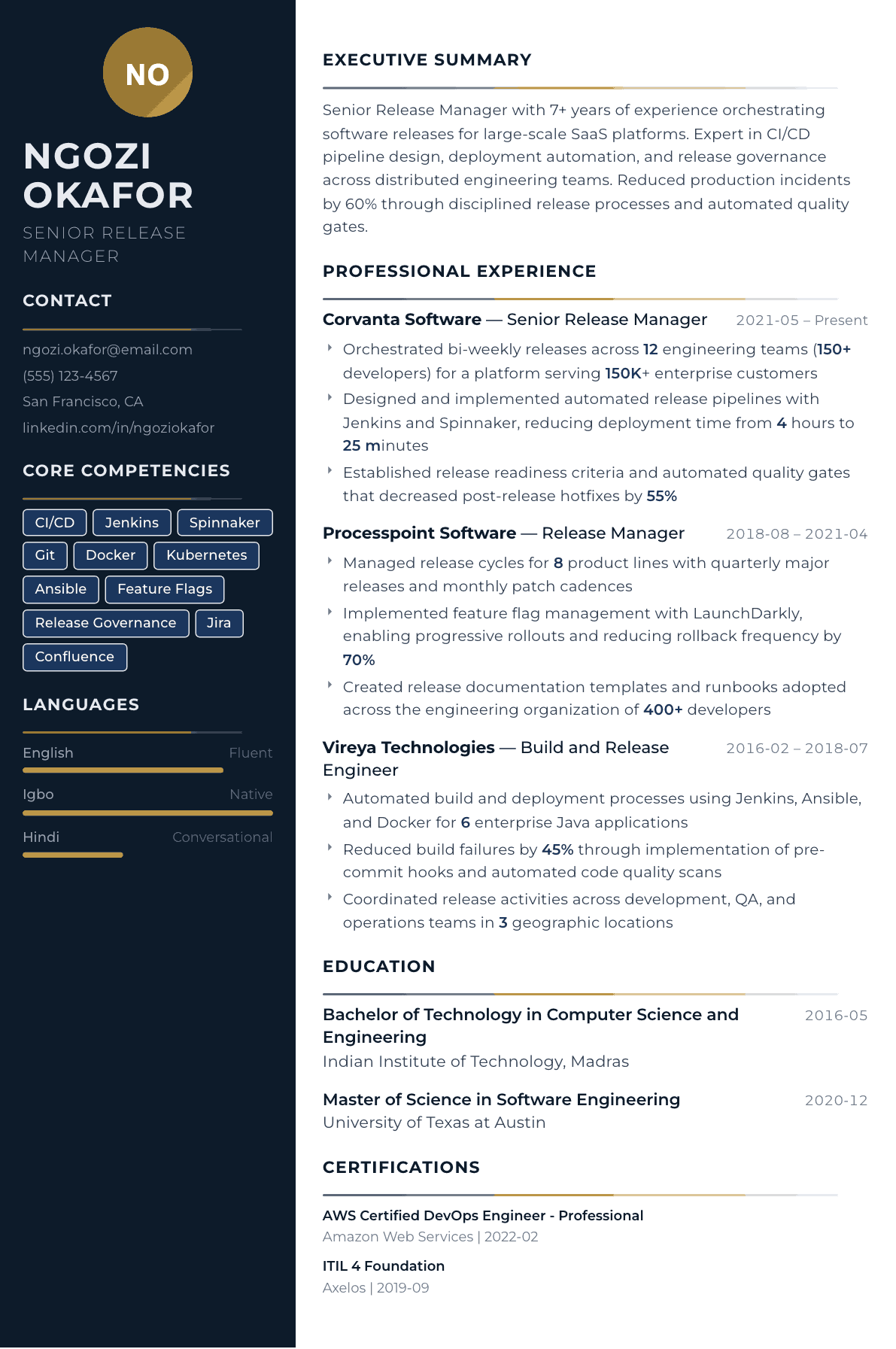
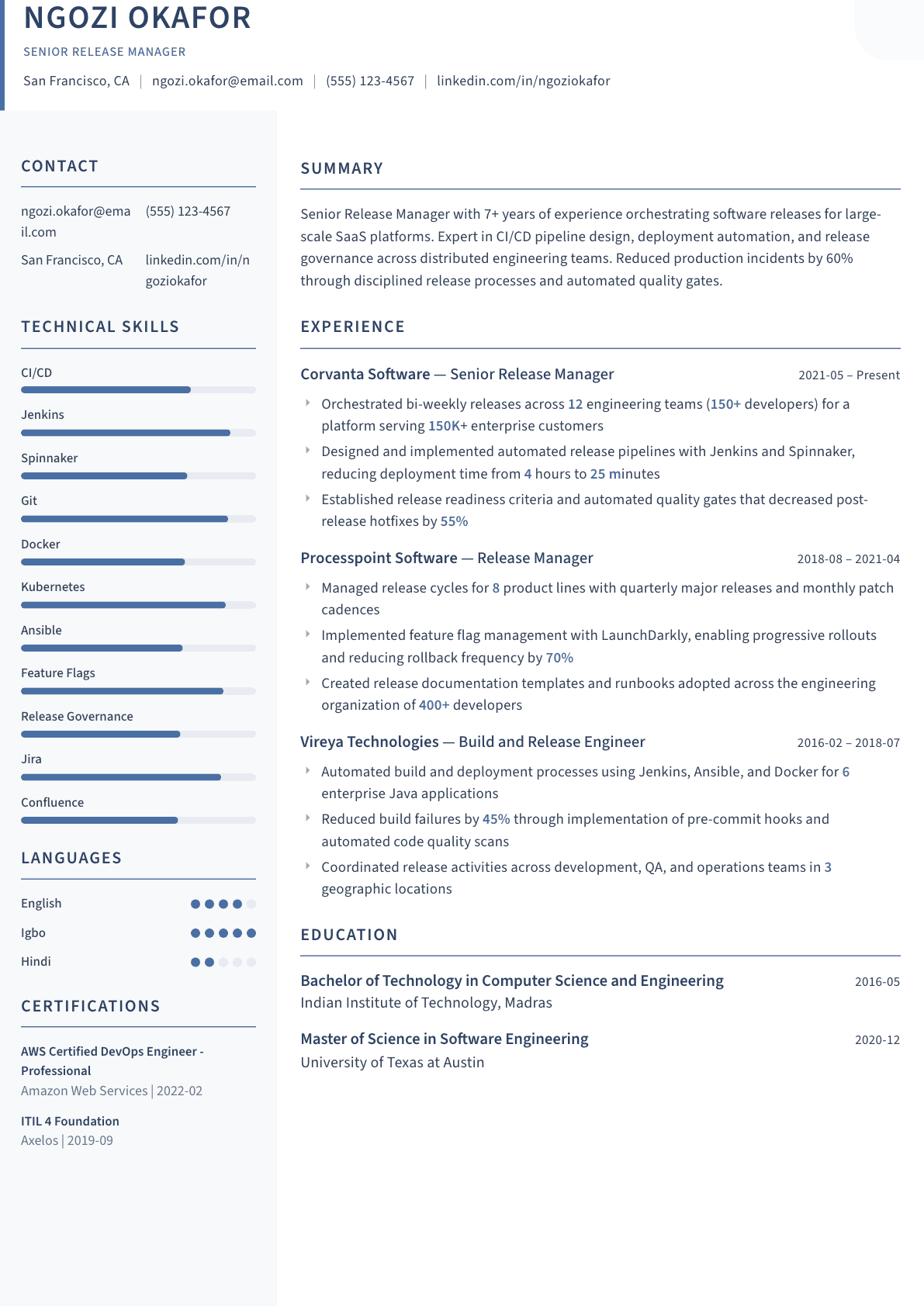
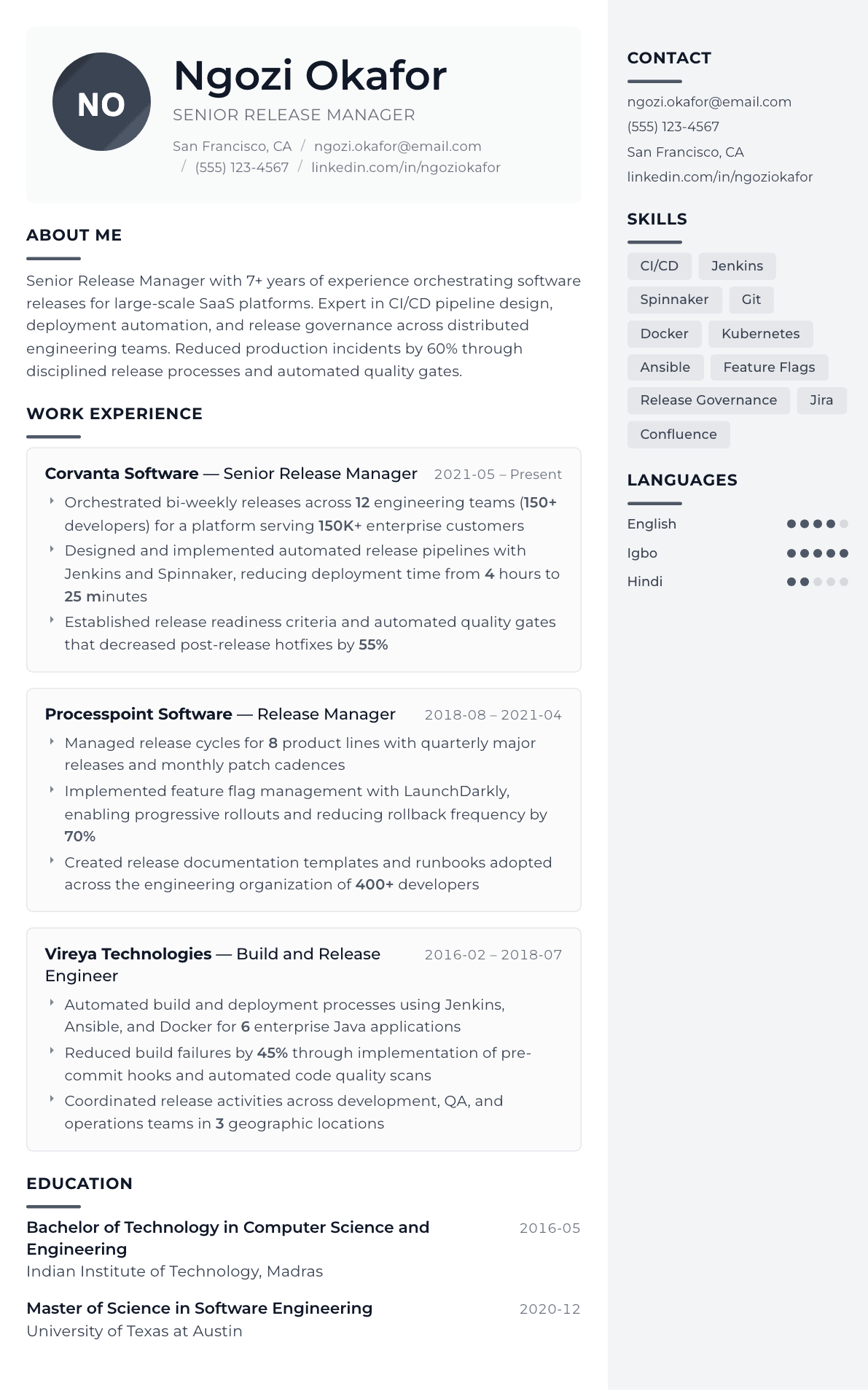
Example Release Manager summary
Release Manager with 7 years of experience orchestrating deployments for SaaS platforms serving 150K+ customers. Designed automated release pipelines reducing deployment time by 90% and post-release incidents by 60%. Expert in CI/CD, feature flag management, and release governance across distributed engineering organizations.
Skills to list on a Release Manager resume
- CI/CD
- Jenkins
- Spinnaker
- GitLab CI
- Docker
- Kubernetes
- Ansible
- Feature Flags
- Release Governance
- Jira
- Change Management
- ITIL
What actually gets this resume read
- Quantify release cadence and scale: number of teams coordinated, deployment frequency, and rollback reduction metrics.
- Highlight CI/CD tools expertise: Jenkins, GitLab CI, GitHub Actions, Spinnaker, ArgoCD, or Harness.
- Include release governance frameworks, quality gates, and change management processes you have established.
- Mention feature flag management experience with tools like LaunchDarkly, Split, or Flagsmith.
- Show cross-functional coordination skills with specific examples of aligning engineering, QA, and product teams.
How to write a release manager resume
A release manager sits between engineering, quality, product, operations and sometimes compliance, and owns the moment when code becomes something customers touch. That position makes the resume unusual: the achievements are almost never a feature you built, they are a cadence you established, a risk you removed, or a bad night that did not happen. Candidates who write like engineers undersell that, and candidates who write like project managers lose the technical credibility the role needs.
A hiring manager reads for four things. The scale of what you coordinated, measured in teams, services and release frequency. The technical depth of your involvement, meaning whether you built the pipeline or booked the change window for someone else. The governance you established, such as readiness criteria, change approval, and audit evidence. And how you handled the release that went wrong, because everyone in this field has one.
This guide covers how to size a release portfolio on paper, which delivery metrics carry weight, how to write about rollbacks and incidents without sounding defensive, and how to keep the resume from reading as pure coordination in a market that expects automation.
Format: release portfolio before the achievements
Reverse-chronological, one page under seven years, two beyond. Under the summary put a release portfolio block for the current role: number of teams and developers coordinated, number of applications or services, release cadence, environments in the promotion path, and the deployment model such as blue green or progressive rollout behind feature flags.
A release manager resume without those numbers is unreadable, because the entire job scales with them. Coordinating one monthly release of a monolith and orchestrating daily releases across a dozen services are different professions with the same title.
- Header: name, title, city, phone, email.
- Order: summary, release portfolio, experience, tooling by stage, certifications, education.
- Name the regulatory context if there is one, such as audited change control in finance or healthcare.
- State whether you were also the build engineer, since many release managers own both roles.
Summary: cadence, scope, and the change you drove
Lead with the cadence you run and the scope it covers, then the direction you moved it. Almost every release manager is hired to make releases more frequent, less risky or both, so state which one you delivered and from what starting point.
End with the mechanism, not the aspiration. Automated readiness checks, feature flags that decoupled deployment from release, a canary stage with automatic halt, or a change advisory process you simplified without losing the audit trail. Mechanism is what makes the claim credible.
Experience: the promotion path and the gates on it
Describe the path a change takes: branch strategy, build, artifact versioning and promotion, environments it passes through, the tests and scans at each gate, approvals required, and the deployment mechanism into production. A reader can tell in one paragraph whether you understand your own pipeline or merely schedule it.
Then the governance layer. Release readiness criteria and who signs them, the go and no-go meeting and how you keep it short, change records, freeze periods around business peaks, and the evidence you produce for auditors. If you removed a manual approval by replacing it with an automated check, that is a strong bullet because it improved both speed and control.
Then coordination across teams. Dependency mapping between services, backward compatible database migrations, coordinating a mobile release train against a backend release, communication to support and customer-facing teams, and the release notes process. Coordination bullets should name the mechanism you used, not simply that you coordinated.
Metrics: use the delivery vocabulary teams already speak
Deployment frequency, lead time from merge to production, change failure rate, and time to restore service are the four that engineering leadership tracks, and using them puts you in the same conversation. Add release predictability: the fraction of planned releases that went out on the planned date without descoping.
Rollback numbers deserve care. A low rollback count can mean either good quality or a team too afraid to roll back, so pair it with time to roll back and how often a release was halted mid rollout. Being able to stop a bad release in minutes is worth more than never having stopped one.
- Deployment frequency and lead time, before and after your changes.
- Change failure rate and mean time to restore for release-caused incidents.
- Time to roll back or halt a progressive rollout, and how often that mechanism was exercised.
- Release predictability: planned versus delivered dates over a quarter.
Tooling: name the stack at every stage
Group your tools by stage rather than in one list: source and branching, build and continuous integration, artifact management, deployment and orchestration, feature flag management, observability, and the tracking system where change records live. A reader wants to know whether you have worked with her stack, and stage grouping answers that fast.
Show that you can read and modify pipeline code rather than only trigger it. Naming the pipeline definitions you have written, the scripts you maintained or the deployment tool you configured is what keeps this resume from reading as scheduling work, which is how the role is often dismissed.
Release Manager resume summary examples
Build and release engineer
Build and release engineer with two years maintaining Jenkins pipelines and artifact repositories for six Java applications. Automated versioning and deployment to three environments, cut build failures by improving dependency caching, and coordinated monthly releases with QA and operations.
Five years in
Release manager coordinating biweekly releases for eight teams and 30 services on a SaaS platform. Introduced feature flags to decouple deployment from release, added automated readiness gates, and moved change failure rate from 18% to 6% over four quarters.
Head of release engineering
Release leader with eleven years, currently owning delivery governance for 150 developers across 12 teams in an audited environment. Took releases from monthly to daily with progressive rollout and automatic halt, and replaced a manual change board with evidence-backed automated approvals.
Work experience bullets: before and after
Before: Coordinated software releases across teams.
After: Ran the biweekly release train for 12 teams and 150 developers on a platform used by 150k enterprise customers, holding a 15 minute go and no-go with published readiness criteria instead of a two hour status call.
Scope, cadence and the specific coordination mechanism replace an activity description with an operating model.
Before: Automated the deployment process.
After: Replaced a scripted manual deployment with a Jenkins and Spinnaker pipeline doing artifact promotion, smoke checks and canary analysis, cutting production deployment from 4 hours of attended work to 25 unattended minutes.
The tools, the stages and the attended time removed show what the automation actually replaced.
Before: Introduced feature flags.
After: Rolled out feature flag management with LaunchDarkly and a flag lifecycle policy, letting teams deploy continuously and release by toggle, which cut full rollbacks from 11 in a quarter to 3.
A flag policy plus the drop in rollbacks shows the practice was governed rather than merely adopted.
Before: Improved release quality.
After: Defined release readiness criteria covering test pass rate, open critical defects, migration reversibility and on-call coverage, and automated the checks in the pipeline, reducing post-release hotfixes by more than half.
Naming the criteria and automating them turns a quality claim into an enforceable gate.
Before: Handled a failed production release.
After: Halted a progressive rollout at 5% traffic when error rates rose, restored the previous version in 8 minutes, and added the missing backward compatibility check for database migrations to the readiness gate.
A concrete incident with detection, recovery time and a permanent control reads as competence rather than as a failure.
Hard skills
- Release planning and cadence design
- CI/CD pipeline design (Jenkins, GitLab CI, GitHub Actions)
- Deployment orchestration (Spinnaker, ArgoCD, Harness)
- Feature flag management (LaunchDarkly, Split, Flagsmith)
- Branching and versioning strategy
- Artifact management and promotion
- Progressive delivery: canary and blue green
- Change management and audit evidence
- Database migration coordination
- Docker and Kubernetes deployments
- Incident and rollback procedures
- Jira and Confluence release tracking
Soft skills
- Running a short decisive go and no-go
- Negotiating scope against a release date
- Communication to support and customer teams
- Staying calm during a failed rollout
- Building trust between engineering and operations
Certifications worth listing
- ITIL 4 Foundation (PeopleCert)
- AWS Certified DevOps Engineer - Professional (Amazon Web Services)
- Certified Kubernetes Administrator (CKA) (Cloud Native Computing Foundation)
- Project Management Professional (PMP) (Project Management Institute)
Mistakes that cost release manager candidates the interview
- Describing the role as coordination only, with no pipeline, tooling or automation detail, which reads as a scheduler in a market that expects engineering.
- Leaving out the release portfolio numbers, so the reader cannot tell whether you ran one monolith or a dozen services.
- Hiding the failed release, when a well told recovery story is one of the most persuasive items available to you.
- Reporting deployment frequency without change failure rate, which lets a reader assume speed came at the cost of stability.
- Listing every tool in the organization rather than the ones you configured or wrote pipeline code for.
- Writing about process governance in abstract terms without naming the gates, approvers and evidence produced.
Release Manager resume questions
Is release manager a technical or a project management role?
It is both, and the balance depends on the organization. Larger enterprises lean toward governance and change control, while product companies expect you to build and modify the pipeline yourself. Write both sides, but lead with the technical half unless the posting is explicitly a governance role.
What metrics should a release manager put on a resume?
Deployment frequency, lead time from merge to production, change failure rate and time to restore service, plus release predictability against planned dates. These are the numbers engineering leadership already reviews, so using them signals that you speak the same language as the team you would join.
How do I write about a release that caused an outage?
State what happened, how quickly it was detected, how long recovery took, and the control you added so it cannot repeat. Owning an incident with a permanent fix is a strength. Omitting all failures entirely is the version that makes an experienced reader suspicious.
Does a release manager need to know Kubernetes and cloud platforms?
For most modern postings yes, at least well enough to read a deployment manifest, understand a rolling update and reason about rollback behavior. You do not need to administer clusters, but you cannot govern a delivery path you cannot follow when something goes wrong at two in the morning.
How do I move from build engineer to release manager?
Keep the pipeline work as your credibility, then add the coordination layer: readiness criteria you defined, go and no-go meetings you ran, cross-team dependency handling and communication to stakeholders. The gap hiring managers look for is judgment about risk across teams, not more automation skill.
Related resume examples
- DevOps Engineer Resume example
- Site Reliability Engineer Resume example
- IT Project Manager Resume example
- MLOps Engineer Resume example
- Cloud Architect Resume example
- Infrastructure Engineer Resume example