MLOps Engineer Resume Examples: the lines they read
Write an MLOps Engineer Resume Around Models Running in Production
By Mustafa Tarabya, founder of CVBooster · Published · Updated
MLOps engineer resume examples, deployment and monitoring wording, platform keywords recruiters search, and a full section by section guide.
Sample resumes for a mlops engineer
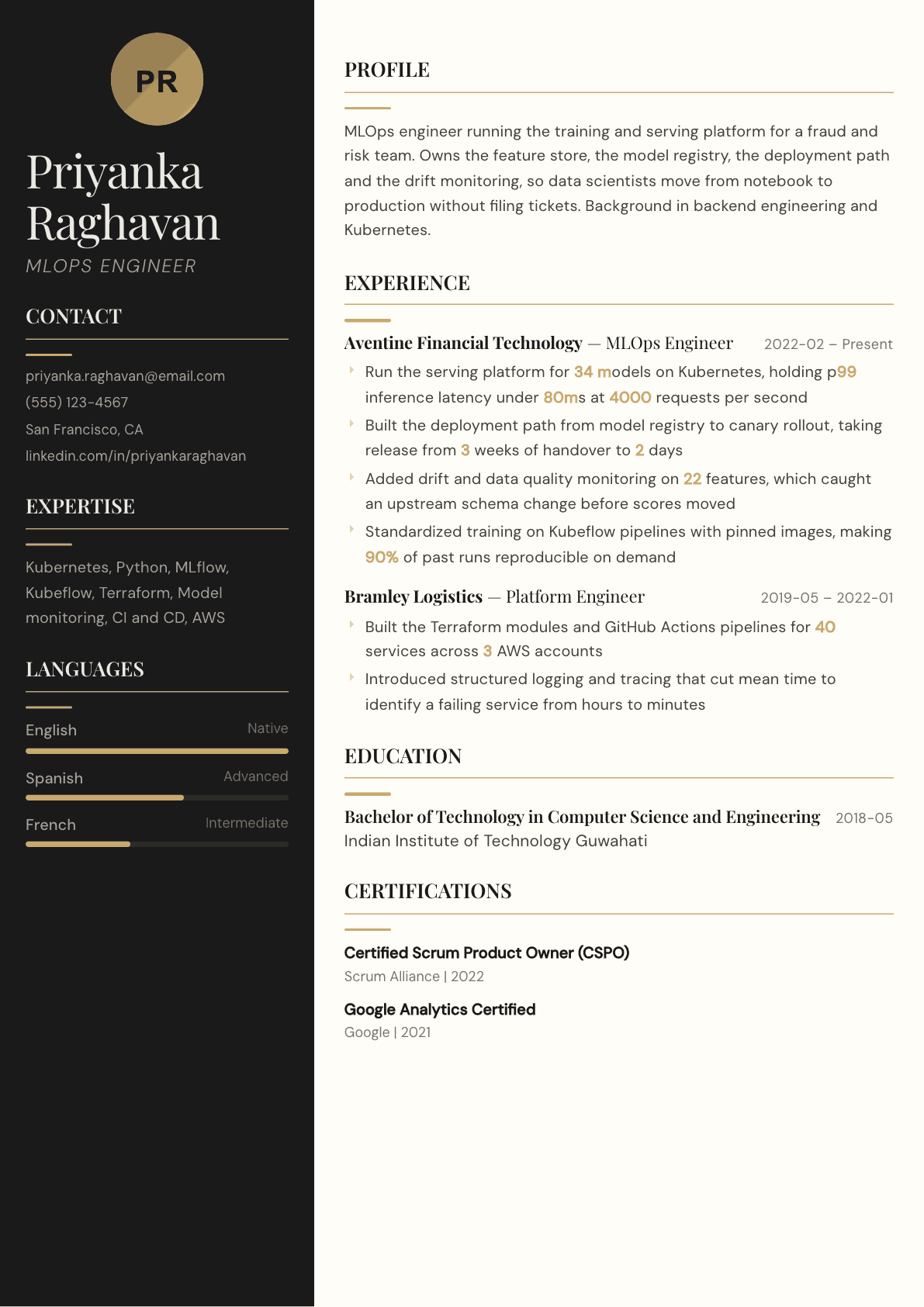
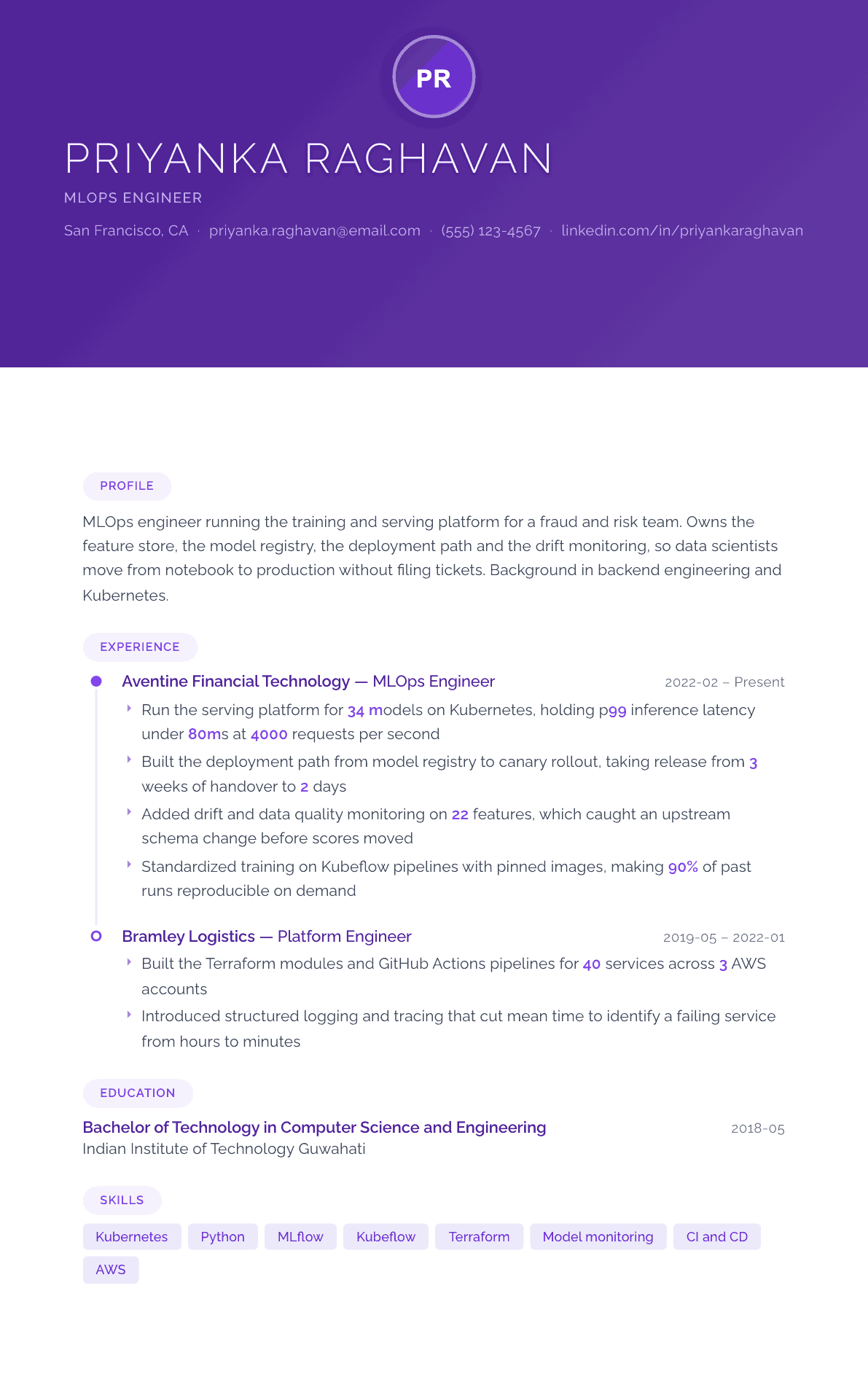
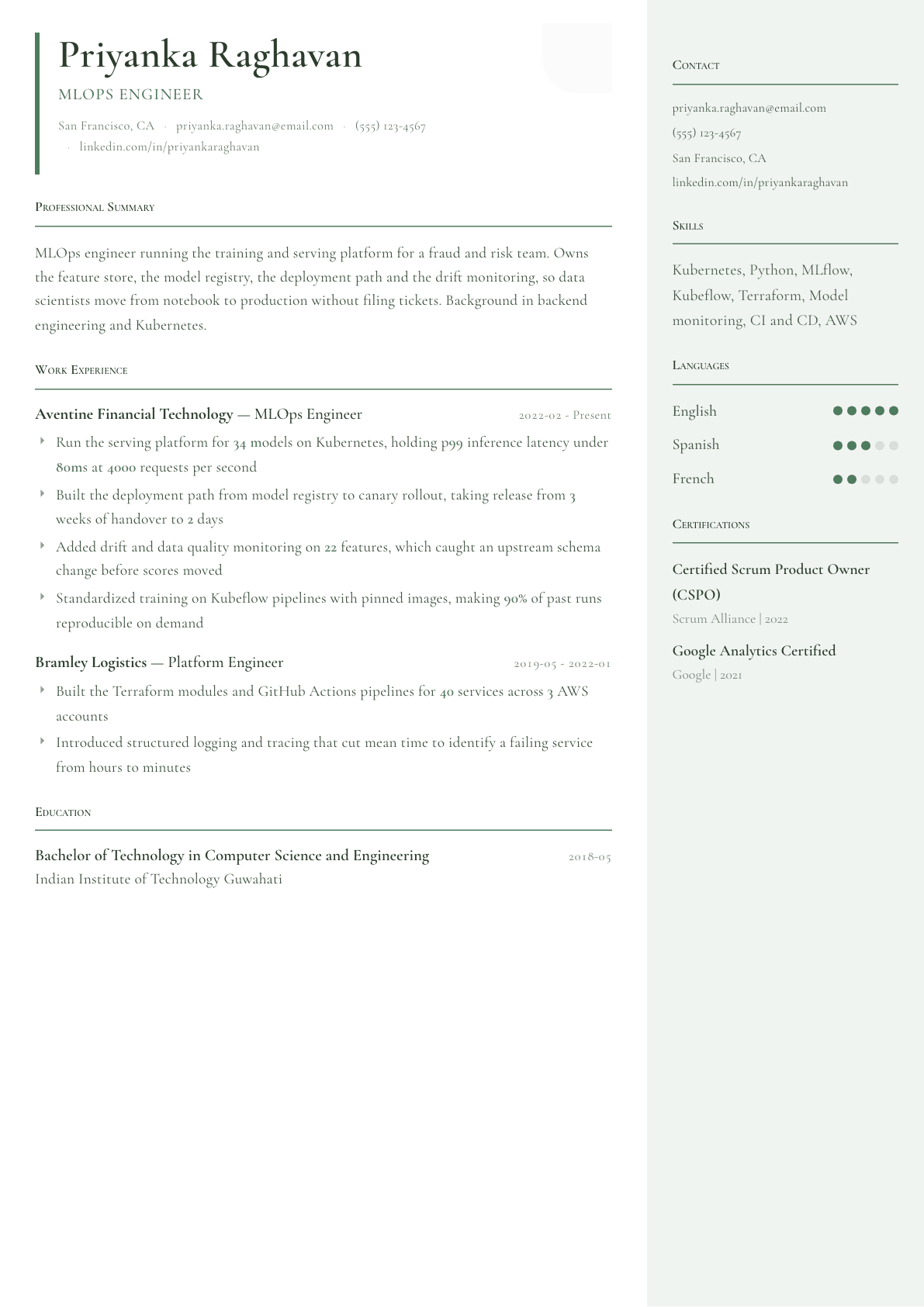
The same mlops engineer content laid out in three CVBooster templates, so you can see what the finished document looks like before you write a word.
Example MLOps Engineer summary
MLOps engineer with seven years across platform and machine learning infrastructure, currently serving three dozen models on Kubernetes for a fraud and risk team. Built the path from model registry to canary rollout that turned a three week handover into a two day release, and added drift monitoring that catches upstream schema changes before scores move. Strong Terraform and pipeline background.
Skills to list on a MLOps Engineer resume
- Kubernetes
- Docker
- Python
- MLflow
- Kubeflow
- Terraform
- CI and CD pipelines
- Model serving
- Feature stores
- Drift monitoring
- AWS SageMaker
- Airflow
- Observability
- GPU scheduling
What actually gets this resume read
- Count the models you keep in production and describe how they are served, whether batch, real time or streaming.
- Show the path from experiment to production, including registry, approval, canary rollout and rollback.
- Put monitoring on the page: drift, data quality, latency and what an alert actually pages someone about.
- Name the infrastructure honestly, since MLOps postings differ sharply between Kubernetes shops and managed platforms.
- Include reproducibility work such as pinned environments, tracked experiments and versioned training data.
- Show the collaboration angle, because the job is judged on how fast data scientists ship without your help.
How to write a mlops engineer resume
MLOps engineer postings almost always come from the same frustration. A data science team has models that work in a notebook and take weeks to reach customers, or models that reached production and then quietly degraded because nothing was watching them. The hiring manager wants proof that you have closed that gap before, on a real system, with real traffic.
That means this resume is more infrastructure than modeling. A panel will ask how you serve, how you roll back, what happens when a feature goes stale, how a training run is reproduced six months later, and who gets paged when inference latency climbs. Answers to those questions belong on the page, not saved for the interview.
This guide covers how to size the platform you run, how to describe the path from experiment to production, what monitoring detail actually convinces a reader, and how to position yourself if you are arriving from platform engineering or from data science rather than from a dedicated MLOps team.
Format: two pages, platform stated before achievements
Reverse chronological, two pages once you have a few years of infrastructure work. Under each role, write one platform line: the cloud, the orchestration layer, the serving approach, the registry and the number of models in production. Managed platform work and self-hosted Kubernetes work are different jobs with different failure modes, and this line settles which one you have done.
Keep a tooling block near the top grouped by function: infrastructure, orchestration, tracking and registry, serving, monitoring. Grouping matters because postings in this space list tools by function and a matching layout reads faster.
- Header: name, city, phone, email, plus a GitHub or a public write-up if the work can be shown.
- Order: summary, tooling by function, experience with a platform line, selected platform projects, education, certifications.
- Keep earlier backend or infrastructure roles, since they explain how you learned to run things reliably.
Summary: models in production, serving mode, and your background
Three or four lines. Say how many models you keep running, how they are served, on what infrastructure, and for what kind of workload. Then say where you came from, because a hiring manager treats a platform engineer who learned machine learning differently from a data scientist who learned infrastructure, and both are valid.
Add one operational claim: latency held under a threshold, release time cut from weeks to days, or a monitoring system that caught a real problem. It gives the reader a reason to keep going.
Experience: describe the path from notebook to production
The strongest bullets trace the route a model takes through your platform. Where experiments are tracked, where an artifact is registered, who approves promotion, how a deployment reaches traffic, whether it goes out behind a canary or a shadow deployment, and how a rollback works. Write it as a path and the reader can see the system.
Give the serving detail: batch scoring on a schedule, a real-time endpoint with a latency target, or streaming inference. Then attach a number that reflects the constraint, such as requests per second and a tail latency figure, or how many rows a batch job scores and inside what window.
Include the platform work that is not model-specific. Terraform modules, pipeline templates, container images, GPU scheduling and cost controls all belong here, because they are what makes the platform reusable rather than a set of one-off deployments.
Monitoring and reproducibility are the two proof points
Write monitoring as three separate things, because they fail differently: infrastructure health, data and feature quality, and model behavior. Latency and error rates cover the first. Null rates, distribution drift and schema change cover the second. Prediction distribution shift and, where labels arrive later, actual performance decay cover the third. Say which alerts page a human and which only open a ticket.
Reproducibility deserves a bullet of its own. Pinned container images, versioned training data, tracked hyperparameters and a recorded random seed are what let someone rerun a model months later during an audit or an incident. Say how far back you can genuinely reproduce, since honesty here reads as experience.
Position yourself for the stack in the posting
This market splits between teams running everything themselves on Kubernetes and teams using a managed platform such as SageMaker or Vertex AI. Read which one the posting describes and lead with the matching experience, then keep the other visible as secondary. Claiming deep expertise in both when one was a proof of concept is caught quickly.
Recurring keywords include model deployment, model registry, feature store, continuous training, drift detection, containerization, orchestration, inference latency, GPU utilization and infrastructure as code. Place each where the work is described rather than in a keyword block.
MLOps Engineer resume summary examples
First dedicated MLOps role
Platform engineer moving into MLOps, currently supporting a data science team of six by containerizing training jobs and building the deployment pipeline for four production models. Comfortable with Terraform, Kubernetes and MLflow, and recently added latency and error alerting to two real-time endpoints.
Four years in machine learning platform
MLOps engineer running the serving platform for 34 models on Kubernetes, holding p99 inference latency under 80ms at around four thousand requests per second. Built the path from model registry to canary rollout that took release from three weeks of handover to two days.
Platform lead
Lead MLOps engineer owning the machine learning platform for three data science teams: feature store, registry, continuous training pipelines and drift monitoring. Set the promotion policy and the on-call runbook for model incidents, and cut GPU spend substantially by scheduling training on preemptible capacity.
Work experience bullets: before and after
Before: Deployed machine learning models to production.
After: Run the serving platform for 34 models on Kubernetes, holding p99 inference latency under 80ms at 4000 requests per second with automatic rollback on error rate breach.
Model count, tail latency, traffic and the rollback trigger show a running platform rather than a set of deployments.
Before: Automated the model deployment process.
After: Built the deployment path from model registry through automated evaluation to canary rollout at 5% of traffic, taking release from a 3 week manual handover to 2 days with no engineer intervention.
Naming the stages and the traffic share makes the automation concrete and shows where safety was preserved.
Before: Set up monitoring for models in production.
After: Added drift and data quality monitoring on 22 features with alerting split between paging thresholds and ticketed warnings, which caught an upstream schema change before predictions moved.
Separating paging from ticketing shows operational judgment, and the caught incident proves the monitoring worked.
Before: Improved reproducibility of training runs.
After: Standardized training on Kubeflow pipelines with pinned base images, versioned datasets and tracked parameters, making 90% of runs from the previous year reproducible on demand during an audit.
A stated share and the audit context prove reproducibility was tested rather than assumed.
Before: Managed cloud infrastructure for the data science team.
After: Wrote the Terraform modules and pipeline templates for three AWS accounts so a data scientist can stand up a training environment from a template instead of raising a ticket.
The reader sees a reusable platform and the specific friction it removed from another team.
Hard skills
- Kubernetes and Docker
- Python
- Terraform and infrastructure as code
- MLflow and model registries
- Kubeflow or Vertex AI pipelines
- AWS SageMaker
- Model serving and inference optimization
- Feature stores
- Drift and data quality monitoring
- CI and CD pipelines
- Airflow
- GPU scheduling and cost control
Soft skills
- Working alongside data scientists
- Incident communication
- Runbook writing
- Prioritizing platform work against requests
- Explaining infrastructure trade-offs
Certifications worth listing
- AWS Certified Machine Learning, Specialty (Amazon Web Services)
- Google Cloud Professional Machine Learning Engineer (Google Cloud)
- Certified Kubernetes Administrator (CKA) (Cloud Native Computing Foundation)
- Microsoft Certified: Azure AI Engineer Associate (Microsoft)
- HashiCorp Certified: Terraform Associate (HashiCorp)
Mistakes that cost mlops engineer candidates the interview
- Writing a data science resume with model accuracy figures, when the hiring manager is buying reliability and release speed.
- Never stating how many models are in production or how they are served, which leaves the scope invisible.
- Treating monitoring as one thing instead of separating infrastructure health, data quality and model behavior.
- Claiming equal depth on Kubernetes and a managed platform when one of them was a proof of concept.
- Leaving out rollback and incident handling, which is the first thing a platform interview probes.
- Skipping reproducibility, so a reader assumes training runs cannot be recreated when someone asks.
MLOps Engineer resume questions
What is the difference between an MLOps engineer and a machine learning engineer?
A machine learning engineer usually builds the models as well as deploying them. An MLOps engineer builds and runs the platform those models live on: pipelines, registry, serving, monitoring and rollback. Match your summary to whichever the posting spends more space describing.
Do I need to show modeling skill on an MLOps resume?
Enough to be a credible partner, not enough to compete with data scientists. Show that you understand evaluation, feature dependencies and why a model degrades. The bulk of the page should be infrastructure, deployment paths and monitoring.
What metrics should an MLOps engineer put on a resume?
Models in production, inference latency at a named percentile, throughput, release lead time, deployment frequency, incident counts and infrastructure cost. These are the numbers a platform lead already tracks, which makes them credible and easy to discuss.
How do I move into MLOps from platform or DevOps engineering?
Lead with the reliability work that transfers, then add the machine learning specifics you have touched: containerizing training jobs, deploying an inference endpoint, or wiring a registry. State plainly which parts are new so the reader trusts the rest of the page.
Should I list cloud certifications for an MLOps role?
Yes, especially when the posting names the provider, because recruiters filter on them early. A Kubernetes administrator credential and a cloud machine learning certification are both worth listing, though neither replaces a described production platform.
Related resume examples
- Machine Learning Engineer Resume example
- DevOps Engineer Resume example
- AI Engineer Resume example
- Cloud Engineer Resume example
- Infrastructure Engineer Resume example
- Site Reliability Engineer Resume example