Site Reliability Engineer Resume Examples: free score
Engineer Uptime with an SRE Resume That Delivers
By Mustafa Tarabya, founder of CVBooster · Published · Updated
Create an SRE resume highlighting your expertise in reliability, observability, and infrastructure automation.
Sample resumes for a site reliability engineer
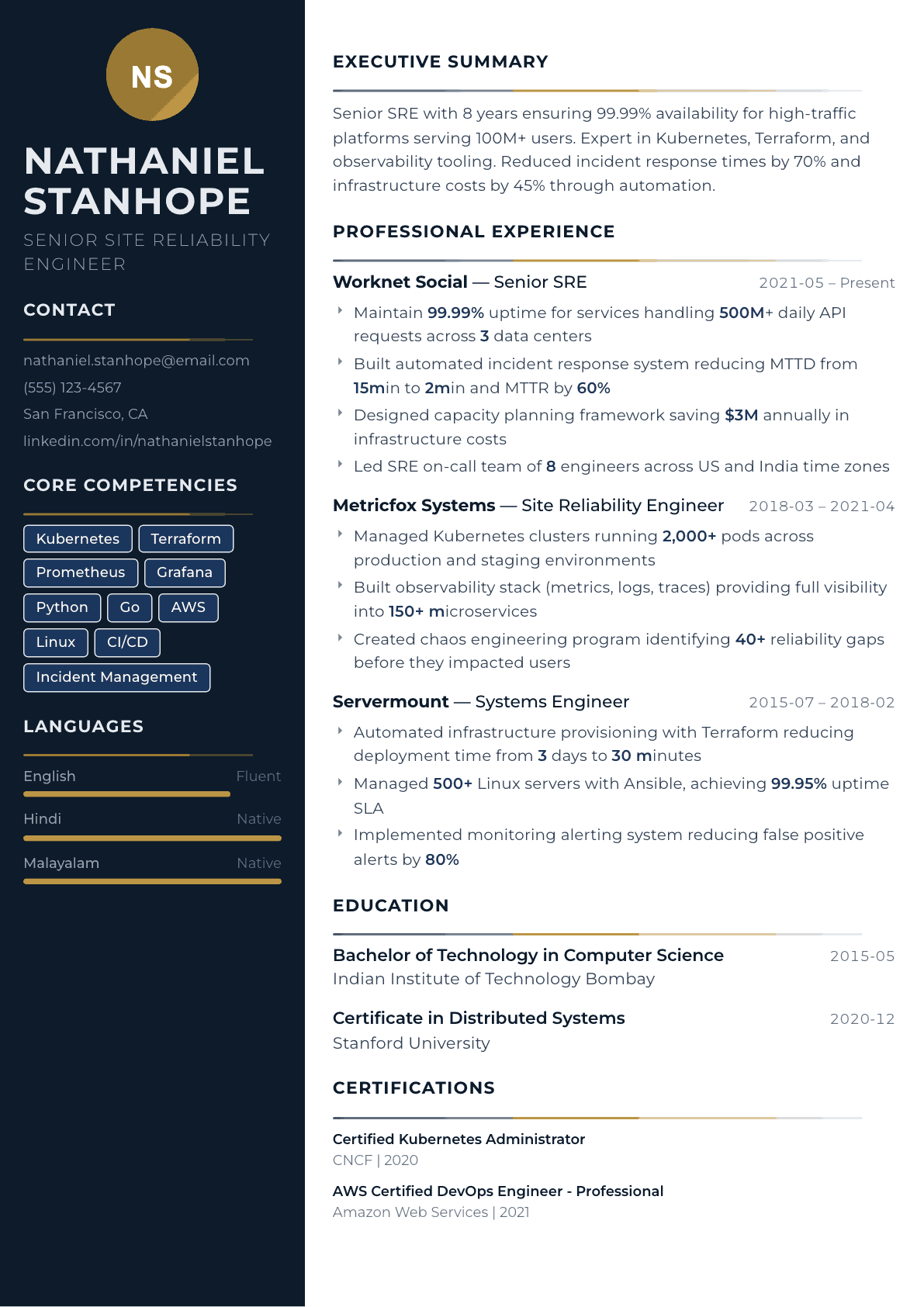
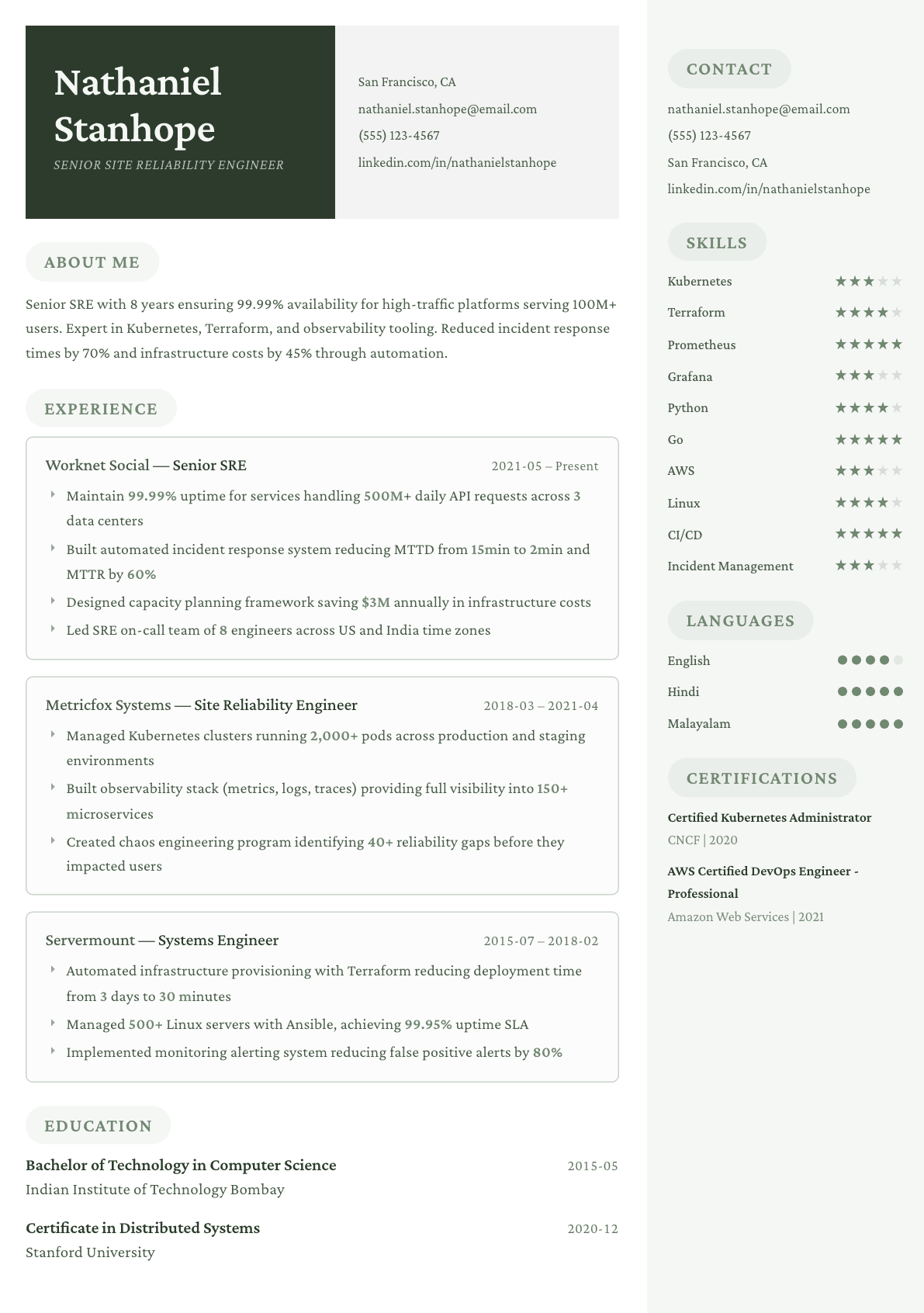
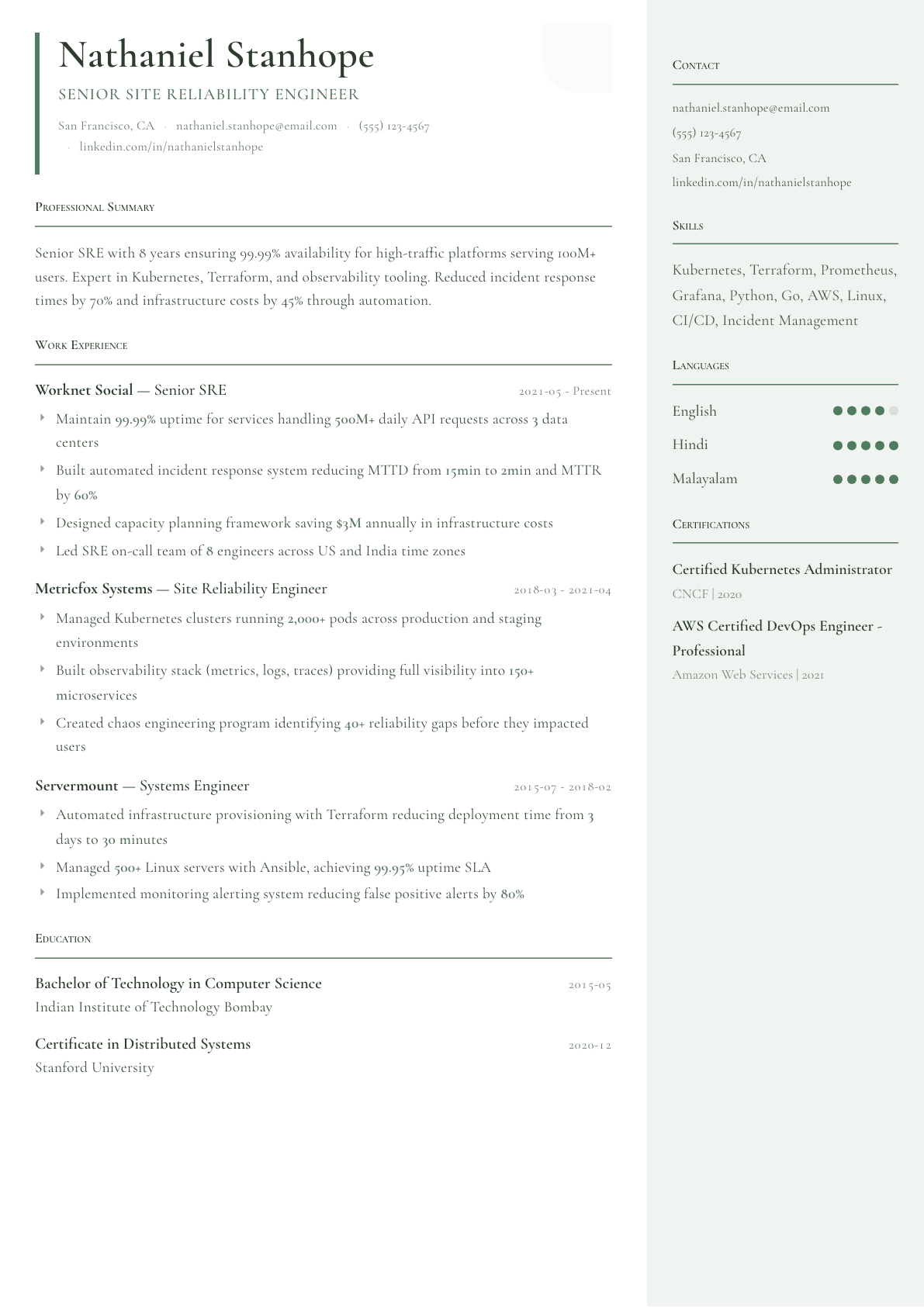
The same site reliability engineer content laid out in three CVBooster templates, so you can see what the finished document looks like before you write a word.
Example Site Reliability Engineer summary
Senior SRE with 8 years maintaining 99.99% availability for platforms serving 100M+ users. CKA certified with expertise in Kubernetes, observability, and infrastructure automation.
Skills to list on a Site Reliability Engineer resume
- Kubernetes
- Terraform
- Prometheus
- Grafana
- Python
- Go
- AWS
- Linux
- CI/CD
- Docker
- Incident Management
- Chaos Engineering
- SLOs/SLIs
- Ansible
What actually gets this resume read
- Quantify uptime, MTTR, and incident reduction metrics.
- Highlight observability and monitoring tool expertise.
- Show infrastructure automation achievements.
- Include on-call and incident management experience.
- Demonstrate cost optimization through automation.
How to write a site reliability engineer resume
A site reliability engineer resume is judged on one question: has this person been woken up at three in the morning by a production system they owned, and did they leave it better than they found it. Everything else on the page is context for that. An SRE hiring manager reads for the size of the estate you carried, the blast radius of the failures you handled, and whether you talk about reliability as a number you were accountable for or as a feeling.
That is why generic infrastructure resumes stall in SRE pipelines. Plenty of candidates list Kubernetes, Terraform and Prometheus. Far fewer say how many clusters, how many services, what the error budget policy was, who paged whom, and what the on-call rotation looked like. The tool list gets you past the keyword filter. The operational detail gets you the phone screen.
This guide covers the section order SRE screeners expect, how to write about incidents without breaching confidentiality, three summaries at different career stages, before-and-after bullets, and the questions engineers moving into reliability work ask most often.
Format: a technical skills block near the top, then scope-first experience
Reverse-chronological, one page under eight years, two pages after. Put a categorized technical skills block directly under the summary, grouped by orchestration, infrastructure as code, observability, cloud, and languages. SRE recruiters filter on named tools before an engineer ever reads the file, and a grouped block is faster to scan than a comma soup.
Keep the layout single-column and plain. Many SRE candidates over-design the page with sidebars and icons, which parses badly and signals nothing about engineering judgment. Links to a GitHub profile, a conference talk, or a public postmortem you wrote belong in the header line.
- Header: name, title, city, email, GitHub, and a link to any public writing on reliability.
- Order: summary, technical skills, experience, education, certifications, open source or talks.
- Name the cloud provider and the orchestration layer in the first two lines of the resume.
Experience: lead every role with the estate you were responsible for
Before the bullets, give the reader a scope line: how many services, how many clusters or nodes, the request volume, the number of environments, and the size of the on-call rotation. A reader cannot calibrate "improved reliability" without knowing whether the system served internal tooling or a public API under sustained load.
Then write bullets that follow reliability work end to end. The strongest pattern is a symptom, an instrumentation or automation change, and a durable outcome expressed in the language of your own service level objectives. Mean time to detect, mean time to restore, page volume per on-call shift, and error budget burn are the four numbers an SRE manager actually recognizes.
Incidents are your best material, so learn to write them without leaking. Describe the failure class rather than the customer: a cascading retry storm, a certificate expiry, a noisy neighbor on a shared node pool, a runaway migration that saturated a replica. Name what you changed so the class stopped recurring.
Reliability engineering, not systems administration
The line between an SRE and an operations engineer on paper is the presence of code. If your bullets are mostly ticket handling, cluster upgrades and patching, the resume reads as administration with a modern tool list. Show the automation you wrote: the operator, the Terraform module others consumed, the runbook you turned into a self-healing controller, the capacity model, the load test harness.
Toil reduction is the concept that separates the two disciplines, and it is worth stating explicitly. Say what manual work existed, what you replaced it with, and how many hours a week the rotation stopped spending on it. That framing is native to the field and immediately readable to anyone who has done the job.
- Name the language you write automation in, and use it in at least two bullets.
- Show one platform artifact other teams adopted: a module, a chart, a controller, a library.
- Include one capacity or cost bullet; infrastructure spend is an SRE concern in most organizations.
On-call, incident command and the human side
Say plainly that you carried a pager, how the rotation was structured, and what role you played during incidents. Incident commander, communications lead and scribe are recognized roles, and claiming the one you actually held is more convincing than a vague statement about handling outages. If you ran blameless postmortem reviews or owned the follow-up action tracker, that belongs on the page.
Senior candidates should show the policy layer as well as the response layer: setting service level objectives with product owners, negotiating an error budget policy that could actually pause feature work, running readiness reviews before a service was allowed into production, and training new engineers into the rotation.
Keywords SRE postings reuse
Reliability job descriptions are written from a small vocabulary: service level objectives and indicators, error budgets, observability, distributed tracing, infrastructure as code, incident response, on-call, chaos engineering, capacity planning, and the specific stack. Mirror the posting wording once in the skills block and once inside a bullet where you show the practice, not just the word.
Watch for the platform variant. A posting that says platform engineering, developer experience or internal developer platform wants the same person described differently, and rewarding that reader means leading with the tooling you built for other engineers rather than the outages you absorbed.
Site Reliability Engineer resume summary examples
Moving into SRE from operations
Linux systems engineer moving into site reliability, with two years running containerized workloads on a managed Kubernetes cluster and a secondary on-call rotation. Automates in Python and Terraform, built the team Grafana dashboards and alert rules, and holds the CKA. Looking for a first dedicated SRE seat.
Five years in
Site reliability engineer with five years owning production for 40 microservices across three regions. Cut mean time to restore from 48 minutes to 11 by rebuilding alerting around service level objectives and replacing three manual runbooks with self-healing controllers. Primary on-call in a six-person rotation.
Staff SRE
Staff site reliability engineer with nine years in high-traffic platforms, most recently owning the reliability program for a payments estate of 200 services. Set the error budget policy adopted by seven product teams, led incident command for severity-one events, and reduced page volume per shift by 60%.
Work experience bullets: before and after
Before: Responsible for maintaining Kubernetes clusters and ensuring high availability.
After: Operated nine production Kubernetes clusters running 1,800 pods across three regions, holding 99.95% availability through two provider zone failures.
Cluster count, pod count, regions and a stated availability figure let a manager size the estate you actually carried.
Before: Improved monitoring and alerting for the platform.
After: Replaced 140 host-level alerts with 22 symptom-based alerts tied to latency and error-rate objectives, cutting pages per on-call shift from 9 to 2.
It shows the alerting philosophy, not just the activity, and the page-volume drop is the number an SRE lead cares about.
Before: Automated manual tasks to save time.
After: Wrote a Go controller that drains and replaces unhealthy nodes automatically, removing roughly six hours of manual toil per week from the rotation.
A named language, a concrete mechanism and hours reclaimed turn a generic claim into engineering evidence.
Before: Participated in incident response and postmortems.
After: Served as incident commander for 30 severity-one events, and ran the blameless review process that closed 85% of action items within two sprints.
Naming the incident role and the follow-through rate shows ownership past the moment the alert clears.
Before: Worked on reducing cloud costs.
After: Built a capacity model from request-per-second forecasts, right-sized 60 node groups and moved batch workloads to spot capacity, lowering monthly compute spend by 38%.
The method is visible, so the saving reads as engineering rather than a one-time cleanup.
Hard skills
- Kubernetes
- Terraform
- Prometheus and Grafana
- Distributed tracing
- SLOs, SLIs and error budgets
- Incident response and on-call
- Go
- Python
- Linux systems internals
- AWS
- CI/CD pipelines
- Chaos engineering
- Capacity planning
- Ansible
Soft skills
- Calm under production pressure
- Incident communication
- Blameless postmortem facilitation
- Cross-team influence without authority
- Written technical clarity
- Prioritizing risk over noise
Certifications worth listing
- Certified Kubernetes Administrator (CKA) (Cloud Native Computing Foundation)
- Certified Kubernetes Application Developer (CKAD) (Cloud Native Computing Foundation)
- AWS Certified DevOps Engineer, Professional (Amazon Web Services)
- AWS Certified Solutions Architect, Associate (Amazon Web Services)
- Google Cloud Professional Cloud DevOps Engineer (Google Cloud)
- HashiCorp Certified: Terraform Associate (HashiCorp)
- Red Hat Certified Engineer (RHCE) (Red Hat)
Mistakes that cost site reliability engineer candidates the interview
- Listing tools without scope, so the reader cannot tell a two-node hobby cluster from a multi-region production estate.
- Describing uptime as a feeling instead of naming the objective, the measurement window and who agreed to it.
- Writing incident bullets that stop at restoration and never mention what changed so the failure class did not return.
- Hiding the automation you wrote under administrative language like maintained, supported and monitored.
- Omitting on-call entirely, which makes an interviewer assume you have never carried production responsibility.
- Using a two-column template with icons for a role where the reader is scanning for exact tool names and versions.
- Naming a customer or a confidential outage detail rather than the failure class, which reads as poor judgment.
Site Reliability Engineer resume questions
How is an SRE resume different from a DevOps engineer resume?
Both list similar tools, but a site reliability engineer resume is organized around production ownership: service level objectives, error budgets, on-call rotations and incident roles. A DevOps resume leans on delivery pipelines and developer workflow. Lead with whichever the posting actually measures.
Can I write about outages without breaching confidentiality?
Yes. Describe the failure class rather than the customer or the exact system: a retry storm, an expired certificate, a saturated replica. Name the detection gap you closed and the control you added. That is enough detail to be credible and nothing an employer could object to.
What if I have never been on call?
Say what you have instead and be honest about it. Secondary rotations, shadowing an incident commander, weekend release duty and running a homelab or a personal cluster all count as evidence. Interviewers forgive limited on-call history far more readily than they forgive an inflated claim.
Should I list certifications on an SRE resume?
They help most when you are moving into reliability from another discipline, because they prove baseline knowledge that your job titles do not. Kubernetes and cloud provider credentials carry the most weight. Place them below experience once you have several years of production ownership behind you.
How much code should an SRE resume show?
Enough that nobody mistakes you for a ticket queue. At least two bullets should describe something you built in Go, Python or a similar language: a controller, an operator, a load harness, a reusable module. Reliability hiring loops almost always include a coding round.
Related resume examples
- DevOps Engineer Resume example
- Platform Engineer Resume example
- Infrastructure Engineer Resume example
- Linux Administrator Resume example
- Release Manager Resume example
- Kubernetes Engineer Resume example