Safety Engineer Resume Examples: the lines they read
Construct a Safety Engineer Resume That Protects Your Career
By Mustafa Tarabya, founder of CVBooster · Published · Updated
Build a safety engineer resume showcasing OSHA compliance, risk assessment, and incident reduction expertise with compelling metrics.
Sample resumes for a safety engineer
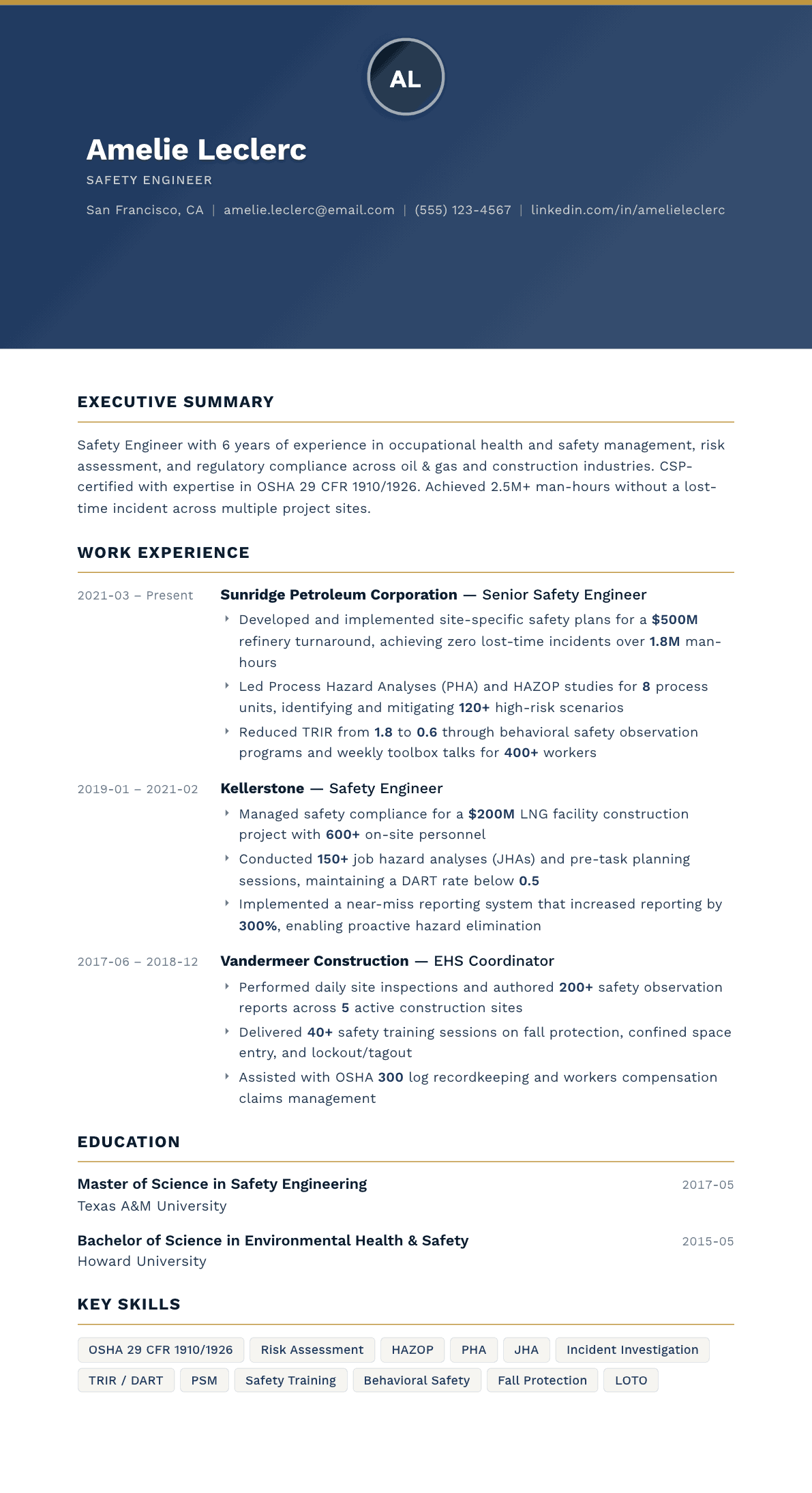
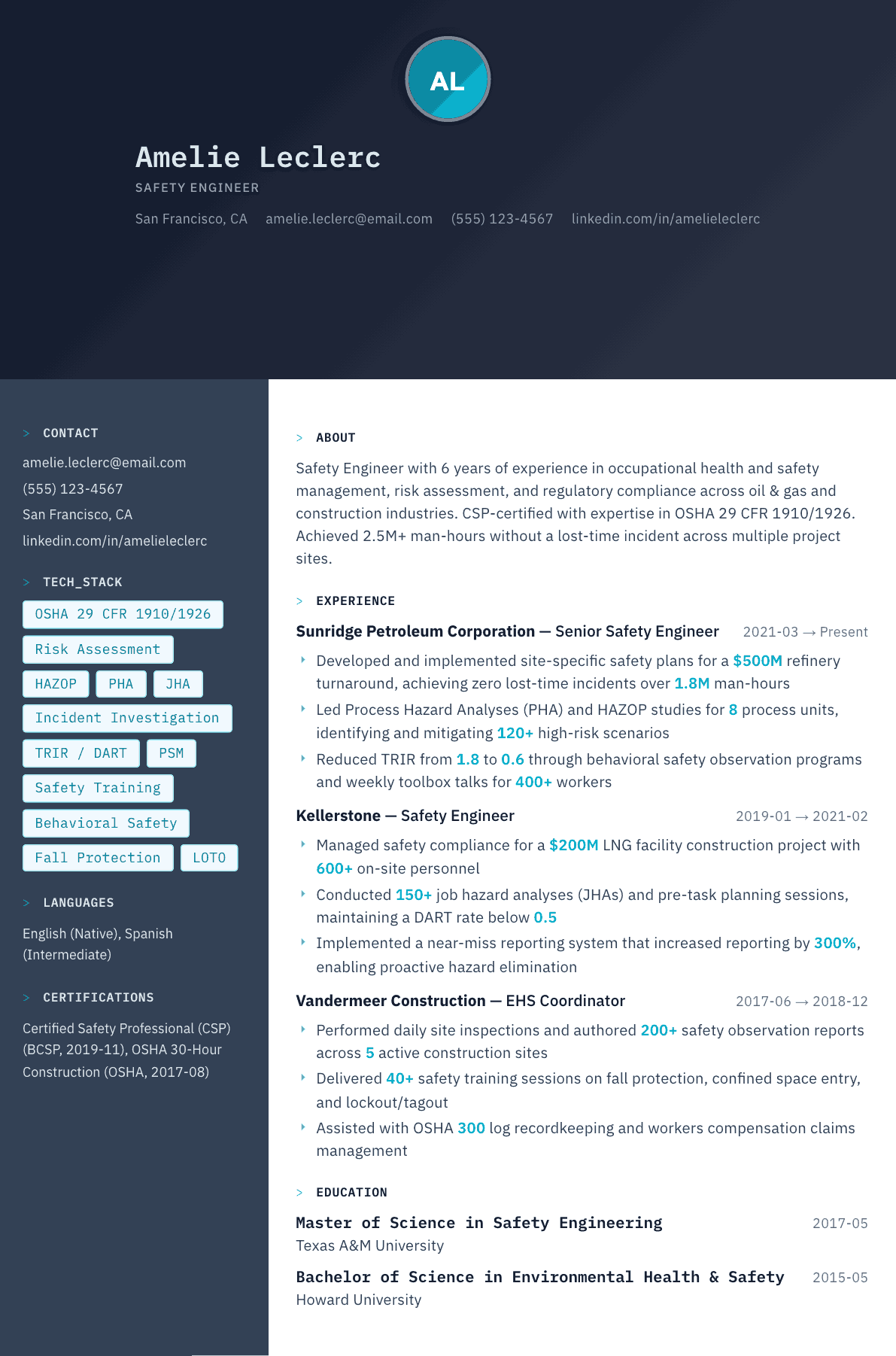
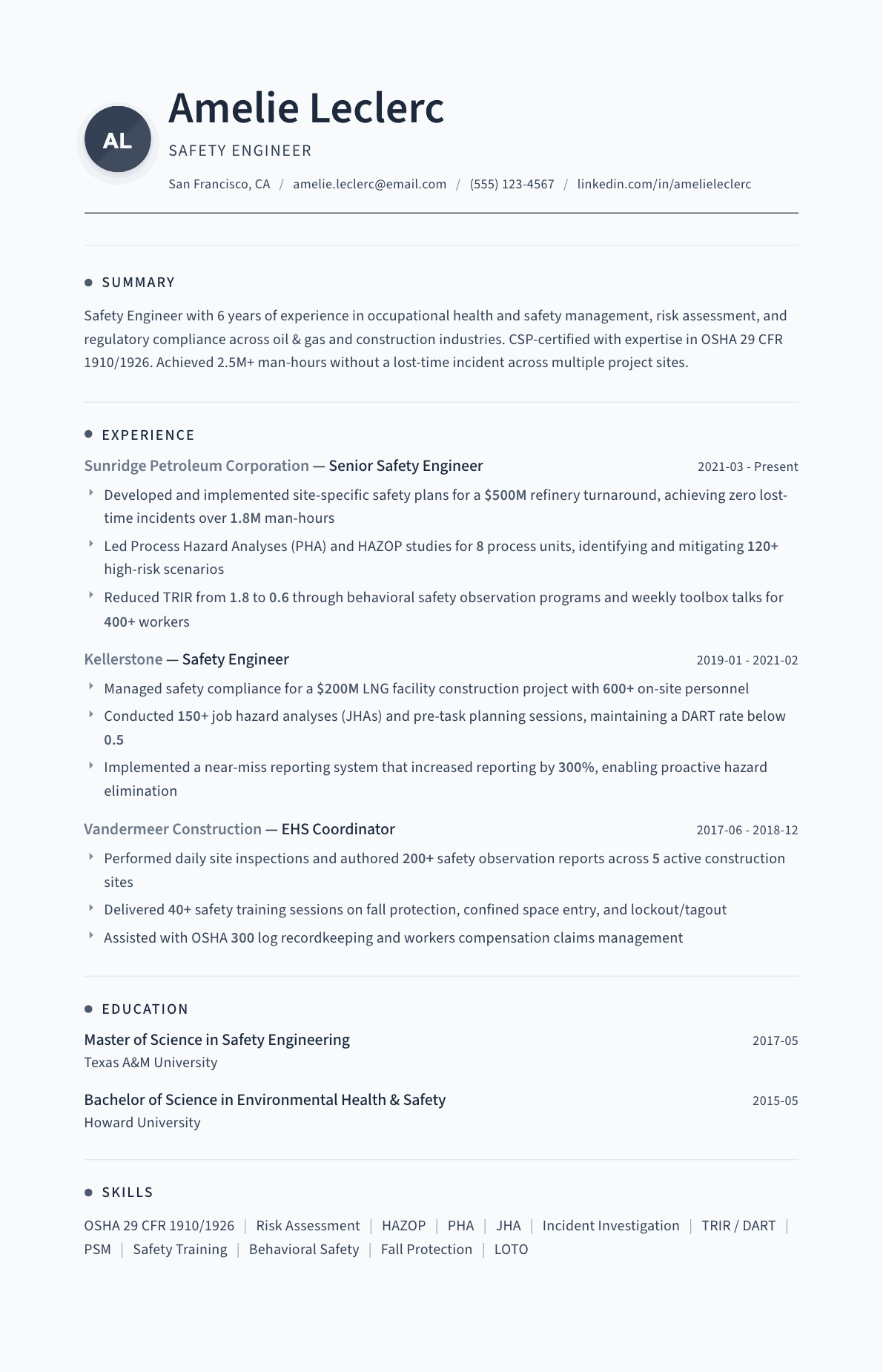
The same safety engineer content laid out in three CVBooster templates, so you can see what the finished document looks like before you write a word.
Example Safety Engineer summary
Certified Safety Professional (CSP) with 6 years of experience in occupational safety management across oil & gas and construction sectors. Expert in OSHA compliance, HAZOP studies, and behavioral safety programs. Achieved 2.5M+ man-hours without a lost-time incident and reduced TRIR from 1.8 to 0.6.
Skills to list on a Safety Engineer resume
- OSHA Compliance
- Risk Assessment
- HAZOP
- PHA
- JHA
- Incident Investigation
- Root Cause Analysis
- PSM
- Safety Training
- Behavioral Safety
- Fall Protection
- Confined Space
- LOTO
- Fire Protection
- Emergency Response Planning
What actually gets this resume read
- Highlight safety metrics: TRIR, DART, EMR, lost-time incident rates, man-hours without incident.
- Include regulatory expertise: OSHA, NFPA, ANSI, EPA, DOT, MSHA.
- Mention certifications prominently: CSP, ASP, CIH, OHST, CHST, SMS.
- Describe risk assessment methodologies: HAZOP, PHA, JHA, bow-tie analysis, fault tree analysis.
- Quantify training programs: number of sessions, participants, topics covered.
- Reference industry-specific safety programs: PSM, behavioral safety, permit-to-work systems.
How to write a safety engineer resume
A safety engineer resume is read by someone who is accountable for an injury rate and for what happens when a regulator arrives. She wants to see the industry you have worked in, the hazards you have controlled, the programs you have written or run, and whether your presence changed the numbers. Safety is one of the few engineering fields where the outcome metric is standardized, so vague claims stand out immediately.
The most common weakness is a resume built entirely from program names. Listing lockout, confined space, fall protection and hot work proves you know the vocabulary. It does not prove you audited the energy control procedures on a hundred machines and found the ones that were wrong. Reviewers want the second version.
This guide covers how to signal industry and hazard profile, which recordable metrics to use and how to attribute them honestly, how to describe risk assessment and incident investigation work, and the credentials that carry weight with a site or corporate safety leader.
Industry and hazard profile go first
Construction, oil and gas, chemicals, manufacturing, utilities, mining, healthcare and warehousing are all safety engineering, and each has a different regulatory frame, a different hazard set and a different culture. State yours in the first line, then name the site scale: headcount, contractor population, number of sites, and whether the work is fixed plant, project-based or field operations.
Follow with the hazard profile you have personally managed. Working at height, energized electrical work, hazardous energy control, confined space entry, mobile equipment, combustible dust, highly hazardous chemicals, radiation and noise all imply different technical depth, and naming them lets a manager map you onto her risk register.
- Header: name, city and state, phone, email, and certification letters after the name if you hold them.
- Order: summary, certifications, safety experience, program and technical skills, education.
- Say whether you were the site lead, part of a corporate team, a consultant or a project safety representative.
Metrics: use the standard ones and attribute them fairly
The recordable incident rate, the days away restricted or transferred rate, the lost time rate and hours worked without a lost-time injury are the numbers a safety leader reads first. Give the period, the population and the direction of travel. A rate quoted without its exposure hours is not interpretable, and experienced reviewers know it.
Leading indicators are the stronger signal because they show a program that prevents rather than counts: near-miss reporting rate, observation coverage, corrective action closure time, inspection completion, and training compliance. A resume that moves both a leading and a lagging indicator reads as engineering, not enforcement.
Attribute honestly. Safety performance belongs to operations, so write the bullet around the intervention you designed and let the rate follow. Claiming an entire site record as a personal result is the fastest way to lose a safety leader's trust.
Risk assessment, investigation and the technical core
Say which formal methods you have run rather than participated in: job hazard analysis, process hazard analysis and hazard and operability studies, what-if and checklist reviews, layer of protection analysis, bow tie diagrams, and machine risk assessment against the applicable machinery safety standards. Facilitating one of these is a distinct and marketable skill.
For investigations, name the methodology and the depth. Root cause methods such as causal factor charting, five why or a structured tree approach, plus your evidence handling, interview technique and the corrective actions you tracked to closure. Say how many serious incidents you have led, because that number is a proxy for experience nobody wants to gain.
Include the quantitative work if you have it: exposure monitoring and industrial hygiene sampling, noise dosimetry, ventilation calculations, arc flash study support, fall clearance calculations, and the design reviews where you removed a hazard rather than adding a procedure.
Programs, regulators and management systems
Name the written programs you authored or rebuilt, not just the ones your employer had. Hazardous energy control, permit to work, contractor management, emergency response, hazard communication, respiratory protection, ergonomics and management of change are all documents somebody has to own, and hiring managers hire people who have owned them.
If you have faced regulators, say so plainly: inspections hosted, citations contested or abated, agency programs participated in, and any voluntary protection or management system certification you helped achieve or maintain. Managing an inspection calmly with the records in order is a genuine differentiator.
Contractors, training and the influence problem
On most sites the contractor population is the higher-risk group and the harder one to control. Describe the prequalification process you ran, the orientation you delivered, the audits you performed and the performance data you tracked, along with the headcount involved.
Training is where a safety engineer changes behavior, so treat it as delivery rather than attendance. Give the courses you built, the audiences, the frequency and any competency verification. A safety engineer who can teach at the workface and write for a boardroom is rare and should say so through examples rather than adjectives.
Safety Engineer resume summary examples
First safety role
Safety specialist with 2 years supporting a manufacturing site of 250 employees, running daily inspections, job hazard analyses and new hire orientation. Completed 30-hour general industry training and an associate-level safety certification, and rebuilt the machine guarding inspection checklist.
Six years in
Safety engineer with 6 years across construction and heavy industrial projects, leading site safety for a workforce of 400 including contractors. Facilitates job hazard analyses, leads incident investigations to root cause, and rebuilt the permit-to-work and confined space entry programs.
Corporate safety lead
Certified safety professional with 14 years in chemical manufacturing, responsible for process safety and occupational safety across 5 plants. Leads hazard and operability studies, owns the corporate management of change and incident investigation standards, and mentors 4 site safety engineers.
Work experience bullets: before and after
Before: Responsible for site safety and OSHA compliance.
After: Led safety for a 400-person industrial construction site, owning the permit-to-work system, contractor prequalification and daily hazard analysis across 9 trade contractors.
Population, programs owned and contractor scope let a reader size the responsibility instead of guessing at it.
Before: Reduced the incident rate at the facility.
After: Introduced a supervisor-led observation program with weekly closure reviews, raising near-miss reporting fourfold and cutting the recordable rate from 3.2 to 1.4 over two years.
The mechanism plus a leading and a lagging indicator make the improvement credible and attributable.
Before: Conducted incident investigations.
After: Led 24 investigations including 3 serious injury events, using causal factor charting to identify systemic causes and tracking 90 corrective actions to verified closure.
Event counts, method and verified closure show investigation discipline rather than report writing.
Before: Performed risk assessments on equipment.
After: Ran machine risk assessments on 60 pieces of production equipment, specifying interlocks and guarding upgrades on 18 machines and rewriting their hazardous energy control procedures.
Machine count and the engineered controls prove hazards were removed, not just documented.
Before: Delivered safety training to employees.
After: Built and delivered a fall protection course for 120 workers with hands-on rescue drills and competency sign-off, replacing a slide-only session that had no practical assessment.
Audience size, hands-on component and verified competency show training that changes behavior.
Hard skills
- Job hazard analysis
- Process hazard analysis and HAZOP facilitation
- Incident investigation and root cause analysis
- Hazardous energy control programs
- Confined space entry and rescue planning
- Fall protection systems
- Machine guarding and risk assessment
- Contractor safety management
- Permit-to-work systems
- Industrial hygiene sampling
- Emergency response planning
- Safety management systems auditing
- Regulatory recordkeeping and reporting
Soft skills
- Stopping work without losing the room
- Influence with supervisors and crews
- Investigation interviewing
- Writing for both the workface and the boardroom
- Composure during regulatory inspections
Certifications worth listing
- Certified Safety Professional (CSP) (Board of Certified Safety Professionals)
- Associate Safety Professional (ASP) (Board of Certified Safety Professionals)
- Construction Health and Safety Technician (CHST) (Board of Certified Safety Professionals)
- Certified Industrial Hygienist (CIH) (American Board of Industrial Hygiene)
- OSHA 30-Hour Construction and General Industry (OSHA Training Institute Education Centers)
- Certified Safety and Health Manager (Institute for Safety and Health Management)
Mistakes that cost safety engineer candidates the interview
- Listing program names without any evidence that you audited, rebuilt or enforced them.
- Quoting an incident rate with no exposure hours or population, which makes the number impossible to interpret.
- Taking personal credit for a site safety record that belonged to the operating team.
- Omitting the hazard profile, so a hiring manager cannot map your experience onto her own risk register.
- Leaving contractor management out on project work, where contractors usually carry the highest exposure.
- Describing training by hours delivered rather than by competency verified, which is what actually reduces incidents.
Safety Engineer resume questions
Which safety metrics belong on a safety engineer resume?
The standard recordable and lost-time rates with their exposure hours and population, plus leading indicators such as near-miss reporting, observation coverage and corrective action closure time. Give the period and the direction, and attribute the result to the program you built.
Do I need a certified safety professional credential?
Many senior and corporate postings require it or an equivalent, and it is often the first filter a recruiter applies. If you are still accumulating the required experience, list the associate-level credential and the target certification with your progress toward it.
How do I write a safety engineer resume when moving between industries?
Lead with the hazards that transfer, such as hazardous energy, work at height, confined space and mobile equipment, then name the regulatory frame of the industry you are entering. Add any study or certification you have completed in the new sector to close the credibility gap.
Should I mention incidents that happened on my watch?
Do not list injuries as failures, but do describe serious investigations you led and the systemic changes that followed. Experienced safety leaders trust a candidate who has managed a real event more than one whose record is silent on the subject.
How much regulatory citation detail should I include?
Name the standards you work under by subject rather than reciting section numbers, and mention inspections hosted or abatements completed. A hiring manager wants to know you can apply the rules and face a regulator, not that you can recite a table of contents.
Related resume examples
- Environmental Engineer Resume example
- Quality Engineer Resume example
- Industrial Engineer Resume example
- Facilities Engineer Resume example
- Fire Protection Engineer Resume example
- Plant Engineer Resume example