Counselor Resume Examples: free ATS score and gap list
Counselor Resume Examples, Keywords and a Full Writing Guide
By Mustafa Tarabya, founder of CVBooster · Published · Updated
Counselor resume example with clinical hour bullets, licensure keywords, and a practical guide to writing each section for counseling job applications.
Sample resumes for a counselor
The same counselor content laid out in three CVBooster templates, so you can see what the finished document looks like before you write a word.
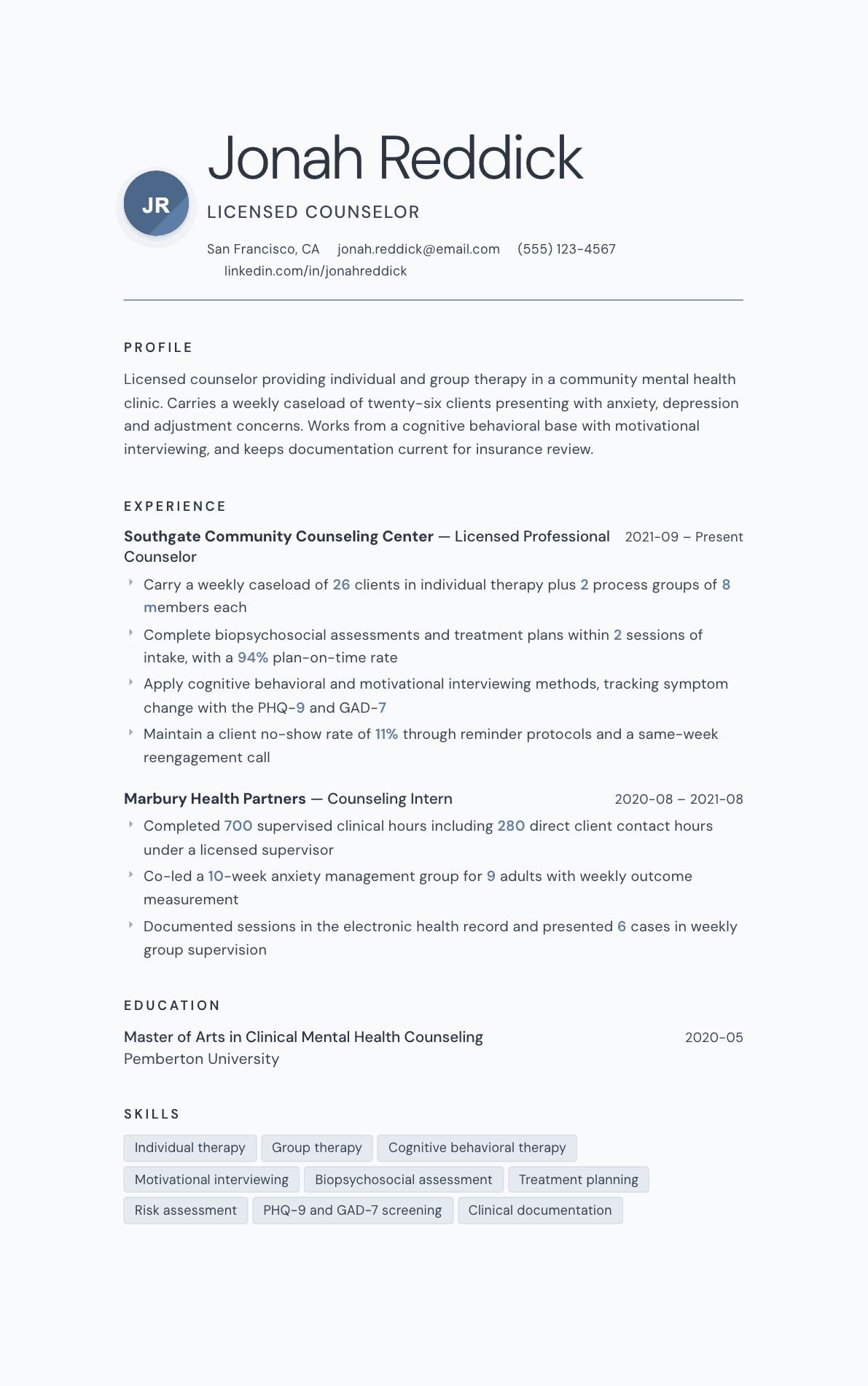
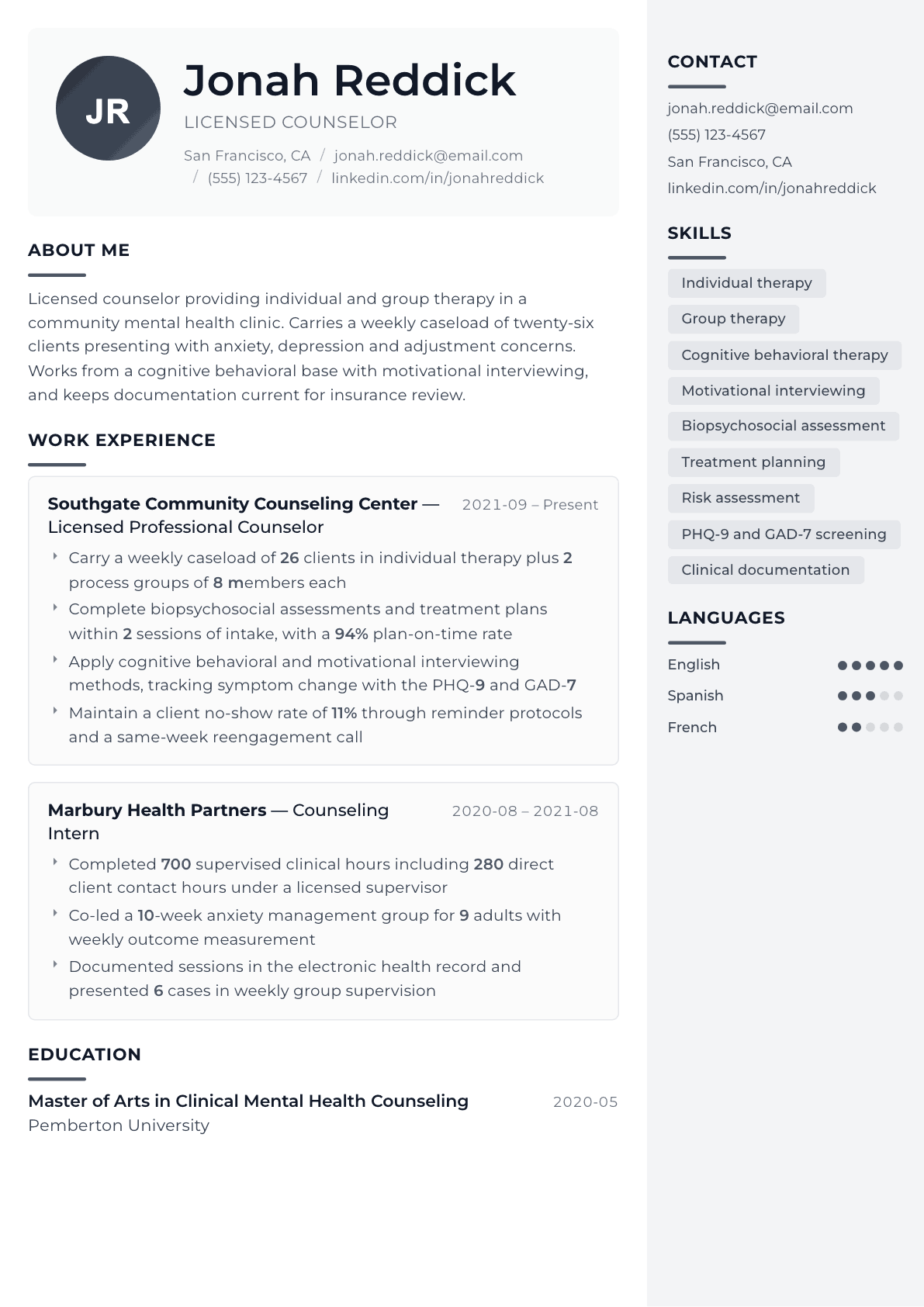
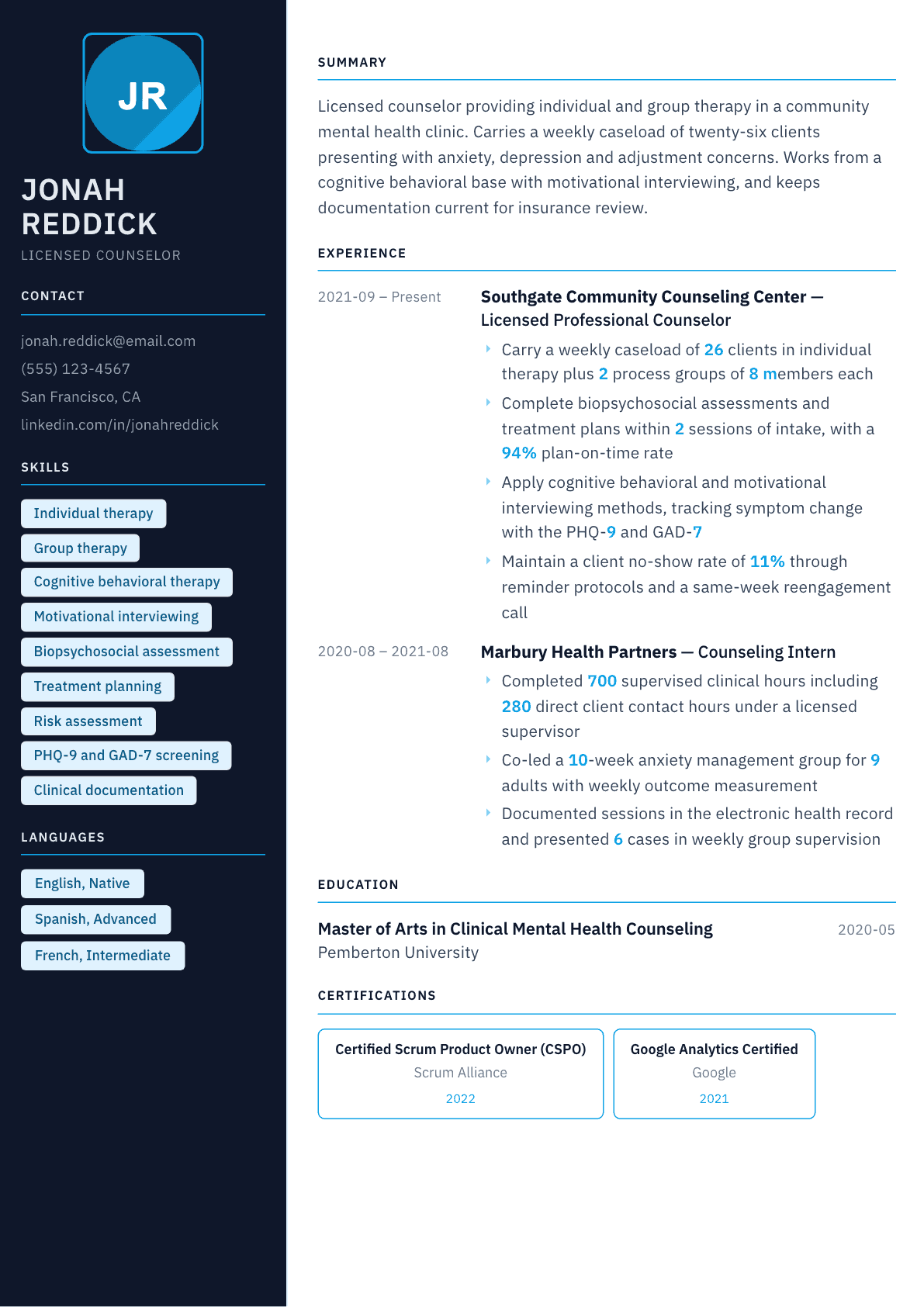
Example Counselor summary
Licensed counselor with four years of community mental health practice carrying a weekly caseload of twenty-six adults. Works from a cognitive behavioral base with motivational interviewing, completes assessments and treatment plans inside two sessions of intake, and measures change with standardized screening tools. Strong on suicide risk assessment, safety planning and documentation that survives a payer audit.
Skills to list on a Counselor resume
- Individual counseling
- Group therapy facilitation
- Cognitive behavioral therapy
- Motivational interviewing
- Solution-focused brief therapy
- Biopsychosocial assessment
- Treatment planning and review
- Suicide risk assessment
- Safety planning
- Outcome measurement
- Clinical documentation
- Case consultation
- Referral and care coordination
- Confidentiality and ethics compliance
- Telehealth delivery
What actually gets this resume read
- Put your license type, state and status in the header, because credentialing staff check it before anything else.
- State your theoretical orientation and the specific methods you use, not just the word therapy on its own.
- Give caseload size and session volume, since a clinical director is estimating whether you can hold their schedule.
- Name the outcome measures you administer, such as the PHQ-9 or GAD-7, because payers ask about measurement.
- For pre-license applicants, list supervised hours and direct contact hours separately with the supervision structure.
- Show risk assessment and safety planning explicitly, as no clinic hires a counselor who is vague about suicide risk.
How to write a counselor resume
A counselor resume passes through a credentialing check before it reaches a clinical supervisor. The first reader confirms license type, state, status and any supervision arrangement, because a clinic cannot bill for a clinician it cannot credential. Only then does a supervisor look at the clinical content, and what she wants to see is caseload capacity, orientation, risk competence and documentation that will not fail a payer audit.
The applications that stall are the ones written like a personal statement. They describe a philosophy of helping, a belief in the therapeutic relationship, and a passion for mental health. All of that is assumed. What is not assumed is whether you can hold twenty-five sessions a week, complete an intake assessment inside the required window, and write a safety plan that a chart reviewer would accept.
This guide covers the sections in the order a clinical director reads them, three summaries across the arc from pre-license to supervisor, before-and-after bullets, and the questions counselors ask when they change settings, chase licensure, or move into private practice.
Format and header: license first, always
Reverse chronological, one page for a pre-license or newly licensed counselor and two once you have several settings and a supervision history. Put the credential after your name in the header, then repeat license type, state and status in a short credential block underneath. Credentialing staff will not hunt for it and hiring can stall for weeks on a missing detail.
Avoid columns, icons and shaded boxes. Health systems and group practices run applicant tracking software that reads plain structure reliably and everything else unpredictably, and a dropped licensure line is the worst possible parsing failure for this role.
- Header: name with credential, city and state, phone, email, license type and status.
- Order: summary, licenses and certifications, clinical experience, education and supervised hours, skills.
- Include telehealth platform experience and any multi-state authority you hold.
Summary: setting, population, caseload, orientation
Say where you practice, who you treat, how many, and how. Community mental health, integrated primary care, private group practice, college counseling, employee assistance and school settings all carry the same job title and very different weekly rhythms, so name yours in the first clause.
Then give caseload volume and orientation. A weekly caseload of twenty-six clients treated from a cognitive behavioral base with motivational interviewing is a specific professional identity. Eclectic and client-centered is not, and a supervisor reads it as a counselor who has not yet formed a practice.
Experience: caseload, assessment cycle, outcomes
Open each job with the volume: individual sessions per week, groups facilitated, and the presenting concerns you carry. Then move to the assessment cycle. Intake, biopsychosocial assessment, diagnosis, treatment plan and review dates are the compliance backbone of any funded clinic, and a counselor who reports plan completion inside the required window is telling a director that the charts will be clean.
Show measurement. Standardized screening tools administered at intake and at intervals, symptom change tracked across a course of treatment, and the way you use those results in session are what payers ask about and most applicants leave out entirely. Naming your instruments is a strong differentiator in a stack of otherwise similar files.
Add the practical clinic metrics that supervisors carry: no-show and cancellation rates, reengagement calls, waitlist movement, and productivity against the expected session target. A counselor who can hold a schedule and keep clients coming back is solving the director hardest operational problem.
Risk, safety and ethics: never leave these vague
Every clinic hires for risk competence. Write the practice, not the sentiment: the screening you use for suicide risk, how you build a safety plan with the client and a support person, when you involve emergency services, and how you document the decision. A vague line about assessing risk when appropriate signals a counselor who has not carried the responsibility alone.
Ethics and confidentiality belong in one line each, tied to something concrete. Consent processes, release of information, mandated reporting, and how you handle a dual relationship in a small community are all real, checkable practices, and they matter more than a statement about adhering to a code.
- Risk: screening instrument, safety planning with a named support person, escalation criteria.
- Ethics: informed consent, releases, mandated reporting, documented clinical decision making.
- Coordination: referrals to psychiatry and higher levels of care, and how you follow up.
Supervised hours, keywords and telehealth
Pre-license counselors should report hours as a table of facts: total supervised hours, direct client contact hours, group versus individual supervision, and the credential of the supervisor. A director is calculating how much supervision she would inherit, so precision here speeds up the decision.
The keyword layer comes straight from postings: individual therapy, group therapy, intake assessment, treatment planning, evidence-based practice, suicide risk assessment, safety planning, case consultation, care coordination, documentation compliance, telehealth. Mirror the ones you genuinely practice, once in the skills block and once inside a bullet where the reader can see the work.
Counselor resume summary examples
Pre-license associate
Counseling graduate with 700 supervised clinical hours including 280 direct client contact hours under a licensed supervisor. Co-led a 10-week anxiety management group for 9 adults, documented in an electronic health record, and presented 6 cases in group supervision. Seeking an associate counselor position.
Four years licensed
Licensed counselor carrying 26 weekly individual clients and 2 process groups in community mental health. Completes assessments and treatment plans within 2 sessions of intake at a 94% on-time rate, tracks symptom change with standardized screens, and holds the no-show rate at 11%.
Clinical supervisor
Clinical supervisor overseeing 8 counselors and pre-license associates in an outpatient clinic while carrying a reduced caseload of 12 clients. Reviews charts before submission, chairs weekly case consultation, and rebuilt the intake pathway so first appointments happen within 9 days instead of 24.
Work experience bullets: before and after
Before: Provided individual counseling to clients.
After: Carried a weekly caseload of 26 adults in individual therapy for anxiety, depression and adjustment concerns, plus 2 process groups of 8 members each.
Caseload, presenting concerns and group load let a director place you in a real schedule.
Before: Completed assessments and treatment plans.
After: Completed biopsychosocial assessments and measurable treatment plans within 2 sessions of intake, holding a 94% on-time plan rate across two audit periods.
The window and the on-time rate are exactly what a chart reviewer measures.
Before: Used evidence-based approaches in sessions.
After: Applied cognitive behavioral protocols and motivational interviewing, tracking symptom change with a standardized depression and anxiety screen at intake and every 4 sessions.
Named methods with a measurement interval prove an actual practice model rather than a preference.
Before: Handled clients in crisis when they came up.
After: Conducted structured suicide risk screening at intake and on presentation of new risk factors, built written safety plans with a named support person, and documented each clinical decision the same day.
Risk work is judged on structure and documentation, so the bullet has to show both.
Before: Worked to reduce client no-shows.
After: Introduced a reminder protocol and a same-week reengagement call for missed appointments, bringing the no-show rate down from 19% to 11% over two quarters.
An intervention with a before and after figure shows ownership of clinic productivity.
Hard skills
- Individual counseling
- Group therapy facilitation
- Cognitive behavioral therapy
- Motivational interviewing
- Solution-focused brief therapy
- Biopsychosocial assessment and diagnosis
- Treatment planning and review
- Suicide risk assessment
- Safety planning
- Standardized outcome measurement
- Clinical documentation and chart compliance
- Telehealth delivery
Soft skills
- Holding a full weekly schedule
- Difficult feedback inside the therapeutic relationship
- Supervision use and case presentation
- Boundaries in small communities
- Composure during a risk disclosure
Certifications worth listing
- National Certified Counselor (NCC) (National Board for Certified Counselors)
- Certified Clinical Mental Health Counselor (CCMHC) (National Board for Certified Counselors)
- Board Certified TeleMental Health Provider (BC-TMH) (Center for Credentialing and Education)
Mistakes that cost counselor candidates the interview
- Burying license type and state so a credentialing coordinator has to email before the file can move.
- Describing an orientation as eclectic, which reads to a supervisor as a practice that has not yet formed.
- Leaving risk assessment as a soft phrase instead of naming the screening, the safety plan and the documentation.
- Omitting caseload volume, which is the first thing a director needs in order to picture you in her schedule.
- Listing every workshop attended, which crowds out the credentials and training that actually differentiate you.
- Reporting supervised hours as a single lump number without separating direct client contact hours.
Counselor resume questions
How do I list my license if I am still pre-license?
State the exact status your state uses, such as associate or provisional licensure, along with the license number where one is issued, your supervisor credential, and your accrued hours. Directors are comfortable hiring pre-license counselors, but they need to see the supervision structure before they can plan around it.
How long should a counselor resume be?
One page while you are pre-license or newly licensed, and two pages once you have several settings, supervision history or specialty training. Anything longer usually repeats the same duties across three jobs, which weakens rather than strengthens the file.
Should I include client outcome data?
Include aggregate and process measures rather than individual results. Screening instruments you administer, the intervals you measure at, plan completion timeliness and no-show rates are all appropriate. Never include anything that could identify a client, even indirectly through a small caseload description.
What changes when I apply to private practice instead of a clinic?
Group practices care about caseload capacity, insurance panels you are credentialed with, specialty niches that fill a schedule, and comfort with independent documentation. Move those to the top and reduce the emphasis on agency compliance work that a smaller practice does not run.
How do I describe telehealth work on a counseling resume?
Name the share of your caseload delivered remotely, the platform type, and how you adapted risk assessment for remote sessions, including how you confirm client location and emergency contacts. Remote risk protocol is the detail supervisors probe, so putting it on the page saves an awkward interview moment.
Related resume examples
- Social Worker Resume example
- Case Manager Resume example
- Behavioral Health Counselor Resume example
- Licensed Professional Counselor Resume example
- Chaplain Resume example
- Marriage and Family Therapist Resume example