Software Architect Resume Examples: the lines they read
Build a Software Architect Resume Around Decisions and Outcomes
By Mustafa Tarabya, founder of CVBooster · Published · Updated
A software architect resume built on decision records, system diagrams and quality attributes, with sample bullets and a full writing guide.
Sample resumes for a software architect
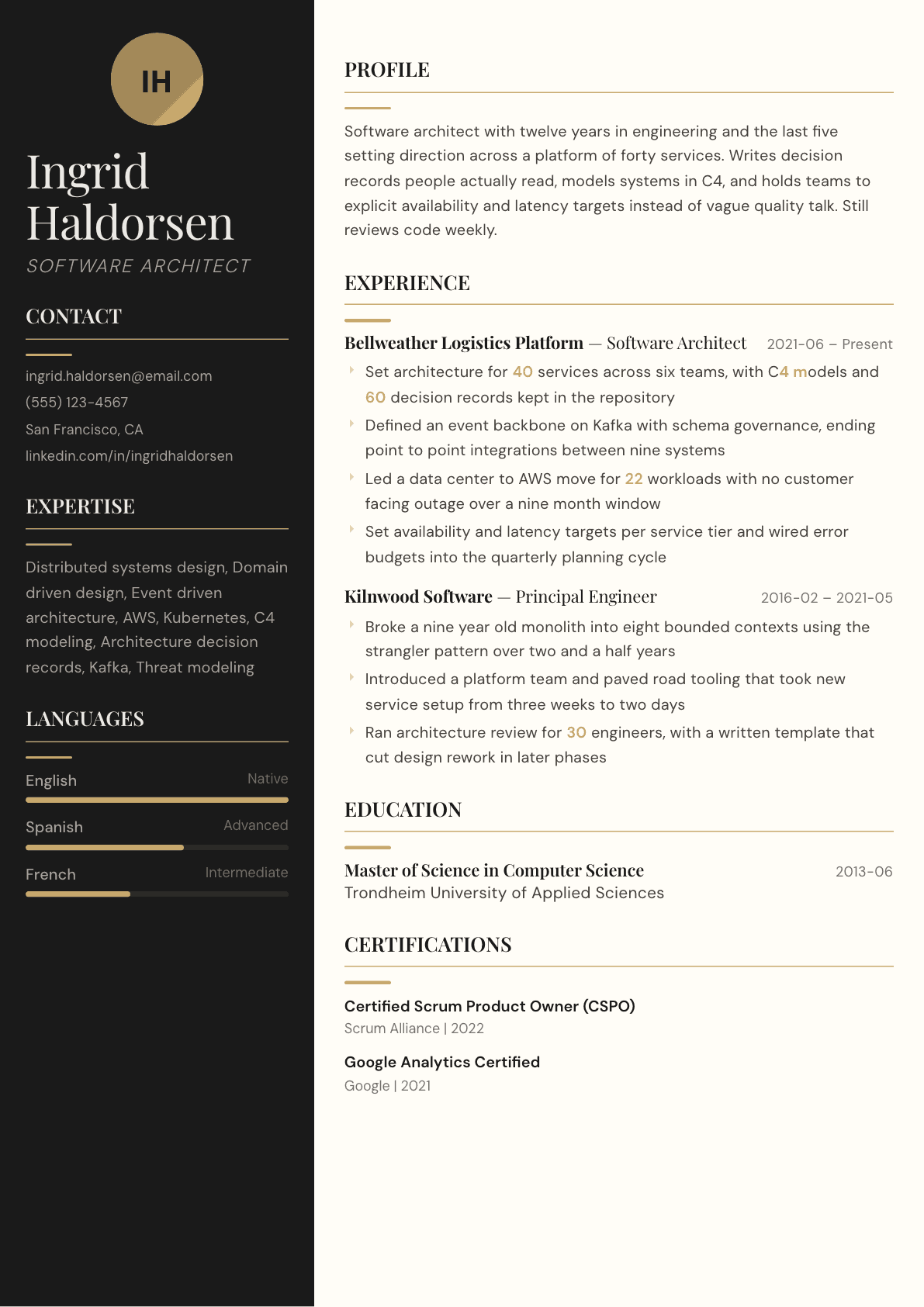
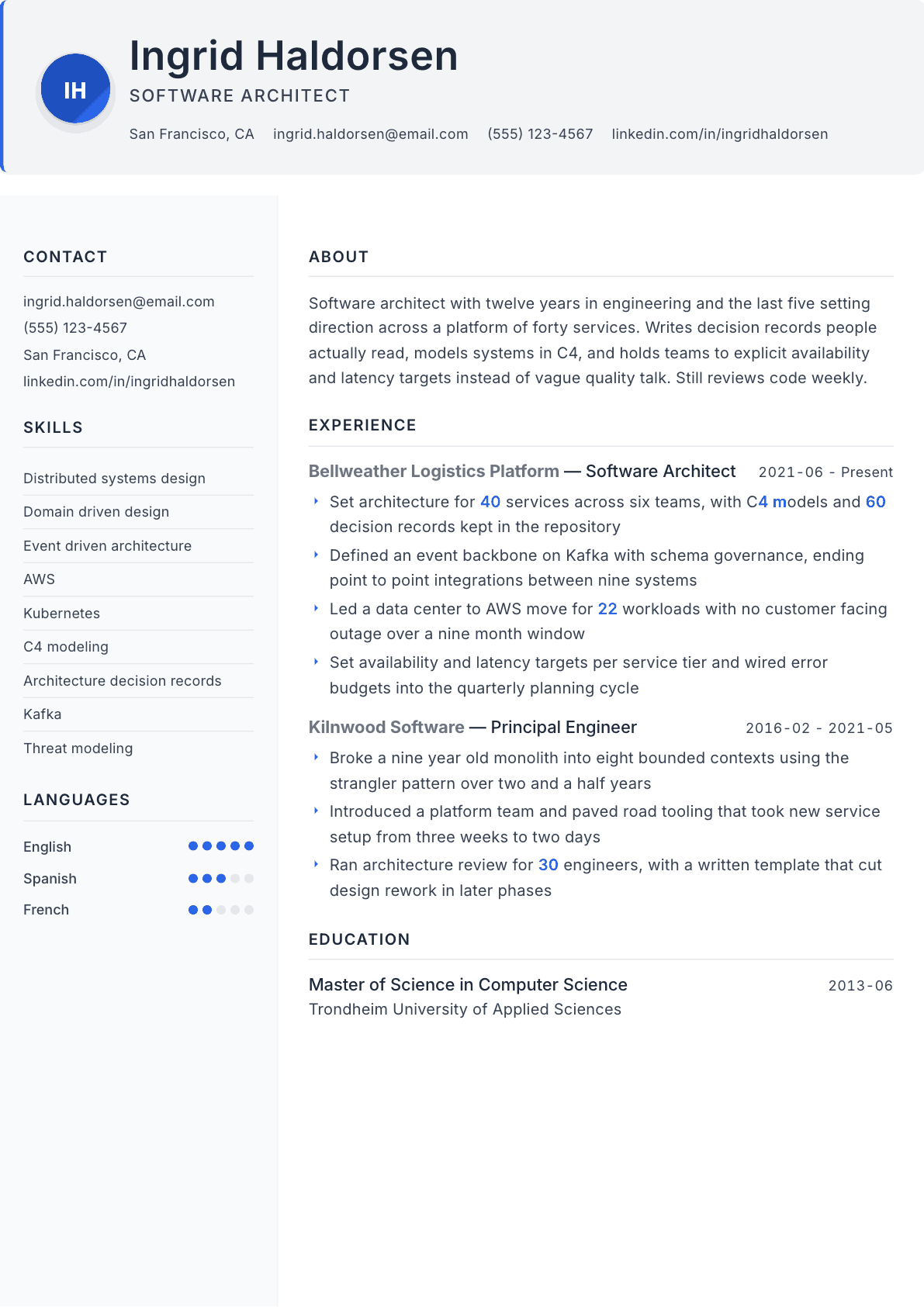
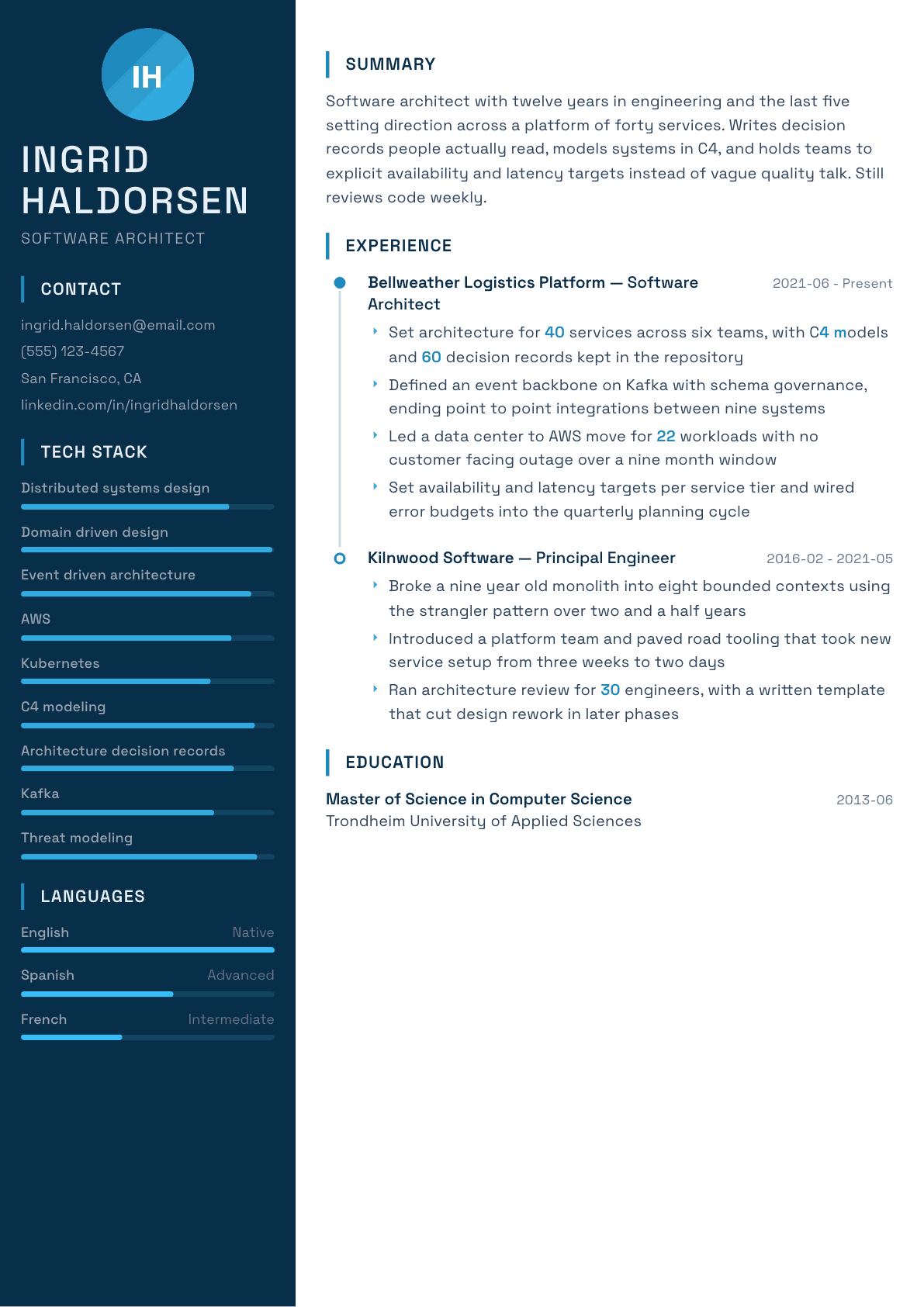
The same software architect content laid out in three CVBooster templates, so you can see what the finished document looks like before you write a word.
Example Software Architect summary
Software architect with twelve years in engineering and five setting technical direction for a logistics platform of forty services and six teams. Models systems in C4, keeps decision records in the repository where engineers find them, and sets explicit availability and latency targets per service tier. Led a twenty two workload cloud migration with no customer facing outage. Looking for a principal architect role in a product organization.
Skills to list on a Software Architect resume
- Distributed systems design
- Microservices architecture
- Domain driven design
- Event driven architecture
- API strategy
- AWS
- Azure
- Kubernetes
- Kafka
- C4 modeling
- Architecture decision records
- Non functional requirements
- Threat modeling
- Cloud migration
- Technical governance
- Cost optimization
What actually gets this resume read
- Lead every job with scope: how many services, teams, engineers and users the architecture you owned actually covered.
- Name the quality attributes you set targets for, availability, latency, recovery time, rather than writing scalable systems.
- Reference decision records or design reviews, because architects are judged on how they document and defend choices.
- Include one migration with duration and outcome, since a finished migration is the clearest proof of architectural work.
- Keep a short hands on line, the languages and platforms you still work in, so you are not read as a diagram only architect.
- Show governance work: standards, paved roads, review processes and how teams adopted them without a mandate.
How to write a software architect resume
An architect resume is judged on scope and consequence. Not what you built, but what you decided, who it constrained, and what happened afterward. The reader is usually a head of engineering or a chief technology officer who has an expensive problem: a monolith that will not scale, a cloud bill nobody can explain, five teams building the same thing three ways. They are scanning for someone who has already resolved a version of it.
The trap is abstraction. Architect resumes drift into vocabulary that could describe any system anywhere: scalable, robust, best practices, cross functional alignment. That language is exactly what a senior reader discounts, because every applicant has it and none of it is checkable. The antidote is numbers and artifacts: services, teams, availability targets, decision records, migrations with dates and outcomes.
This guide sets out how to structure an architect resume, what belongs in each section, three summaries by career stage, five rewritten bullets, the errors that make experienced architects look generic, and the questions candidates at this level ask most.
Format: two pages, scope stated before anything else
Two pages is normal and expected at this level. Use reverse chronological order and open each role with a scope line before the bullets: the platform, the number of services, the number of teams and engineers, the user base and the operating constraints such as regulation or uptime commitments.
Keep a short technical block so the automated screen still matches, but do not let it dominate. A reader at this level cares more about a migration you finished than about a list of eighteen technologies, and a long tools list on an architect resume can read as a senior developer applying one title too high.
- Header: name, architect title, city, phone, email, and a talk or writing link if you have one.
- Order: summary, core competencies, experience, selected architecture work, education, certifications.
- Scope line for every role, then four or five bullets with decisions and outcomes.
Summary: breadth of engineering years, current scope, and one finished thing
Four lines. Total engineering years and how many of them were architecture, the domain, the current scope in services and teams, and one completed piece of work that a reader can weigh. A finished migration, a platform standard adopted across teams, or an availability target you set and held.
Include a hands on signal. Architects who never touch code lose credibility with the engineers they need to influence, and hiring managers know it. A short clause about the languages and platforms you still work in solves this in a few words.
Experience: decisions, constraints, and what changed as a result
The most persuasive architect bullets have three parts: the constraint, the decision, and the consequence. An integration mesh that had become nine point to point connections, an event backbone with schema governance as the decision, and the retirement of those connections as the consequence.
Quality attributes are your natural vocabulary. Availability, latency, recovery time objective, throughput, cost per transaction, and the security posture. Say which ones you set targets for, at what level, and how they were enforced in planning. Error budgets tied to quarterly commitments are far more convincing than the word reliability.
Migrations are the clearest proof of architecture work because they finish or they do not. Give the workload count, the duration, the approach such as strangler or parallel run, and the customer impact. A migration described without a duration reads as one that is still going.
Artifacts: the documents that prove how you work
Architects are judged on how they record and defend choices. Name the artifacts you produce: decision records kept in the repository next to the code, C4 diagrams at context and container level, threat models, non functional requirement catalogs, and the review process that turns them into agreement.
Governance belongs here too. A paved road with templates and guardrails that teams adopt because it is easier than the alternative shows a different kind of skill than a standards document nobody reads. Say how adoption happened, since voluntary adoption is the hard part.
- Architecture decision records, with roughly how many and where they live.
- C4 or similar models, and who consumes them.
- Non functional requirements and the service tiers they apply to.
- Review forums: cadence, participants, and what a review must produce.
Cost, security and the business case
Architects increasingly own cost. Reserved capacity, right sizing, storage tiering, and killing services nobody uses are all legitimate architecture outcomes, and they translate directly into the language the executive reader thinks in. Describe the mechanism and the direction of the change rather than inventing a figure you cannot defend.
Security should appear as design work: threat modeling, secret management, identity boundaries between services, data classification, and how you handled an audit requirement. In regulated industries this section is often what decides the interview.
Software Architect resume summary examples
Moving into architecture
Lead engineer with eight years building distributed services, now owning design across three teams. Wrote the decision records for a payments integration, set the service template used for new projects, and ran the design review that reduced rework. Seeking a first formal architect role in a product organization.
Platform architect
Software architect with twelve years in engineering and five setting direction for a logistics platform of 40 services across six teams. Defined the event backbone with schema governance, led a 22 workload cloud migration with no customer facing outage, and set availability targets by service tier.
Principal architect
Principal architect with eighteen years across banking and marketplaces, currently accountable for technical strategy in an engineering organization of 120. Chairs the architecture forum, owns the cost and reliability targets agreed with the executive team, and still reviews designs and code every week.
Work experience bullets: before and after
Before: Designed scalable microservices architecture.
After: Set architecture for 40 services across six teams with C4 models and 60 decision records kept in the repository beside the code they govern.
Service and team counts plus the artifacts replace an adjective every applicant uses with facts a reader can weigh.
Before: Introduced event driven architecture.
After: Defined an event backbone on Kafka with a schema registry and compatibility rules, retiring nine point to point integrations between order, billing and warehouse systems.
Naming what the decision removed shows the problem it solved rather than the pattern it followed.
Before: Led a cloud migration.
After: Led a data center to cloud move of 22 workloads over nine months using parallel run and staged cutover, completing with no customer facing outage.
Workload count, duration, approach and impact are the four things a reader needs to trust a migration claim.
Before: Improved system reliability.
After: Set availability and latency targets per service tier, wired error budgets into quarterly planning, and made budget exhaustion a trigger for pausing feature work.
A concrete governance mechanism proves reliability was managed rather than merely wished for.
Before: Broke up the monolith.
After: Decomposed a nine year old monolith into eight bounded contexts using the strangler pattern over two and a half years, with each extraction released behind a routing layer.
The number of contexts, the technique and the timescale describe a completed program instead of an intention.
Hard skills
- Distributed systems design
- Domain driven design and bounded contexts
- Event driven architecture and messaging
- API strategy and versioning
- Cloud platform architecture on AWS or Azure
- Kubernetes and container platforms
- Data architecture and storage selection
- Non functional requirements and service tiers
- Threat modeling and security design
- C4 modeling and architecture decision records
- Migration strategy including strangler and parallel run
- Cloud cost management
Soft skills
- Influence without direct authority
- Writing decisions people actually read
- Facilitating design review without dominating it
- Translating technical risk for executives
- Coaching senior engineers toward architecture
- Choosing which battles to leave alone
Certifications worth listing
- TOGAF Enterprise Architecture Practitioner (The Open Group)
- AWS Certified Solutions Architect, Professional (Amazon Web Services)
- Microsoft Certified: Azure Solutions Architect Expert (Microsoft)
- iSAQB Certified Professional for Software Architecture, Foundation Level (International Software Architecture Qualification Board)
- Certified Kubernetes Administrator (CKA) (Cloud Native Computing Foundation)
Mistakes that cost software architect candidates the interview
- Writing in abstractions such as scalable and robust, which a senior reader discounts because every applicant claims them.
- Omitting scope, so nobody can tell whether you architected three services for one team or forty across six.
- Listing patterns as though naming them were the achievement, with no constraint or consequence attached.
- Describing migrations with no duration or end state, which reads as a program that never finished.
- Dropping every hands on signal, leaving engineers to assume you cannot read the code you are governing.
- Filling half a page with a technology list, which makes a senior developer resume wearing an architect title.
- Claiming organization wide standards without saying how teams were brought to adopt them.
Software Architect resume questions
How long should a software architect resume be?
Two pages. One page cannot carry the scope, artifacts and outcomes this role is judged on, and three invites skimming. Compress anything older than a decade into a short early career block with titles and dates only.
Should an architect still show coding experience?
Yes. A brief line on the languages and platforms you still work in, plus evidence you review code or build proofs of concept, protects your credibility with the engineers you will need to influence and with the manager hiring you.
Is a TOGAF certification worth having?
It helps most in large enterprises and consultancies where the framework is part of the operating model, and it can be a filter in public sector procurement. In product companies a cloud architecture credential usually carries more weight.
How do I move from senior engineer to architect on paper?
Lead with the design work you already do: decision records you wrote, reviews you ran, standards other teams adopted, and systems you scoped end to end. Reframe your titles honestly but let the architecture content occupy the top of each role.
What should an architect say about cost?
Name the levers you pulled and the direction they moved: right sizing, reserved capacity, storage tiering, or retiring unused services. Describe the mechanism and the outcome you can defend, since an invented saving figure is easy to unravel in an interview.
Related resume examples
- Solutions Architect Resume example
- Cloud Architect Resume example
- Technical Lead Resume example
- Java Developer Resume example
- Integration Architect Resume example
- Data Architect Resume example