Java Developer Resume Examples: the lines they read
Java Developer Resume: Java Software Developer Examples, Junior to Lead
By Mustafa Tarabya, founder of CVBooster · Published · Updated
A Java developer resume sample built around Spring Boot, JVM tuning and the keywords enterprise recruiters search, plus a Java programmer resume guide.
Sample resumes for a java developer
The same java developer content laid out in three CVBooster templates, so you can see what the finished document looks like before you write a word.
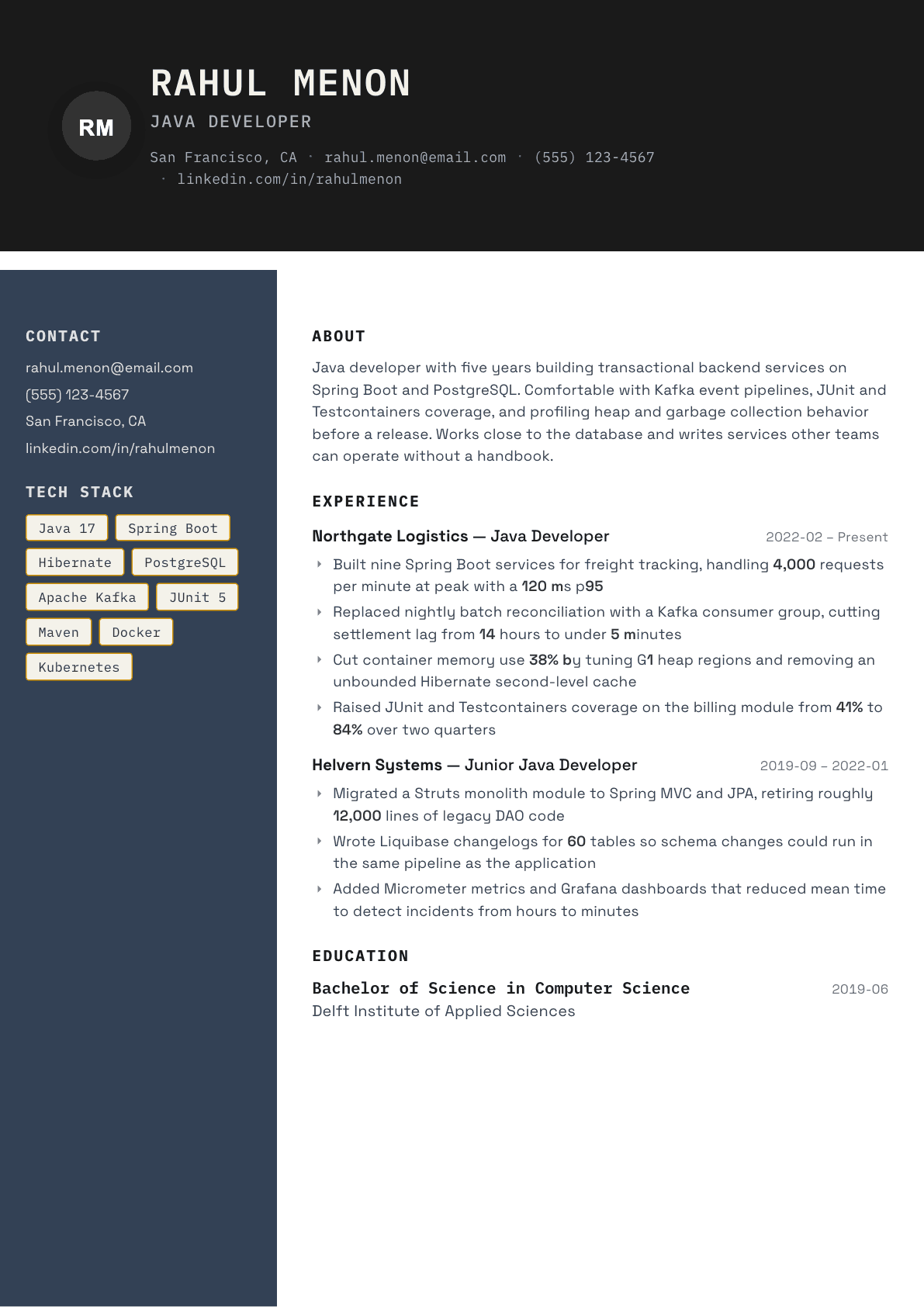
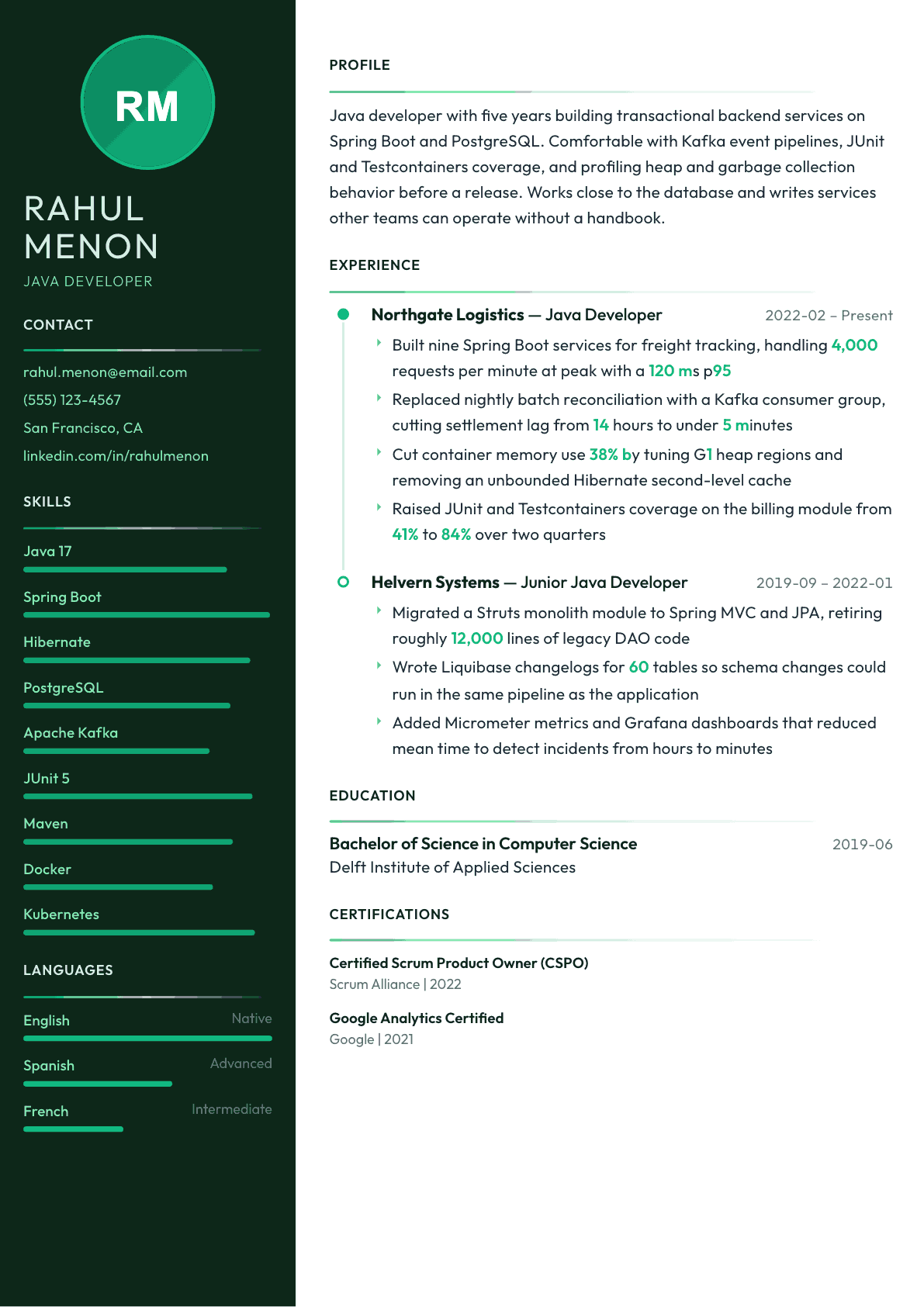
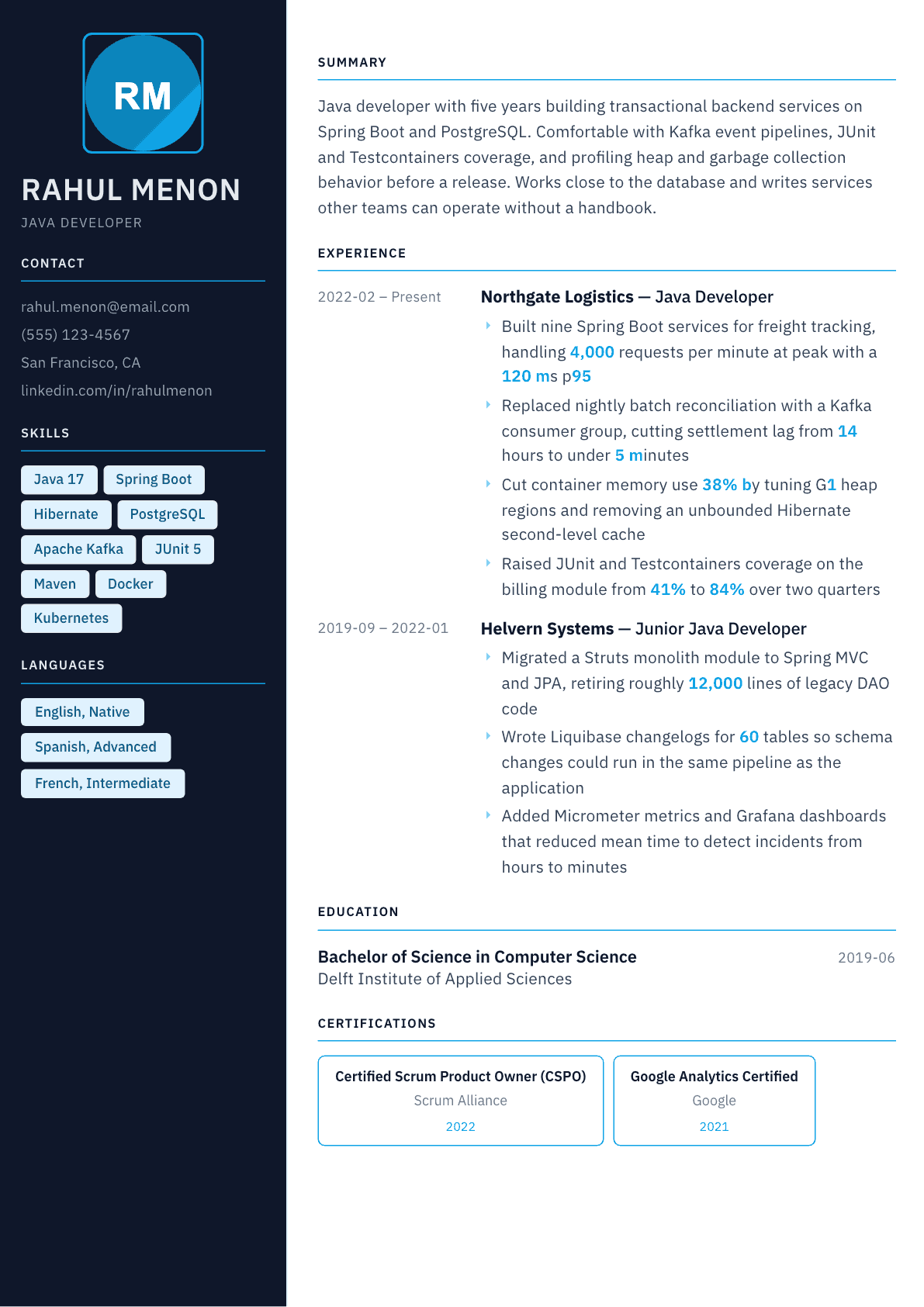
Example Java Developer summary
Java developer with five years of backend work on Spring Boot services behind a payments and logistics platform. Owns schema design in PostgreSQL, event flows in Kafka, and the JVM tuning that kept memory use flat while traffic tripled. Writes tests with JUnit 5 and Testcontainers so releases go out weekly rather than quarterly. Looking for a senior backend role on a product with real transaction volume.
Skills to list on a Java Developer resume
- Java
- Spring Boot
- Spring Security
- Hibernate and JPA
- REST API design
- Apache Kafka
- PostgreSQL
- Maven
- Gradle
- JUnit 5
- Mockito
- Docker
- Kubernetes
- JVM performance tuning
- CI/CD pipelines
What actually gets this resume read
- Name the Java version and the framework generation you used, because Java 8 and Java 17 hiring pools differ sharply.
- Give each service a size: requests per second, table count, message volume or the number of services you own.
- Put build tooling, Maven or Gradle, and your test stack in the skills block, since enterprise screens filter on both.
- Show one performance story with the mechanism: garbage collection tuning, connection pool sizing or a query plan you fixed.
- Say which database and ORM you used, and whether you write SQL by hand, because that answers a common interview doubt.
- If you have worked on a monolith to services migration, describe the slice you carried rather than the whole program.
How to write a java developer resume
Java hiring is unusually specific. A bank, an insurer and a product startup all post for a Java developer and all three mean different things: one wants Spring Boot behind an Oracle estate, one wants batch processing that has to reconcile to the cent, one wants services that survive a traffic spike. The resume that works names which of those worlds you have lived in, in the first four lines.
The screen itself is usually a keyword pass followed by a lead engineer reading your experience section for two minutes. The keyword pass wants the version, the framework, the build tool, the database and the test stack. The lead engineer wants to see that you understand what the JVM does under load, because that is what separates a developer who can add an endpoint from one who can keep the service up.
The same advice serves a Java programmer resume and a Java developer resume, since most postings use the two titles for the same backend seat; the FAQ explains where the emphasis shifts. This guide covers the format enterprise applicant tracking systems parse cleanly, how to write the summary and experience sections for backend work, three example summaries at different career stages, before and after bullets, and the questions Java candidates ask most.
Format: reverse chronological, one column, tools named in every job
Use a single column with plain section headings. Large enterprises run older parsers, and a two column layout with a sidebar of skills often arrives with the dates attached to the wrong employer. One page is enough under six years of experience, two pages after that.
Put a technical skills block near the top, grouped by kind: language and version, frameworks, data, messaging, build and test, infrastructure. Grouping matters because a reader scanning for Kafka should not have to read a thirty item comma list to find it.
- Header: name, title, city, phone, email, and links to a code profile if the code there is worth reading.
- Order: summary, technical skills, experience, education, certifications.
- Each job line: company, title, dates, then one line naming the domain and the system size before the bullets.
Summary: version, framework generation, domain, one signature strength
Four lines at most. Say how many years, which Java version family you work in day to day, the framework, the domain, and one thing you are known for. A reader who sees Java 17 and Spring Boot and payments knows immediately whether to keep reading.
If most of your work has been on an older stack, say so plainly and name what you have done to move forward. Honesty about a Java 8 estate plus evidence of an upgrade you led reads far better than a summary that implies current versions and an interview that reveals otherwise.
Written out for a Java software developer resume: Java software developer, Java 17 and Spring Boot 3, five years on payment services for a regional bank. Moved a nightly batch to event driven processing with Kafka and owns the service's load tests. Four lines, and the keyword pass and the lead engineer both get what they came for.
Experience: system size first, then the engineering underneath
Open each role with the shape of the system: how many services, how many tables, what the traffic looks like, who the users are. A screener cannot tell an internal admin tool from a settlement engine unless you say so, and the difference decides whether your bullets are impressive or ordinary.
Then three to five bullets that show mechanism. Anyone can write that they built REST endpoints. Write instead that you replaced a nightly batch with a Kafka consumer group and what that did to reconciliation lag. Name the concurrency primitives when they matter: thread pools, CompletableFuture, virtual threads, database connection pool sizing.
Reserve one bullet per role for something outside coding: an upgrade you led, a runbook you wrote, a junior engineer you brought up, an incident you owned. Backend teams hire for operability as much as for output.
Skills: the block the keyword pass reads
Mirror the vocabulary of the posting, then add the specifics that prove depth. Spring Boot alone is weak; Spring Boot with Spring Security, Spring Data and Spring Cloud Gateway tells a reader which parts of the ecosystem you have used. The same is true of persistence: JPA and Hibernate are not the same claim as writing and reading SQL.
Keep the list to things you would defend in an interview. A Java resume that lists Scala, Go, Rust and Python alongside twelve Java technologies invites a question you do not want to answer badly.
- Language: Java version family, records, streams, optional, virtual threads if you use them.
- Frameworks: Spring Boot, Spring Data, Spring Security, Quarkus or Jakarta EE if that is your world.
- Data and messaging: PostgreSQL, Oracle, Hibernate, Flyway or Liquibase, Kafka, RabbitMQ.
- Build and test: Maven, Gradle, JUnit 5, Mockito, Testcontainers, JMeter or Gatling.
Performance and reliability: the section that separates senior candidates
Every experienced Java developer has at least one story about memory or latency. Put it on the resume with the mechanism and the measurement: a heap dump that revealed a caching mistake, a garbage collection pause you traced with GC logs, a connection pool set too small for the thread count, an N plus one query the ORM was generating quietly.
This is also where monitoring belongs. Micrometer metrics, distributed traces, structured logs and a dashboard someone else can read are all evidence that you have carried a service in production rather than handed it over at merge time.
Java software developer resume example, start to finish
Most resumes for Java read the same at the top, so the sample below shows a complete page for a mid level Java software developer applying to a backend team in financial services. The person and employers are invented. A Java programmer resume uses the same order; if your work is mostly maintenance and feature work on one application, say so in the summary and lead the experience section with the codebase and the release cadence instead of the architecture.
- Header: Daniel Ortiz, Java Software Developer. City, phone, email, link to a code profile with two projects worth reading.
- Summary: Java software developer with six years on Spring Boot services for payments and lending, working in Java 17 day to day. Owns four services behind a loan origination platform, from design through on call. Known for test coverage and for cleaning up slow queries before they become incidents.
- Technical skills: Java 17 and Java 11; Spring Boot, Spring Data, Spring Security; PostgreSQL and Oracle with Hibernate and Flyway; Kafka; Maven and Gradle; JUnit 5, Mockito, Testcontainers; Docker, Kubernetes, Jenkins.
- Current role, Java Software Developer, a regional lender, three years: builds and runs four Spring Boot services for loan applications and credit decisions; moved the credit check from a nightly batch to a Kafka consumer so applicants get a decision during the same visit; wrote the contract tests that now gate every release.
- Previous role, Java Programmer, an insurance software vendor, three years: maintained a large Java 8 policy administration application on a quarterly release cycle; migrated two modules from Struts to Spring MVC behind a feature toggle; fixed the N plus one queries behind the slowest screen in the product.
- Education and certifications: Bachelor of Science in Computer Science; Oracle Certified Professional, Java SE 17 Developer.
Java Developer resume summary examples
First Java role
Computer science graduate with a nine month internship building Spring Boot REST services against PostgreSQL, plus a personal project running on Docker with JUnit and Testcontainers coverage above 70%. Comfortable with Maven, Git and code review. Looking for a junior backend role on a team that reviews carefully.
Five years in
Java developer with five years on Spring Boot services in logistics, owning nine microservices behind a freight tracking platform. Built the Kafka pipeline that cut settlement lag from 14 hours to minutes and tuned G1 collection to hold memory flat through a traffic doubling. Strong on PostgreSQL and test automation.
Lead backend engineer
Senior Java engineer with eleven years in payments and core banking, currently technical lead for a team of seven. Drove the move from Java 8 and WebLogic to Java 21 and Kubernetes across 30 services, set the testing standard now used platform wide, and stays on call for the systems the team owns.
Work experience bullets: before and after
Before: Developed REST APIs using Spring Boot.
After: Built nine Spring Boot services for freight tracking, serving 4,000 requests per minute at a 120 ms p95 with contract tests against four downstream systems.
The volume, the latency target and the number of integrations turn a generic claim into a system a reader can picture.
Before: Worked with Kafka for messaging.
After: Replaced a nightly reconciliation batch with a Kafka consumer group and idempotent handlers, cutting settlement lag from 14 hours to under 5 minutes.
Naming what Kafka replaced, and the lag before and after, shows you chose the tool for a reason.
Before: Improved application performance.
After: Traced a memory climb to an unbounded Hibernate second level cache, resized G1 heap regions, and reduced container memory use by 38% without adding instances.
The mechanism is the proof; without it a performance claim is unverifiable in an interview.
Before: Wrote unit tests for the billing module.
After: Raised billing module coverage from 41% to 84% with JUnit 5 and Testcontainers running a real PostgreSQL instance, cutting escaped defects to fewer than two per release.
Real database tests and a defect outcome say more than a coverage number on its own.
Before: Involved in migrating legacy code.
After: Migrated four Struts modules to Spring MVC and JPA behind a feature toggle, retiring a large legacy DAO layer while the product kept releasing every two weeks.
Saying how the migration ran alongside delivery answers the question every hiring manager asks about legacy work.
Hard skills
- Core Java and the collections framework
- Spring Boot and Spring Data
- Spring Security
- Hibernate and JPA
- REST API design
- Apache Kafka
- PostgreSQL and Oracle
- Maven and Gradle
- JUnit 5, Mockito and Testcontainers
- Concurrency and thread pools
- JVM profiling and garbage collection tuning
- Docker and Kubernetes
- Flyway and Liquibase migrations
Soft skills
- Code review with reasons attached
- Incident ownership
- Estimating legacy work honestly
- Explaining tradeoffs to non engineers
- Mentoring junior developers
- Writing runbooks others can follow
Certifications worth listing
- Oracle Certified Professional: Java SE 17 Developer (Oracle)
- Oracle Certified Associate, Java SE 8 Programmer (Oracle)
- AWS Certified Developer, Associate (Amazon Web Services)
- Certified Kubernetes Application Developer (CKAD) (Cloud Native Computing Foundation)
Mistakes that cost java developer candidates the interview
- Leaving the Java version out entirely, which forces the recruiter to assume the oldest one and move on to the next file.
- Listing every Spring project ever released as if you have used all of them, then failing the first question about Spring Security filters.
- Writing bullets that describe the framework rather than your work, so the reader learns what Spring Boot does but not what you did.
- Hiding the size of the system, leaving a screener unable to tell a two table internal tool from a settlement platform.
- Padding the skills block with Python, Go and Rust to look versatile, which dilutes the keyword match a Java posting is scanning for.
- Claiming microservices experience when the work was one deployable with three packages inside it.
Java Developer resume questions
What is the difference between a Java programmer resume and a Java software developer resume?
Very little in format, a lot in emphasis. A Java programmer resume usually centers on code delivered inside an existing application: features, fixes, releases and the frameworks used. A Java software developer resume adds design and ownership: services you designed, systems you ran in production and decisions you made. Use the title the posting uses, and match the emphasis to it.
Should I put my Java version on the resume?
Yes, and be specific about the version you work in daily rather than the newest one you have read about. Teams filter hard on this because upgrading a large estate is expensive, and a candidate who has done it is worth more than one who has not.
How do I show microservices experience honestly?
Give the count of services you owned, how they communicated, and how they were deployed. If you worked in a modular monolith, say that and describe the module boundaries. Overstating this is the fastest way to fail a system design interview.
Do Java certifications matter to hiring managers?
They help most at the junior end and in consultancies where client proposals list credentials. For senior roles the Oracle certifications rarely move a decision, while a cloud or Kubernetes credential can, because it covers ground the resume otherwise only claims.
What if all my experience is on Java 8 and an old framework?
Say it plainly and pair it with proof of movement: a side project on a current version, an upgrade you scoped, or a module you moved to Spring Boot. Managers accept legacy history far more easily than a resume that hides it until the interview.
Related resume examples
- Backend Developer Resume example
- Software Engineer Resume example
- Kotlin Developer Resume example
- Software Architect Resume example
- Node.js Developer Resume example
- C# Developer Resume example