Integration Architect Resume Examples: read this first
Connect Your Career with an Integration Architect Resume
By Mustafa Tarabya, founder of CVBooster · Published · Updated
Build a compelling integration architect resume showcasing API design, middleware platforms, and enterprise systems integration experience.
Sample resumes for a integration architect
The same integration architect content laid out in three CVBooster templates, so you can see what the finished document looks like before you write a word.
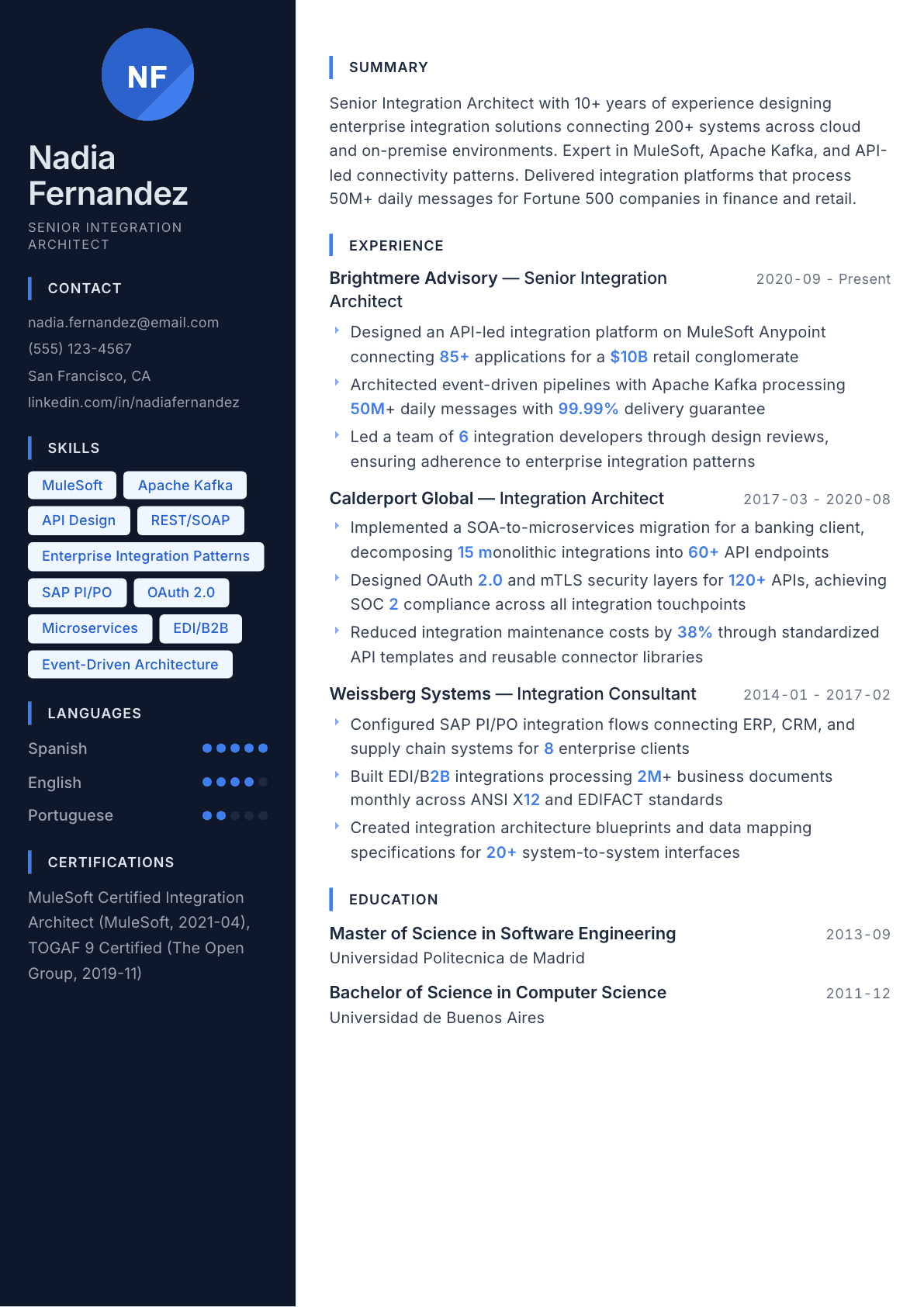
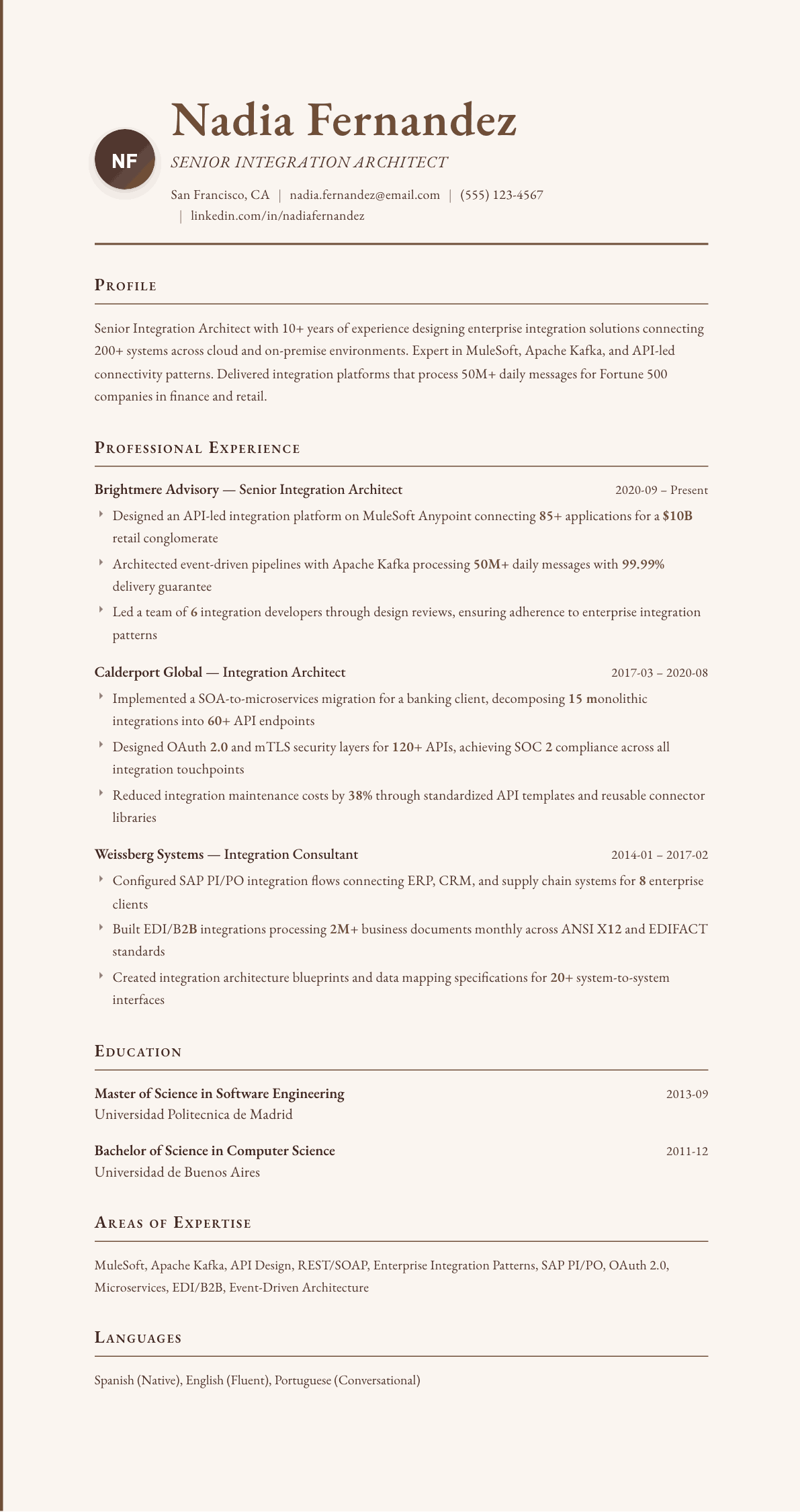
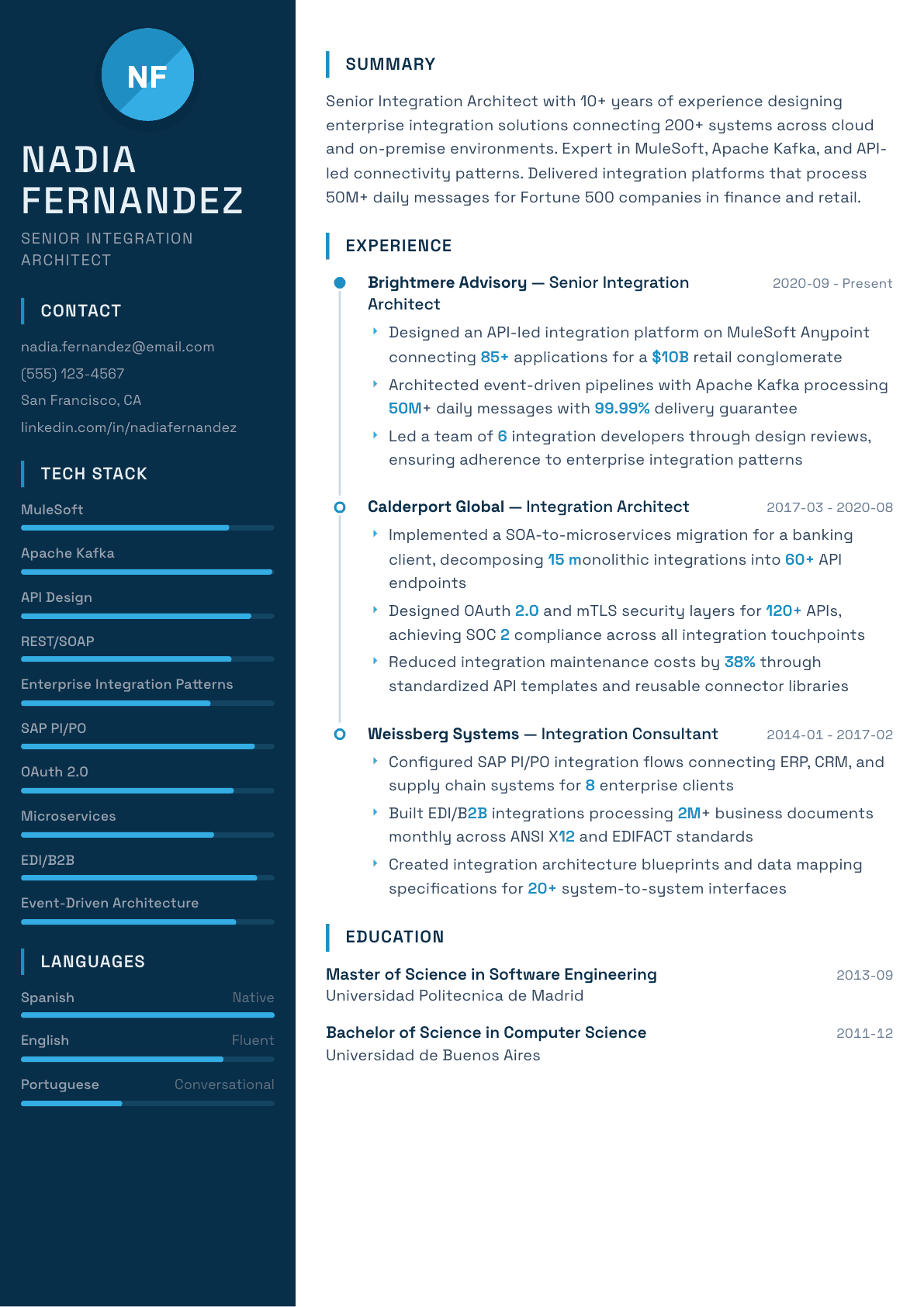
Example Integration Architect summary
Integration Architect with 10 years of experience connecting 200+ enterprise systems across cloud and on-premise environments. MuleSoft Certified with expertise in API-led connectivity, Apache Kafka event streaming, and SOA-to-microservices migration. Delivered integration platforms processing 50M+ daily messages for Fortune 500 companies.
Skills to list on a Integration Architect resume
- MuleSoft
- Apache Kafka
- API Design
- REST/SOAP
- Enterprise Integration Patterns
- SAP PI/PO
- Dell Boomi
- OAuth 2.0
- Microservices
- EDI/B2B
- Event-Driven Architecture
- TOGAF
What actually gets this resume read
- Highlight integration platforms: MuleSoft, Dell Boomi, Informatica, IBM Integration Bus, or Azure Integration Services.
- Quantify message volumes, system counts, and SLA metrics to demonstrate the scale of your integration work.
- Include enterprise integration patterns knowledge: pub/sub, event sourcing, saga, and choreography vs. orchestration.
- Mention API governance, security standards (OAuth, mTLS), and compliance achievements.
- Show EDI/B2B and industry-specific protocol experience if applicable to your target roles.
How to write a integration architect resume
An integration architect is hired to make systems that were never designed for each other work as one, and to do it in a way the next team can maintain. The person screening your resume is usually an enterprise architecture lead or a delivery director, and she is looking for evidence of two things: that you have designed integration at a scale where the wrong choice is expensive, and that you can explain that design to people who do not write code.
The common failure is a resume that reads like a senior developer with a longer tool list. Integration architecture is judged on patterns and tradeoffs: synchronous against event driven, point to point against a hub, orchestration against choreography, and how you handle the ugly realities of ordering, duplication, partial failure and reconciliation. A resume that never names a pattern or a tradeoff cannot be sorted above the developers applying for the same posting.
This guide covers the layout an architecture screener expects, how to describe platforms and patterns credibly, three summaries across career stages, rewritten bullets, and the governance questions that come up in every integration architect interview.
Format: two pages, with a landscape line for every engagement
Two pages is normal and expected at this level, because architecture is evaluated on the breadth of systems you have connected. Reverse chronological, single column, no diagrams inside the resume itself. Keep any architecture diagram for a portfolio document you bring to the interview.
Open each role with a landscape line: the industry, the core systems in play, the integration platform, and the message or transaction volume. A reader who sees enterprise resource planning, a customer relationship system, a warehouse platform and a payments provider named in one line already knows the shape of the problem you were solving.
- Header: name, city, email, and professional profile link.
- Order: summary, core competencies as a short grouped block, experience with landscape lines, certifications, education.
- Consultants list the client industry and engagement length rather than the client name where confidentiality applies.
Name the platforms, and say what layer you owned
Integration platforms are not interchangeable and hiring is usually platform specific. Say which you have designed on: MuleSoft Anypoint, Boomi, Apache Camel, Azure Integration Services with Logic Apps and Service Bus, Workato, SAP Integration Suite, TIBCO, IBM App Connect, or an in-house layer on Kafka. Then say whether you set the standards or implemented against someone else's.
Distinguish the messaging backbone from the application layer. Kafka, RabbitMQ, Azure Service Bus, Amazon SQS and SNS, and a legacy enterprise service bus each imply different guarantees, and an architect is expected to explain the guarantee, not only the product.
Patterns and tradeoffs are the actual content
Write the design decision and the reason. API-led connectivity with a system, process and experience layer; event-driven choreography with a published schema; a canonical data model versus mapping at the edges; the saga pattern for a transaction that spans systems; the outbox pattern for reliable publication. Each of these tells a reader more than a paragraph of general architecture language.
Then handle the hard realities out loud. Exactly-once expectations against at-least-once delivery, idempotency keys, message ordering, poison messages and dead letter handling, replay after an outage, and reconciliation reports for finance. Interviewers at this level probe these first, and a resume that raises them sets the tone.
Governance, security and the operating model
Architecture is also about what other people are allowed to build. Say what you standardized: reusable connectors and templates, naming and versioning rules, an API catalog, a review board, or an onboarding path that let product teams build their own integrations without breaking the estate. Reuse rates and reduced delivery time are the results worth stating.
Security and compliance carry weight because integration is where data crosses boundaries. Name what you designed: OAuth 2.0 flows, mutual TLS, token exchange and scopes, API gateway policies, field-level encryption, data residency constraints, and audit logging. If you worked under an external audit or a regulated regime, say so plainly, since it changes how a hiring manager reads everything else.
- Say whether you owned monitoring for integration flows, including message tracing and business-level reconciliation alerts.
- Name legacy formats where you have them: EDI, flat files over managed file transfer, SOAP, and mainframe interfaces still matter to enterprise employers.
- Give migration work a shape: how many interfaces moved, over what period, and how you ran the two systems in parallel.
Keywords enterprise integration postings repeat
These postings recycle a consistent vocabulary: API-led connectivity, enterprise integration patterns, middleware, event-driven architecture, message broker, ESB, REST and SOAP, JSON and XML, data mapping and transformation, API gateway, TOGAF, and the named platform. Mirror the posting language once in the competencies block and once in a bullet where a real design sits behind it. Write both the acronym and the expanded term the first time each appears.
Integration Architect resume summary examples
Integration developer moving up
Integration developer with three years building MuleSoft flows and REST APIs connecting a customer relationship system, a billing platform and a warehouse system. Owns error handling and retry design for 30 production interfaces, and is now leading design reviews for a small delivery team.
Six years in
Integration architect with six years designing API-led and event-driven solutions in retail and logistics, most recently connecting 60 applications through an Anypoint platform. Designs the canonical model and the reusable connector set, and sets the versioning and error handling standards two delivery teams follow.
Lead or principal architect
Principal integration architect with fourteen years across banking and manufacturing, owning integration strategy for estates of more than 200 systems. Led a move from a legacy service bus to event-driven architecture on Kafka, chairs the design authority, and mentors five architects across delivery teams.
Work experience bullets: before and after
Before: Designed integrations between enterprise systems.
After: Designed an API-led integration layer connecting the enterprise resource planning system, the customer platform and three logistics partners, with system, process and experience layers so partner changes never reached core applications.
Naming the layers and the isolation they bought shows an architectural decision, not just a set of connections.
Before: Worked with Kafka for messaging.
After: Introduced event-driven order processing on Kafka with a registered schema, the outbox pattern for reliable publication and consumer replay from a retained topic, which removed the nightly batch reconciliation entirely.
The named patterns and the batch process retired make the design verifiable and give it a business consequence.
Before: Improved integration reliability.
After: Added idempotency keys, bounded retries with exponential backoff and dead letter queues with an operator replay tool across 45 interfaces, cutting failed transactions requiring manual repair from about 80 a week to under 5.
Failure handling described concretely, with the manual repair volume it removed, is the strongest evidence an architect can offer.
Before: Created API standards for the organization.
After: Published an API design standard covering naming, versioning, pagination and error format, backed by a reusable template and a review checklist, which four delivery teams adopted and which cut design review cycles from three rounds to one.
Standards only count when someone follows them, so adoption and the review time saved carry the bullet.
Before: Managed the migration from legacy middleware.
After: Planned and led migration of 120 interfaces off a legacy service bus over four quarters, running old and new in parallel with reconciliation reporting so finance could sign off before each cutover.
The interface count, the timeline and the parallel-run control show how the risk was actually managed.
Hard skills
- API-led connectivity design
- Enterprise integration patterns
- MuleSoft Anypoint or comparable platform
- Apache Kafka and event streaming
- Message brokers and queues
- REST and SOAP services
- JSON, XML and schema design
- Canonical data models and mapping
- API gateway and policy design
- OAuth 2.0 and mutual TLS
- EDI and managed file transfer
- Microservices decomposition
- Integration monitoring and tracing
- Solution and architecture documentation
Soft skills
- Explaining design to non-technical stakeholders
- Design authority facilitation
- Vendor and partner negotiation
- Mentoring developers
- Tradeoff reasoning
- Writing decision records
Certifications worth listing
- MuleSoft Certified Integration Architect (Salesforce MuleSoft)
- MuleSoft Certified Platform Architect (Salesforce MuleSoft)
- TOGAF Enterprise Architecture Practitioner (The Open Group)
- Boomi Professional Integration Developer (Boomi)
- Microsoft Certified: Azure Solutions Architect Expert (Microsoft)
- AWS Certified Solutions Architect, Professional (Amazon Web Services)
- Confluent Certified Developer for Apache Kafka (Confluent)
Mistakes that cost integration architect candidates the interview
- Writing like a developer with a longer tool list, so the resume never names a pattern, a tradeoff or a decision you owned.
- Leaving out the systems landscape, which makes it impossible to judge whether you connected three applications or two hundred.
- Ignoring failure handling. Retries, ordering, duplicates and reconciliation are what interviewers at this level ask about first.
- Claiming platform expertise across every major integration product, which reads as shallow when hiring is nearly always platform specific.
- Omitting governance and standards work, when the ability to make other teams build consistently is much of the value of the role.
- Describing consulting engagements without industry, duration or scale, which leaves a long list of clients that carries no information.
Integration Architect resume questions
How is an integration architect resume different from a solution architect resume?
The integration version centers on the connections: message flows, contracts, delivery guarantees and the systems on each end. A solution architect resume centers on one system or product design, so the emphasis shifts from interfaces to overall application structure.
Should I include architecture diagrams with my resume?
Not inside the resume, since they parse badly and shrink to nothing on screen. Prepare one or two sanitized diagrams for the interview instead, and reference the design in a bullet so the interviewer knows to ask.
Do I still need hands-on development skills as an architect?
Most employers expect it. Being able to build a flow, read a payload and debug a broken interface keeps your designs realistic, and teams distrust an architect who cannot open the tooling they are prescribing.
How do I describe client work under confidentiality?
Give the industry, the engagement length, the systems by type rather than by brand where required, and the scale in interfaces or messages. Reviewers in consulting are used to this and judge the design detail rather than the client name.
Which certification carries most weight for integration roles?
The platform certification matching the employer stack, since integration hiring follows the product in use. An architecture framework credential adds credibility for enterprise roles but rarely substitutes for platform depth on the page.
Related resume examples
- Solutions Architect Resume example
- Systems Architect Resume example
- Cloud Architect Resume example
- Software Architect Resume example
- API Developer Resume example
- Backend Developer Resume example