Data Architect Resume Examples: the lines they read
Write a Data Architect Resume That Shows Platform Level Ownership
By Mustafa Tarabya, founder of CVBooster · Published · Updated
Data architect resume examples, modeling and governance wording, platform keywords recruiters search, and a complete writing guide.
Sample resumes for a data architect
The same data architect content laid out in three CVBooster templates, so you can see what the finished document looks like before you write a word.
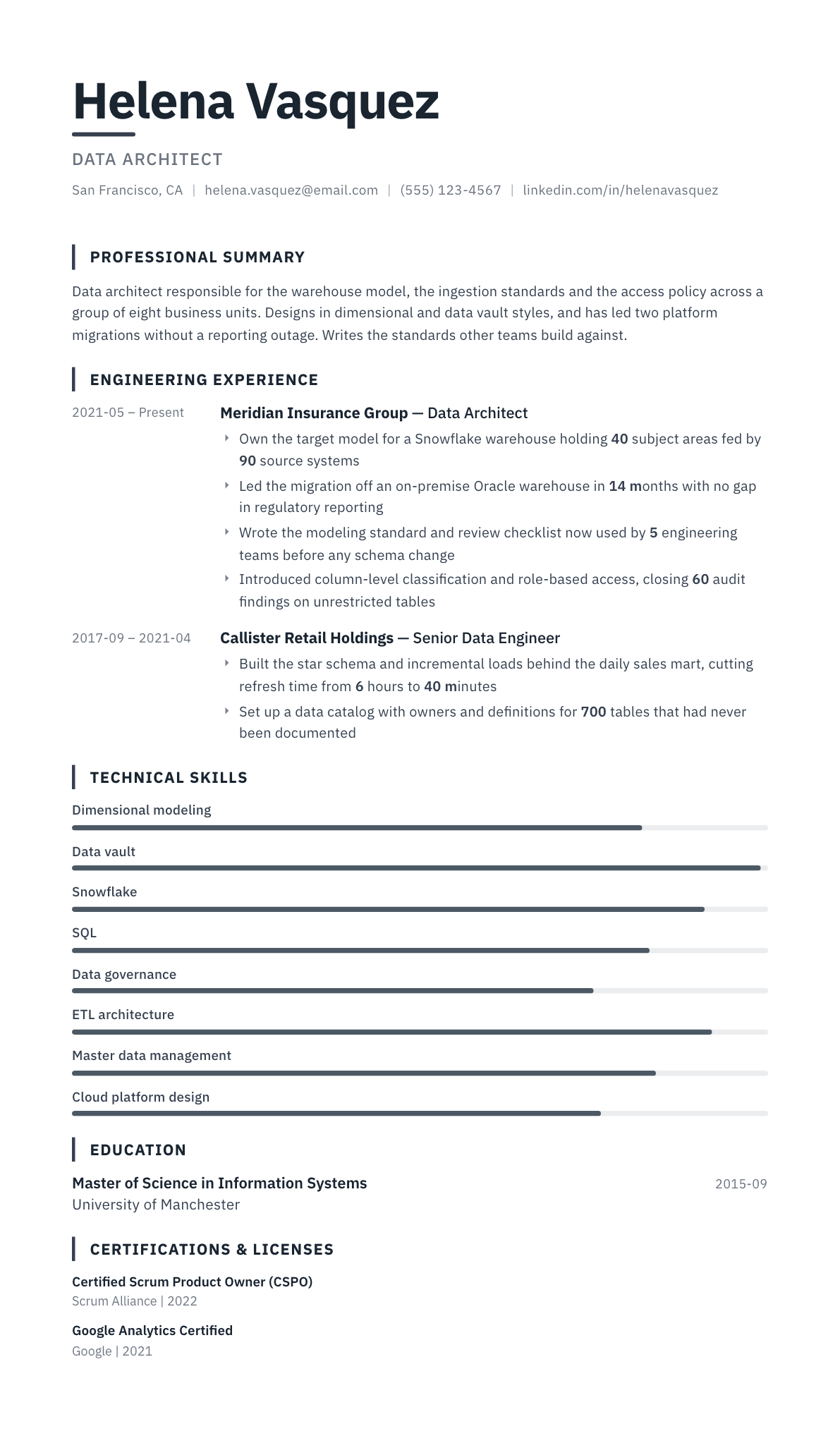
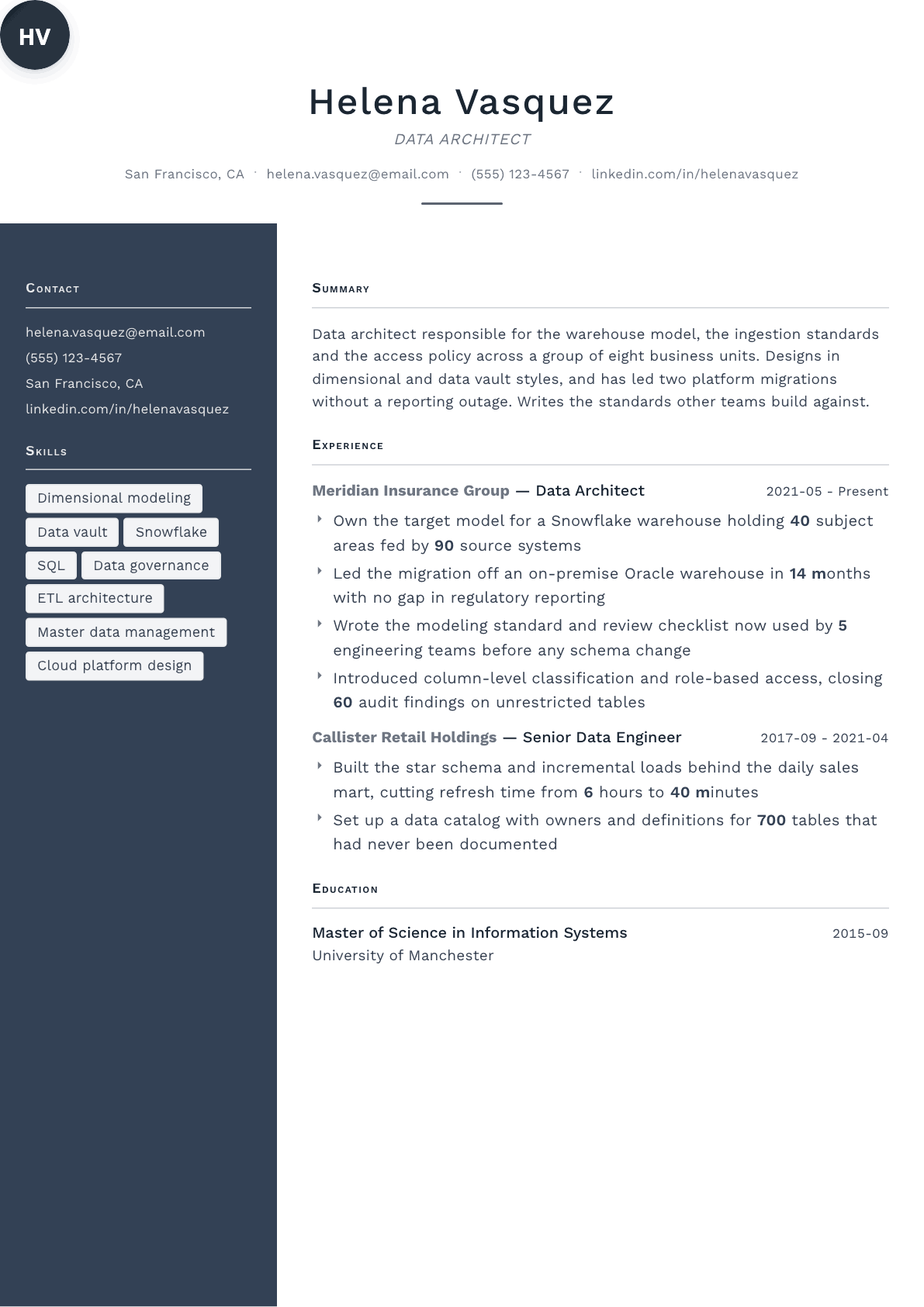
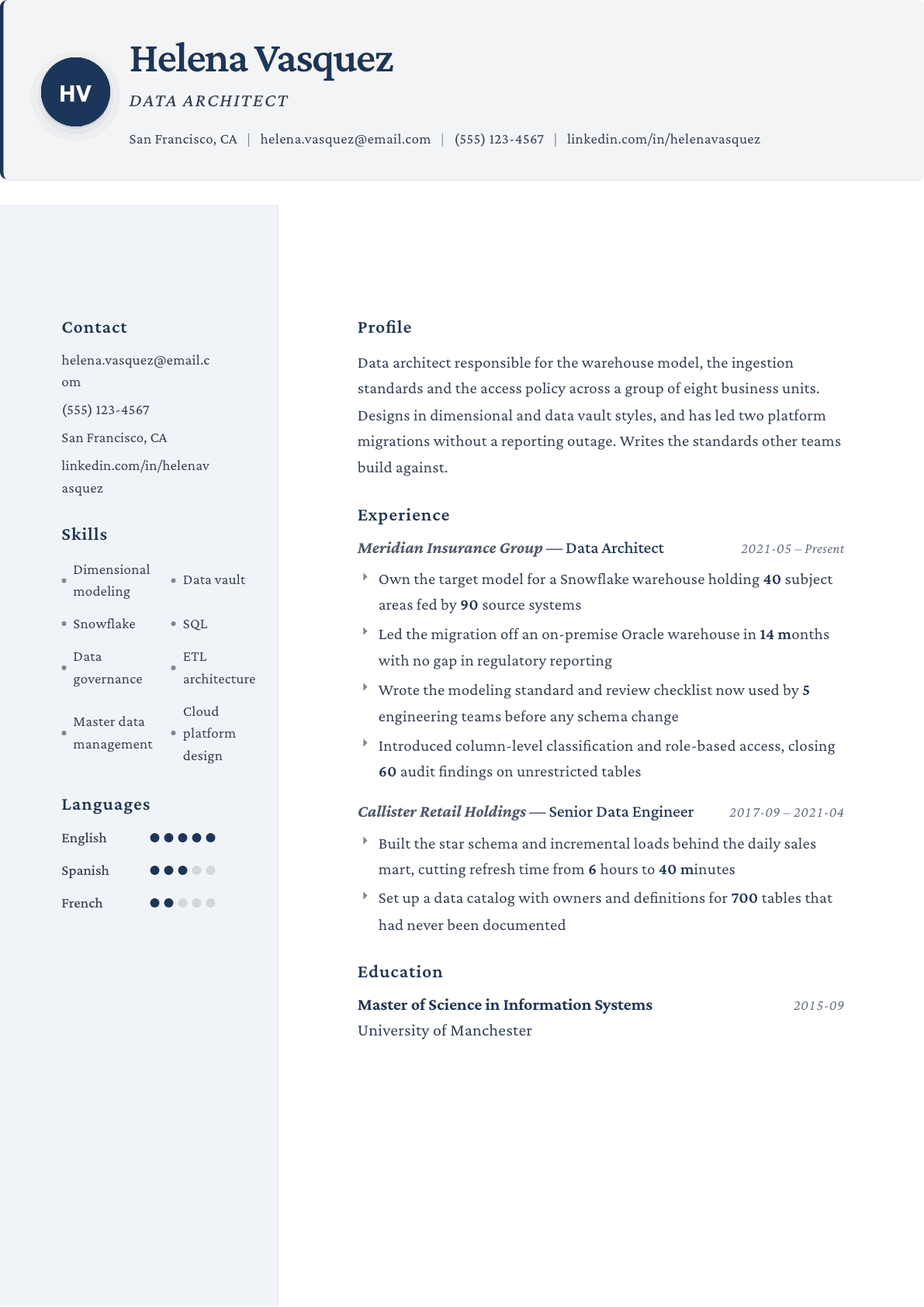
Example Data Architect summary
Data architect with eleven years across warehousing and platform design, currently owning the target model and ingestion standards for a warehouse fed by ninety source systems. Led a migration off an on-premise Oracle estate without interrupting regulatory reporting, and introduced column-level classification that closed a long-standing set of audit findings. Designs in both dimensional and data vault styles.
Skills to list on a Data Architect resume
- Dimensional modeling
- Data vault modeling
- Snowflake
- BigQuery
- SQL
- Data governance
- Data lineage
- Master data management
- ETL and ELT architecture
- dbt
- Data warehouse migration
- Access control design
- Metadata and cataloging
- Solution architecture
What actually gets this resume read
- Say which modeling style you design in, since dimensional, data vault and one big table imply different teams.
- Give the scale of the estate: source systems, subject areas, warehouse size and how many teams build on it.
- Put governance work on the page, including classification, retention, lineage and who approves schema change.
- Describe migrations by what stayed working, because architects are hired on risk control as much as design.
- Name the platform stack precisely, from warehouse to orchestration to catalog, rather than saying cloud data tools.
- Show the artifacts you produced such as target models, standards and review checklists that other teams use.
How to write a data architect resume
A data architect resume is read by someone who has been burned. Either a warehouse migration ran long and broke reporting, or a model was designed for one department and then inherited by eight, or an auditor asked who could read a column of personal data and nobody knew. The hiring manager is looking for the person who prevents the next version of that, so the resume has to demonstrate control as much as design.
The role also has an identity problem. Some data architect postings are senior data engineering with a different title, some are enterprise architecture with almost no hands-on work, and some sit inside a governance function. Your page has to declare which one you have been. The way to do that is to state the estate you were responsible for and the artifacts you personally produced.
What follows covers how to size the estate on paper, how to write about modeling choices in a way another architect can argue with, how to give governance and migration work the space they deserve, and the questions that come up when an experienced data engineer writes their first architect resume.
Format: two pages, estate before achievements
Reverse chronological, two pages, plain single column. Under each role write an estate line before the bullets: warehouse platform, number of source systems, subject areas or domains, the consuming teams, and where you sat in the reporting structure. A reader can then judge whether your experience matches an estate of ten sources or two hundred.
Keep a platform block near the top listing warehouse, transformation, orchestration, catalog and access tooling by product name. Postings for this role filter hard on those names, and burying them inside prose costs you matches.
- Header: name, city, phone, email, and a professional profile link.
- Order: summary, platform and tooling, experience with an estate line, selected architecture programs, education, certifications.
- Move certifications up if a cloud provider credential is named in the posting.
Summary: modeling style, platform, and the scale you have handled
Three or four lines. Say how long you have designed data platforms, which warehouse you know best, which modeling styles you actually design in, and the largest migration or consolidation you have led. Dimensional, data vault, third normal form and a wide denormalized table approach imply very different teams and very different problems, so naming yours narrows the reader to the right conclusion quickly.
If you are moving up from senior data engineering, say so and name the architecture artifacts you already own: the target model, the standards other teams build against, the review that approves schema change.
Experience: one design program per role with its consequences
Each role should carry one substantial program described across two bullets. State the problem, the design and the constraint. Consolidating six departmental marts onto one conformed model, replacing nightly extracts with change data capture, or introducing a semantic layer so definitions stop drifting are all recognizable programs with recognizable pain behind them.
Then the consequence in numbers a data leader tracks: refresh time, number of pipelines retired, cost per query or per terabyte scanned, how many teams adopted the standard, how many duplicate definitions were removed. Design without consequences reads like a diagram nobody built.
Use the remaining bullets for the unglamorous half of the job: writing standards, chairing a design authority, reviewing other teams schema changes, retiring dead tables, and documenting things nobody had documented.
Governance, access and lineage belong on the page
Say what you did about classification, retention, access control and lineage. Column-level classification of personal data, role-based grants replacing shared accounts, a retention policy applied to raw layers, and lineage from source to report all show that you treat data as something with obligations attached rather than only a modeling exercise.
Name the regulatory context in general terms where it applies, such as designing for personal data handling or for financial reporting controls. Do not quote statutes or invent compliance outcomes.
Migrations: write them around what kept working
Architects are hired on risk control. Write a migration by its sequence and its safety net: parallel running, reconciliation between old and new outputs, a cutover plan per subject area, and the reporting that never went dark. The duration matters, but continuity matters more, and a reader who has lived through a bad migration will notice which one you emphasized.
Data Architect resume summary examples
Moving up from senior data engineering
Senior data engineer stepping into architecture, currently owning the target model and load standards for a warehouse fed by 30 source systems. Designed the conformed customer dimension now used by three reporting teams, and wrote the schema change review that every pipeline goes through before release.
Six years as an architect
Data architect responsible for the warehouse model, ingestion standards and access policy across eight business units on Snowflake. Designs in both dimensional and data vault styles. Led a migration off an on-premise Oracle estate in 14 months with no gap in regulatory reporting.
Enterprise data architect
Enterprise data architect setting the target state for a group data platform across three regions, chairing the design authority and owning the master data strategy for customer and product. Consolidated 11 departmental marts to one conformed model and cut warehouse spend by a third in the process.
Work experience bullets: before and after
Before: Designed the data warehouse architecture for the company.
After: Owned the target model for a Snowflake warehouse covering 40 subject areas fed by 90 source systems, with a documented conformed dimension set that five engineering teams build against.
Counting subject areas, sources and consuming teams gives the reader the size of the estate instead of a title restatement.
Before: Led a migration to a cloud data platform.
After: Led the migration off an on-premise Oracle warehouse over 14 months, running old and new in parallel per subject area with automated reconciliation, and completed it with no gap in regulatory reporting.
The sequence and the reconciliation show how risk was controlled, which is the part an architect is hired for.
Before: Improved data governance across the organization.
After: Introduced column-level classification and role-based access on the warehouse, replacing shared service accounts, which closed 60 audit findings on unrestricted access to personal data.
A named control and the findings it closed turn governance from an aspiration into completed work.
Before: Created data models for reporting.
After: Designed the star schema and incremental load pattern behind the daily sales mart, cutting refresh from 6 hours to 40 minutes and removing the overnight window that had blocked morning reporting.
The modeling choice and the runtime result show the design served an operational constraint, not just a diagram.
Before: Documented existing data assets.
After: Built a catalog with named owners and agreed definitions for 700 previously undocumented tables, then retired 130 that had no queries against them in six months.
Documentation plus removal proves the exercise changed the estate rather than producing a spreadsheet.
Hard skills
- Dimensional modeling
- Data vault modeling
- Snowflake and BigQuery
- SQL and query tuning
- ETL and ELT architecture
- Change data capture design
- Data governance frameworks
- Data lineage and cataloging
- Master data management
- Access control and classification
- Warehouse migration planning
- dbt and transformation layers
Soft skills
- Standard setting
- Design review facilitation
- Explaining trade-offs to business owners
- Risk framing
- Working across teams without authority
Certifications worth listing
- SnowPro Advanced: Architect (Snowflake)
- Google Professional Cloud Architect (Google Cloud)
- AWS Certified Data Engineer, Associate (Amazon Web Services)
- Certified Data Management Professional (CDMP) (DAMA International)
- Microsoft Certified: Azure Solutions Architect Expert (Microsoft)
Mistakes that cost data architect candidates the interview
- Never stating the size of the estate, so a reader cannot tell whether you designed for ten sources or two hundred.
- Describing a migration by its duration alone, with nothing about parallel running or reconciliation.
- Saying cloud data tools instead of naming the warehouse, orchestrator and catalog by product.
- Leaving governance, access and retention off the page, which reads as an architect who has never faced an audit.
- Presenting modeling preferences as absolutes rather than choices with trade-offs you can defend.
- Writing a senior data engineer resume under an architect title, with pipelines built but no standards produced.
Data Architect resume questions
What is the difference between a data architect and a data engineer resume?
An engineer resume centers pipelines built and problems fixed. An architect resume centers the target model, the standards other teams follow, the review that approves change, and the migrations you sequenced. Both use the same tools, but the artifacts are different.
Should a data architect resume list specific modeling methods?
Yes, and be exact. Say whether you design in dimensional, data vault, third normal form or a denormalized wide table style, and where you have used each. It is the fastest way for a hiring manager to see whether your habits match the estate.
How much SQL detail belongs on an architect resume?
Enough to show you can still read a bad query plan. One bullet about tuning, clustering or partitioning per role is plenty. The bulk of the page should be model design, standards and platform decisions rather than individual queries.
Do cloud certifications matter for a data architect role?
They help when the posting names the platform, because recruiters screen on them early. A Snowflake, Google Cloud or Azure architecture credential is worth listing. It never substitutes for a described migration or a model you can defend in an interview.
How do I show governance work without sounding like a compliance officer?
Tie every control to a design decision. Classification drove the access model, retention drove the raw layer partitioning, lineage drove the catalog. Written that way it reads as architecture with obligations, which is exactly how a hiring manager thinks about it.
Related resume examples
- Data Engineer Resume example
- Systems Architect Resume example
- ETL Developer Resume example
- Analytics Engineer Resume example
- GIS Analyst Resume example
- Software Architect Resume example