Sports Agent Resume Examples: free ATS score and gap list
Build a Sports Agent Resume That Wins Client Meetings
By Mustafa Tarabya, founder of CVBooster · Published · Updated
Sports agent resume examples with contract, recruiting and endorsement keywords, plus a writing guide for agency and player representation roles.
Sample resumes for a sports agent
The same sports agent content laid out in three CVBooster templates, so you can see what the finished document looks like before you write a word.
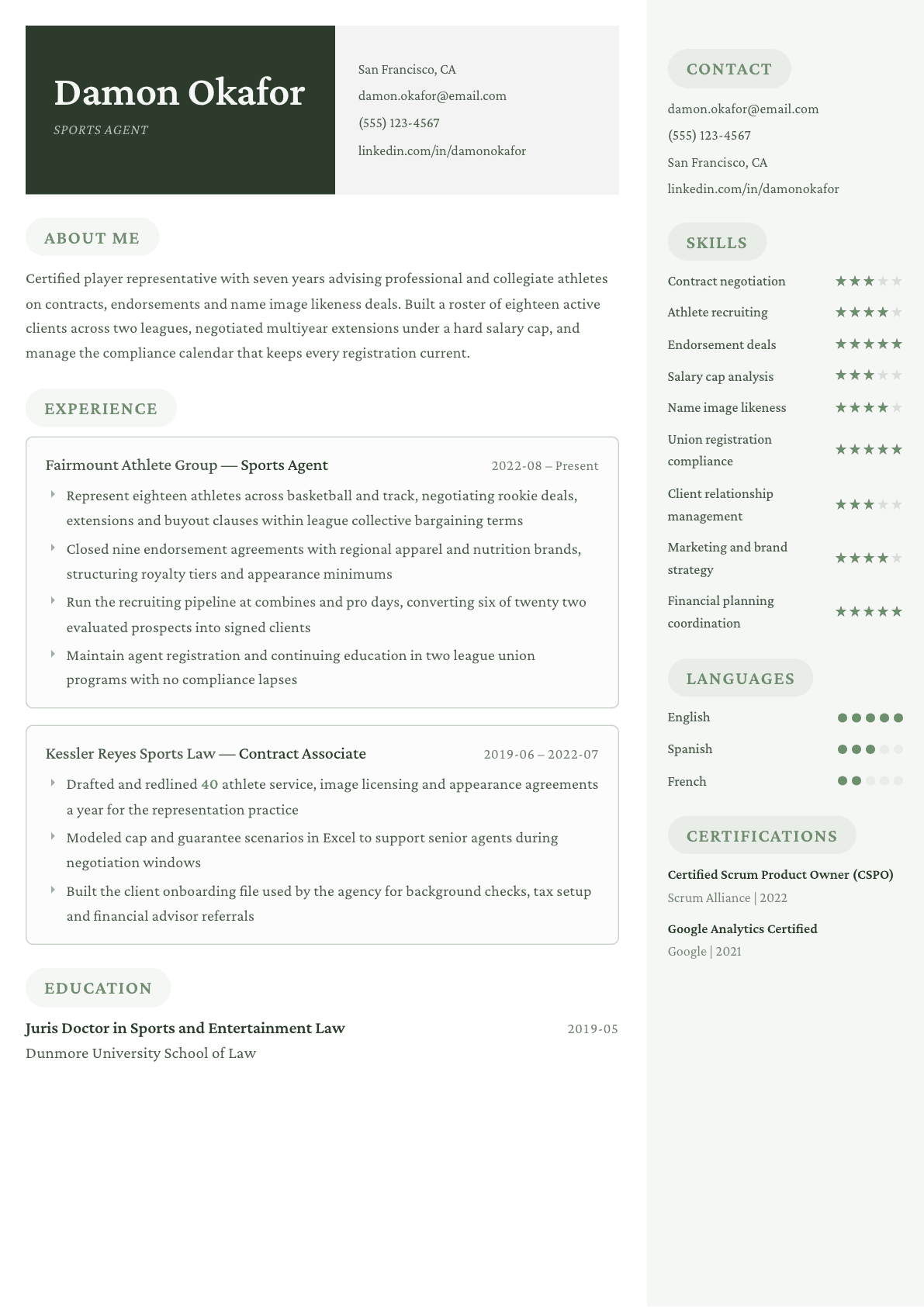
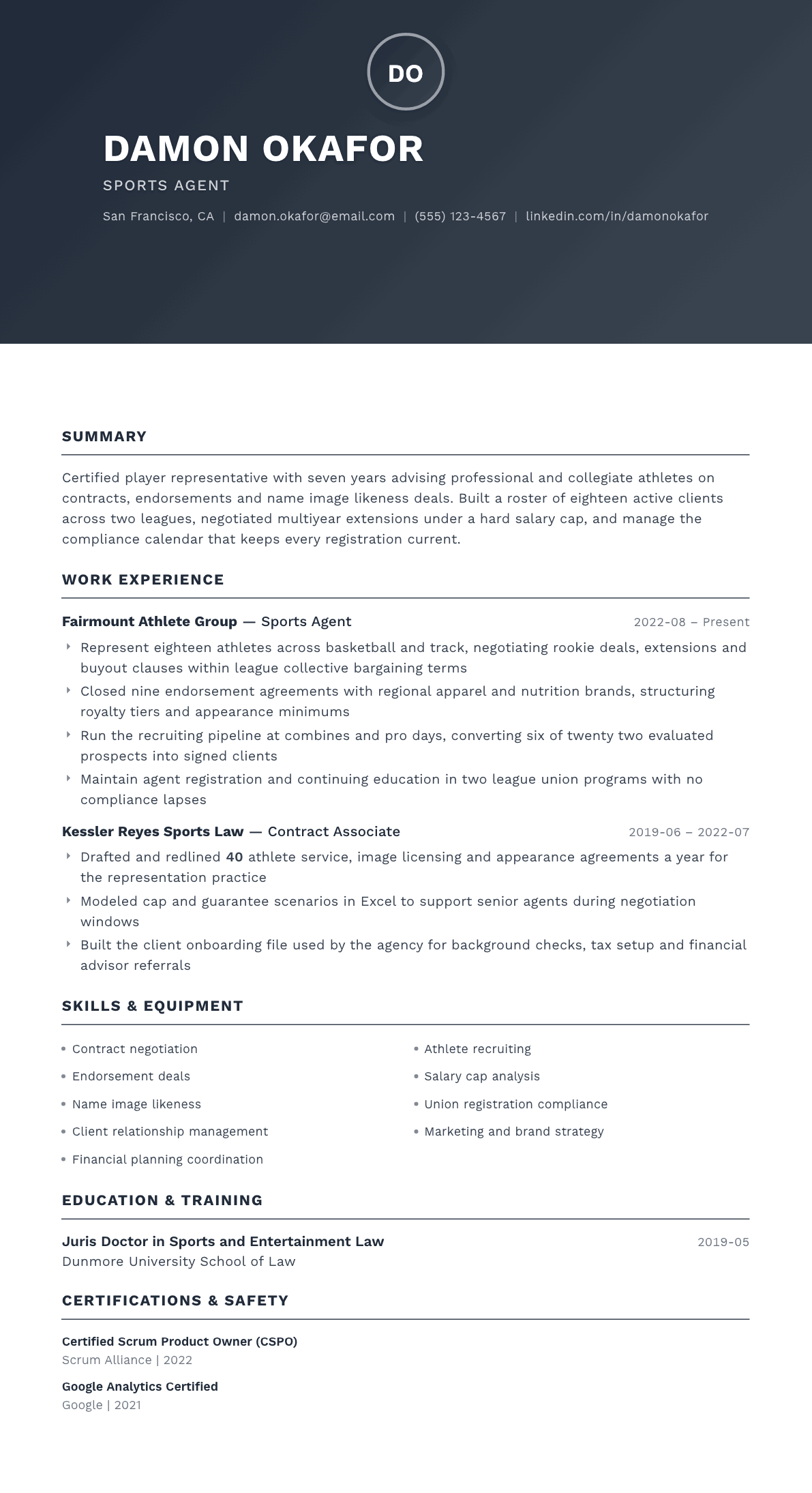
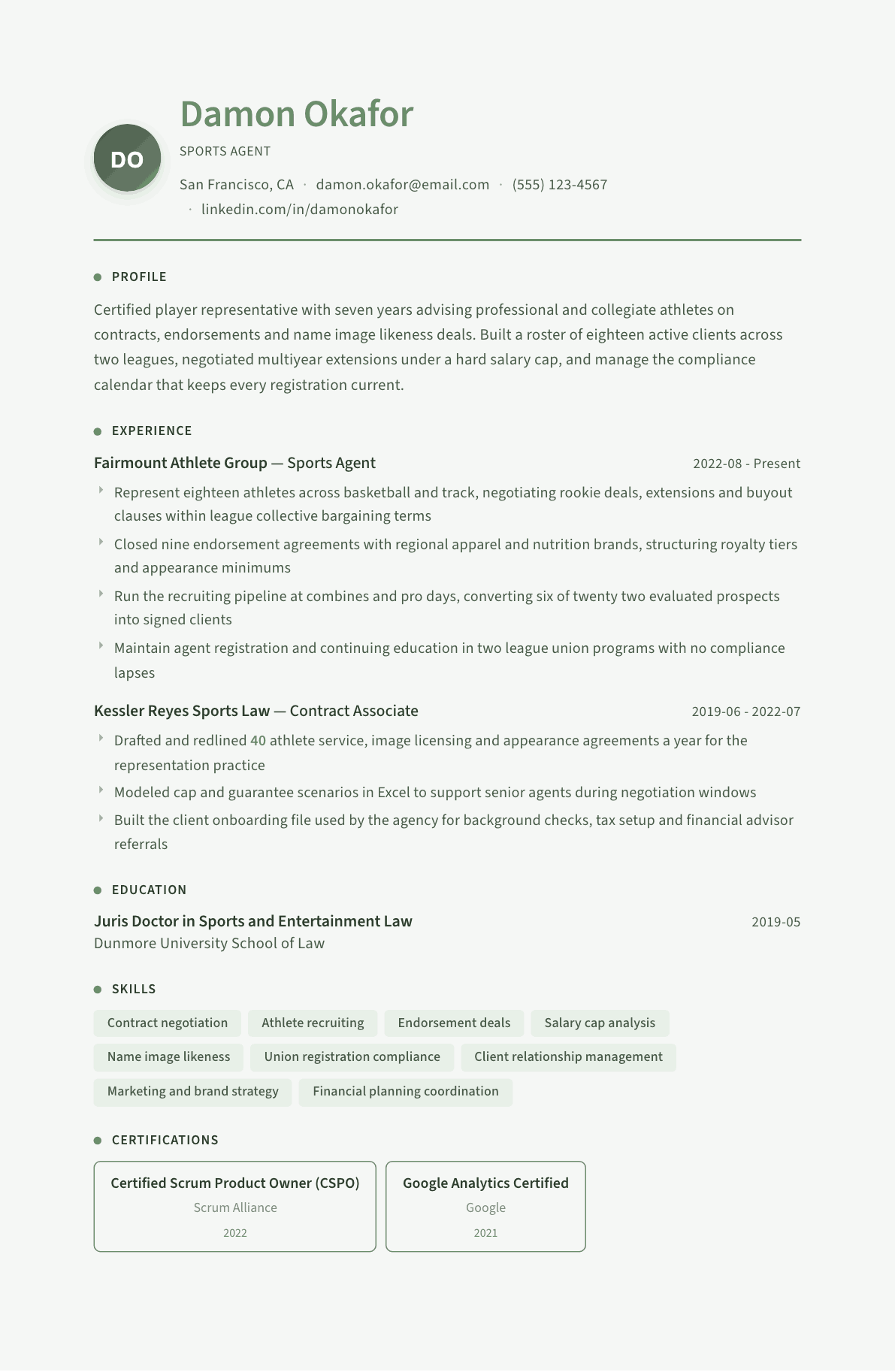
Example Sports Agent summary
Sports agent with seven years representing professional and collegiate athletes, currently managing a roster of eighteen clients across two leagues. Negotiates rookie deals, extensions and endorsement agreements inside collective bargaining limits, recruits at combines and pro days, and keeps every union registration and continuing education requirement current.
Skills to list on a Sports Agent resume
- Athlete contract negotiation
- Collective bargaining agreement terms
- Salary cap and guarantee modeling
- Endorsement and licensing deals
- Name image likeness advising
- Client recruiting and scouting events
- Agent registration compliance
- Contract drafting and redlining
- Roster and pipeline management
- Brand partnership development
- Financial advisor coordination
- Media and publicist liaison
- Trade and free agency strategy
What actually gets this resume read
- Lead with your league registrations and the unions that certify you, since agencies verify those before anything else.
- Quantify the roster: how many active clients, in which sports, and at what level of competition.
- Separate the two jobs an agent does, winning deals and recruiting clients, into distinct bullets with distinct numbers.
- Name the deal types you have closed, from rookie contracts and extensions to endorsements and appearance agreements.
- Show compliance work explicitly, because a single lapsed registration can cost an agency its ability to represent players.
- Include the collegiate side if you have it, especially name image likeness advising, which agencies now staff for directly.
How to write a sports agent resume
Agency hiring is a trust decision dressed up as a resume review. The partner reading your application wants to know three things before anything else: are you registered and in good standing with the unions whose players you would touch, have you closed a deal or only supported one, and can you bring or build a client list without embarrassing the firm. Everything else on the page is context.
That is why a sports agent resume looks different from a general business resume. Registration and certification go near the top, not the bottom. Roster size and deal types replace vague talk about relationship building. Recruiting gets its own numbers, because signing clients and negotiating for them are two separate skills and most applicants are strong at only one.
What follows is the section order an agency principal reads, three sample summaries for a new certified agent, a working agent with a roster and a senior representative, rewritten bullets, and the questions that come up when a representation application does not move.
Format: credentials first, roster second, everything else after
Reverse chronological, one page until you have a roster worth two. Agencies are small firms, so the reader is usually a partner who also has a negotiation window open. Structure the page so the first fifteen lines answer the trust questions.
Do not use a functional layout. In representation, dates matter because registration lapses, non compete terms and client movement are all read from your timeline. A resume that obscures when you were where invites the wrong assumption.
- Header: name, city and state, phone, email, bar admission if you hold one, and your league or union agent registrations.
- Section order: summary, certifications and registrations, representation experience, deal highlights, education, memberships.
- Law graduates add a short bar and jurisdiction line rather than burying admission inside education.
- If you have a client roster you cannot name for confidentiality, describe it by sport, level and count instead.
Summary: sports, roster count, deal types, registration status
Four elements, three lines. Which sports and at what level, how many active clients, which deals you personally negotiated, and which registrations you hold. That combination tells a principal within seconds whether you are a recruiter, a closer or a support attorney.
Skip the language every applicant uses. Passion for sport is assumed in a room where everyone took a pay cut to be there. The differentiator is a specific closed deal, a specific pipeline and a clean compliance record.
Experience: separate the deals you closed from the deals you supported
Be precise about your seat at the table. Lead negotiator, second chair, contract drafting support and marketing side representation are four different roles, and inflating one into another is the fastest way to lose a reference check in a field this small.
Then structure bullets around the actual work. Playing contracts and extensions belong together with the cap or bargaining context that constrained them. Endorsements, appearance agreements and licensing are a separate line because they involve different counterparties and different royalty structures. Recruiting gets its own bullet with conversion numbers from combines, pro days, showcases and campus visits. Servicing, the unglamorous half, covers travel, taxes, financial advisor referrals, media training and the calls at midnight after a bad game.
Name image likeness advising has become a hiring line of its own. If you have built collective relationships, structured group licensing or advised on state and school disclosure rules, put it in its own bullet rather than folding it into general marketing work.
- Give the roster: how many active clients, which sports, which competitive level.
- Name the deal categories you led, from rookie scale and extensions to buyouts and release clauses.
- Quantify recruiting: prospects evaluated, meetings taken, clients signed, and retention across a cycle.
- Show endorsement work with structure detail such as royalty tiers, appearance minimums or category exclusivity.
- Include the compliance calendar you maintain, since a lapsed registration is an existential risk for a firm.
Certifications, registrations and the compliance record
Give this its own block. Player association certifications such as the NFL Players Association Contract Advisor, the National Basketball Players Association Certified Agent, the Major League Baseball Players Association Certified Agent and the National Hockey League Players Association Certified Agent are the credentials agencies verify first. Add your Uniform Athlete Agents Act state registrations by state, plus bar admission if you have one.
State continuing education and exam status plainly, and if your record is clean, say it in one line. Firms do not expect you to advertise it, but a candidate who volunteers a clean compliance history is signaling that he understands what the firm is actually buying.
Skills and keywords agencies filter on
Agency postings repeat a narrow vocabulary: contract negotiation, collective bargaining agreement, salary cap, guaranteed money, endorsement, licensing, name image likeness, client acquisition, roster management, agent certification. Use each once in a section header or skills block and once inside a bullet where you did the thing. Add the tools where they are real: cap modeling in Excel, contract management systems, CRM for pipeline tracking and the scouting databases you read.
Sports Agent resume summary examples
Newly certified
Newly certified contract advisor and licensed attorney with three years drafting athlete service, image licensing and appearance agreements for a representation practice. Modeled cap scenarios for senior agents through two negotiation cycles, and now building a first roster from regional college and combine relationships.
Working roster
Sports agent representing eighteen basketball and track athletes, with lead responsibility for rookie deals, two multiyear extensions and nine regional endorsement agreements. Signed six clients from twenty two prospects evaluated last cycle, and holds current certification and state registrations with no compliance findings.
Senior representative
Senior representative and practice lead managing a roster of forty athletes across three leagues and a team of four junior agents. Negotiates franchise level extensions and category exclusive endorsement portfolios, owns firm recruiting strategy, and runs the certification and continuing education calendar for the entire representation group.
Work experience bullets: before and after
Before: Negotiated contracts for professional athletes.
After: Served as lead negotiator on eleven playing contracts including two multiyear extensions with guaranteed money above the position average, working inside collective bargaining rookie scale limits.
Naming the seat, the count and the constraint proves you carried the negotiation rather than sat in the room while it happened.
Before: Recruited new clients for the agency.
After: Evaluated twenty two draft eligible prospects across combines and pro days, took fourteen family meetings and signed six clients, five of whom remain on the roster into a second contract.
A recruiting funnel with retention at the end shows you can sign athletes and keep them, which is the number agencies underwrite.
Before: Worked on endorsement deals.
After: Structured nine endorsement agreements with apparel and nutrition brands, negotiating royalty tiers, appearance minimums and category exclusivity, and tracked deliverables so every partner renewed on schedule.
The structural terms show you understand what makes a marketing deal profitable rather than merely signed.
Before: Handled compliance requirements.
After: Maintained certification, continuing education and Uniform Athlete Agents Act registrations across four states, with every filing submitted before deadline and no findings in two audit cycles.
Compliance is a liability question for the firm, so a concrete record beats the word compliance every time.
Before: Advised college athletes on NIL.
After: Advised twelve collegiate clients on name image likeness agreements, reviewing collective terms and school disclosure requirements before signature and coordinating tax setup with their accountants.
The specific workflow shows real practice in an area many applicants claim after reading about it.
Hard skills
- Playing contract negotiation
- Collective bargaining agreement interpretation
- Salary cap and guaranteed money modeling
- Endorsement and licensing structuring
- Name image likeness advising
- Contract drafting and redlining
- Client recruiting at combines and showcases
- Agent certification and state registration compliance
- Roster and pipeline management
- Trade, waiver and free agency mechanics
- Financial advisor and tax coordination
- Media training and publicist liaison
Soft skills
- Negotiation composure
- Family and inner circle trust building
- Discretion under media pressure
- Difficult conversation handling
- Long horizon relationship maintenance
- Availability at unreasonable hours
Certifications worth listing
- NFLPA Certified Contract Advisor (NFL Players Association)
- NBPA Certified Player Agent (National Basketball Players Association)
- MLBPA Certified Player Agent (Major League Baseball Players Association)
- NHLPA Certified Agent (NHL Players Association)
- FIFA Football Agent Licence (FIFA)
Mistakes that cost sports agent candidates the interview
- Claiming you negotiated a deal you supported, in a field small enough that one reference call will find the truth.
- Leaving certifications and state registrations off the first page, which forces the reader to guess whether you can legally act.
- Describing relationships without a roster count, so nobody can tell a full book of business from two friends who play professionally.
- Naming clients who have not consented to be named, which reads as a confidentiality risk rather than a credential.
- Skipping the recruiting funnel entirely, when client acquisition is the half of the job most agencies are hiring for.
- Padding the page with fandom, tournaments attended and sports media hobbies instead of deal and compliance evidence.
Sports Agent resume questions
Do I need a law degree to work as a sports agent?
No. Certification comes from the player associations rather than the bar, and several leagues certify non attorneys who pass their exam. A law degree helps with contract drafting and is common on agency teams, but a proven recruiting record matters more to most firms.
How do I list clients if I signed a confidentiality agreement?
Describe the roster without names. Give the count, the sports, the competitive level and the deal categories, for example eighteen athletes across two leagues with rookie deals, two extensions and nine endorsements. Reference checks handle the verification.
What belongs on a sports agent resume with no clients yet?
Lead with certification status, bar admission if you have it, and the negotiation support work you did: contracts drafted, cap models built, deal terms researched. Then show relationship groundwork such as campus visits, showcases and coaching contacts you already maintain.
Should I include name image likeness work?
Yes, in its own bullet. Collective negotiations, group licensing, school disclosure compliance and tax coordination for collegiate clients are now a staffed function at many firms, and the experience is scarce enough to be a differentiator.
How long should a sports agent resume be?
One page while you are building a roster, two once you carry a real book of business, junior agents to supervise or multiple league registrations. A third page is never read, and deal highlights should be trimmed to the most recent cycles.
Related resume examples
- Talent Agent Resume example
- Contract Manager Resume example
- Sports Marketing Manager Resume example
- Professional Athlete Resume example
- Sports Coach Resume example
- Head Coach Resume example