Sports Analyst Resume Examples: the lines they read
Craft a Sports Analyst Resume Front Offices Read Twice
By Mustafa Tarabya, founder of CVBooster · Published · Updated
Sports analyst resume examples covering tracking data, modeling tools and scouting keywords, with a guide to writing for front office and media roles.
Sample resumes for a sports analyst
The same sports analyst content laid out in three CVBooster templates, so you can see what the finished document looks like before you write a word.
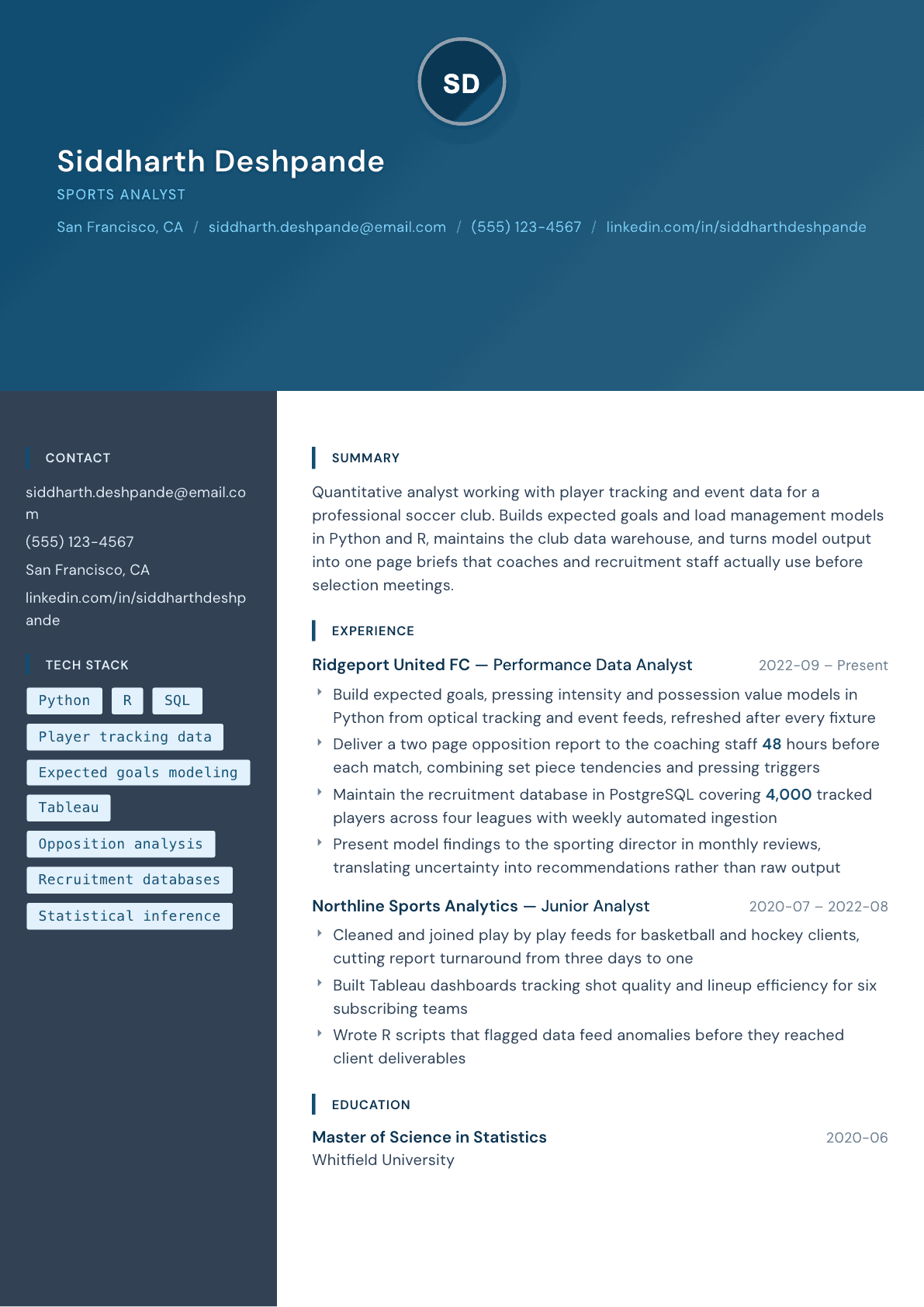
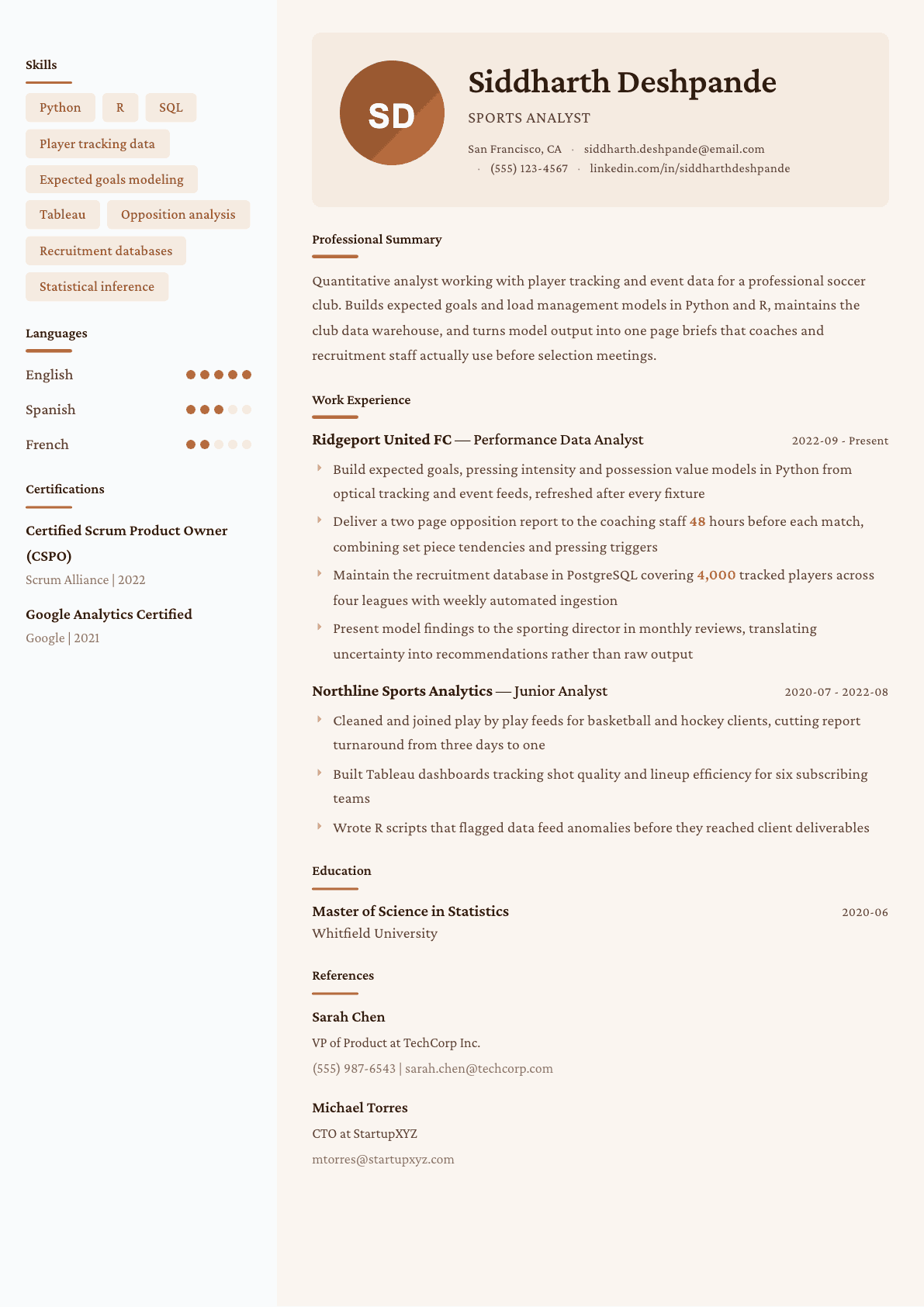
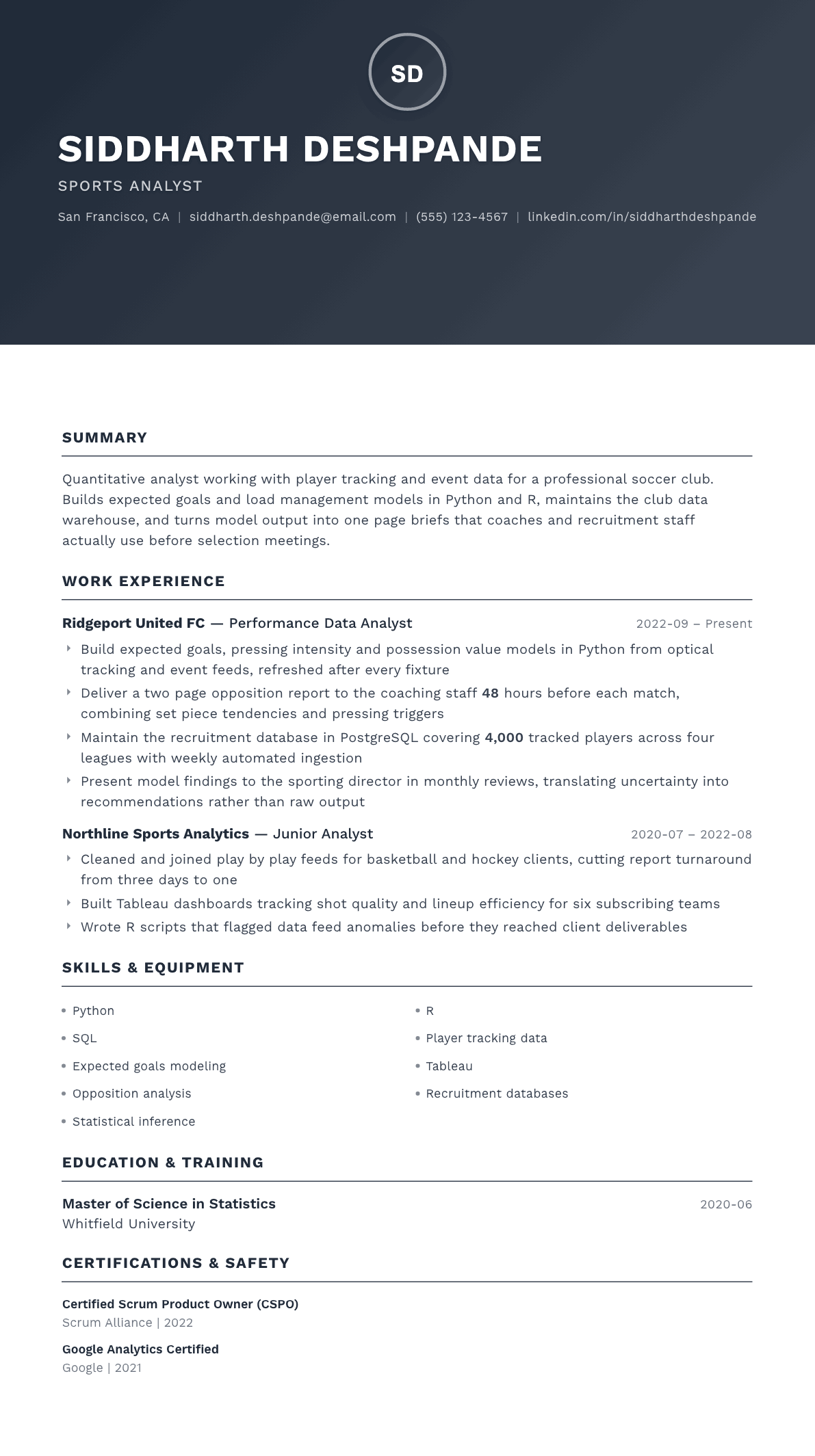
Example Sports Analyst summary
Sports analyst with four years turning tracking and event data into selection and recruitment decisions for a professional club. Builds expected goals and pressing models in Python, maintains a four league player database in SQL, and briefs coaching staff with short opposition reports rather than dashboards nobody opens.
Skills to list on a Sports Analyst resume
- Python
- R
- SQL and PostgreSQL
- Player tracking and event data
- Expected goals and possession value models
- Opposition and scouting reports
- Tableau and Power BI
- Recruitment database management
- Load and availability analysis
- Statistical modeling
- Data pipeline automation
- Video analysis platforms
- Coaching staff briefings
What actually gets this resume read
- Name the data sources you have handled, whether optical tracking, event feeds, wearables or play by play logs.
- Say which sport and which competition level, because a hockey front office reads soccer models very differently.
- Show the delivery, not just the model: opposition reports, selection briefs, dashboards, recruitment shortlists.
- List the stack explicitly, Python, R, SQL, Tableau, and the database you maintained, so keyword filters catch you.
- Include one bullet on communicating with coaches, because clubs reject analysts who cannot brief a technical staff.
- Link a public portfolio of your own analysis if you have one, since front offices treat it as the real work sample.
How to write a sports analyst resume
Two very different jobs share this title. One sits inside a club or front office, joining tracking feeds to scouting notes and answering questions a head coach asks on Tuesday about a Saturday fixture. The other sits in media, explaining the same numbers to an audience on air or in print. A resume that does not declare which one it is aiming at will lose both.
This guide assumes the club and front office version, with a note where the media route differs. The person reading your application is usually a head of analysis or a sporting director, and he has seen a hundred applicants who can build a model and perhaps five who can get a coaching staff to act on one. Your page has to prove you are in the second group.
Below is the section order that reader follows, sample summaries for a first analyst role, a working club analyst and a head of analysis, before and after bullets, and the questions that come up when technically strong applications keep getting rejected.
Format: sport, stack and portfolio in the first six lines
One page for a first role, two once you have club experience and publications behind you. Reverse chronological, single column, plain headings. Heads of analysis read on a laptop between video sessions and will not fight a layout.
Put the portfolio link in the header next to your email. In this field the public work is the interview. A repository of code, a written match analysis or an interactive visualization gets opened before the education section, and an applicant without one is asking to be judged on claims alone.
- Header: name, city, email, phone, portfolio or repository link, and the sports you have worked in.
- Section order for a club role: summary, technical skills, analysis experience, selected projects, education.
- Media analyst applications move a broadcast reel or clips link to the same header position.
- Keep the code samples public and current, because a dead link reads worse than no link at all.
Summary: the sport, the data type, the model, the decision it changed
A club summary needs four facts in three lines: which sport and level, which data you work with, what you build, and which decision it fed. Tracking data for a professional soccer club is a different craft from play by play for basketball or pitch level data for baseball, and the reader is filtering on that first.
The fourth fact is the one applicants leave out. A model that no one used is a hobby project. Say that your possession value work fed selection meetings, or that your availability model changed the training load discussion, and you have separated yourself from the pile without inflating anything.
Experience: pipeline, model, delivery, adoption
Write each job in four layers. Pipeline is where the data comes from and how it stays clean: optical tracking providers, event feeds, wearable exports, video platform tags, and the database you maintain. Model is what you build and in what language. Delivery is the artifact a human receives, an opposition report, a recruitment shortlist, a dashboard, a selection brief. Adoption is who used it and for what.
Give volume where it exists: how many players tracked, how many leagues covered, how often the pipeline refreshes, how many reports a season. A recruitment database covering four leagues and several thousand tracked players says more about your engineering than any adjective.
Include the communication bullet deliberately. Clubs reject analysts who present coefficients to a coaching staff. Show that you produced a two page brief, that you presented in a selection meeting, or that you sat in the video room while your work was used.
- Name the data sources by type: optical tracking, event data, wearable GPS, play by play, video tags.
- State the language and database, not just the word analytics: Python, R, SQL, PostgreSQL, BigQuery.
- Give the model family you built, such as expected goals, possession value, availability or lineup efficiency.
- Describe the deliverable and its cadence, for example an opposition report two days before every fixture.
- Close each job with who acted on the work: coaching staff, recruitment, medical, sporting director.
Technical skills: a block the filter can read
Group them so a reader can skim: languages, databases, visualization, sport specific platforms, and statistics. Python and R belong under languages with the libraries you actually use. SQL belongs with the database flavor. Tableau or Power BI go under visualization. Video and tracking platforms such as Hudl, Sportscode, Wyscout, Second Spectrum or Catapult go under sport tools, and only the ones you have hands on with.
Under statistics, name methods rather than the word modeling: regression, mixed effects, Bayesian estimation, survival analysis, clustering. A head of analysis reads that block to work out whether you can defend a model when a coach pushes back on it.
Projects and keywords that get an application read
Add a selected projects block if you are moving into sport from another field. Two or three entries, each with the data source, the question, the method and the finding, one line apiece. That is the closest thing to club experience an outsider can offer, and hiring staff read it seriously when it uses real public data.
Postings repeat a stable vocabulary: performance analysis, data pipeline, expected goals, opposition analysis, recruitment support, load management, dashboard, stakeholder communication. Mirror the words that are true of you, once in the skills block and once inside a bullet.
Sports Analyst resume summary examples
First analyst role
Statistics graduate with two internships in sports data, building shot quality and lineup models in R from public play by play feeds. Published three written match analyses with reproducible code, comfortable in SQL, and looking for a junior analyst position inside a club performance department.
Club analyst
Performance analyst at a professional soccer club, building expected goals and pressing models in Python from optical tracking and event feeds. Delivers a two page opposition report before every fixture, maintains a four league recruitment database in PostgreSQL, and presents findings to the sporting director monthly.
Head of analysis
Head of analysis leading a department of five across performance, recruitment and medical analytics for a first division club. Owns the data platform and vendor relationships, sets the modeling standards the department works to, and sits in selection and transfer committee meetings as the analytical voice.
Work experience bullets: before and after
Before: Analyzed player performance data for the team.
After: Built expected goals and pressing intensity models in Python from optical tracking and event feeds, refreshed within twelve hours of every fixture and reviewed with the coaching staff each Monday.
Naming the model, the data source and the refresh cycle turns a generic claim into a working process the reader can picture.
Before: Created reports for the coaching staff.
After: Delivered a two page opposition report before each match covering set piece tendencies, pressing triggers and likely lineups, condensed from tracking data into the three points the head coach could use in team meeting.
The format, the content and the constraint show you understand that adoption depends on brevity, not completeness.
Before: Maintained the scouting database.
After: Maintained a recruitment database in PostgreSQL covering four thousand tracked players across four leagues, with weekly automated ingestion and anomaly checks that flag broken provider feeds before analysts see them.
Scale plus data quality engineering demonstrates the unglamorous work that keeps an analysis department credible.
Before: Used Tableau to visualize statistics.
After: Built Tableau dashboards on shot quality and lineup efficiency for six subscribing teams, replacing a manual weekly deck and cutting report turnaround from three days to one.
A before and after on turnaround proves the visualization solved an operational problem rather than looking attractive.
Before: Presented findings to management.
After: Presented model output to the sporting director in monthly reviews, framing uncertainty as a recommendation with a confidence range rather than handing over raw coefficients.
How you present is the skill clubs screen for, and this shows you translate rather than transmit.
Hard skills
- Python with pandas and scikit-learn
- R and tidyverse
- SQL and PostgreSQL
- Optical tracking and event data
- Expected goals and possession value models
- Opposition and set piece analysis
- Recruitment database management
- Tableau and Power BI
- Wearable GPS and load monitoring data
- Video analysis platforms
- Data pipeline automation
- Regression, mixed effects and Bayesian methods
Soft skills
- Explaining uncertainty to non technical staff
- Working to a fixture deadline
- Pushback from experienced coaches
- Written brevity
- Cross department collaboration
- Intellectual honesty about a weak model
Mistakes that cost sports analyst candidates the interview
- Writing a general data science resume and swapping in the word sport, with no fixture cycle, coaching staff or scouting context anywhere.
- Listing model names without saying which decision they informed, which reads as coursework rather than club work.
- Omitting the portfolio link, when public analysis is the closest thing this field has to a work sample.
- Naming every library ever imported instead of the three tools you would be trusted to own on day one.
- Confusing the media analyst and club analyst tracks on one page, so neither hiring manager sees a fit.
- Reporting model accuracy with no mention of data quality, when broken provider feeds are the real daily problem.
Sports Analyst resume questions
Do I need to have played the sport to work as a sports analyst?
No, but you need fluency in how the sport is coached. Watching with intent, learning the vocabulary a staff uses for pressing or spacing, and writing analysis that a coach recognizes matters far more than a playing background.
How do I break into club analysis from another industry?
Build a public portfolio on open data, write two or three analyses that answer a real question, and publish the code. Then apply to junior or academy roles, where clubs hire on demonstrated craft rather than prior club employment.
Should a sports analyst resume include a portfolio link?
Yes, in the header. Hiring staff open it early and treat it as the primary evidence. Keep it small and current: a repository, one or two written analyses, and a visualization that loads quickly on a phone.
Which programming language should I lead with?
Lead with the one you would defend in a technical conversation. Python is more common in club engineering work and R remains strong in statistical analysis. Listing both is fine, but the resume should make clear which one is your first language.
How is a media sports analyst resume different?
Media applications lead with a reel, on air credits, publication bylines and audience reach, and treat modeling as supporting evidence. Club applications invert that, leading with the data stack and the internal decisions your work supported.
Related resume examples
- Data Analyst Resume example
- Statistician Resume example
- Sports Journalist Resume example
- Sports Coach Resume example
- Kinesiologist Resume example
- Assistant Coach Resume example