Sports Journalist Resume Examples: the lines they read
Write a Sports Journalist Resume Editors Take Seriously
By Mustafa Tarabya, founder of CVBooster · Published · Updated
Sports journalist resume examples with beat reporting, deadline filing and multimedia keywords, plus a guide to clips, bylines and section order.
Sample resumes for a sports journalist
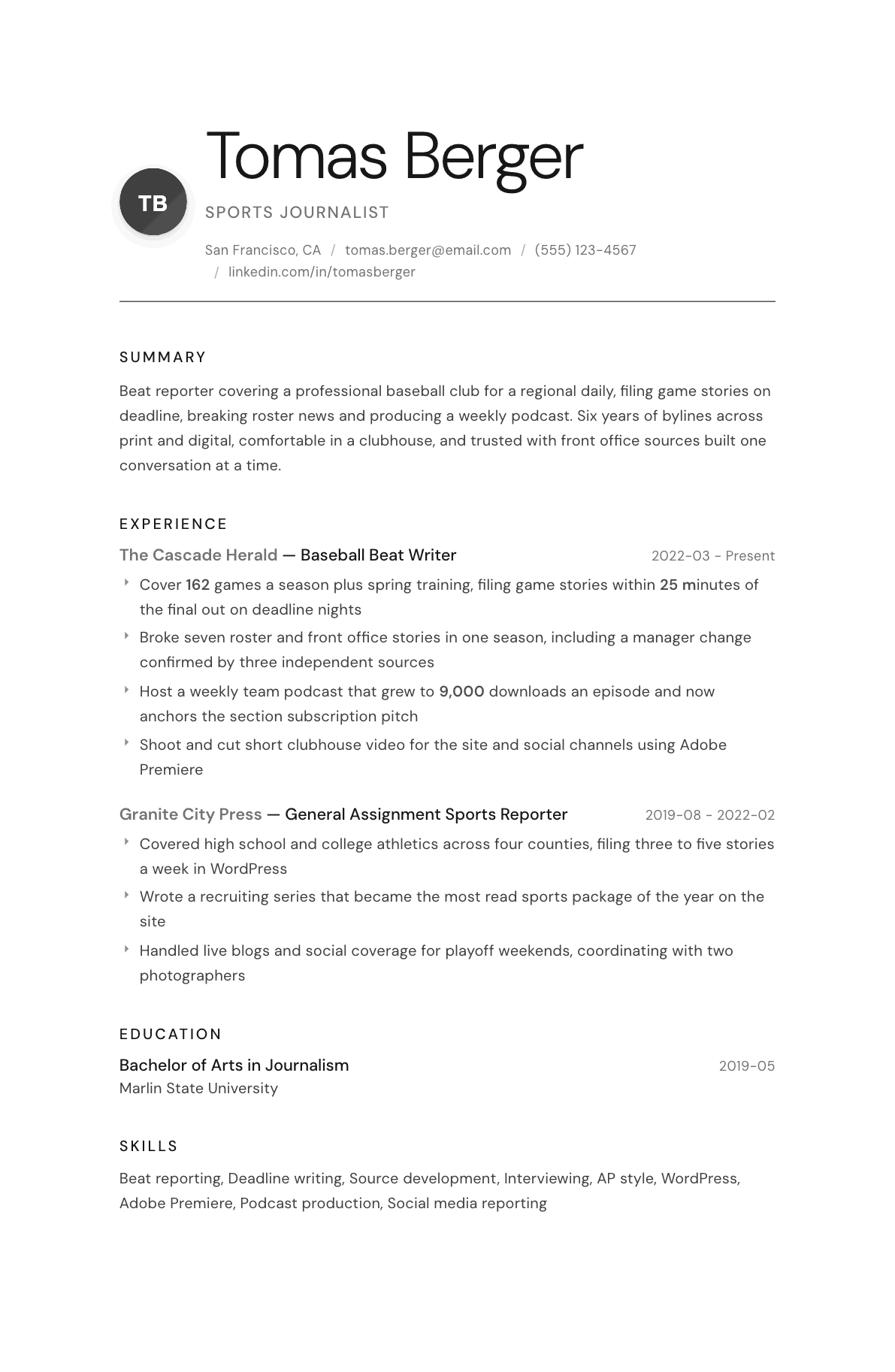
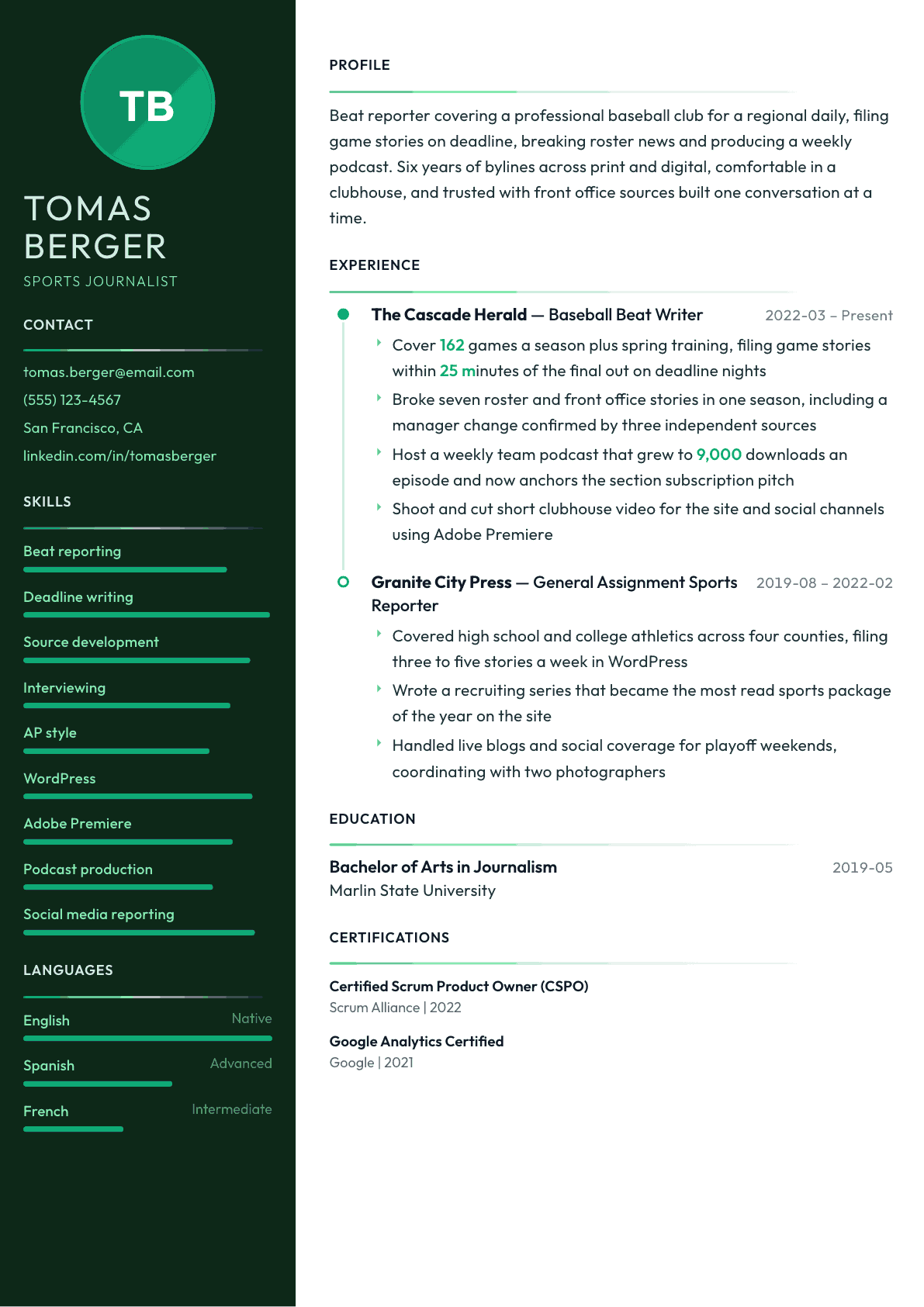
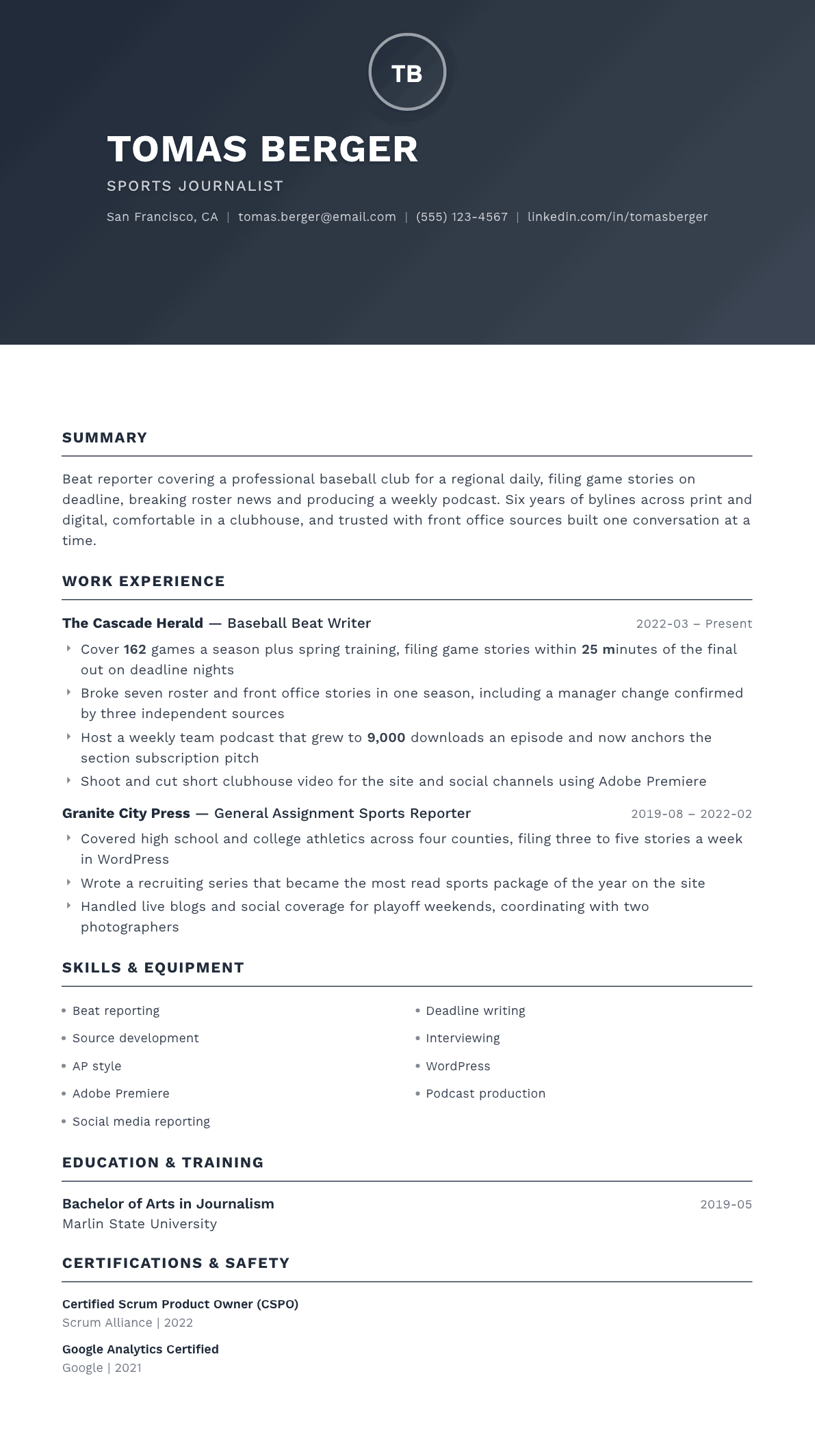
The same sports journalist content laid out in three CVBooster templates, so you can see what the finished document looks like before you write a word.
Example Sports Journalist summary
Sports journalist with six years on professional and college beats, filing game stories minutes after the final out and breaking roster news sourced from front office contacts. Produces a weekly team podcast, cuts clubhouse video in Premiere, and writes to AP style in a newsroom content system without a copy desk safety net.
Skills to list on a Sports Journalist resume
- Beat reporting
- Deadline game stories
- Source development
- Enterprise and investigative features
- AP style
- Interviewing athletes and executives
- Live blogging and in game updates
- WordPress and CMS publishing
- Podcast hosting and production
- Adobe Premiere video editing
- Social media reporting
- Photo and caption writing
- Media credential and access management
What actually gets this resume read
- Put a clips link in the header, because a sports editor will open it before reading your second bullet.
- Name the beat and the level covered, since a prep beat and a professional beat are different hiring decisions.
- Give the deadline reality: how fast you file after a final whistle and how many stories a week you produce.
- Count the stories you broke and say how they were sourced, which is the credibility test in this field.
- List the production tools you actually use, from the content system to video editing and podcast software.
- Include audience numbers only where you own them, such as a podcast or newsletter you built and still run.
How to write a sports journalist resume
A sports editor hires on three signals and reads the resume mainly to confirm them: the clips, the beat, and whether you can file clean copy fast enough to make an edition. The page itself is a table of contents pointing at your work. If it does not carry a clips link in the first two lines, the editor is deciding based on the least interesting thing about you.
The second thing the editor looks for is proof you can operate inside a locker room. Sourcing, credential handling, the ability to ask a losing coach an uncomfortable question and still be welcome the next week, these are learned behaviors that separate a beat writer from someone who can write nicely about sport. Bullets that name broken stories and how they were sourced carry that signal.
This guide walks the page in the order an editor reads it, gives sample summaries for a first newsroom job, an established beat writer and a columnist or senior writer, rewrites the bullets applicants usually submit, and answers the recurring questions about clips, freelance work and multimedia.
Format: clips link at the top, one page until you have a decade
One page, reverse chronological, plain and readable. A newsroom hiring editor is reading applications alongside a live news cycle and will scan for beat, outlet and clips before reading a single bullet.
The header does more work here than in any other field. Name, city, phone, email, a portfolio or clips link, and your social handle if you use it professionally for reporting. If the clips live behind a paywall, host copies yourself so the editor is never blocked at the door.
- Header: name, city and state, phone, email, clips or portfolio link, professional social handle.
- Section order: summary, reporting experience, selected work, skills and tools, education, awards.
- A selected work block of five to eight headlines with outlet and one line of context beats a long list of every byline.
- Freelancers group commissions under one heading with the outlets named, rather than listing each assignment as a job.
Summary: beat, level, output, and what you break
Name the beat and the level in the first clause. Covering a professional franchise, a college conference and a metro high school region are three different hiring decisions, and an editor filtering for a vacant pro beat needs to see that word immediately.
Then output and originality. How many stories a week, how fast you file after a final whistle, and what kind of work you are known for: enterprise features, injury and roster news, tactical analysis, investigative pieces. One specific broken story beats any adjective you could use about yourself.
Experience: deadline reality, sourcing, and the second job every reporter now has
Every reporting job needs three things on the page: the beat, the volume, and the deadline. Filing a game story within twenty five minutes of the final out on a night edition is a concrete skill, and editors treat it as one. Say it plainly.
Sourcing deserves its own bullet. Count the stories you broke in a season and describe how they were confirmed, for example a manager change verified with three independent sources before publication. That single detail tells an editor you understand the difference between a tip and a story, which is what she is actually buying.
Then the production work reporters now carry: live blogs, in game social updates, video cut for the site, a podcast, a newsletter. Name the tools, the cadence and any audience you personally built. Audience numbers belong on the page only where you own the product, not where you are one byline among many.
- State the beat, the season length and the number of events covered.
- Give the filing window after a final whistle and the weekly story count.
- Count broken stories and describe the sourcing standard you held them to.
- List the content system, the video editor and the audio tools you actually work in.
- Include enterprise or investigative work separately, since it is graded differently from daily coverage.
Selected work: the block that does the persuading
Five to eight entries, each a headline, the outlet, and one line on why it mattered or how it was reported. Choose for range rather than volume: one deadline game story, one broken news piece, one long feature, one piece of accountability reporting, one multimedia project. An editor is testing whether you can do more than the thing you did most recently.
Do not paste story text into the resume. Link out, keep the link stable, and make sure each piece opens without a subscription wall or an app prompt. A single dead link in this block costs more than a weak bullet elsewhere.
Skills, tools and the vocabulary of a newsroom posting
Sports desk postings repeat a small vocabulary: beat coverage, deadline writing, enterprise reporting, source development, AP style, live coverage, multimedia storytelling, audience engagement, credential management. Mirror the ones that are true of you.
Under tools, be concrete: the content management system you publish in, Adobe Premiere or a comparable video editor, audio recording and editing software, social scheduling tools, and any data or spreadsheet work you use for records and statistics reporting. Language skills belong here too, because they widen the pool of athletes you can interview without a translator.
Sports Journalist resume summary examples
First newsroom job
Journalism graduate with two internships and a season covering college athletics for a student daily, filing three stories a week to AP style. Shot and edited video for the site, ran playoff live blogs, and published a recruiting series that became the most read package of the term.
Beat writer
Baseball beat writer covering a full season plus spring training for a regional daily, filing game stories within twenty five minutes of the final out. Broke seven roster and front office stories last season, hosts a weekly team podcast, and cuts clubhouse video for the site and social channels.
Senior writer
Senior sports writer and columnist with twelve years across two metro dailies, covering professional football and Olympic sports including three championship assignments. Writes long form enterprise alongside a twice weekly column, mentors beat reporters on sourcing, and has testified on newsroom access issues.
Work experience bullets: before and after
Before: Covered the local baseball team for the newspaper.
After: Covered a full 162 game season plus spring training as the primary beat writer, filing game stories within twenty five minutes of the final out on deadline nights.
Season length and filing window replace a vague beat claim with the two facts a sports editor is actually testing.
Before: Broke several stories during the season.
After: Broke seven roster and front office stories in one season, including a manager change confirmed by three independent sources before publication.
A count plus a sourcing standard turns a claim about scoops into evidence of reporting discipline.
Before: Produced a podcast about the team.
After: Created and host a weekly team podcast that grew to nine thousand downloads an episode and now anchors the sports section subscription pitch.
Owning a product with an audience and a commercial role shows value beyond the byline count.
Before: Wrote features and long form pieces.
After: Reported a four part series on youth travel team costs, built on eighteen interviews and two years of league filings, which prompted a state association policy review.
Method and consequence prove enterprise capability, where the words feature and long form prove nothing.
Before: Handled social media during games.
After: Ran live coverage for playoff weekends across the site live blog and team accounts, coordinating with two photographers and filing updated copy between innings.
Naming the workflow and the people you coordinated with shows newsroom operating skill rather than posting.
Hard skills
- Beat reporting
- Deadline game stories
- Source development and verification
- Enterprise and accountability reporting
- AP style
- Interviewing athletes, coaches and executives
- Live blogging and in game updates
- CMS publishing
- Adobe Premiere video editing
- Podcast hosting and audio editing
- Records and statistics research
- Media credential and access management
Soft skills
- Composure in a hostile locker room
- Question discipline in a press conference
- Building trust with reluctant sources
- Working nights, weekends and travel
- Accepting a hard edit
- Judgment on when a story is not ready
Mistakes that cost sports journalist candidates the interview
- Burying the clips link at the bottom of the page or omitting it, which forces the editor to judge you on adjectives.
- Listing every byline instead of curating five to eight pieces that show range across deadline, news and feature work.
- Describing coverage without the beat level, so an editor cannot tell prep sports from a professional franchise.
- Claiming audience numbers for outlet accounts you did not build, which collapses in the first interview question.
- Leaving out sourcing detail on broken stories, when verification standard is the trait the desk is most worried about.
- Linking clips that sit behind a subscription wall with no hosted copy, so half the selected work block never opens.
Sports Journalist resume questions
How many clips should I include with a sports journalism application?
Five to eight, chosen for range rather than recency. Include one deadline game story, one piece of broken news, one feature and one multimedia project, each with a stable link that opens without a subscription prompt.
Do I need a journalism degree for a sports desk job?
It helps for a first job and matters little afterward. Editors hire on clips, beat experience and reliability under deadline. Strong student newspaper work, freelance commissions and a self published beat can substitute for the credential.
How should freelancers structure the experience section?
Group freelance work under a single heading with the date range, then name the outlets you published in and the kind of work each commissioned. Listing every assignment as a separate job makes a steady career look fragmented.
Should I list social media followers?
Only where the audience is genuinely yours, such as a newsletter, podcast or personal reporting account you built. Follower counts on an employer account are not portable and an editor will discount them immediately.
What does a sports editor look for that applicants leave off?
Deadline speed, the sourcing standard behind broken stories, and evidence you can produce beyond text. Video, audio and live coverage are now part of most beats, and applicants who ignore them look narrower than they really are.
Related resume examples
- Journalist Resume example
- Content Writer Resume example
- Sports Analyst Resume example
- Sports Marketing Manager Resume example
- Editor Resume example
- Sports Coach Resume example