Crisis Counselor Resume Examples: the lines they read
Build a Crisis Counselor Resume That Proves Calm Under Pressure
By Mustafa Tarabya, founder of CVBooster · Published · Updated
A crisis counselor resume sample plus keywords, hotline and mobile team examples, de-escalation credentials and a step by step writing guide.
Sample resumes for a crisis counselor
The same crisis counselor content laid out in three CVBooster templates, so you can see what the finished document looks like before you write a word.
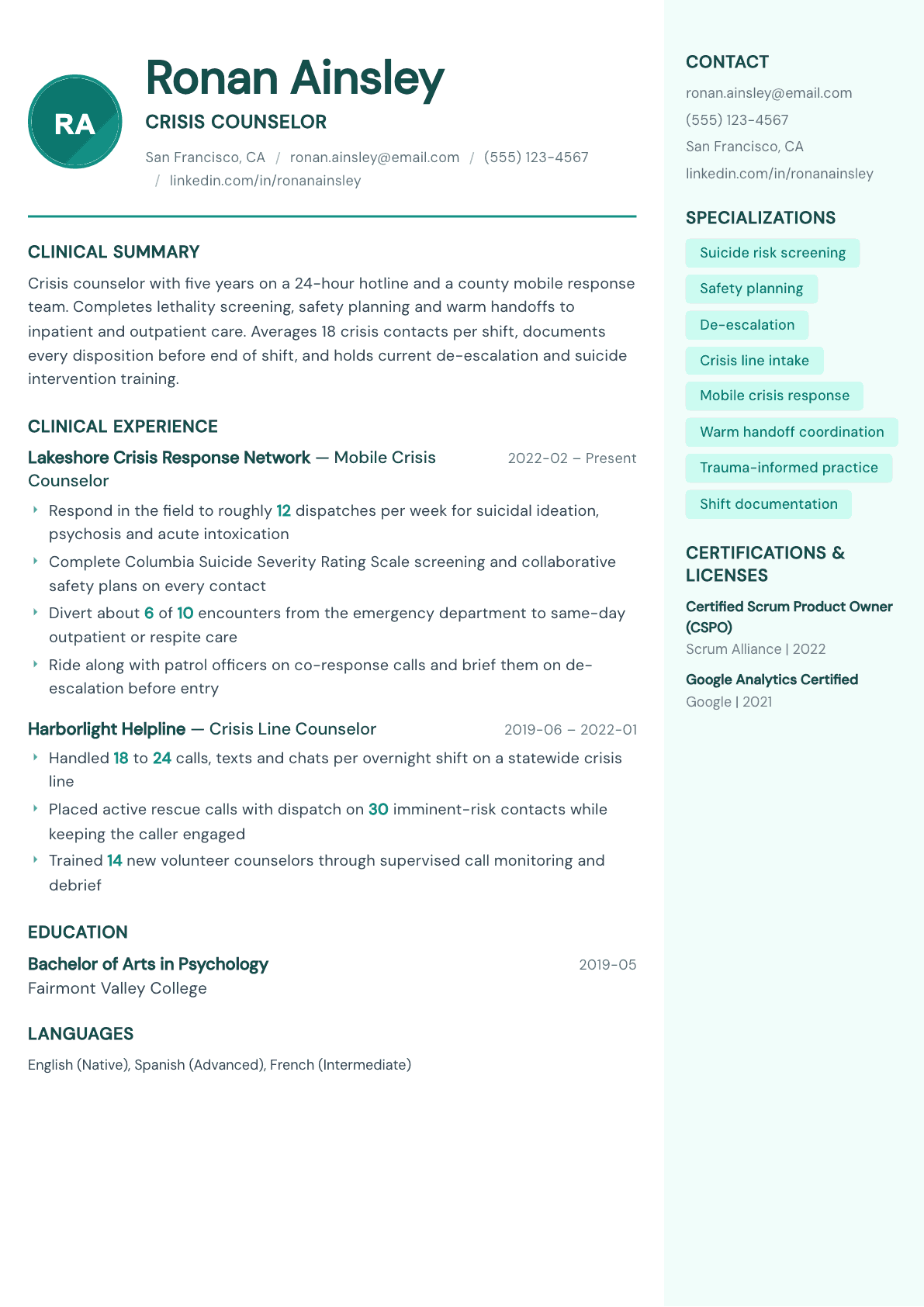
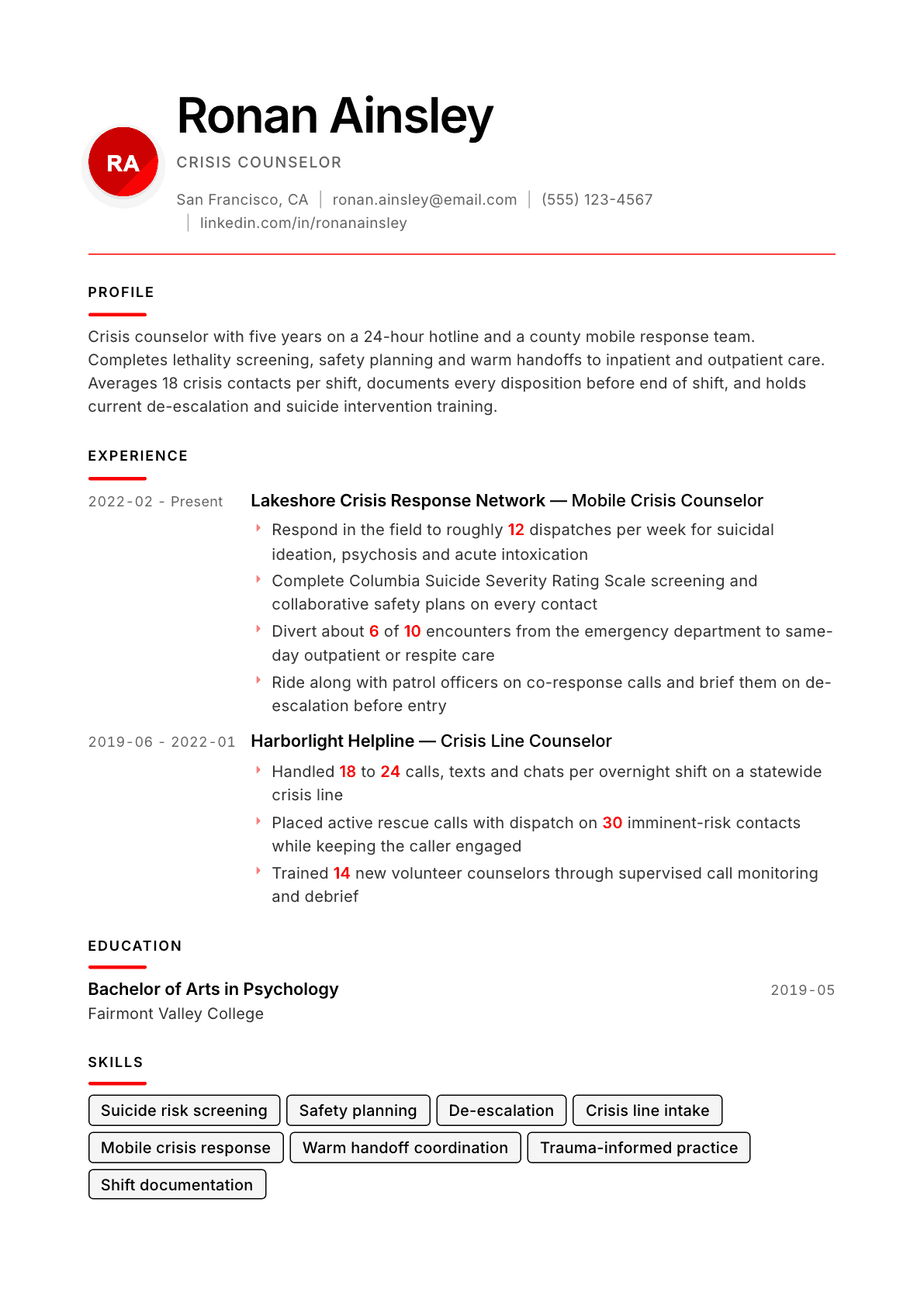
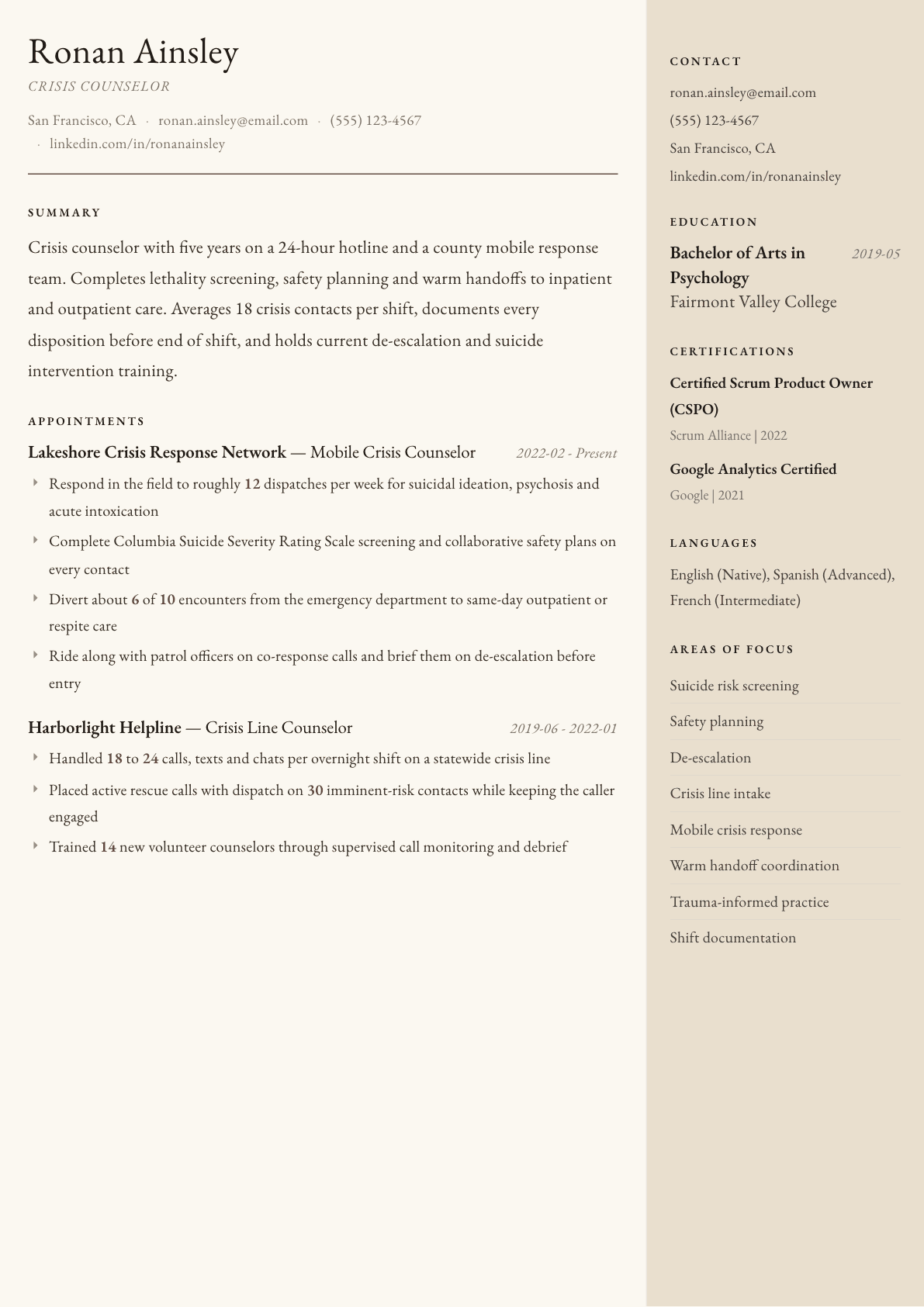
Example Crisis Counselor summary
Crisis counselor with five years across a statewide hotline and a county mobile response team, averaging 18 contacts per shift. Skilled in lethality screening, collaborative safety planning and verbal de-escalation on scene with law enforcement present. Diverts most encounters to outpatient or respite care instead of the emergency department. Available for overnight and weekend coverage.
Skills to list on a Crisis Counselor resume
- Crisis intervention
- Suicide risk screening
- Columbia Suicide Severity Rating Scale
- Safety planning
- Verbal de-escalation
- Mobile crisis response
- Crisis line intake
- Involuntary hold procedures
- Trauma-informed care
- Substance withdrawal recognition
- Law enforcement co-response
- Referral and warm handoff
- Shift documentation
- Debriefing
What actually gets this resume read
- Say which crisis channel you worked, hotline, text line, mobile team or emergency department, because the skills differ sharply.
- Give contact volume per shift and the share that ended in a safety plan rather than an involuntary hold.
- Name the screening instrument you use, such as the Columbia scale, and who trained you on it.
- Show your handoff work: the receiving level of care, the follow-up call and how the disposition was documented.
- List de-escalation and suicide intervention training with the issuing organization and the year it was renewed.
- Note your shift availability, since crisis employers screen hard for overnight, weekend and holiday coverage.
How to write a crisis counselor resume
Crisis programs hire on two questions that a normal behavioral health resume never answers. Can this person stay regulated when someone is standing in a doorway with a knife or sobbing into a text line at four in the morning, and will they still finish the disposition note before the shift ends. Everything else is training.
That means a crisis counselor resume has to be structured around contacts, channels and dispositions rather than around therapy language. A supervisor staffing a mobile team reads for how many dispatches you have taken, who you rode with, what share of encounters ended somewhere other than an emergency department, and whether you know the difference between a voluntary transport and a hold in the jurisdiction you worked.
The sections below follow the order a crisis supervisor scans, with example summaries for a newly trained counselor, an experienced responder and a shift lead, before and after bullets pulled from the way this work is really described, and the questions crisis staff ask when they start applying.
Name the channel first: line, text, mobile team or emergency department
Crisis work splits into settings that share a name and almost nothing else. A text line counselor manages three conversations at once and never sees a face. A mobile responder walks into an apartment with a partner and sometimes a patrol officer. An emergency department clinician works in a room with security nearby and a psychiatrist a phone call away. Say which one you did, in the job line itself, before any bullet.
Then add the operating facts that a scheduler needs: coverage hours, whether the team ran two person response, average response time targets and the geographic area covered. A rural team covering four counties is a different job from a downtown team with a fifteen minute target, and both employers know it.
- Job line: employer, team type, coverage hours, and the counties or catchment you responded to.
- Say whether you responded alone, with a clinical partner, or in co-response with law enforcement or paramedics.
- Note the referral source mix: self, family, dispatch, school or hospital, since it shapes the work.
Count contacts and, more importantly, count dispositions
Volume proves stamina. Contacts per shift, dispatches per week, or conversations per hour on a text platform give a supervisor an immediate read on the pace you are used to. Give the number as a range if it varied by shift, since overnight and daytime volumes differ.
Disposition proves skill. A crisis counselor who resolves an encounter in place with a safety plan and a next-day appointment has done harder work than one who calls for transport every time. Report the share of contacts that ended in community stabilization, a voluntary walk-in, respite, or a scheduled follow-up, and be honest about the ones that required a hold. Programs are funded on diversion, so this is the number that gets you called.
Screening instruments, safety planning and the hold decision
Name the risk instrument you were trained on and use it as a verb. The Columbia protocol, the ASQ toolkit and agency lethality screens all appear in postings by name. Say who trained you, how the screen fed the disposition, and what the documentation looked like afterward.
Safety planning deserves its own line, and it should show the parts people leave out: means restriction conversations with a family member, involving a support person by phone, and the follow-up call schedule. Then describe the hold decision the way a supervisor thinks about it, as a documented judgment made with consultation, not as a switch you flip.
The handoff, the follow-up, and why they belong on the page
Crisis work is judged by what happens two days later. A resume that stops at the encounter looks like a resume from someone who has never been asked why a client bounced back within the week. Write the handoff: the receiving level of care, who you spoke to there by role, what you sent, and when the follow-up contact happened.
If your program ran a follow-up protocol at twenty-four hours or seven days, give your completion rate. If you built the warm handoff relationships with a walk-in clinic, a withdrawal management unit or a respite house, say so. Those relationships are the part a new hire cannot bring, which makes them worth stating.
Availability, safety training and the practical filters
Crisis employers screen on logistics before clinical fit. Overnight availability, weekend and holiday rotation, a valid driver license for field response, comfort riding with law enforcement, and current de-escalation training all belong in a short block near the skills. Leaving them out makes a recruiter guess, and recruiters guess conservatively.
Add the debriefing side too. Programs that lose staff to burnout look for people who use consultation and post-incident debriefs rather than absorbing everything quietly, so a line about how you used team debrief after a difficult call reads as maturity, not weakness.
- Shift availability, on-call rotation and the response radius you can cover by car.
- Current de-escalation and suicide intervention training with the issuing organization.
- Language capacity, since crisis lines route by language and interpreter delay costs minutes.
Crisis Counselor resume summary examples
Newly trained responder
Crisis counselor with one year on a statewide text and chat line, handling 14 conversations per overnight shift for suicidal ideation, self-harm and family conflict. Trained on the Columbia protocol and collaborative safety planning, and completes disposition notes before end of shift.
Four years in the field
Mobile crisis counselor with four years responding to about 12 dispatches a week for psychosis, suicidal ideation and acute intoxication. Resolves roughly 6 of 10 encounters in the community with a safety plan and next-day appointment, and rides co-response calls with patrol officers.
Crisis team shift lead
Crisis team lead with nine years across hotline, mobile response and emergency department triage, now running overnight staffing for a five-county catchment. Built the seven-day follow-up protocol, precepts new responders through supervised call monitoring, and chairs post-incident debriefs.
Work experience bullets: before and after
Before: Answered crisis calls and helped callers in distress.
After: Handled 18 to 24 calls, texts and chats per overnight shift on a statewide line, holding three concurrent conversations during peak hours without missing a queue target.
Volume, channel and concurrency show the pace you can sustain, which is the first thing a crisis supervisor screens for.
Before: Assessed clients for suicide risk.
After: Completed Columbia protocol screening on every contact and built collaborative safety plans that included means restriction agreements with a family member present.
Naming the instrument and the hardest part of safety planning shows trained practice instead of a general claim.
Before: Worked with police on mental health calls.
After: Rode co-response with patrol officers on scene calls, briefed the officer on approach and containment before entry, and took the lead voice once the scene was secure.
Describing the division of roles proves you have actually worked a scene rather than heard about co-response.
Before: Referred clients to services after the crisis.
After: Arranged same-day walk-in appointments or respite placement on most field encounters, called the receiving clinician directly, and completed the seven-day follow-up contact on nine of ten cases.
A warm handoff and a follow-up completion rate answer the question of what happened after you left.
Before: Trained new staff on the crisis line.
After: Precepted 14 new counselors through supervised call monitoring, scored their first live contacts against the program rubric, and led their post-shift debriefs for the first month.
The count and the method turn a vague training claim into a repeatable process a supervisor can hand you.
Hard skills
- Crisis intervention
- Columbia protocol screening
- Lethality assessment
- Collaborative safety planning
- Verbal de-escalation
- Mobile field response
- Crisis line and text platform intake
- Involuntary hold criteria and process
- Substance intoxication and withdrawal recognition
- Law enforcement co-response
- Warm handoff coordination
- Disposition documentation
Soft skills
- Regulation under threat
- Rapid rapport building
- Concise handoff communication
- Consultation seeking
- Post-incident debriefing
- Nonjudgmental listening
Certifications worth listing
- Applied Suicide Intervention Skills Training (ASIST) (LivingWorks)
- QPR Gatekeeper Instructor (QPR Institute)
- Mental Health First Aid (National Council for Mental Wellbeing)
- Nonviolent Crisis Intervention (Crisis Prevention Institute)
Mistakes that cost crisis counselor candidates the interview
- Writing a therapy resume for a crisis job, full of modality names and treatment planning, with no contact volume anywhere on the page.
- Saying you have crisis experience without naming the channel, so a supervisor cannot tell a text line shift from a field dispatch.
- Leaving out disposition outcomes, which hides the diversion work that crisis programs are funded and evaluated on.
- Omitting shift availability and driver license status, the two logistics filters that decide whether a scheduler even calls.
- Describing every encounter as successfully de-escalated, which reads as unfamiliarity with how these calls actually end.
- Ignoring documentation entirely, when unclosed dispositions are the most common reason a crisis counselor loses the job.
Crisis Counselor resume questions
Do I need a clinical license to work as a crisis counselor?
It depends on the program. Hotlines and many peer-adjacent teams hire bachelor level staff with agency training, while mobile teams that write holds or bill insurance usually require a license or supervised license track. Read the posting's credential line before rewriting anything.
How do I show crisis skills if my experience is on a text line?
Give conversation volume, concurrency, the risk screening you completed in writing, and how you arranged active rescue with dispatch. Text work develops rapid assessment without tone or body language, which is a real skill worth stating directly.
Should I list the number of holds I have initiated?
Mention that you have carried the hold decision and how you documented consultation, but do not turn it into a scoreboard. Supervisors read a high hold count as a diversion problem, so pair it with the encounters you resolved in the community.
How do I keep a crisis resume from sounding traumatic to read?
Write about process rather than incident detail. Describe the screening, the plan and the handoff, and keep specific client circumstances off the page. Clinical restraint on paper is itself evidence that you handle confidential material carefully.
What belongs in the skills section for a crisis counselor?
The risk instruments you are trained on, the de-escalation model your employer used, the record system you documented in, your languages, and your availability for overnight and holiday coverage. Keep therapy modalities short unless the posting asks for them.
Related resume examples
- Social Worker Resume example
- Outreach Coordinator Resume example
- Behavioral Health Counselor Resume example
- Peer Support Specialist Resume example
- Youth Counselor Resume example
- Psychotherapist Resume example