Addiction Counselor Resume Examples: what gets the call
Create an Addiction Counselor Resume for Treatment Center Hiring
By Mustafa Tarabya, founder of CVBooster · Published · Updated
Addiction counselor resume sample with level of care detail, ASAM and group work examples, credential placement and a writing guide.
Sample resumes for a addiction counselor
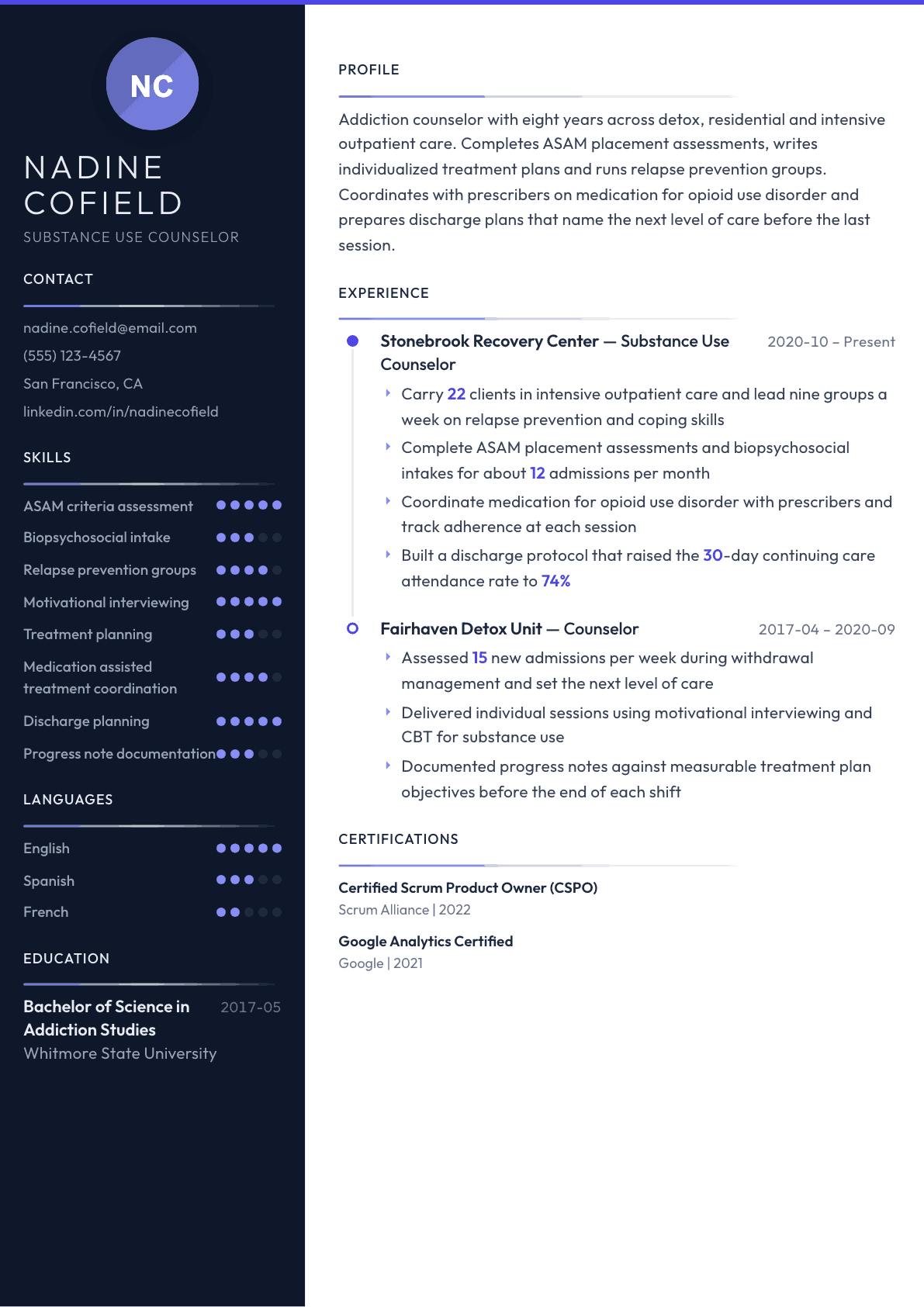
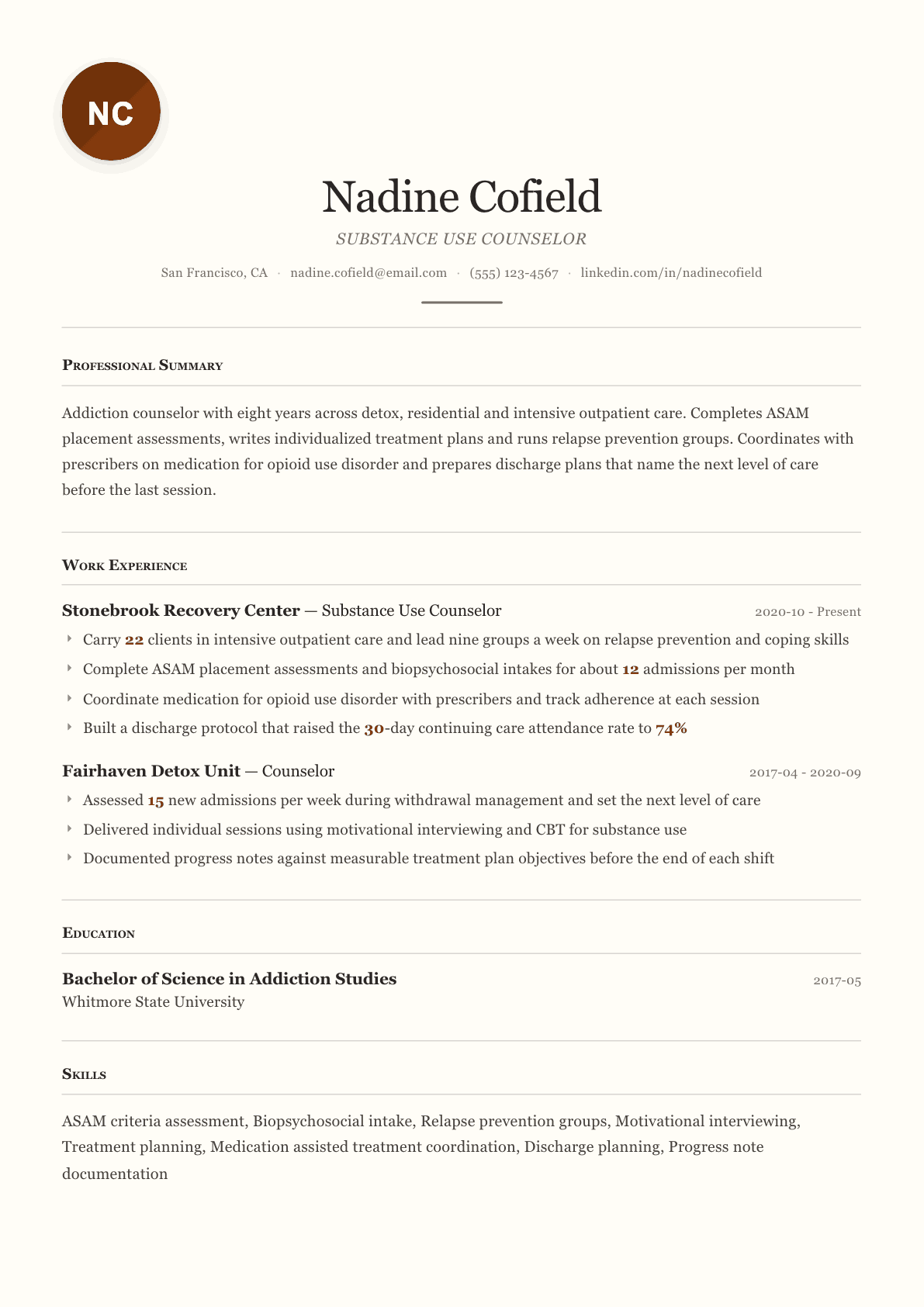
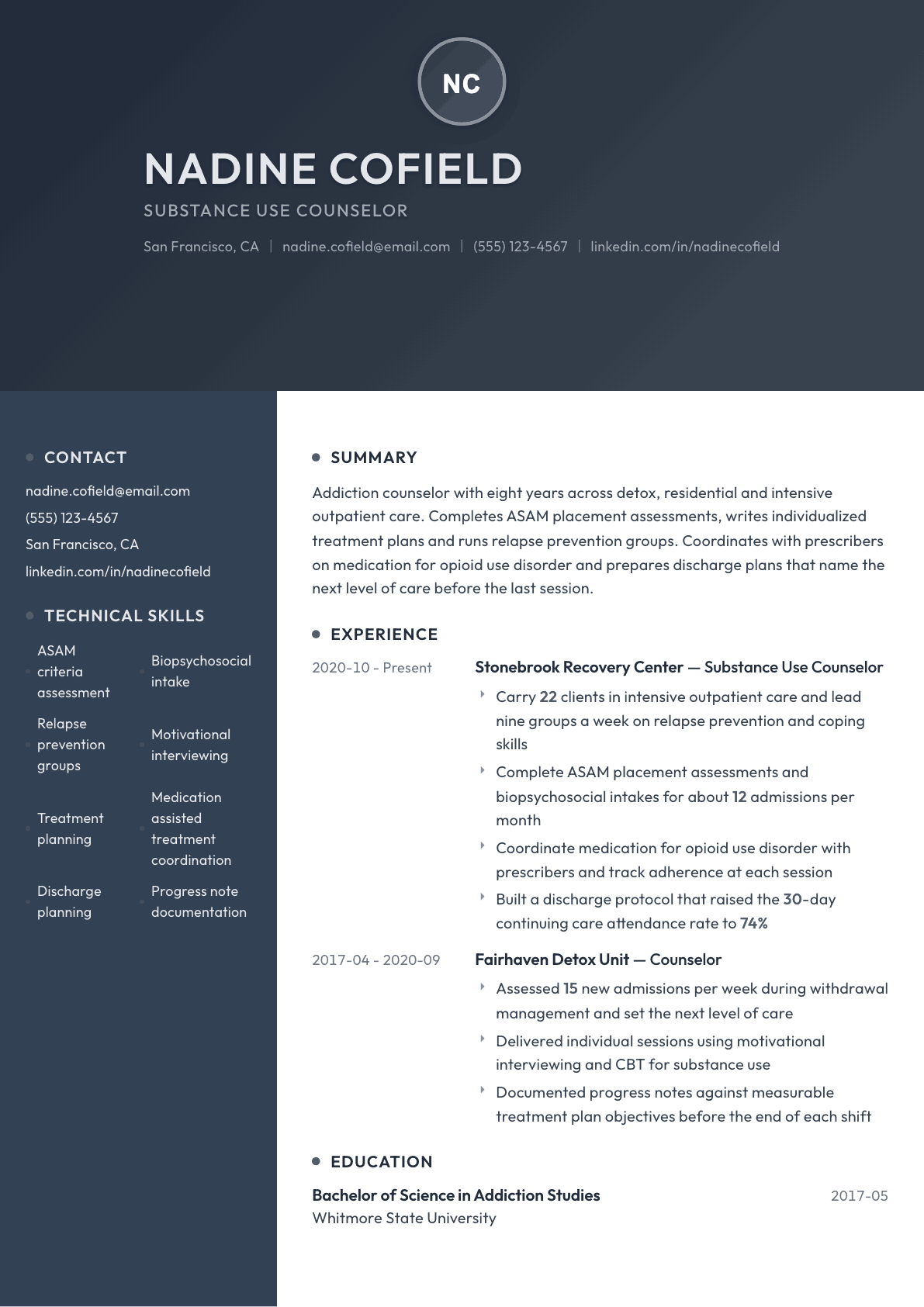
The same addiction counselor content laid out in three CVBooster templates, so you can see what the finished document looks like before you write a word.
Example Addiction Counselor summary
Addiction counselor with eight years across withdrawal management, residential and intensive outpatient programs. Completes ASAM placement assessments and biopsychosocial intakes, carries 22 clients and leads nine groups a week on relapse prevention. Coordinates medication for opioid use disorder with prescribers and writes discharge plans that name the next level of care. Documentation stays current for utilization review.
Skills to list on a Addiction Counselor resume
- Substance use assessment
- ASAM criteria
- Biopsychosocial intake
- Individual counseling
- Group counseling
- Relapse prevention planning
- Motivational interviewing
- Cognitive behavioral therapy for substance use
- Medication assisted treatment coordination
- Withdrawal management support
- Treatment planning
- Discharge and continuing care planning
- Family education sessions
- Confidentiality under federal substance use rules
What actually gets this resume read
- Name every level of care you have worked, from withdrawal management to residential, intensive outpatient and aftercare.
- Show ASAM assessment fluency by counting placements completed rather than saying you understand the criteria.
- Give group counts per week and topic, because treatment centers staff their group schedule from your resume.
- Describe your work alongside prescribers on medication for opioid use disorder without judging the modality.
- Put the counseling credential and its issuing body high on the page, along with license status if you hold one.
- Include documentation compliance, since utilization review and payer audits ride on your progress notes.
How to write a addiction counselor resume
Treatment centers hire addiction counselors against a schedule. There is a group at nine, an intake at eleven, a utilization review call at two, and a discharge that has to be planned before the bed turns over. The clinical director reading your resume is trying to work out which of those slots you can cover in your first week without supervision holding your hand.
That makes the useful facts specific: the levels of care you have worked, the assessments you complete, the group schedule you have carried, whether you can coordinate with a prescriber on medication for opioid use disorder without editorializing, and whether your notes hold up when a payer asks why the client still needs this level of care.
The sections below follow that reading order, with example summaries for a counselor in training, an experienced clinician and a clinical supervisor, before and after bullets taken from the way this work is usually undersold, and the questions counselors ask when moving between programs or toward licensure.
List the levels of care, because they are the map of your experience
Withdrawal management, residential, partial hospitalization, intensive outpatient, standard outpatient and recovery housing are all separate working environments with separate paperwork. Put the level of care in each job line, along with the census or caseload you carried. A director staffing an intensive outpatient track will hire the counselor who names it.
If you have moved down the continuum with clients, say so, because continuity of care is the part programs struggle to staff. A counselor who has run detox intakes and then carried the same clients through outpatient understands the drop-off point between them better than either specialist.
- Job line: facility, level of care, caseload or census, and the populations served.
- Note whether the program was abstinence based, medication supportive, or both, since philosophy shapes daily practice.
- Include specialty tracks you carried: adolescents, criminal justice referrals, pregnant clients or co-occurring disorders.
Assessment work is the credential that shows through
Naming assessment fluency separates trained counselors from staff who ran groups. Say how many biopsychosocial intakes you complete a month, that you place clients using the ASAM criteria dimensions rather than by bed availability, and how you document a level of care recommendation that a payer will authorize.
Add the screening tools that a treatment program actually uses at intake and through the episode, along with the co-occurring assessment work. A counselor who can recognize when a client needs a psychiatric evaluation and route it that day is worth more than one who defers everything to the clinical director.
The group schedule, in the detail a scheduler needs
Groups are the engine of most treatment programs, so give the count and the content. Groups per week, average size, and the curricula you deliver: relapse prevention, cognitive behavioral coping skills, seeking safety for trauma, anger management, family education and early recovery skills. Say which ones you have facilitated alone and which you co-led.
Then show how you handle the parts that are hard: a member who dominates the room, a client who comes in intoxicated, a group where two members have a history outside treatment. A sentence about managing group process reads as experience, because it is not something you can invent.
Medication, discharge and documentation that survives review
Programs are constantly screening for counselors who work well with medication for opioid use disorder. Describe your coordination with prescribers, how you track adherence in session, how you handle a client whose recovery community disapproves of medication, and the education you provide to families about it. Neutral, practical language on this topic tells a director more than any credential.
Discharge planning is the other quiet test. Name the next level of care before the last session, arrange the first appointment, involve family or a recovery support, and set the follow-up. Then close the loop with documentation: progress notes tied to treatment plan objectives, weekly plan reviews, and clean records for utilization review and payer audits.
- Name the record system, note turnaround and any audit or accreditation survey your files passed.
- Describe continuing care attendance or engagement outcomes if your program measured them.
- Show your handling of confidentiality rules specific to substance use records, including consent forms.
Credentials, licensure track and keywords
Put the counseling credential and its issuing body high on the page with your license status. Many counselors are working toward a higher credential while employed, so state hours accrued and supervision arrangements plainly rather than leaving a reader to guess your scope.
For keywords, mirror the posting: substance use disorder, co-occurring disorders, ASAM criteria, biopsychosocial assessment, individualized treatment plan, relapse prevention, motivational interviewing, medication assisted treatment, continuing care and clinical documentation. Each should appear where it describes work you performed.
Addiction Counselor resume summary examples
Counselor in training
Substance use counselor in training with a year in withdrawal management, completing 15 admissions assessments a week and co-leading early recovery skills groups. Accruing supervised hours toward a state counseling credential, documents progress notes before end of shift, and coordinates next level of care at discharge.
Seven years in treatment
Addiction counselor with seven years across residential and intensive outpatient care, carrying 22 clients and leading nine groups a week on relapse prevention and coping skills. Completes ASAM placement assessments, coordinates medication for opioid use disorder with prescribers, and writes discharge plans that name the next level of care.
Clinical supervisor
Clinical supervisor with twelve years in substance use treatment, overseeing eight counselors and the intensive outpatient track for a two-site program. Rebuilt the discharge protocol to raise continuing care attendance, leads utilization review calls with payers, and prepared the last accreditation survey.
Work experience bullets: before and after
Before: Ran groups for clients in treatment.
After: Facilitated nine groups a week averaging ten clients, covering relapse prevention, cognitive coping skills and a family education session on medication for opioid use disorder.
Group count, size and curriculum let a director slot you straight into a schedule instead of interviewing to find out.
Before: Completed assessments for new clients.
After: Completed roughly 12 biopsychosocial intakes a month and documented ASAM dimension by dimension placement recommendations that payers authorized without additional review.
Volume plus the authorization outcome shows assessment work that holds up outside the building.
Before: Worked with clients on medication assisted treatment.
After: Coordinated buprenorphine and naltrexone plans with the prescriber, tracked adherence at each session, and coached clients on responding to recovery community pushback about medication.
Naming the medications and the social pressure clients face shows practical fluency rather than policy awareness.
Before: Helped clients plan for discharge.
After: Named the next level of care by the midpoint of the episode, booked the first continuing care appointment before discharge, and raised 30-day attendance in that step-down to 74%.
A timed process with a measured result turns discharge planning from a form into a program improvement.
Before: Wrote progress notes and treatment plans.
After: Wrote individualized treatment plans with measurable objectives, reviewed them weekly with each client, and closed progress notes before end of shift across two payer audits with no chart returned.
The review cadence and audit outcome answer the question every clinical director has about documentation reliability.
Hard skills
- Substance use disorder assessment
- ASAM criteria placement
- Biopsychosocial intake
- Individualized treatment planning
- Relapse prevention counseling
- Group facilitation
- Motivational interviewing
- Cognitive behavioral therapy for substance use
- Co-occurring disorder screening
- Medication for opioid use disorder coordination
- Discharge and continuing care planning
- Utilization review documentation
Soft skills
- Nonjudgmental engagement
- Group process management
- Family communication
- Composure with relapse
- Consultation seeking
- Consistency across a caseload
Certifications worth listing
- National Certified Addiction Counselor Level I (NCAC I) (NAADAC, the Association for Addiction Professionals)
- Master Addiction Counselor (MAC) (NAADAC, the Association for Addiction Professionals)
- Certified Alcohol and Drug Counselor (CADC) (International Certification and Reciprocity Consortium)
- Certified Clinical Supervisor (CCS) (International Certification and Reciprocity Consortium)
Mistakes that cost addiction counselor candidates the interview
- Describing the employer without naming the level of care, so a director cannot tell residential work from a weekly outpatient group.
- Omitting group counts and curricula, which are the exact details a clinical scheduler needs before making an offer.
- Writing about the ASAM criteria as knowledge rather than counting the placements you have completed with them.
- Signaling a bias against medication for opioid use disorder, which removes you from consideration at most programs.
- Skipping documentation compliance, when unreviewed treatment plans and late notes are what cost a program its authorization.
- Leaving credential status ambiguous, so the reader cannot tell what you may do unsupervised on your first day.
Addiction Counselor resume questions
What credential do I need to work as an addiction counselor?
Requirements are state specific. Many states run a tiered counselor credential with supervised hour requirements, and some positions require an independent clinical license. Put the exact credential, the issuing body and your hours toward the next tier on the page.
How do I write my resume if I am in recovery myself?
Treat it as optional and professional. Programs value the perspective, but the resume should sell clinical skill: assessments, groups, treatment planning and documentation. If you choose to mention it, one line in the summary is enough, without details.
Should I list every group curriculum I have facilitated?
List the ones you could run alone tomorrow, with the training behind them. Four well described curricula are stronger than twelve names, because clinical directors build their weekly schedule directly from what you claim you can facilitate.
How do I move from residential treatment into outpatient work?
Emphasize the parts that transfer: assessment volume, treatment planning, group facilitation and documentation. Then address the outpatient specific gaps directly, such as managing a caseload across a week rather than a milieu, and coordinating care with outside prescribers.
What outcomes can an addiction counselor honestly claim?
Process and engagement outcomes you controlled: intake volume, treatment plan review cadence, group attendance, step-down appointment rates and continuing care engagement. Recovery outcomes belong to the client, and experienced directors distrust a resume that claims them.
Related resume examples
- Counselor Resume example
- Behavioral Health Counselor Resume example
- Social Worker Resume example
- Peer Support Specialist Resume example
- Licensed Professional Counselor Resume example
- Life Coach Resume example