Systems Architect Resume Examples: the lines they read
Design a Systems Architect Resume That Builds Confidence
By Mustafa Tarabya, founder of CVBooster · Published · Updated
Create a systems architect resume showcasing your ability to design complex, scalable enterprise architectures.
Sample resumes for a systems architect
The same systems architect content laid out in three CVBooster templates, so you can see what the finished document looks like before you write a word.
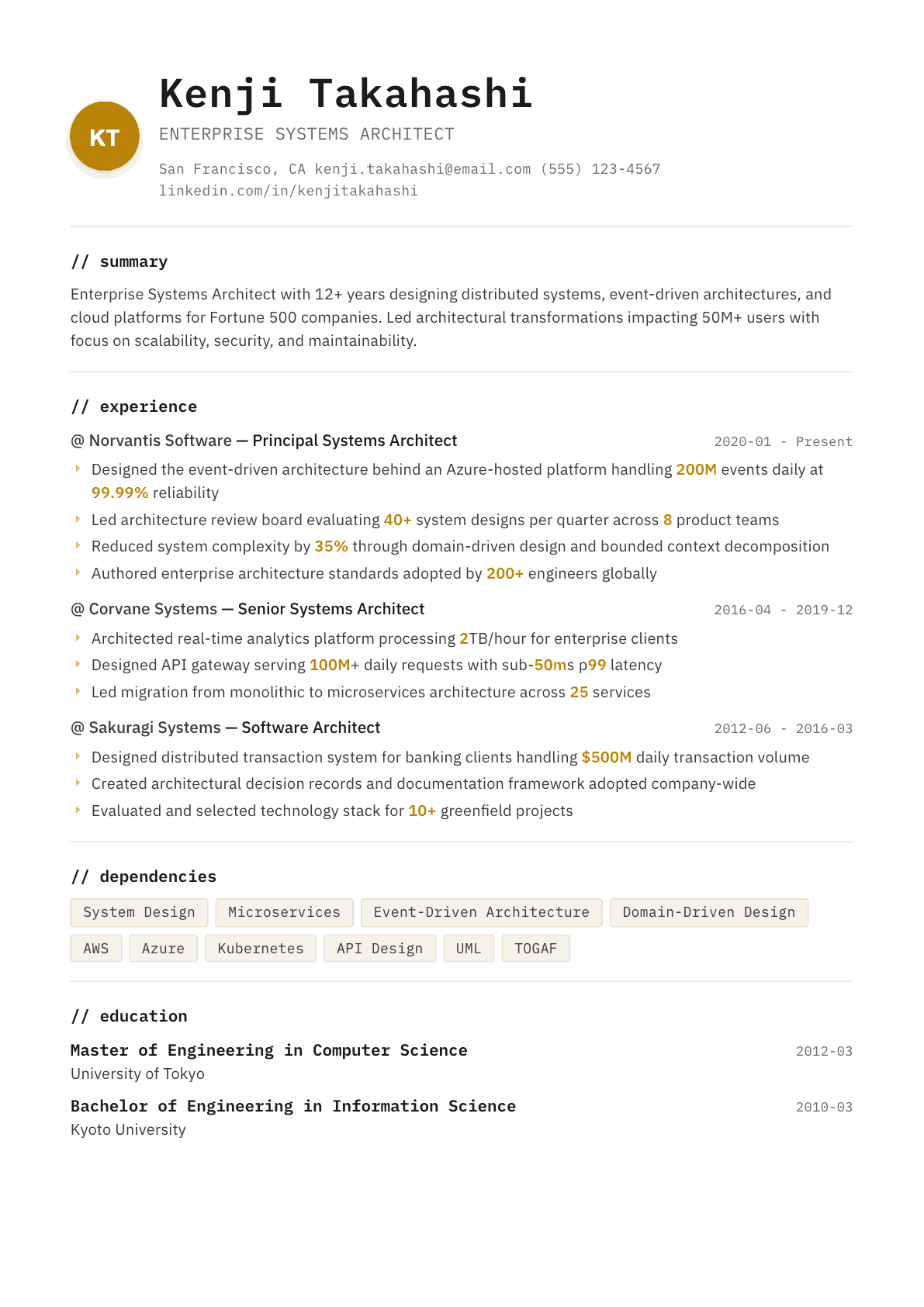
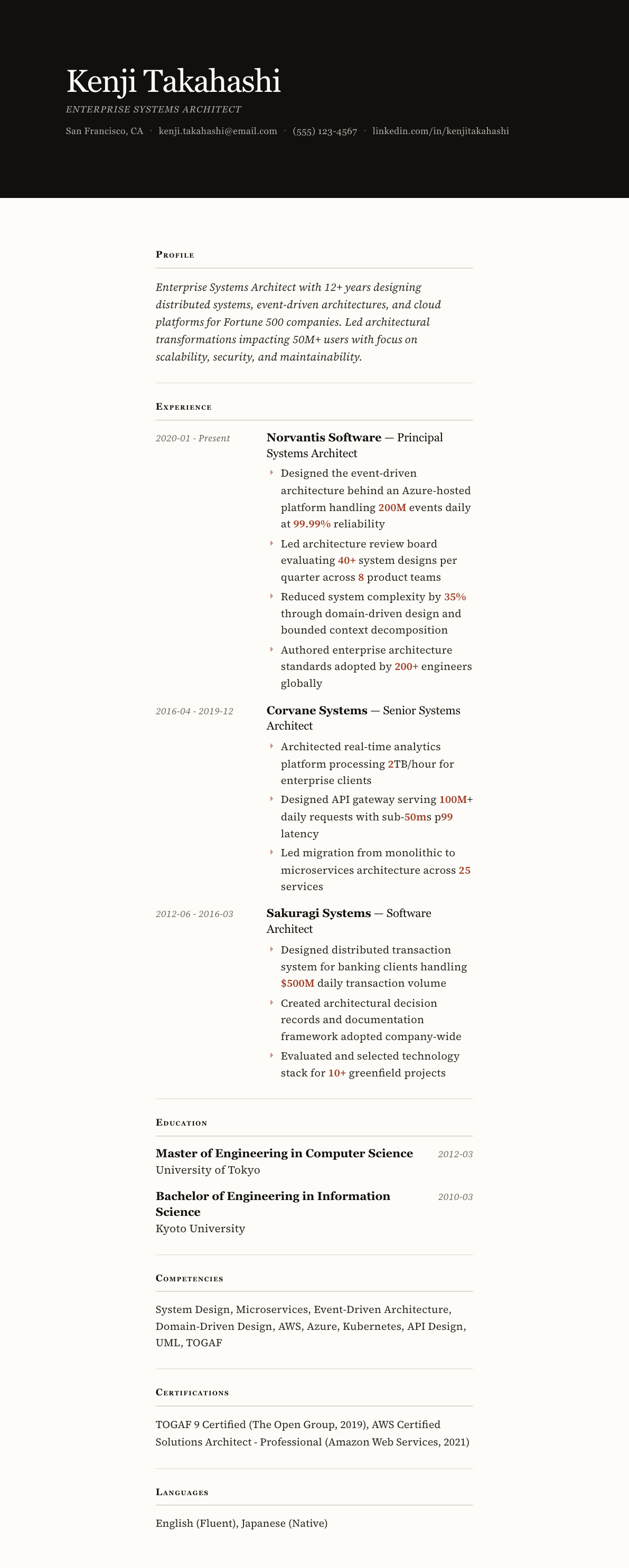
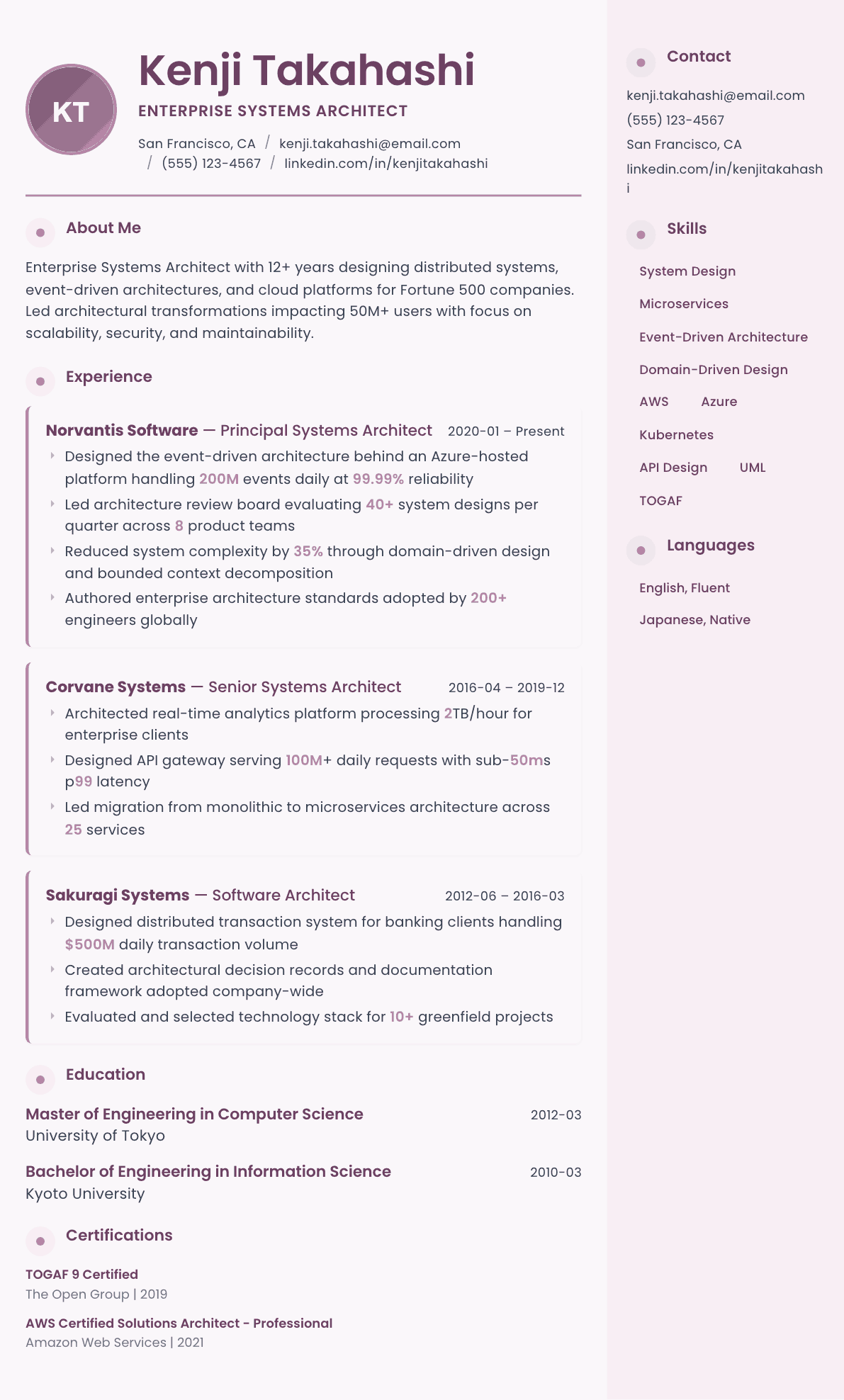
Example Systems Architect summary
Enterprise Systems Architect with 12 years designing scalable distributed systems for Fortune 500 companies. TOGAF certified with expertise in microservices, event-driven architectures, and cloud platforms serving 50M+ users.
Skills to list on a Systems Architect resume
- System Design
- Microservices
- Event-Driven Architecture
- Domain-Driven Design
- AWS
- Azure
- Kubernetes
- API Design
- TOGAF
- UML
- Cloud Architecture
- Distributed Systems
- Performance Engineering
- Security Architecture
What actually gets this resume read
- Emphasize large-scale system design experience with concrete metrics.
- Show breadth across cloud platforms, databases, and messaging systems.
- Include architecture framework knowledge (TOGAF, Zachman).
- Highlight cross-team leadership and standards creation.
- Demonstrate both technical depth and strategic thinking.
How to write a systems architect resume
A systems architect is hired to make the expensive decisions correctly: how a platform is decomposed, where state lives, what talks to what, and which trade-offs the organization will be living with for the next five years. The resume is read by people who have inherited someone else's bad decisions, so they are unusually skeptical readers.
What convinces them is evidence of durable design. Not the diagram, but the reasoning: what you optimized for, what you deliberately gave up, and how the system behaved once it carried real load. A systems architect resume that lists technologies and team sizes without a single trade-off named reads as a senior engineer who has been given a bigger title.
This guide covers the structure that works for architecture hiring, how to write about system decomposition and migrations, three summaries from first architecture role to chief architect, before-and-after bullets, and the questions engineers ask when they move into the architecture track.
Format: two pages, with system scale visible immediately
Two pages is standard and expected, because this role is not junior and the design history is the value. Under the summary, put a compact block covering architecture domains, platforms, data technologies and messaging systems. Keep the layout single column: architecture resumes are frequently forwarded around a panel and printed, and columns break both.
Scale belongs on the first page. Number of services, users or transactions, data volume, number of engineering teams building on your design, and the number of environments or regions. Without those numbers, an interviewer cannot tell whether your architecture served one product team or an entire company.
- Order: summary, architecture and technology block, experience, education, certifications, publications.
- Give every role a scale line before its bullets: services, teams, traffic, regions, data volume.
- Mention any architecture framework you actually practice, and skip the ones you only read about.
Experience: decomposition, state and the trade-off you made
The strongest architecture bullets describe a boundary decision. Where you drew a service boundary and why, how you separated read and write paths, what you chose to keep synchronous, which consistency model you accepted, where you put a cache and what you did about invalidation. These are the questions the interview will circle back to anyway, so put the answers on the page.
Every serious design has a cost you accepted. Say it. Choosing eventual consistency to survive a regional outage, accepting duplicate storage to keep a domain independent, keeping a legacy database as the source of truth for another year because the migration risk was worse. Naming the cost is the single fastest way to read as an architect rather than a technology enthusiast.
Migrations deserve their own bullets because they are where architecture meets reality. Describe the sequencing: the strangler pattern around the legacy system, the dual-write window, the shadow traffic, the rollback plan, and how long the two systems ran in parallel. Architects are hired far more often to move a system than to draw a new one.
Influence: standards, reviews and the teams that build from your design
A systems architect who cannot get a design adopted is not doing the job. Show the mechanisms you used: a design review forum you chaired, architecture decision records you introduced, a golden path or paved road that made the right choice the easy one, a reference implementation you wrote so teams had something to copy.
Quantify adoption where you can. The number of teams building on a pattern, the number of services migrated onto a shared platform, the reduction in bespoke integrations, the proportion of new services following the standard. Adoption numbers prove influence in a way that job titles never do.
- Name the forum: design authority, architecture review board, technical steering group.
- Name the artifact: decision records, reference implementation, blueprint, platform library.
- Name the adoption: how many teams, how many services, over how long.
Non-functional requirements are the architect's section
Availability targets, recovery point and recovery time objectives, latency budgets, throughput ceilings, data retention rules, tenancy isolation and the security model belong on a systems architect resume in a way they do not belong on a developer's. These are the requirements that shape structure, and showing you designed against explicit numbers signals discipline.
Cost is now a first-class non-functional requirement in most organizations. If you changed a storage tiering strategy, moved a workload to a different compute model, or redesigned a chatty integration that was burning egress, that is architecture work and it belongs alongside the availability figures.
Keywords systems architecture postings reuse
The recurring vocabulary includes distributed systems, system design, microservices, event-driven architecture, domain-driven design, API design, scalability, high availability, disaster recovery, security architecture, and named cloud and messaging platforms. Use the posting phrasing once in your technology block and once inside a bullet where you show the practice.
Frameworks are worth a careful word. Mentioning TOGAF, the C4 model or architecture decision records is credible only if your bullets show the artifacts. A framework name with no artifact behind it invites a question you will not enjoy answering.
Systems Architect resume summary examples
First architecture role
Senior backend engineer moving into a systems architect seat, with four years designing service boundaries for an order management platform of 20 services. Introduced architecture decision records to the team and led the split of a shared database into per-domain stores. Strong in Java, Kafka and Kubernetes.
Seven years in
Systems architect with seven years designing distributed platforms in insurance and travel. Owns the target architecture for a booking system serving 40 million requests a day across two regions, decomposed a decade-old monolith into 30 services, and chairs a design review attended by five engineering teams.
Chief architect
Chief architect with fifteen years across payments and logistics platforms. Sets the technical direction for 200 engineers, owns the reference architecture that 90% of new services now follow, and led a multi-year mainframe decommissioning program that retired 14 legacy interfaces without a customer-facing outage.
Work experience bullets: before and after
Before: Designed a microservices architecture for the platform.
After: Decomposed a monolithic policy system into 18 services along domain boundaries, keeping underwriting synchronous and moving document generation onto an event queue.
Naming the boundaries and what stayed synchronous shows a real decomposition rather than a fashionable label.
Before: Improved system scalability and reliability.
After: Redesigned the read path with a materialized view and regional replicas, holding p95 read latency under 90ms while daily traffic tripled over 18 months.
A stated latency budget held through a known traffic increase is architecture evidence; scalable is an adjective.
Before: Led the migration off the legacy system.
After: Sequenced a strangler migration off a mainframe billing system, running shadow traffic for nine weeks and dual writes for four before cutover, with a tested rollback at every stage.
The sequencing and the rollback plan are what an interviewer will probe, so answering in advance builds trust.
Before: Created architecture standards for engineering teams.
After: Published a paved-road service template with logging, tracing and deployment built in, adopted by 22 of 25 new services in its first year.
Adoption counts turn a standards claim into demonstrated influence across the organization.
Before: Worked on reducing infrastructure costs.
After: Retiered cold event data to object storage and consolidated three overlapping message brokers into one, lowering platform infrastructure cost by 27% with no change to retention guarantees.
It names the architectural change and confirms the guarantee that was preserved, which is the part a reviewer worries about.
Hard skills
- Distributed systems design
- Domain-driven design
- Event-driven architecture
- Microservices decomposition
- API and contract design
- Kafka and message brokers
- Kubernetes
- AWS
- Azure
- Data modeling and storage strategy
- High availability and disaster recovery
- Security architecture
- Performance engineering
- Architecture decision records
Soft skills
- Trade-off reasoning
- Design review facilitation
- Persuading teams without authority
- Written architecture communication
- Mentoring senior engineers
- Stakeholder alignment
Certifications worth listing
- TOGAF Enterprise Architecture Practitioner (The Open Group)
- AWS Certified Solutions Architect, Professional (Amazon Web Services)
- Microsoft Certified: Azure Solutions Architect Expert (Microsoft)
- Google Cloud Professional Cloud Architect (Google Cloud)
- Certified Kubernetes Administrator (CKA) (Cloud Native Computing Foundation)
- ISTQB Certified Tester, Foundation Level (International Software Testing Qualifications Board)
Mistakes that cost systems architect candidates the interview
- Presenting designs with no trade-off named, which reads as diagram production rather than architecture.
- Omitting scale entirely, leaving the reader unable to tell a departmental tool from a platform under real load.
- Listing an architecture framework with no artifact anywhere in the experience section to back it up.
- Describing a migration only by its end state, with nothing about sequencing, parallel running or rollback.
- Claiming standards work without adoption numbers, so influence stays an assertion.
- Filling the page with implementation detail from six years ago instead of recent design ownership.
- Ignoring non-functional requirements such as recovery objectives, tenancy isolation and cost.
Systems Architect resume questions
How is a systems architect resume different from a senior engineer resume?
A senior engineer resume proves you build well. A systems architect resume proves you decide well: boundaries, state, consistency, sequencing, and the costs you accepted. If yours reads as a list of things built, it will be screened as an engineering application.
Should I include architecture diagrams in my resume?
No. Diagrams break parsing and compress badly into a page, and a reviewer cannot interrogate a picture. Describe the decision in prose, then bring sanitized diagrams to the interview where the reasoning can be discussed properly.
How much hands-on coding should a systems architect show?
Enough that nobody suspects you have drifted away from implementation. One or two bullets about a reference implementation, a platform library or a prototype you wrote yourself is usually sufficient, and most panels include a design exercise rather than a coding round.
Do I need TOGAF for a systems architect role?
It matters in large enterprises and in consultancies that sell to them, and much less in product companies. List it if you hold it, and make sure your experience section shows the artifacts it implies. Never list a framework you have only studied.
How do I show architecture influence when I had no formal authority?
Point at the mechanisms and their reach: the review forum you started, the decision records that ended a recurring argument, the template other teams copied, the migration you convinced three teams to sequence your way. Adoption counts are the proof.
Related resume examples
- Solutions Architect Resume example
- Cloud Architect Resume example
- Software Engineer Resume example
- Software Architect Resume example
- Integration Architect Resume example
- Backend Developer Resume example