Backend Developer Resume Examples: the lines they read
Architect a Backend Developer Resume That Scales
By Mustafa Tarabya, founder of CVBooster · Published · Updated
Build a powerful backend developer resume highlighting API design, database optimization, and distributed systems expertise with ATS-optimized templates.
Sample resumes for a backend developer
The same backend developer content laid out in three CVBooster templates, so you can see what the finished document looks like before you write a word.
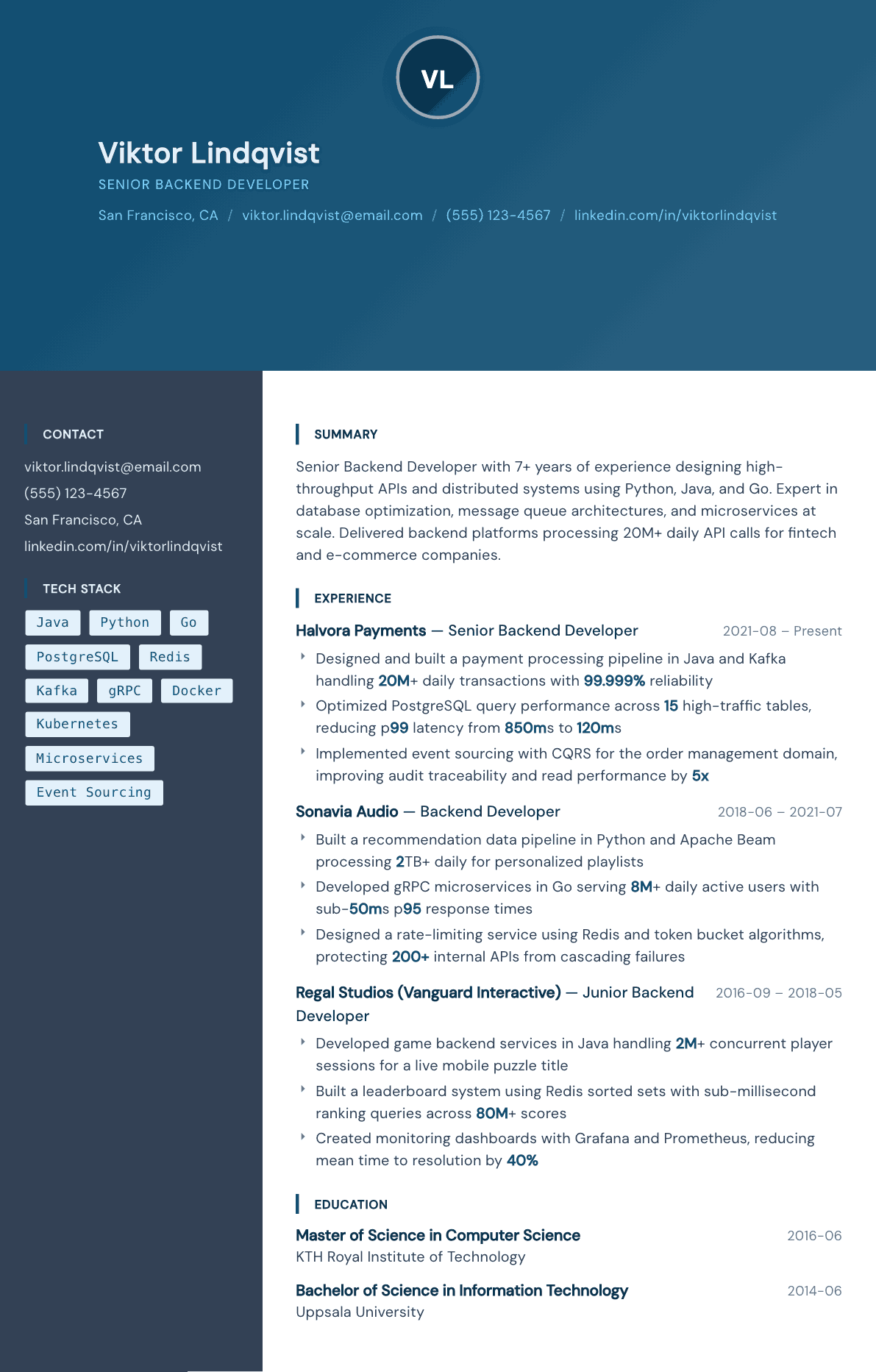
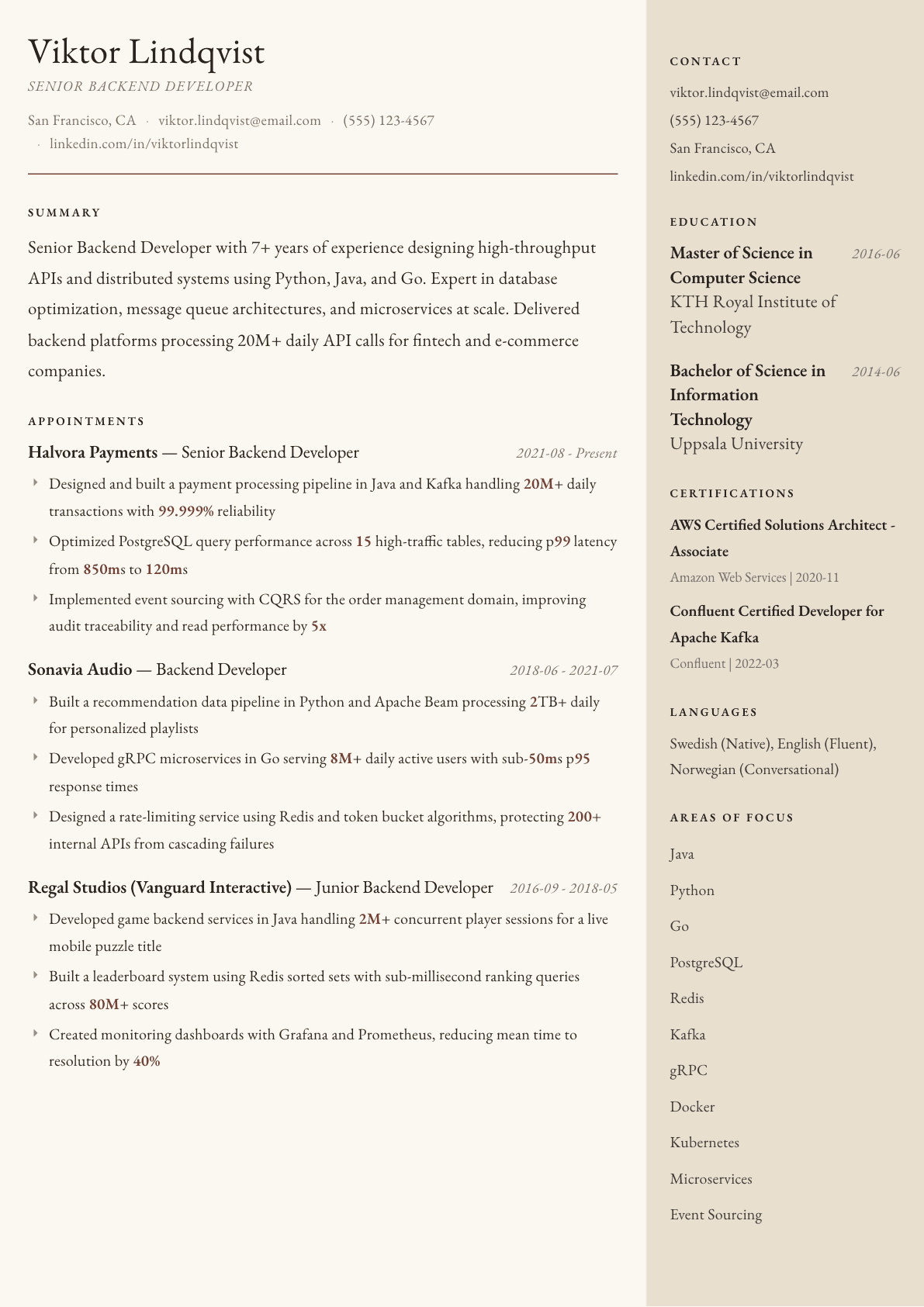
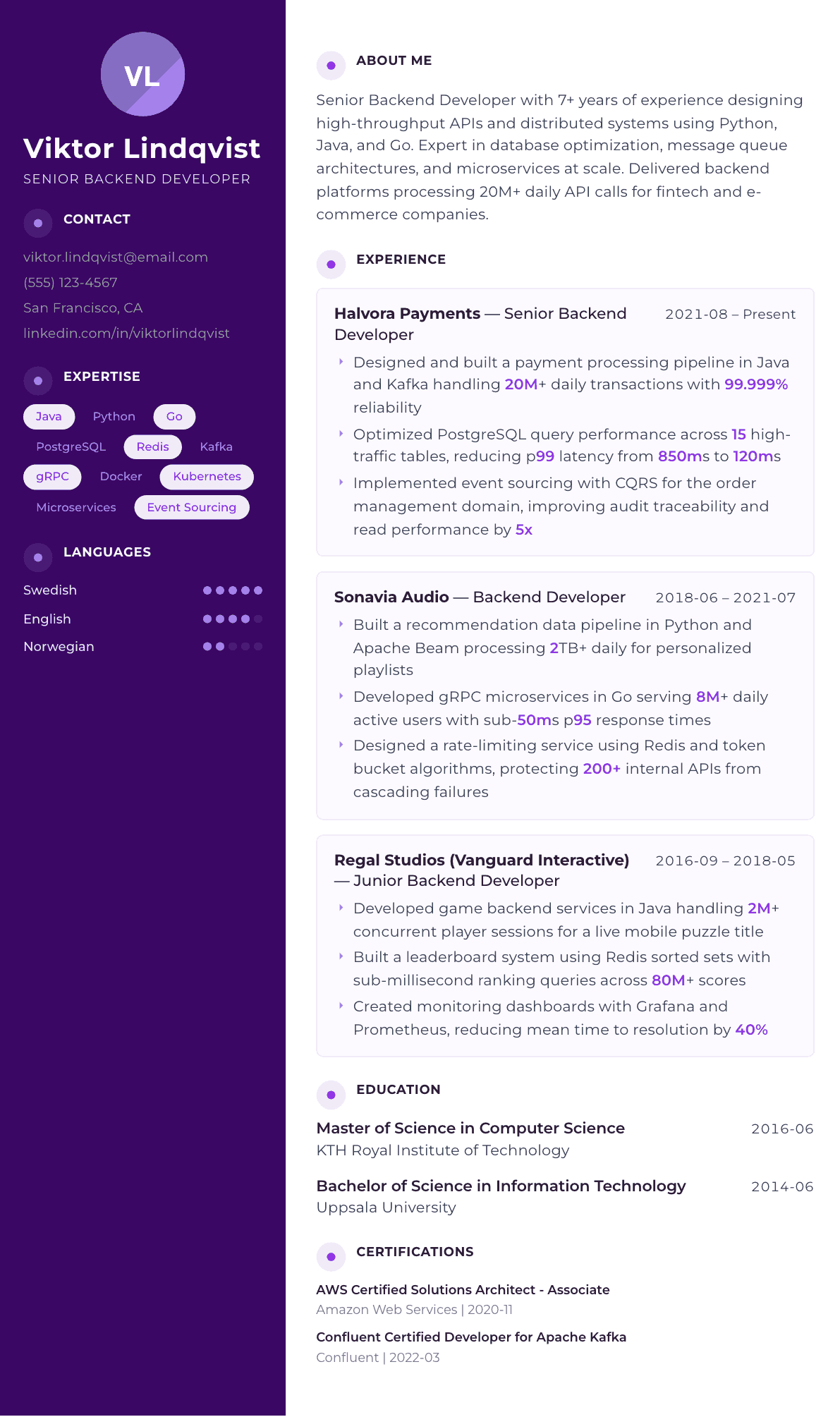
Example Backend Developer summary
Backend Developer with 7 years of experience building high-throughput APIs and distributed systems for fintech and media companies. Expert in Java, Python, and Go with a track record of delivering platforms processing 20M+ daily transactions with 99.999% reliability. Skilled in PostgreSQL optimization, Kafka streaming, and microservices architecture.
Skills to list on a Backend Developer resume
- Java
- Python
- Go
- PostgreSQL
- Redis
- Kafka
- gRPC
- REST APIs
- Docker
- Kubernetes
- Microservices
- Event Sourcing
What actually gets this resume read
- Focus on system design and architecture decisions: why you chose specific patterns and their measurable outcomes.
- Quantify API performance: throughput (requests/sec), latency (p50/p95/p99), and reliability (uptime percentage).
- Highlight database expertise with specific optimization techniques: indexing, query planning, sharding, or replication.
- Include message queue and streaming experience: Kafka, RabbitMQ, SQS, or Redis Pub/Sub.
- Show distributed systems knowledge: consensus, eventual consistency, circuit breakers, and saga patterns.
How to write a backend developer resume
A backend developer resume is evaluated on the questions the system design interview will ask anyway. How much traffic did your service take, what did it store, what happened when a dependency was down, and how did you know it was down. A file that lists languages and frameworks answers none of those, which is why so many technically strong backend engineers get filtered before anyone reads their code.
The strongest backend resumes are written in the vocabulary of load and failure. Requests per second, latency at the ninety-fifth and ninety-ninth percentiles, error budget, queue depth, replication lag, retry and timeout policy, idempotency. These are not buzzwords; they are the terms an engineer who has been on call uses, and an interviewer can tell within two bullets whether you speak them naturally.
This guide covers the layout that gets a backend file past both the automated screen and the engineering read, three summaries from junior to staff level, five rewritten bullets, and the questions backend developers ask when they need to demonstrate system design judgment on paper.
Format: stack grouped by layer, systems described by traffic
One page under about four years, two pages after. Reverse chronological, single column, plain text stack lines. Group the technical block by layer rather than dumping a single list: languages, data stores, messaging and streaming, infrastructure and orchestration, and observability. Grouping makes the screen faster and it signals that you think in layers.
For each role, open with a one-line system description before the bullets: what the service did, roughly what traffic it carried, what it stored and who depended on it. Without that line every backend bullet is unscaled, and a reader cannot tell a batch job from a payment path.
- Languages: Java, Python, Go, and the runtime versions where they matter.
- Data: PostgreSQL, Redis, and any wide-column or document store, with your role in schema design.
- Messaging: Kafka, RabbitMQ, or a managed queue, with delivery semantics you handled.
- Platform: Docker, Kubernetes, the cloud provider, and the deployment pipeline.
Summary: domain, traffic scale, and the reliability bar you held
Name the domain first because backend problems are domain shaped. Payments, media delivery, marketplace inventory and internal platform tooling all impose different constraints, and a hiring manager wants to know whether you have carried the constraint they are hiring against.
Then the scale and the reliability bar. Daily transactions or requests, the availability target you operated to, and one system you designed rather than maintained. A backend engineer who has designed a service from a blank page and then run it in production is a different hire from one who has only extended existing services, and the summary is where you make that clear.
Experience: API design, data modeling, and what happens under failure
Write API work as contract decisions. Whether you designed a resource-oriented interface or a remote procedure call service, how you versioned it, how you handled pagination and partial failure, what your idempotency strategy was for writes, and how you kept backward compatibility for existing clients. Those decisions are the everyday substance of backend work and almost nobody writes about them.
Data modeling and query performance deserve their own bullets. Index design, query plan analysis, denormalization tradeoffs, partitioning or sharding, connection pooling and migration strategy on a live table. A bullet reporting a latency reduction from a specific indexing or query change is more persuasive than any framework list, because it shows you can find the cost inside a running system.
Then failure. Timeouts and retry budgets, circuit breakers, backpressure, dead letter queues, at-least-once processing with deduplication, and how you handled a partial outage in a dependency. Any bullet that describes what your service does when something else breaks marks you as someone who has been paged.
Distributed systems and asynchronous work: name the tradeoff
Distributed systems terms are easy to sprinkle and hard to defend, so attach each one to a decision. If you used event sourcing, say what it bought you and what it cost in read complexity. If you moved a synchronous call to a queue, say what you gave up in consistency and how the client experienced it. If you introduced a saga, say what compensating actions you had to write.
Include the operational reality of streaming systems: partition strategy, consumer lag, rebalancing behavior, ordering guarantees within a key, and schema evolution for message payloads. These details separate an engineer who has run Kafka in production from one who has read about it.
- Consistency: what you chose, and how the product tolerated it.
- Ordering and deduplication: the key you partitioned on and how duplicates were handled.
- Migration: how you moved traffic to a new service without downtime.
- Cost: infrastructure spend reduced through right-sizing, caching or query work.
Observability, testing and the terms a screener searches
Say how you know your service is healthy. Metrics you defined, dashboards you built, distributed tracing you instrumented, structured logging, alert thresholds tied to user impact rather than machine state, and on-call rotation participation. Engineers who write meaningful alerts are rarer than engineers who write features, and hiring managers know it.
Testing belongs beside it: unit coverage on the domain layer, contract tests between services, integration tests against containerized dependencies, and load testing with the tool and the target you ran against. For keywords, keep the ones the postings use accurate and adjacent to your work: microservices, REST APIs, gRPC, event sourcing, distributed systems, Docker and Kubernetes.
Backend Developer resume summary examples
Junior backend developer
Backend developer with 2 years building services in Python and Go for an internal logistics platform. Owns three REST services backed by PostgreSQL, wrote the integration test suite against containerized dependencies, and cut a nightly batch job from four hours to under one.
Seven years in
Backend Developer with 7 years building high-throughput APIs and distributed systems in fintech and media. Designed a payment pipeline in Java and Kafka handling over 100 million daily transactions, cut a critical query from 850 to 120 milliseconds at the ninety-ninth percentile, and runs on-call for six services.
Staff backend engineer
Staff backend engineer with 12 years, currently owning the transaction platform for a marketplace serving millions of daily orders. Led the decomposition of a monolith into eight services with no customer-visible downtime, set the reliability and on-call standards, and mentors five engineers.
Work experience bullets: before and after
Before: Built REST APIs using Java and Spring Boot.
After: Designed and built a payment processing API in Java handling over 100 million daily transactions, with idempotency keys on every write, versioned contracts for four client teams, and a documented deprecation path for the previous interface.
Traffic scale plus contract decisions show API ownership rather than endpoint implementation.
Before: Optimized database queries for better performance.
After: Cut ninety-ninth percentile latency on the order lookup path from 850 to 120 milliseconds by adding two composite indexes, rewriting a correlated subquery, and moving a hot read to a Redis cache with a short expiry.
Naming the percentile, the baseline and the three specific changes makes the improvement verifiable.
Before: Worked with Kafka for messaging.
After: Rebuilt order event processing on Kafka with partitioning by customer key to preserve ordering, consumer lag alerting, a dead letter queue for poison messages, and deduplication so at-least-once delivery stayed safe for downstream writes.
Partitioning, lag monitoring and duplicate handling are the parts of streaming work that prove production experience.
Before: Migrated services to Kubernetes.
After: Migrated eleven services to Kubernetes with resource requests tuned from real usage, readiness and liveness probes tied to dependency health, and a gradual traffic shift that kept error rates flat throughout the cutover.
Probe design and a controlled traffic shift show operational judgment beyond running a deployment command.
Before: Improved system reliability.
After: Raised availability of the checkout service by adding timeouts and a circuit breaker around a slow third-party dependency, degrading to a cached response path so a partner outage stopped taking the checkout flow down with it.
Describing the degradation behavior shows you design for failure rather than assuming dependencies stay up.
Hard skills
- Java
- Python
- Go
- REST API design and versioning
- gRPC and protocol buffers
- PostgreSQL schema and index design
- Redis caching strategies
- Kafka and event-driven architecture
- Microservices and service decomposition
- Docker and Kubernetes
- Distributed tracing and metrics
- Load testing and capacity planning
- CI and CD pipelines
- Event sourcing and CQRS
Soft skills
- Design documents
- Code review
- On-call ownership
- Incident communication
- Tradeoff reasoning
- Mentoring
Certifications worth listing
- Certified Kubernetes Application Developer (CKAD) (Cloud Native Computing Foundation)
- AWS Certified Developer, Associate (Amazon Web Services)
- AWS Certified Solutions Architect, Associate (Amazon Web Services)
- Google Cloud Professional Cloud Developer (Google Cloud)
Mistakes that cost backend developer candidates the interview
- Listing frameworks without a single number describing traffic, data volume or latency.
- Describing services with no indication of what they did or who depended on them.
- Claiming microservices experience without naming a boundary decision or a migration you ran.
- Writing about performance improvements with no percentile and no baseline measurement.
- Leaving out failure handling, which is the fastest way to look like someone who has never been on call.
- Ignoring observability, so the reader cannot tell whether you would notice your own outage.
- Padding the skills list with every technology touched once, which dilutes the ones you are genuinely strong in.
Backend Developer resume questions
Which backend metrics should I put on a resume?
Throughput in requests or transactions per period, latency at a stated percentile, availability against the target you operated to, and cost where you changed it. Always include the baseline and the timeframe, because a bare number gives an interviewer nothing to probe.
How do I show system design ability without a design title?
Describe one system per role at the decision level: what you chose for storage, consistency and messaging, and what you gave up. A well-argued tradeoff in two lines demonstrates more design capability than a job title claiming architecture ownership.
Should I list every language I have used?
No. List the two or three you would accept a technical interview in today, and mention others only where you did real work in them. A long language list reads as shallow exposure and invites a screen in the one you are weakest in.
How do I write about on-call and incident work?
Give the rotation, the services you carried, and one incident described by cause, mitigation and the follow-up change you made. Incident writing shows composure and ownership, and it is one of the strongest differentiators between similar backend candidates.
Does cloud certification help a backend developer?
It helps most when you are moving into a team whose platform you have not used, or early in a career where production evidence is thin. It rarely outweighs demonstrated production work, so keep certifications in a short section near the end.
Related resume examples
- Full-Stack Developer Resume example
- Software Engineer Resume example
- Data Engineer Resume example
- Golang Developer Resume example
- Python Developer Resume example
- API Developer Resume example