Test Automation Engineer Resume Examples: free ATS score
Build a Test Automation Engineer Resume That Shows Suite Health
By Mustafa Tarabya, founder of CVBooster · Published · Updated
Test automation engineer resume examples, framework keywords and a writing guide covering suite design, flaky test triage, CI integration and coverage.
Sample resumes for a test automation engineer
The same test automation engineer content laid out in three CVBooster templates, so you can see what the finished document looks like before you write a word.
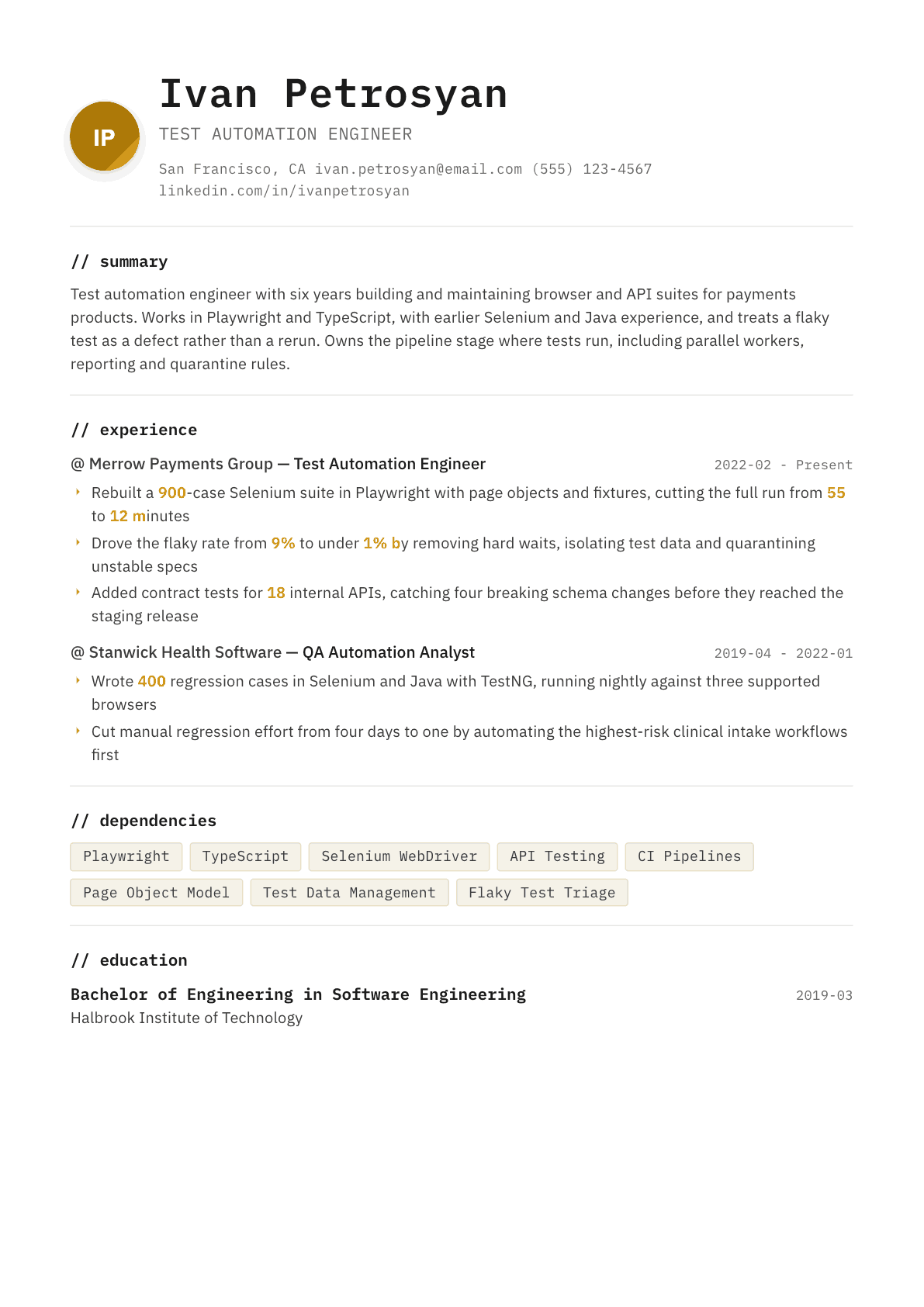
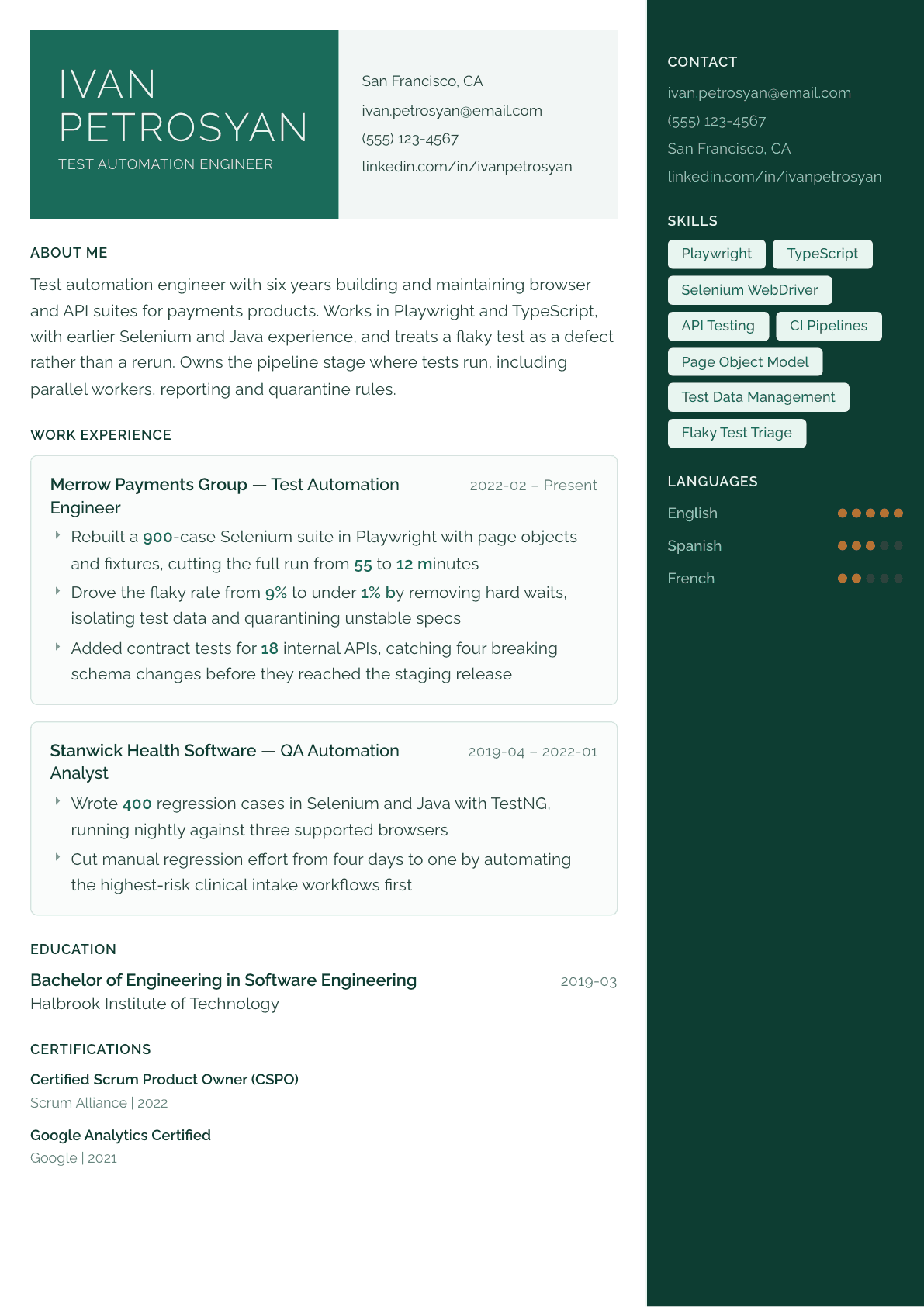
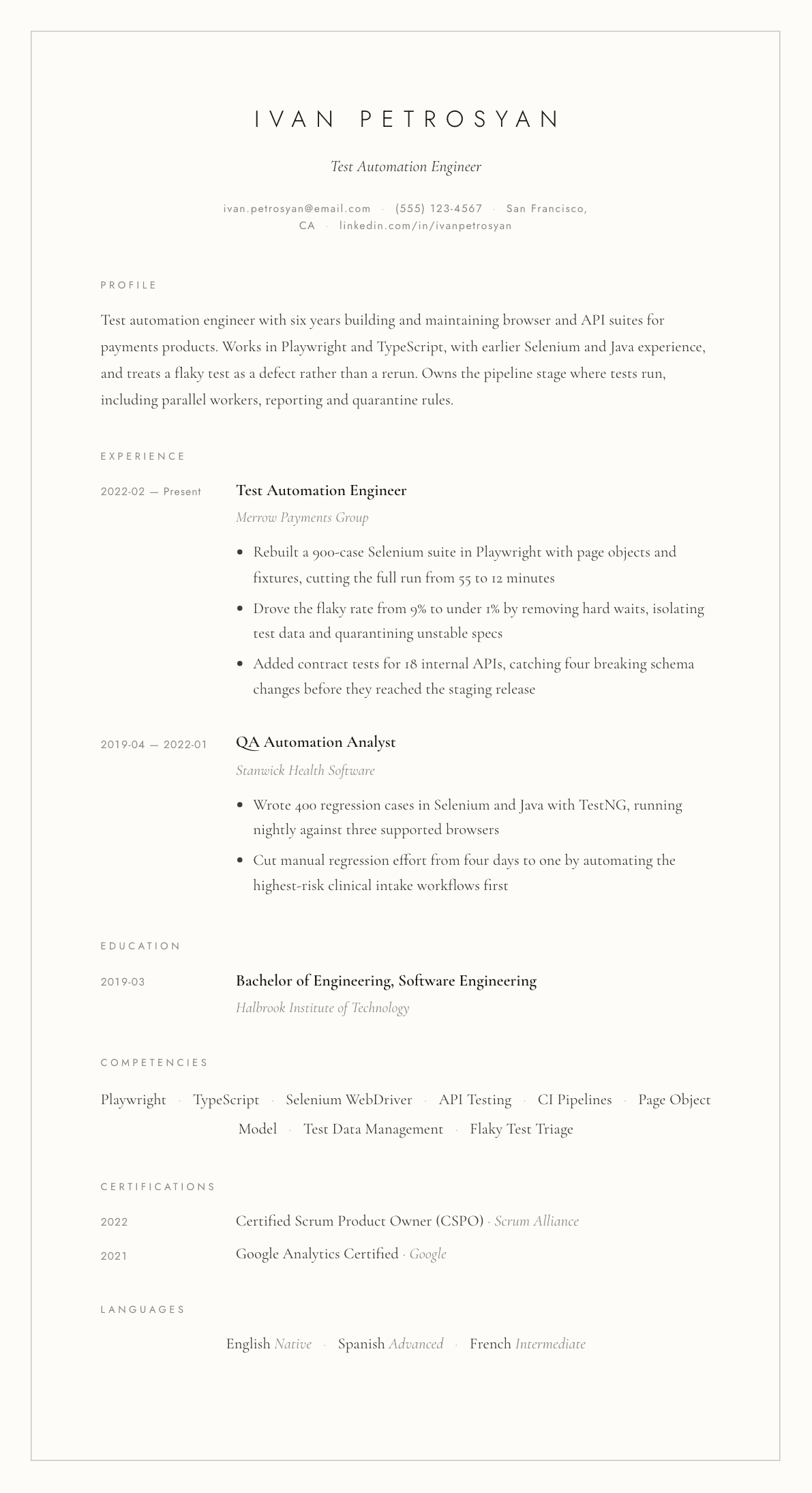
Example Test Automation Engineer summary
Test automation engineer with six years owning browser and API suites for payments and health software. Migrated a large Selenium suite to Playwright, brought the flaky rate under control through test data isolation and quarantine rules, and added contract tests that catch schema breaks before staging. Comfortable owning the pipeline stage, the reporting and the triage rota that keep a suite trusted.
Skills to list on a Test Automation Engineer resume
- Playwright
- Selenium WebDriver
- Cypress
- TypeScript
- Java
- Python
- REST API Testing
- Contract Testing
- Page Object Model
- CI/CD Pipelines
- GitHub Actions
- Test Data Management
- Performance Testing
- Appium
- Test Reporting
- Defect Triage
What actually gets this resume read
- Name the framework, the language and the runner together, because Playwright with TypeScript reads differently from Selenium with Java.
- Give suite size in test cases and the full run time, since both tell a lead what you have maintained.
- Report your flaky rate and what you did about it, as this is the question every automation interview reaches.
- Show where the suite runs in the pipeline and who reacts when it goes red, not just that it exists in CI.
- Include API and contract testing separately from browser testing, because many teams need the API layer more.
- Explain your test data strategy: fixtures, seeded accounts or an environment reset, since it drives suite stability.
How to write a test automation engineer resume
Every engineering manager hiring a test automation engineer has lived through a suite nobody trusts. It goes red on a Tuesday for reasons unrelated to the change, someone reruns it, and within a quarter the team ignores the result entirely. So the screening question behind the whole resume is simple: has this candidate ever made a suite trustworthy and kept it that way?
That is why suite size, run time and flaky rate belong on the page. They are the three numbers a lead can interrogate in an interview, and almost no applicant includes them. Framework names alone do not answer the question, because anyone can write a passing test on a clean page.
This guide covers how to lay out a test automation resume, how to describe framework work without listing every library, three summaries by experience level, before and after bullets, the questions that come up when a manual tester moves into automation or an automation engineer moves toward a platform role, and how resumes for testing jobs change between manual, automation and SDET roles.
Format: framework, language and pipeline visible immediately
Reverse chronological, one page under six years. Right under the summary put a technical block that pairs each framework with its language and runner, because Playwright with TypeScript and Selenium with Java are different hiring pools even though both say automation.
Add an environment line per role: the product under test, the suite size, where the suite runs, and how many engineers depend on it. That line frames every bullet underneath it.
- Header: name, title, city, phone, email, and a repository link if the framework code is yours to share.
- Order: summary, technical skills, experience, certifications, education, open source or side projects.
- Environment line per role: application type, suite size, run time, pipeline position, team size.
Summary: what you automate and how stable it stays
Name the layer you work at first: browser, API, mobile, or a mix. Then the stack and the stability record. A candidate who says she took a nine hundred case suite from a fifty five minute run to twelve minutes and held the flaky rate under one in a hundred is describing exactly the work the role exists for.
If your background is manual testing, say so plainly and show the transition. Testers who moved into automation often write better tests, because they know which paths actually break.
Experience: framework design, stability, coverage, pipeline
Framework bullets should describe the design decisions: page objects or component wrappers, fixtures, how test data is created and torn down, how you isolate parallel workers, and where assertions live. A reader can tell within one line whether you built a framework or inherited scripts.
Stability bullets are the strongest currency in this field. Give the flaky rate before and after, and name the causes you removed: hard waits replaced by state based conditions, shared accounts replaced by per test data, order dependencies broken, third party calls stubbed. Add your quarantine policy, because a team needs to know what happens to a flaky spec while it is being fixed.
Coverage bullets should be risk based rather than percentage based. Say which flows are automated and why those first: checkout, authentication, payment capture, refunds. Coverage figures without a risk argument tell a lead nothing about your judgment.
Pipeline bullets close the loop. Where the suite runs, on what trigger, how long the feedback takes, who is paged when it fails, and whether a red suite blocks a release. Automation that nobody acts on is a hobby, and interviewers probe this hard.
Skills: separate the layers, name the runner
Group by layer: browser automation, API and contract testing, mobile, performance, and the supporting tooling for reporting and continuous integration. Within each, name the framework and the language together. Add the assertion and reporting libraries only if a team would recognize them.
Include the engineering skills that make automation maintainable: version control workflow, code review, containerized test environments, and the ability to read the application code you are testing. Those are what make an automation engineer part of the engineering team rather than a service alongside it.
Keywords screeners search for in this role
Recurring terms include regression suite, page object model, fixtures, parallel execution, continuous integration, contract testing, mocking, test data management, defect triage and cross-browser coverage. Attach each to a real example rather than listing them.
Do not claim performance or security testing from a single exploratory afternoon. Both fields have specialists, and a thin claim collapses fast when the interviewer works in one of them.
Resumes for testing jobs: manual, automation and SDET versions
Resumes for testing jobs are read against three different hiring bars, and the posting tells you which one. A manual or QA tester role is hired on test design, defect reports and product knowledge. A test automation role is hired on framework work and suite stability. An SDET role is hired as a software engineer who specializes in testing, so code quality and design come first.
Keep one master resume and change the summary, the order of experience bullets and the skills layer for each. The lines below show the same tester written three ways.
- Manual or QA tester: designed test cases from user stories for a mobile banking app, ran regression before each release, and wrote defect reports with steps, logs and screenshots that developers could reproduce on the first try.
- Test automation engineer: built a Playwright suite in TypeScript covering the checkout and login flows, cut suite run time by running tests in parallel in CI, and removed flaky waits so the team trusted a red build.
- SDET: designed an API test framework in Java with reusable clients and test data builders, reviewed pull requests from product engineers for testability, and added contract tests between two services.
- Skills block for all three: name the test types (functional, regression, API, performance), the tools (Jira, TestRail, Postman, Playwright or Selenium), the language, and the CI system.
Test Automation Engineer resume summary examples
Manual tester moving to automation
QA tester with three years of manual coverage on a clinical intake product, now writing automated regression in Playwright and TypeScript. Automated the 40 highest-risk cases and cut manual regression from four days to one. ISTQB foundation certified and comfortable reading application code to debug a failure.
Six years, suite owner
Test automation engineer with six years owning browser and API suites for payments products. Migrated a 900-case Selenium suite to Playwright, taking the full run from 55 minutes to 12 and the flaky rate from 9% to under 1% through test data isolation and quarantine rules.
Quality engineering lead
Quality engineering lead with ten years building test platforms rather than test scripts. Sets framework standards across four product teams, runs the triage rota that keeps the pipeline trusted, and introduced contract testing that catches schema breaks before any service reaches the staging environment.
Work experience bullets: before and after
Before: Wrote automated tests using Selenium.
After: Wrote 400 regression cases in Selenium and Java with TestNG, running nightly across three supported browsers with per test account seeding.
Case count, runner, browser coverage and data seeding turn a tool mention into a description of a maintained suite.
Before: Reduced flaky tests in the suite.
After: Drove the flaky rate from 9% to under 1% by removing hard waits, isolating test data per worker and quarantining unstable specs with an owner and a due date.
The before and after rate plus the named causes shows a method, and the quarantine policy shows it holds over time.
Before: Migrated the test framework.
After: Rebuilt a 900-case Selenium suite in Playwright with page objects and fixtures, cutting the full run from 55 minutes to 12 while keeping the same coverage set.
Stating that coverage stayed constant is what makes the speed improvement believable rather than a quiet reduction in scope.
Before: Tested APIs as well as the user interface.
After: Added contract tests for 18 internal APIs, catching four breaking schema changes before they reached the staging release.
The defect count caught upstream proves the API layer earned its place instead of duplicating browser coverage.
Before: Integrated tests into the CI pipeline.
After: Ran the smoke set on every pull request in under four minutes and the full suite nightly, with failures routed to the owning team through the on-call channel.
Timing plus routing shows the pipeline produces action, which is the only reason to automate in the first place.
Hard skills
- Playwright with TypeScript
- Selenium WebDriver with Java
- Cypress
- REST API test automation
- Contract testing
- Page object and fixture design
- Parallel test execution
- Test data management
- Continuous integration pipelines
- Mobile automation with Appium
- Mocking and service virtualization
- Test reporting and dashboards
Soft skills
- Risk based prioritization
- Defect triage under release pressure
- Code review of test code
- Pairing with developers on failures
- Communicating quality risk to product
- Documentation of suite ownership
Certifications worth listing
- ISTQB Certified Tester Foundation Level (International Software Testing Qualifications Board)
- ISTQB Certified Tester Advanced Level Test Automation Engineer (International Software Testing Qualifications Board)
- ISTQB Certified Tester Foundation Level Agile Tester (International Software Testing Qualifications Board)
Mistakes that cost test automation engineer candidates the interview
- Listing frameworks with no suite size, run time or stability record, which leaves the reader unable to judge scale.
- Claiming coverage as a single figure without saying which flows are covered and why those came first.
- Ignoring flaky tests entirely, when suite trust is the central problem the role exists to solve.
- Describing the pipeline as integrated with continuous integration and stopping there, with no trigger, timing or ownership.
- Padding the skills block with libraries you imported once, which invites questions that cost you the interview.
- Hiding a manual testing background instead of using it as evidence that you know which paths actually break.
Test Automation Engineer resume questions
Should I include the flaky rate on my resume?
Yes, and it is the single most persuasive number you can give. State it before and after your work, name the causes you removed, and be ready to explain how you measured it across reruns.
How do I move from manual testing into a test automation role?
Automate the highest-risk flows in your current product, even a small set, and describe the manual effort it removed. Pair that with one language you can be interviewed in, and keep your exploratory testing history visible as an asset.
What should resumes for testing jobs include?
The kind of testing you do, the product you tested, your test design and defect reporting, the tools and language you use, and one stability or coverage result. Manual testing roles weight test cases and defect quality; automation and SDET roles weight framework code, suite stability and pipeline work, so reorder the page for each.
How much programming should a test automation engineer claim?
Enough to be reviewed like any other engineer: version control workflow, clean abstractions, dependency management and the ability to read the application code. Say which language you would choose for a live coding exercise.
Is ISTQB certification useful for automation roles?
It helps clear automated filters and shows shared vocabulary, particularly in regulated industries and in Europe. It will not substitute for a portfolio of framework code or a suite you can describe in stability terms.
Related resume examples
- QA Engineer Resume example
- DevOps Engineer Resume example
- Manual QA Tester Resume example
- Site Reliability Engineer Resume example
- Software Engineer Resume example
- Java Developer Resume example