QA Engineer Resume Examples: free ATS score and gap list
Quality Assurance Engineer and Software Test Resume Examples
By Mustafa Tarabya, founder of CVBooster · Published · Updated
Quality assurance engineer resume and CV examples at three levels for software testing, with automation and manual bullets, metrics and tools.
Sample resumes for a qa engineer
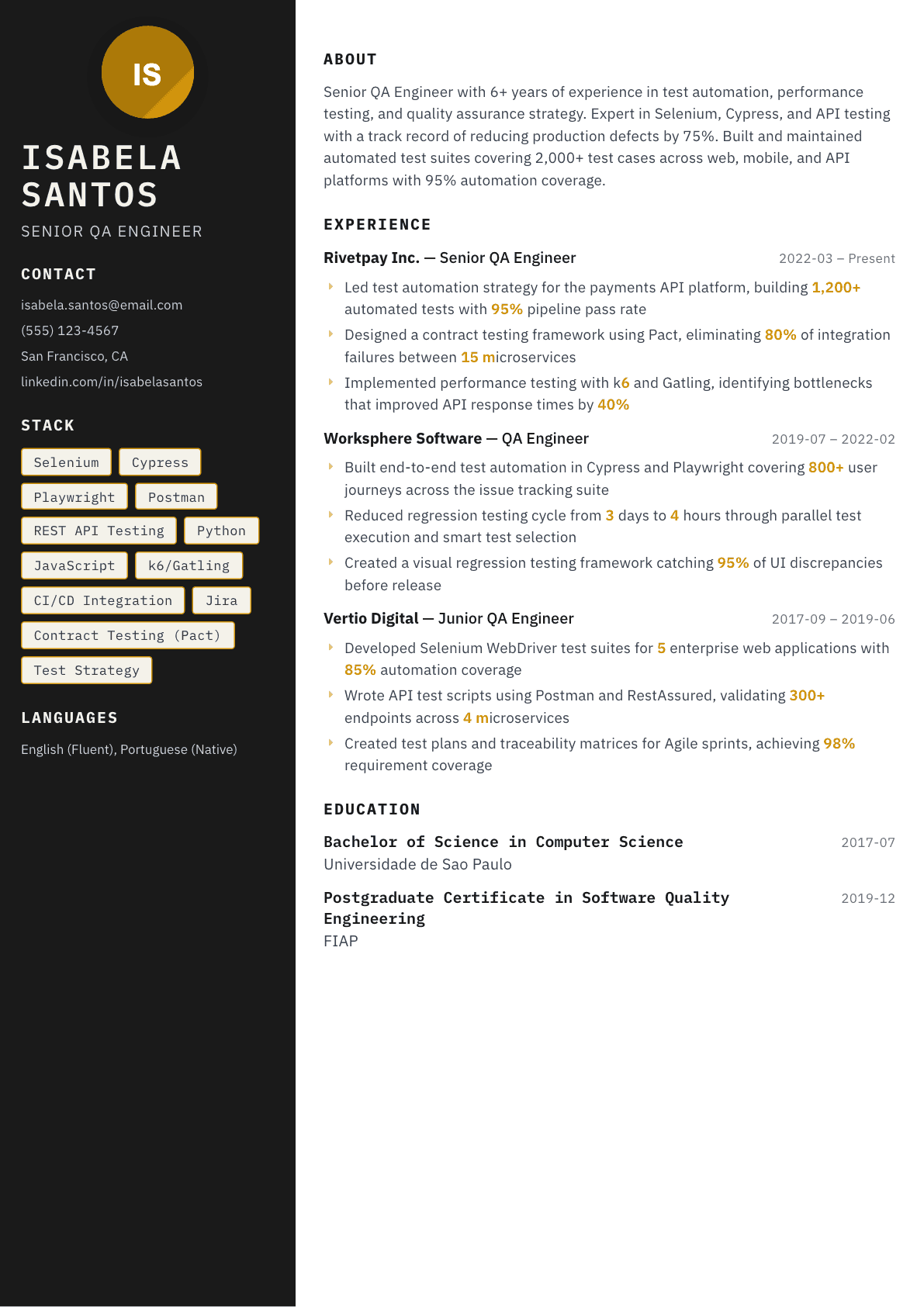
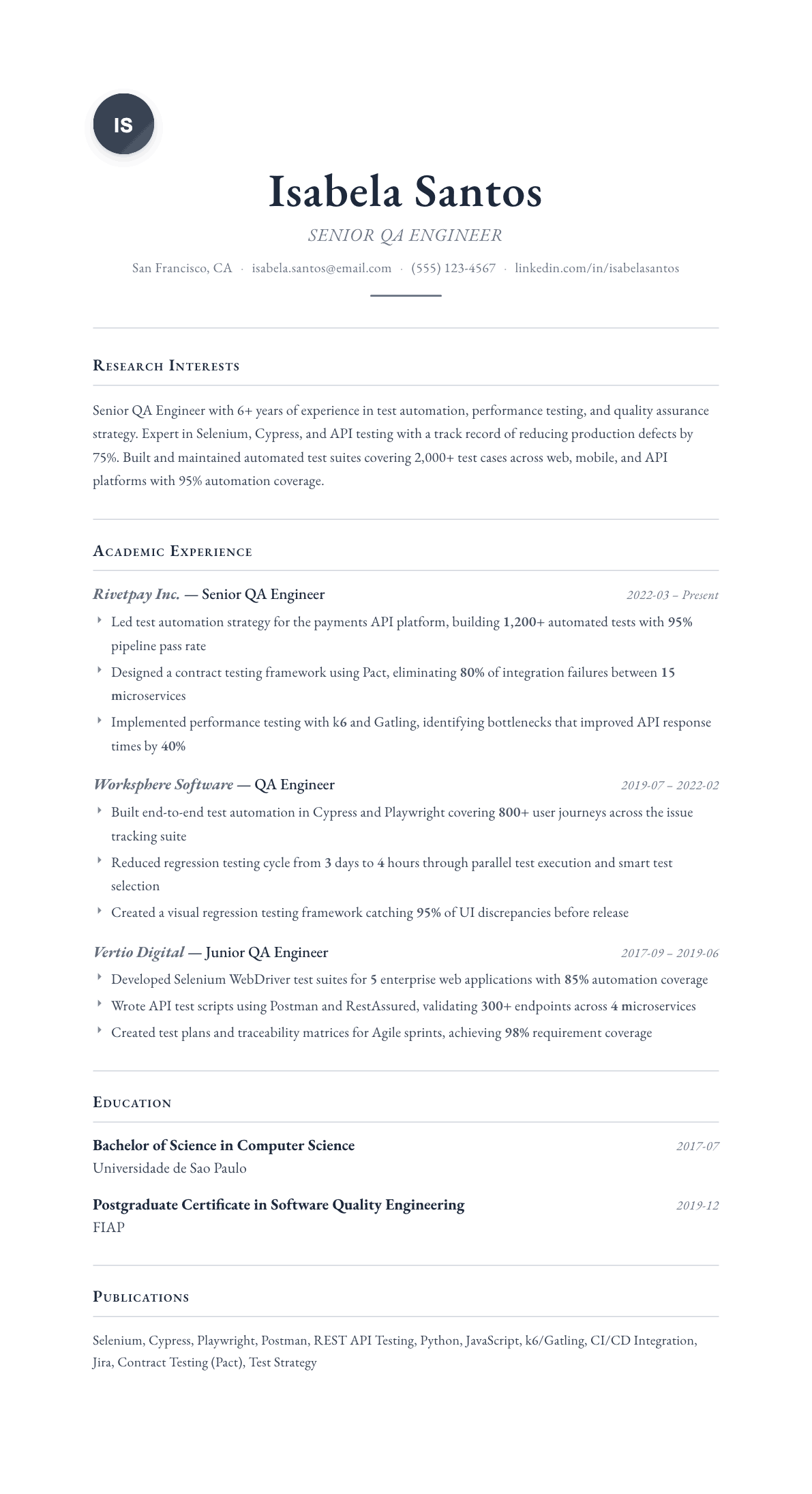
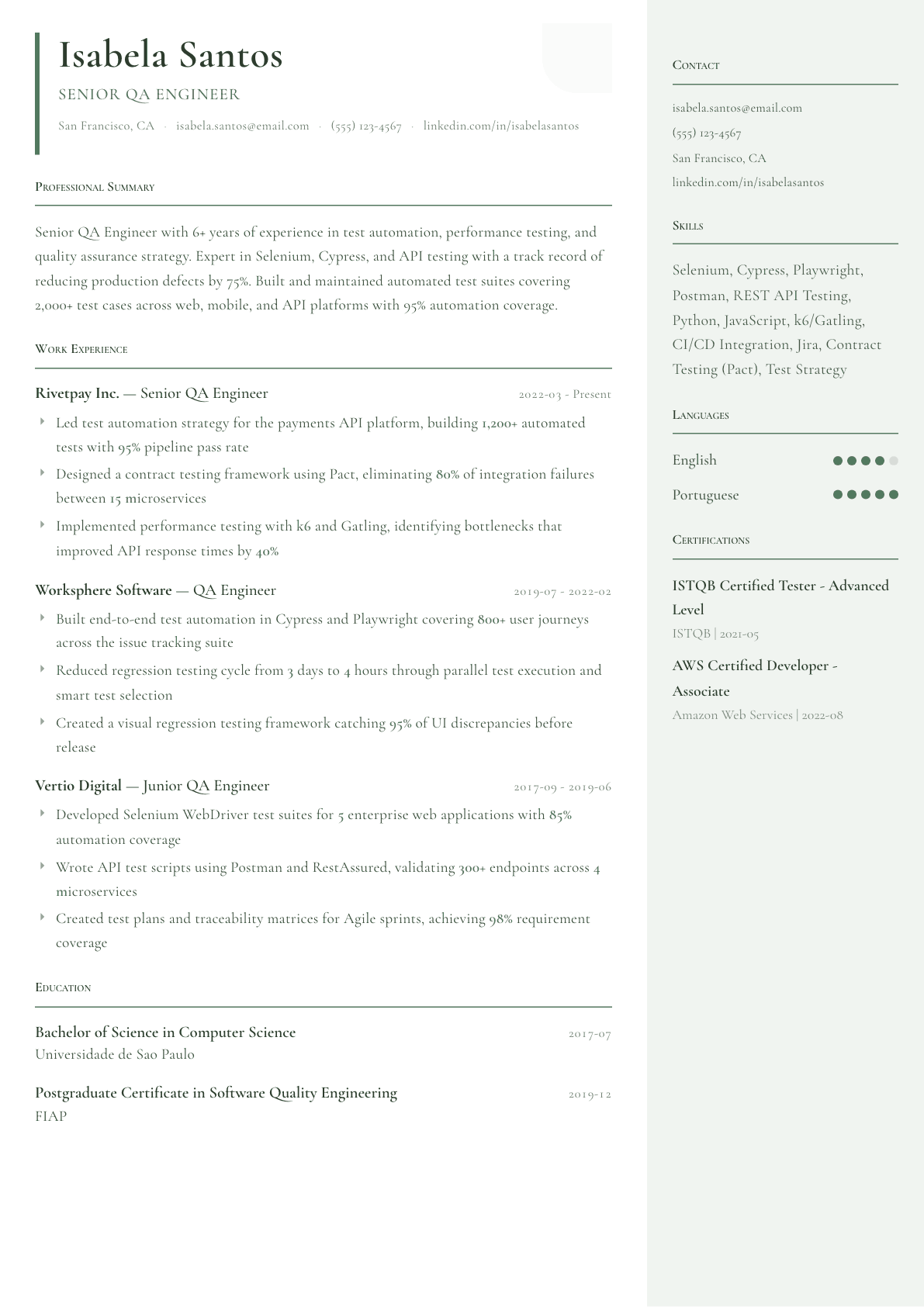
The same qa engineer content laid out in three CVBooster templates, so you can see what the finished document looks like before you write a word.
Example QA Engineer summary
Senior QA Engineer with 6 years of experience building comprehensive test automation frameworks for web, mobile, and API platforms. Reduced production defects by 75% and achieved 95% automation coverage across 2,000+ test cases. Expert in Cypress, Playwright, performance testing, and integrating quality gates into CI/CD pipelines.
Skills to list on a QA Engineer resume
- Selenium WebDriver
- Cypress
- Playwright
- Postman/Newman
- REST API Testing
- Python
- JavaScript/TypeScript
- Performance Testing (k6/Gatling)
- CI/CD Integration
- Contract Testing (Pact)
- Mobile Testing (Appium)
- Test Strategy & Planning
What actually gets this resume read
- Quantify quality improvements: defect reduction percentage, automation coverage, and test cycle time savings.
- List testing tools and frameworks: Selenium, Cypress, Playwright, Appium, or custom frameworks.
- Include testing types you excel at: functional, performance, security, accessibility, or contract testing.
- Highlight CI/CD integration: tests in GitHub Actions, Jenkins, or CircleCI with pass rate metrics.
- Show shift-left testing initiatives: TDD, BDD, or developer testing enablement programs you led.
How to write a qa engineer resume
Across the software testing industry, the QA engineer title covers a wide range, from manual test execution against written cases to writing the automation framework the whole engineering organization depends on. Because the title is the same at both ends, a hiring manager reads a QA resume defensively, looking for evidence of which end you sit at. She finds it in three places: whether you write code, whether you own a framework or only add tests to someone else's, and whether you can describe a defect you found that no scripted case would have caught.
The second thing she checks is where testing sits in your process. A QA engineer who receives a build at the end of a sprint and runs a regression pass is doing a different job from one who reviews acceptance criteria before the story is estimated, pairs on test design, and gates the pipeline. Say which one you have been, and if you moved the team from the first to the second, that migration is your best material.
This guide covers the quality assurance engineer resume from the title line down: how to write about test automation without listing tools, the quality metrics that survive interrogation, how to present manual and exploratory testing as skill rather than as a lack of automation, and the mistakes that make experienced testers look junior on paper.
Software test resume format: state the testing scope in the first block
Reverse-chronological, one page under six years. Under the summary add a testing profile: the product type, the platforms you cover such as web, mobile, API or desktop, the size of the automated suite, where it runs in the pipeline, and the release cadence you test against. Testing a payments API on a daily release is a different job from testing a desktop installer twice a year, and the reader needs to know which.
If you write test code, say so in the first three lines and name the language. A large part of the applicant pool cannot, so this single fact moves your file to a different pile.
Written out at the manual end, a software test resume opens: Software tester, insurance claims web app, writes and runs about 60 test cases a sprint from acceptance criteria, logs defects in Jira with steps and screenshots, and owns the regression checklist before each release. At the automation end: Test engineer, Playwright and TypeScript, built the end to end suite that gates every merge to main.
- Header: name, title, city, email, and a repository link in plain text if your framework work is public.
- Order: summary, testing profile, experience, tools by test type, certifications, education.
- Name the domain: payments, healthcare, gaming and embedded each carry testing constraints a reader will value.
- Include the team structure: embedded in a squad, a central quality team, or the only tester on the product.
Summary: what you test, how it runs, what you own
Name the surfaces you test, the automation stack, and the piece of quality infrastructure you own. Owning something is the key word. A framework, the pipeline test stage, the test data strategy, the device lab or the performance suite are all ownable, and owning one of them places you above the candidates who list the same tools.
If you came from manual testing and moved into automation, say it directly with the timeline. It is a common and respected path, and stating it prevents the reader from assuming the automation is thin.
Experience: the pyramid, the pipeline, and the defects you found
Describe your test suite by layer, because a thousand end to end tests is a warning sign rather than an achievement. Unit and component tests owned by developers, integration and contract tests at the service boundary, a thin end to end layer over the critical journeys, and how long each layer takes to run. A QA engineer who can talk about test distribution and runtime is talking like an engineer.
Then the pipeline. Where tests run, what blocks a merge, what blocks a release, how flaky tests are quarantined and fixed rather than retried forever, and the pass rate you hold the suite to. Flakiness is the most common reason a suite gets ignored, so describing how you kept it trustworthy is strong material.
Then the finding. Write about at least one defect class you caught that a scripted case would have missed: a race condition under concurrent checkout, a currency rounding error, a token expiry on a long session, a data migration that silently dropped records. Exploratory testing skill is what separates a QA engineer from a script runner, and it only shows through specifics.
Metrics: which quality numbers are believable
Coverage percentage on its own is weak, because everyone knows a high line coverage figure can accompany a bad suite. Stronger numbers are escaped defect rate, defects found before release versus after, regression cycle duration, suite runtime, flaky test rate, and the time from a merge to a trustworthy signal.
Attach the number to a decision. A regression pass that went from three days to four hours matters because it changed the release cadence. A contract testing layer matters because it removed a class of integration failures between services. State the consequence, not only the measurement.
- Suite size by layer, with runtime for each layer and the total pipeline feedback time.
- Flaky test rate and what you did to bring it down, including quarantine and root cause work.
- Escaped defects: how many reached production and what changed after.
- Release confidence: what gates a release and who signs it off.
Tools: organize by test type, not alphabetically
Group into functional web, mobile, API, performance, contract, accessibility and security. A reader hiring for mobile scans for Appium, XCUITest, Espresso and a device cloud, and a flat list hides all four. Under each group, name the assertion and reporting layer too, since that is where framework design actually lives.
Include test data and environment management, which most resumes omit and most teams struggle with. Fixtures and factories, database seeding and teardown, service virtualization or mocks such as WireMock, containerized dependencies with Testcontainers, and how you kept environments from drifting.
Quality assurance engineer resume and CV examples, three levels
A CV for software testing names the kind of testing you do in the first line, manual, automated, API, mobile or performance, then the product, the tools and what your testing changed. In the United States the same document is usually called a resume, and recruiters search the same words either way: software tester, QA analyst, QA engineer, test automation. The three software testing CV examples below show the summary and two experience lines for a manual tester, an automation engineer and a QA lead.
Keep the titles you held, even if they vary, and put the testing type in brackets or in the first bullet so a recruiter searching for one of those terms finds you.
Write the title out once in full. A quality assurance engineer resume that only ever says QA can miss a search for the long form, so use Quality Assurance Engineer in the header or the summary and QA everywhere else. Check the posting before you send, too: in manufacturing, a quality assurance engineer runs supplier audits, inspection plans and corrective actions under a quality management system, which is a different resume from software testing, and the examples below are for software.
- Example one, manual tester: Software Tester with two years of manual and exploratory testing on a web banking app. Writes test cases from user stories, runs regression before each release and logs defects in Jira with steps, screenshots and severity.
- Example one, bullet: Found a login lockout defect during exploratory testing of the password reset flow two days before release, which the scripted regression pack did not cover.
- Example two, automation engineer: QA Automation Engineer with five years on retail ecommerce. Builds and maintains a Playwright suite in TypeScript that runs on every pull request, plus API tests in Postman and REST Assured for the order service.
- Example two, bullet: Moved the nightly regression from a manual checklist to automated runs, cutting the release sign off from two days to an afternoon.
- Example three, QA lead: QA Lead with nine years in healthcare software, owning the test strategy for a patient portal and its mobile apps. Leads four testers, sets the quality gates in the pipeline and reports release risk to product and engineering leads.
- Example three, bullet: Introduced risk based test planning tied to each release's changed areas, so the team now tests the riskiest flows first and ships on the planned date.
QA Engineer resume summary examples
Junior QA engineer
QA engineer with two years of manual and exploratory testing on a web application, now writing Cypress tests for the checkout and account journeys. Comfortable with API testing in Postman, writing clear defect reports, and test case design using boundary and equivalence techniques.
Five years in
QA engineer with five years across web and API testing for a payments product. Owns a Playwright suite of 600 tests running on every pull request in 11 minutes, added Pact contract tests between six services, and cut the regression cycle from three days to four hours.
Lead QA engineer
Lead QA engineer with nine years, owning test strategy for a platform of 40 services. Rebalanced a top-heavy suite toward contract and integration tests, brought the flaky rate from 12% to under 1%, and coaches eight developers on test design and pipeline quality gates.
Work experience bullets: before and after
Before: Wrote automated tests using Selenium.
After: Built a page object based Selenium suite of 320 tests for the account and billing journeys, running in parallel across four browsers in 14 minutes as a merge gate.
Design pattern, suite size, runtime and its role in the pipeline turn a tool mention into a working system.
Before: Performed manual testing on new features.
After: Ran charter-based exploratory sessions on each new checkout feature, finding a currency rounding defect and a session expiry bug during payment that the scripted regression pack did not cover.
Naming the technique and the defects found proves testing skill that automation cannot replace.
Before: Improved test coverage across the application.
After: Rebalanced a suite of 900 end to end tests into 200 end to end, 450 integration and 250 contract tests, cutting total runtime from 2 hours to 18 minutes with the same defect detection.
It shows an understanding of test distribution rather than treating more tests as better.
Before: Reduced flaky tests in the CI pipeline.
After: Instrumented the suite to track failure history per test, quarantined 40 unstable tests, fixed the underlying wait and test data leakage causes, and brought the pipeline pass rate from 71% to 98%.
The measurement, the quarantine process and the root causes show a systematic fix rather than added retries.
Before: Did performance testing for the release.
After: Modeled peak checkout traffic in k6 at 3,000 virtual users, found a connection pool limit that raised the ninety-fifth percentile latency past 4 seconds, and verified the fix before the seasonal peak.
The load model, the bottleneck found and the timing against a real business event make the test consequential.
Hard skills
- Test strategy and test design techniques
- Selenium WebDriver
- Cypress
- Playwright
- Appium and mobile device testing
- API testing (Postman, REST Assured)
- Contract testing (Pact)
- Performance testing (k6, JMeter, Gatling)
- Test data and environment management
- Testcontainers and service virtualization
- CI pipelines and quality gates
- Python or JavaScript for test code
- Accessibility testing (axe, screen readers)
- Defect tracking and traceability in Jira
Soft skills
- Exploratory testing curiosity
- Writing defect reports developers can act on
- Advocating for quality without blocking delivery
- Risk-based prioritization
- Pairing with developers on test design
Certifications worth listing
- ISTQB Certified Tester Foundation Level (ISTQB)
- ISTQB Advanced Level Test Analyst (ISTQB)
- ISTQB Advanced Level Test Automation Engineer (ISTQB)
- Certified Software Quality Engineer (CSQE) (American Society for Quality)
Mistakes that cost qa engineer candidates the interview
- Listing testing tools with no suite size, runtime or pipeline placement, which reads as tool exposure rather than ownership.
- Leading with a coverage percentage, a number every experienced reader discounts immediately.
- Presenting a large end to end suite as an achievement without mentioning runtime or flakiness.
- Hiding manual and exploratory testing out of embarrassment, when specific defects found by hand are among the strongest evidence on the page.
- Writing defect counts with no severity or category, so the reader cannot tell trivial issues from release blockers.
- Never mentioning test data or environments, the two problems that sink most automation efforts in practice.
QA Engineer resume questions
What should a CV for software testing include?
The testing types you do, the product and industry, the tools by test type, the size of the suite or the release cadence you supported, and specific defects or process changes your testing produced. Include manual and exploratory testing as a skill, with an example of a defect found by hand. Add ISTQB if you hold it.
How much coding does a quality assurance engineer resume need to show?
Enough to prove you can build and maintain a framework, not just add cases to one. Name the language, the design patterns you used, how you handled test data and reporting, and any helper library or tooling you wrote for the team. That is the line between a QA engineer and a software engineer in test in most job markets.
What quality metrics belong on a QA resume?
Escaped defect rate, regression cycle time, suite runtime by layer, flaky test rate and the pipeline pass rate. These describe whether the team can release with confidence. Coverage percentage alone is the weakest number you can lead with because it can be high on a suite that catches nothing.
How do I move from manual QA to test automation on my resume?
Put the automation work first inside each role even when it was a smaller part of the job, name the framework and the tests you wrote, and keep the manual work as evidence of test design ability. Add a project section if your professional automation is still thin, with a real repository behind it.
Is ISTQB certification worth listing?
It is widely recognized by recruiters, particularly in Europe and for enterprise and consultancy roles, and it costs nothing to list. It will not persuade an engineering-led team on its own, so pair it with framework ownership and pipeline work rather than letting it carry the page.
Related resume examples
- Software Engineer Resume example
- DevOps Engineer Resume example
- Technical Writer Resume example
- Test Automation Engineer Resume example
- Manual QA Tester Resume example
- Analytics Engineer Resume example