Software Engineering Intern Resume Examples: free score
Land a Software Engineering Internship With a Resume That Has No Job History
By Mustafa Tarabya, founder of CVBooster · Published · Updated
Software engineering intern resume examples, coursework and project wording, ATS keywords and a guide to filling a page before your first job.
Sample resumes for a software engineering intern
The same software engineering intern content laid out in three CVBooster templates, so you can see what the finished document looks like before you write a word.
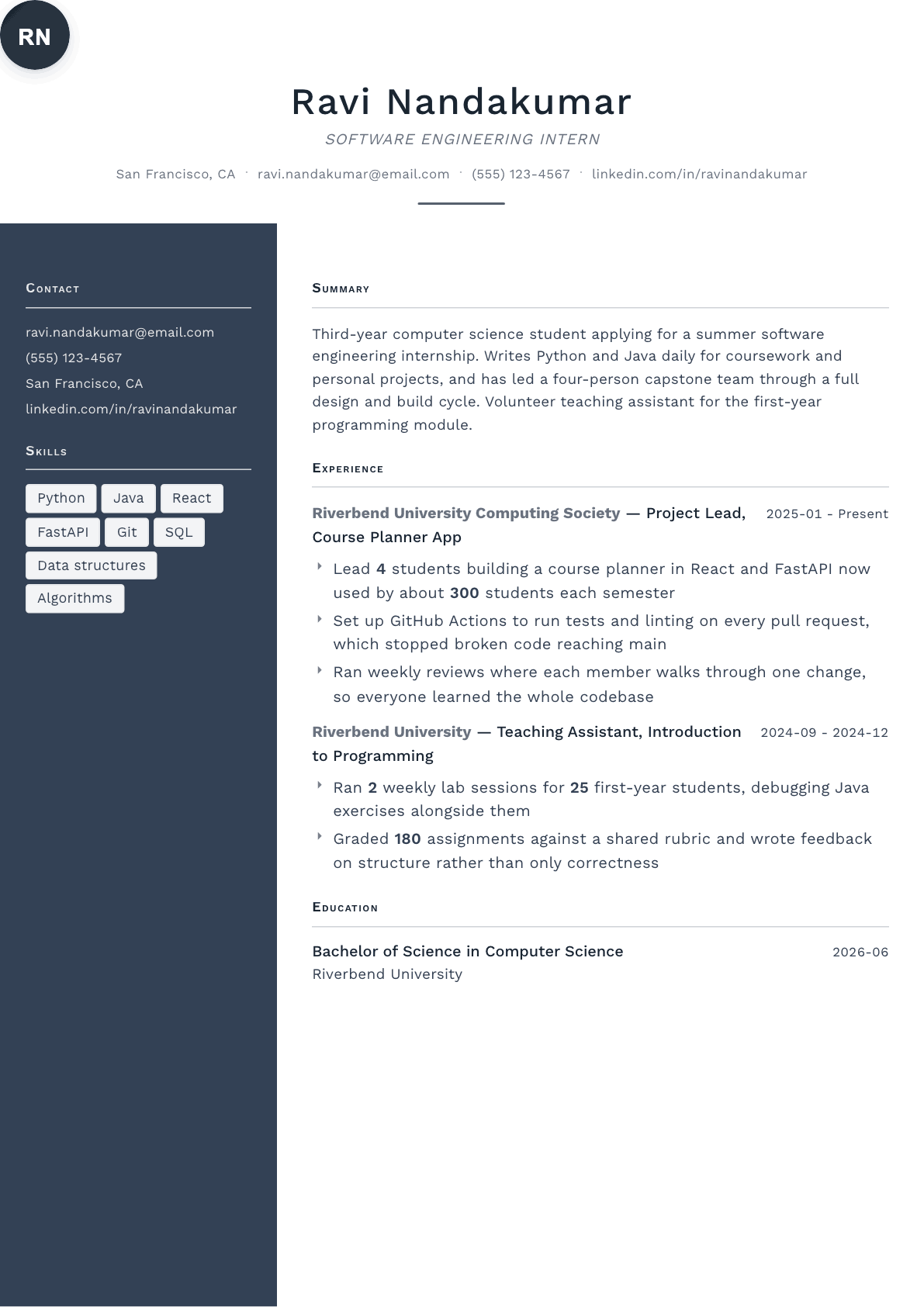
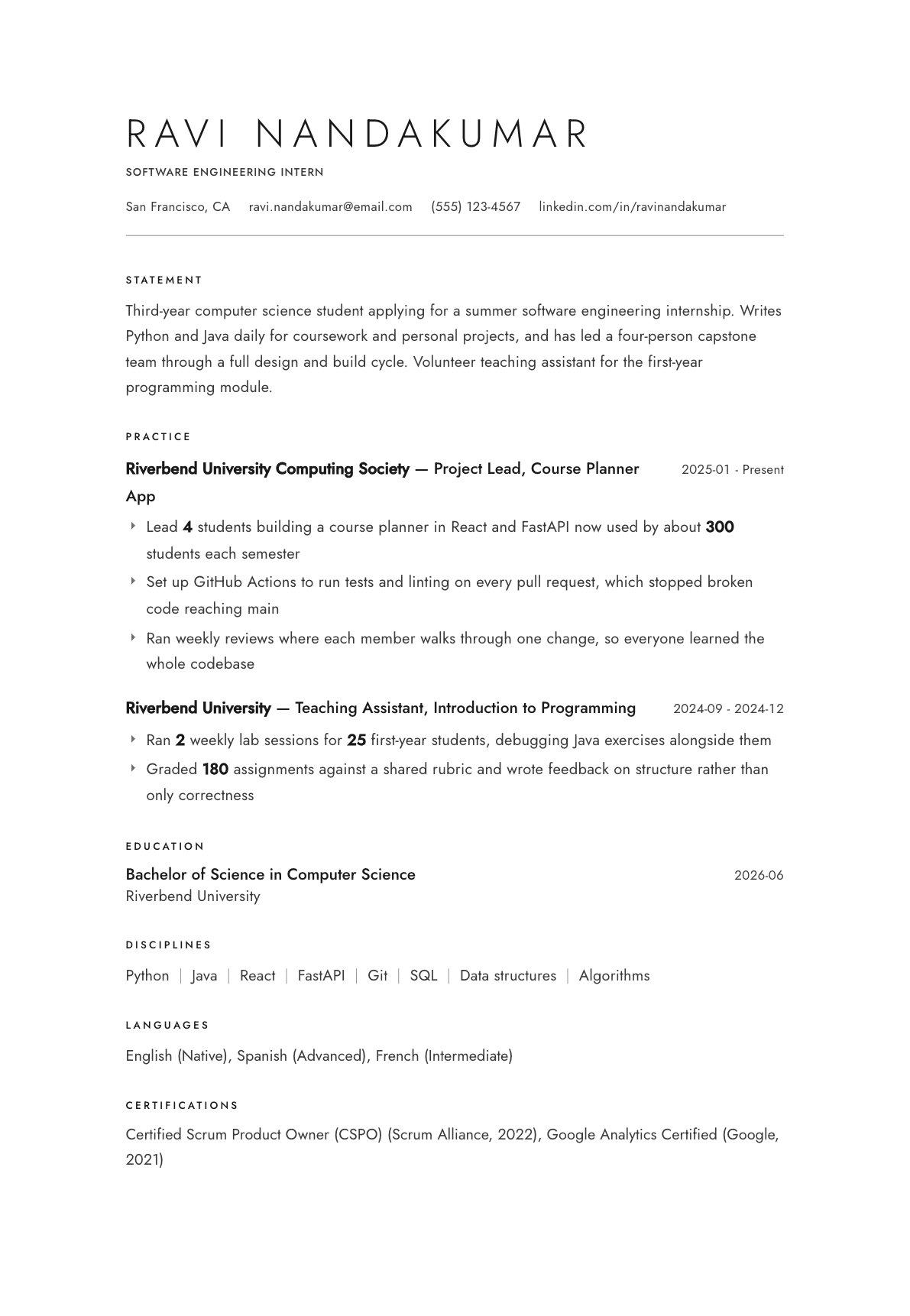
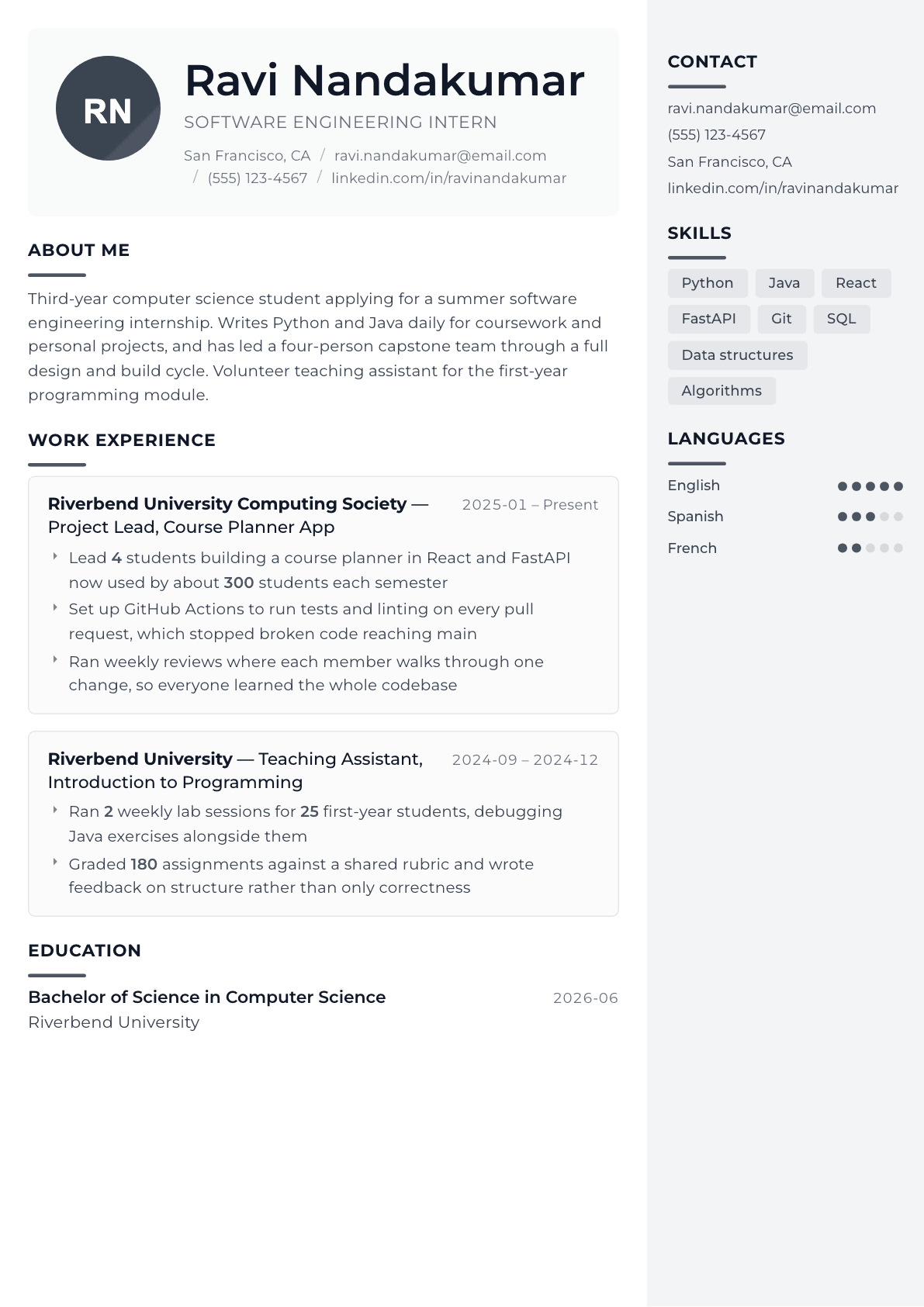
Example Software Engineering Intern summary
Third-year computer science student seeking a summer software engineering internship. Leads a four-person team building a course planner in React and FastAPI used across a university department, and works as a teaching assistant for first-year programming. Strong in Python, Java and SQL, with a habit of writing tests before asking for review. Available for a twelve-week placement from June.
Skills to list on a Software Engineering Intern resume
- Python
- Java
- JavaScript
- C
- React
- SQL
- Git and GitHub
- Data structures
- Algorithms
- Object-oriented design
- Unit testing
- Linux command line
- Technical writing
- Team projects
What actually gets this resume read
- Lead with education, then projects, then any work, because a recruiter for interns reads in that order.
- Give each project a role, a stack, a user count or a purpose, and a link to the running code.
- List relevant coursework only when it maps to the posting, such as operating systems or database design.
- Include tutoring, lab demonstrating and society roles, since they show you can explain technical work.
- State your graduation month and your availability window, as internship pipelines filter on both.
- Skip a skills bar chart claiming a percentage in a language you have used for one semester.
How to write a software engineering intern resume
An internship resume is judged on potential rather than record, which sounds forgiving until you see how the screening actually works. Large programs receive far more applications than they can read closely, so the first pass is mechanical: graduation date inside the window, availability that matches the program dates, the language named in the posting, and some evidence of code that exists outside coursework. Fail any of those and a human never sees the page.
The second pass is a student engineer reading for signal. She wants to know that you have written something longer than an assignment, that you can explain a technical choice, and that you have worked with other people on code. A capstone team, a society project, a lab demonstrating role or a small open source patch all provide that. A list of course titles does not.
This guide covers how to order a page with no professional history, how to turn coursework and society work into entries that read like real experience, what to do about the skills section, and the questions students ask when they write this resume for the first time.
Format: one page, education first, dates everywhere
One page, single column, plain headings. Education goes at the top with your institution, degree, expected graduation month and any award. Then projects, then any experience including tutoring and part-time work, then technical skills. Every entry carries a date range, because recruiters for internship programs filter on timing before anything else.
State your availability explicitly near the top: the months you can work and whether you need a placement of a particular length for course credit. Programs with fixed start dates screen on this line and it is the single most common thing students leave off.
- Header: name, city, phone, university email, GitHub link, and your expected graduation month.
- Sections: summary with availability, education, projects, experience, technical skills, and relevant coursework only if it maps to the posting.
- No photo, no rating bars, no two-column template that a parser can misread.
Summary: year of study, stack, and what you are looking for
Two lines. Year of study and degree, the languages you write most, the kind of team you want to join, and the dates you are free. That is the whole job of an internship summary. Anything about being a passionate learner is invisible to a reader who has seen a thousand of them.
If you have a specialism forming already, such as graphics, embedded work, machine learning or web infrastructure, name it. Teams remember the applicant who wanted something specific.
Projects: one built thing, described like it mattered
The strongest internship resumes have one project described in real depth rather than five listed by name. Give the stack, the time period, your role if it was a team, what it does, who uses it, and one problem that was genuinely hard. Concurrency, a rate limit, a data format that lied about itself, or performance on a large input are all worth a sentence.
Group projects need your own contribution stated. Write that you built the scheduling logic and set up the test pipeline, not that the team built an application. Reviewers assume the smallest possible share unless you tell them otherwise.
A public repository with a working readme is worth more than a portfolio site with screenshots. If your best code is in a private university repository, say so and describe it anyway.
Experience: teaching, societies, and jobs that show reliability
Lab demonstrating, teaching assistant work and running a computing society are the closest thing most students have to professional engineering experience, because they involve explaining technical work to people who are stuck. Write them with numbers: sessions run, students supported, assignments graded, events organized.
Part-time work outside technology stays on the page while it is needed, compressed to one line, because a reviewer does read reliability into someone who held a job through term time. Once you have two solid project entries, cut it.
Coursework, skills, and what the filter is looking for
List relevant coursework only when the module maps to the posting: operating systems, databases, distributed systems, compilers, computer networks, machine learning. Six module names is plenty and generic introductory titles add nothing.
For skills, split languages from tools and keep both honest. Internship postings filter on Python, Java, C, JavaScript, SQL, Git and sometimes a framework, so use those exact words where they are true. Leave out anything you met once in a single lab.
Software Engineering Intern resume summary examples
Second-year student
Second-year computer science student looking for a first summer software engineering internship. Writes Python and Java for coursework and has built a small web scraper that tracks reading list availability for my cohort. Available for twelve weeks from June and comfortable with Git and the Linux command line.
Penultimate year
Third-year computer science student applying for a summer software engineering internship. Leads a four-person team building a course planner in React and FastAPI used by around three hundred students a semester, and works as a teaching assistant for first-year programming. Available June to September.
Returning intern or final year
Final-year computer science student returning from a summer internship where I built an internal reporting service in Go and took it through code review and release. Looking for a graduate internship converting to a full role, with interest in backend infrastructure and observability.
Work experience bullets: before and after
Before: Worked on a group project for a university module.
After: Led four students building a course planner in React and FastAPI, personally owning the timetable conflict solver and the GitHub Actions pipeline that runs tests on every pull request.
Naming your own component and the team size turns a shared assignment into evidence of individual capability.
Before: Teaching assistant for a programming course.
After: Ran two weekly lab sessions for 25 first-year students, debugging Java exercises alongside them, and graded 180 assignments against a shared rubric with written feedback on structure.
Volumes and the nature of the feedback show real technical teaching rather than attendance at a lab.
Before: Built a website as a personal project.
After: Built a reading list availability tracker in Python that checks library stock every morning and emails my cohort, handling a source page that changes its markup without notice.
The awkward real-world constraint is what makes a small project interesting to an engineer reading it.
Before: Familiar with version control and testing.
After: Set up GitHub Actions to run tests and linting on every pull request for the society project, which stopped broken code reaching the main branch during a busy exam period.
A configured pipeline with a consequence is proof, where familiarity is only an assertion.
Before: Participated in a hackathon.
After: Built the backend for a campus lost property app during a 24 hour hackathon, including the image upload path and a matching endpoint, and placed third out of eighteen teams.
Stating your component and the result makes the event a piece of work rather than an activity.
Hard skills
- Python
- Java
- JavaScript
- C or C++
- SQL
- Git and GitHub
- Data structures and algorithms
- Object-oriented design
- Unit testing
- Linux command line
- React or another front-end framework
- Technical writing
Soft skills
- Explaining technical work to beginners
- Working in a small team
- Time management around study
- Taking feedback on code
- Independent learning
Certifications worth listing
- AWS Certified Cloud Practitioner (Amazon Web Services)
- Microsoft Certified: Azure Fundamentals (AZ-900) (Microsoft)
- Google IT Automation with Python Professional Certificate (Google)
Mistakes that cost software engineering intern candidates the interview
- Leaving off the expected graduation month and availability window, which is the first filter most internship programs apply.
- Listing every module you have taken instead of the handful that match the posting.
- Describing a group project without saying which part you personally built.
- Using a designed two-column template that a parser reads out of order and drops your dates from.
- Padding the skills section with technologies met once in a single lab exercise.
- Writing a page of adjectives about enthusiasm with no built thing behind them.
Software Engineering Intern resume questions
What goes on a software engineering intern resume with no work experience?
Education with your expected graduation month, one or two projects described in depth with your own contribution named, any teaching or society role, and an honest technical skills list. Add availability dates near the top so recruiters can screen you in.
How long should an internship resume be?
One page without exception at this stage. If it runs over, cut generic coursework, reduce part-time jobs to a single line each and keep only the two strongest projects. Depth on one project beats a list of five.
Do I need a GitHub profile to get an internship?
It is not required but it helps a lot, provided what is there runs. One repository with a clear readme, sensible commits and code you can talk about is better than a dozen forks of tutorials that were never touched.
Should I list my expected graduation date or my start date?
Both. Programs match candidates to fixed windows, so state the month you graduate and the months you are available. If your course requires a placement of a particular length for credit, say that too, since it affects which programs can take you.
Is it worth applying for an internship in a language I have not used?
Often yes, if the fundamentals overlap and you say so honestly. Name the language you are strongest in, mention any small project in the target language, and let the interview test the transfer. Never claim experience you cannot demonstrate.
Related resume examples
- Intern Resume example
- Software Engineer Resume example
- Junior Software Engineer Resume example
- Computer Science Student Resume example
- Machine Learning Engineer Resume example
- Data Scientist Resume example