Water Treatment Engineer Resume Examples: free ATS score
Create a Water Treatment Engineer Resume Built on Process, Permits and Plant Performance
By Mustafa Tarabya, founder of CVBooster · Published · Updated
Water treatment engineer resume example covering plant process design, permit compliance and commissioning, with keywords and a writing guide.
Sample resumes for a water treatment engineer
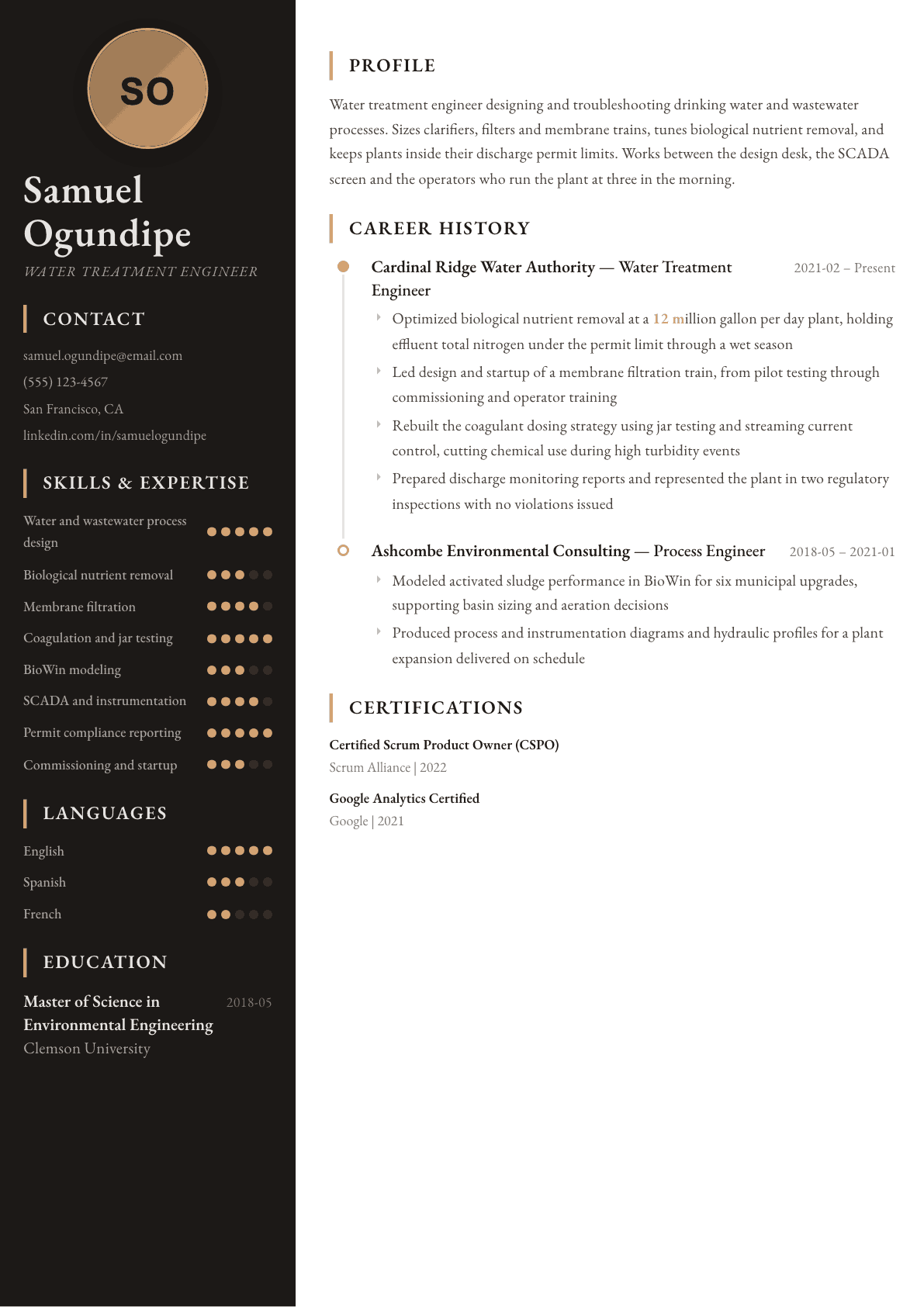
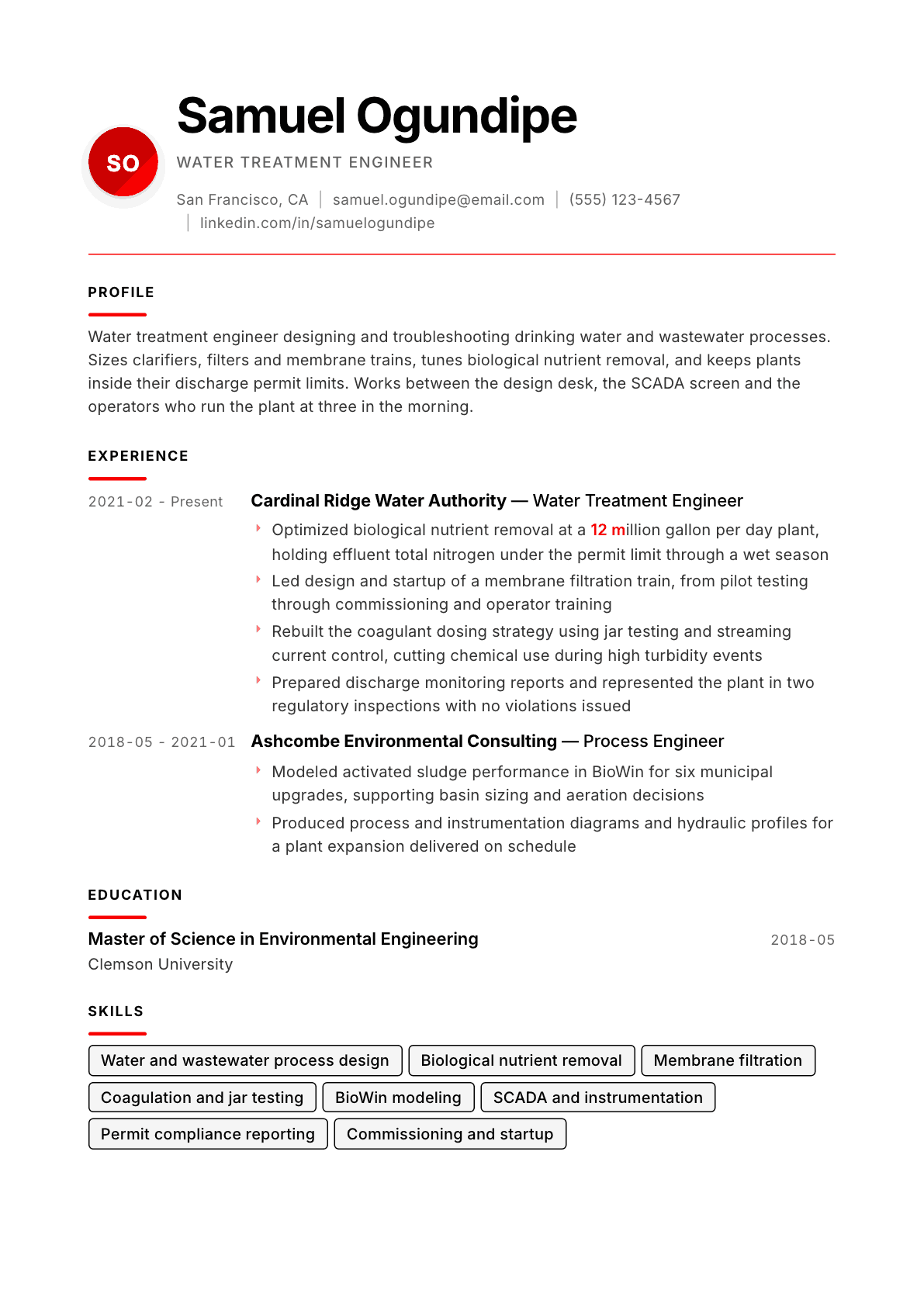
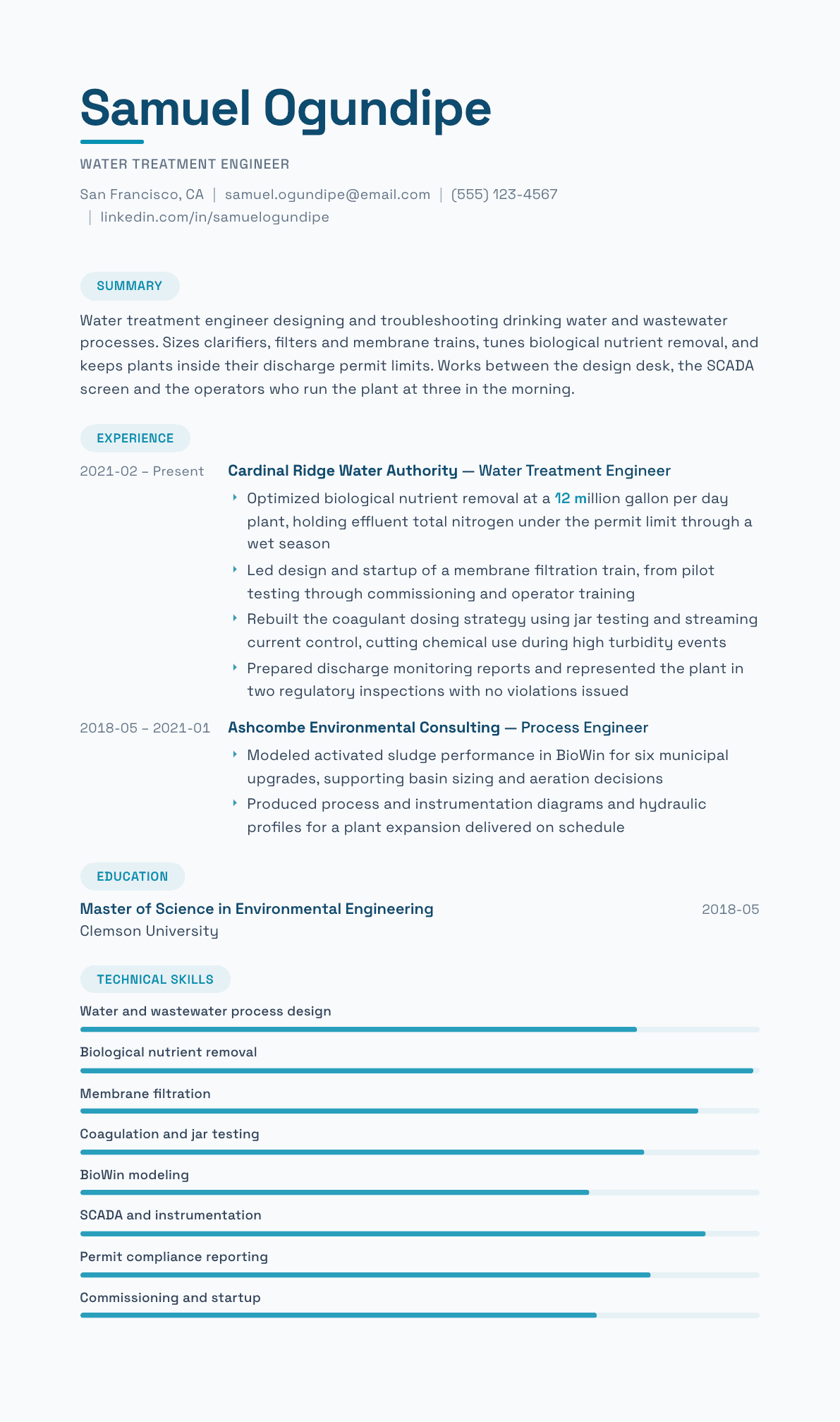
The same water treatment engineer content laid out in three CVBooster templates, so you can see what the finished document looks like before you write a word.
Example Water Treatment Engineer summary
Water treatment engineer with six years across municipal drinking water and wastewater plants, covering process design, optimization and startup. Tuned biological nutrient removal to hold effluent nitrogen inside permit limits, commissioned a membrane filtration train from pilot through operator training, and rebuilt a coagulant dosing strategy using jar testing. Experienced in regulatory inspections and monitoring reports. Seeking a senior process engineering role at a regional water authority.
Skills to list on a Water Treatment Engineer resume
- Water treatment process design
- Wastewater treatment process design
- Biological nutrient removal
- Activated sludge operation
- Membrane filtration and reverse osmosis
- Coagulation, flocculation and sedimentation
- Disinfection and CT compliance
- Sludge handling and dewatering
- BioWin and process modeling
- Hydraulic modeling
- SCADA and instrumentation
- Discharge permit compliance
- Commissioning and startup
- Operator training
What actually gets this resume read
- Give plant capacity in gallons or cubic meters per day, because that single figure tells a hiring manager your scale.
- Separate drinking water from wastewater experience, and name the unit processes you personally operated or designed.
- Show permit outcomes plainly: parameters held, reports filed, inspections passed, without claiming credit for the whole plant.
- Name your modeling and control tools, such as BioWin, WaterCAD, EPANET, or the SCADA platform you worked in.
- Put professional engineer licensure and any state operator certification in a credentials block near the top.
- Include commissioning and operator training work, since a plant owner values an engineer the operators will listen to.
How to write a water treatment engineer resume
A water treatment engineer is hired against two constants: a permit that cannot be exceeded and a plant that cannot stop. Everything on the resume should support a manager deciding whether you can keep both true. Plant capacity, the unit processes you have run or designed, and the permit outcomes you have been part of are the facts that carry the file.
The discipline splits between drinking water and wastewater, and between consulting design and utility operations. A consultant sizes basins and produces drawings. A utility engineer tunes a process at two in the morning with the operators. Both are valuable, and a resume that does not say which one you are leaves the reader guessing.
This guide covers the structure water and wastewater employers expect, three summaries across career stages, before and after bullets from process and commissioning work, and the questions engineers ask when the plant result belongs to a whole shift rather than to them.
Format: capacity, process train, and your side of the table
Head every job with the plant capacity and the process train. A twelve million gallon per day plant with biological nutrient removal and membrane filtration is an immediately legible scope statement, and it does more work than a paragraph of description would.
Then say whether you sat with the owner or the consultant. Design engineers get judged on drawings, models and specifications. Utility engineers get judged on compliance, uptime and chemical cost. State your side clearly and the reader stops trying to work it out.
- Header: name, professional engineer designation if held, city and state, phone, email.
- Sections: summary, licenses and certifications, technical skills, experience by plant or project, education.
- Add a regulatory line naming the permit programs and reporting regimes you have worked under.
Summary: water or wastewater, design or operations
Four facts, two sentences. Drinking water or wastewater. Design or operations. The unit processes you know best. The scale you have worked at. That is enough for a utility director or a consulting principal to know whether to keep reading.
Add one line on commissioning if you have it. Startup engineers are scarce, because the work requires process knowledge, instrumentation literacy and the patience to train operators who have every reason to distrust a new system.
Process work: name the unit, the target, the control
Unit processes are the vocabulary of this field. Coagulation and flocculation, sedimentation, filtration, disinfection with contact time compliance, activated sludge, biological nutrient removal, anaerobic digestion, membrane filtration, reverse osmosis, sludge dewatering. Name the ones you have designed or operated and drop the ones you have only read about.
Every process bullet needs a target and a control action. Holding effluent total nitrogen under a permit limit through a wet season is a target. Adjusting internal recycle and aeration setpoints to get there is the control action. A bullet with only one of the two reads as either a result you inherited or an activity with no purpose.
Chemical optimization is worth its own line. Rebuilding a coagulant dosing strategy from jar testing and streaming current control is a concrete piece of process engineering, and chemical cost is one of the few numbers a utility board looks at directly.
Permits, reporting and inspections
Compliance work belongs on the resume, described carefully. Say which parameters you were responsible for, that you prepared discharge monitoring reports, and how inspections went. Representing a plant in a regulatory inspection is a genuine responsibility and reads as trust from the utility.
Do not claim the whole plant record. A permit result belongs to operators, maintenance and management as well as the engineer. Describe your contribution: the process change you made, the report you prepared, the corrective action you closed. Careful phrasing here reads as professionalism, not modesty.
Design tools, commissioning and operator training
Name your modeling and drafting tools: process simulation software for activated sludge, hydraulic modeling for distribution and collection systems, and the drafting package you produced process and instrumentation diagrams in. Say what you delivered, whether hydraulic profiles, basin sizing calculations or a full design package.
Commissioning bullets should follow the sequence: pilot testing, factory and site acceptance, startup, performance testing, operator training and handover. Naming that sequence proves you have taken a system into service rather than designed one that someone else started up.
Water Treatment Engineer resume summary examples
New graduate
Environmental engineering graduate with a thesis on phosphorus removal in a bench scale sequencing batch reactor, plus an internship at a municipal wastewater plant covering sampling and monitoring reports. Trained in process modeling and hydraulic calculations. Seeking an entry water treatment engineer role at a utility or consultancy.
Six years in
Water treatment engineer at a 12 million gallon per day municipal plant, covering biological nutrient removal optimization, membrane filtration startup and coagulant dosing strategy. Prepares discharge monitoring reports, has represented the plant in two regulatory inspections, and trains operators on new process equipment.
Chief process engineer
Chief process engineer with sixteen years across municipal drinking water and wastewater, holding professional registration and leading design and startup for plant expansions. Has commissioned four treatment trains, rebuilt two struggling nutrient removal processes into consistent compliance, and manages a team of five engineers and modelers.
Work experience bullets: before and after
Before: Improved wastewater treatment performance.
After: Optimized biological nutrient removal at a 12 million gallon per day plant, adjusting internal recycle and aeration setpoints to hold effluent total nitrogen under the permit limit through a full wet season.
Plant capacity, the control actions and the permit outcome together prove the engineering rather than asserting improvement.
Before: Worked on a membrane filtration project.
After: Led design and startup of a membrane filtration train from pilot testing through site acceptance, performance testing and operator training, handing the system over with a written operating protocol.
The full commissioning sequence shows the system entered service rather than reaching substantial completion on paper.
Before: Reduced chemical usage at the plant.
After: Rebuilt the coagulant dosing strategy using jar testing and streaming current control, cutting chemical use during high turbidity events without losing filtered water quality.
Naming the methods and the constraint held makes a chemical saving credible to another process engineer.
Before: Handled regulatory reporting.
After: Prepared monthly discharge monitoring reports and represented the plant in two regulatory inspections, with no violations issued and every corrective action closed within the agreed schedule.
Reporting cadence plus inspection outcome converts an administrative duty into demonstrated compliance ownership.
Before: Modeled treatment processes for upgrades.
After: Modeled activated sludge performance in BioWin for six municipal upgrades, supporting basin sizing and aeration decisions and producing the hydraulic profiles issued with the design package.
The project count and the deliverables show modeling that fed real design, not an academic exercise.
Hard skills
- Drinking water process design
- Wastewater process design
- Coagulation, flocculation and sedimentation
- Filtration and backwash design
- Disinfection and contact time compliance
- Activated sludge operation and control
- Biological nutrient removal
- Membrane filtration and reverse osmosis
- Anaerobic digestion and sludge dewatering
- BioWin and process simulation
- Hydraulic modeling of distribution and collection systems
- Process and instrumentation diagrams
- SCADA and instrumentation
- Discharge permit compliance and reporting
- Commissioning, startup and operator training
Soft skills
- Working alongside plant operators
- Calm response to a process upset
- Regulator communication
- Clear written procedures
- Public meeting presentation
- Coordinating with maintenance crews
Certifications worth listing
- Fundamentals of Engineering (FE) (NCEES)
- Professional Engineer (PE), Environmental or Civil (NCEES and state licensing boards)
- Board Certified Environmental Engineer (American Academy of Environmental Engineers and Scientists)
- Water Treatment Operator Certification (State drinking water primacy agencies)
- Wastewater Treatment Operator Certification (State water pollution control agencies)
Mistakes that cost water treatment engineer candidates the interview
- Omitting plant capacity, which is the single figure that tells a hiring manager the scale you have worked at.
- Mixing drinking water and wastewater experience into one paragraph when employers recruit for them separately.
- Claiming a compliance record that belonged to the whole plant instead of naming the change you personally made.
- Listing unit processes you have read about rather than designed or operated, which collapses in a technical interview.
- Leaving out operator certification, which many utility postings require alongside an engineering degree.
- Skipping commissioning and training work, the scarcest capability on most treatment engineering teams.
Water Treatment Engineer resume questions
Do I need a professional engineering license as a water treatment engineer?
For consulting design work it is expected, because drawings and calculations get stamped. Utility process roles often accept a license as preferred rather than required, but the credential still moves a file up the pile and is usually necessary for senior positions.
Should I list an operator certification alongside my engineering degree?
Yes, and put it near the top. Many utilities value an engineer who holds a treatment operator certification because it proves you understand the plant from the operator side, and some postings require a specific grade level regardless of your degree.
How do I claim credit for permit compliance fairly?
Name your specific contribution rather than the plant record. The process change you made, the report you prepared, the corrective action you closed, the inspection you attended. Experienced hiring managers notice when a candidate takes proportionate credit, and they trust the rest of the resume more for it.
What is the difference between a consulting and a utility resume in this field?
A consulting resume leads with projects, deliverables, modeling and design packages. A utility resume leads with plants, capacity, compliance and uptime. If you are moving between the two, rewrite the top third to speak the language of the side you are applying to.
How much detail should I give on modeling software?
Name the packages and say what the model produced. A process simulation that drove basin sizing, or a hydraulic model that justified a pump station change, shows the tool was used for a decision. Software listed alone reads as a training course rather than working capability.
Related resume examples
- Environmental Engineer Resume example
- Chemical Engineer Resume example
- Water Resources Engineer Resume example
- Plant Engineer Resume example
- Solar Energy Engineer Resume example
- Power Plant Operator Resume example