Shopify Developer Resume Examples: the lines they read
Create a Shopify Developer Resume Merchants Trust
By Mustafa Tarabya, founder of CVBooster · Published · Updated
A Shopify developer resume example covering Liquid, theme and app work, store metrics worth listing, and a section by section writing guide.
Sample resumes for a shopify developer
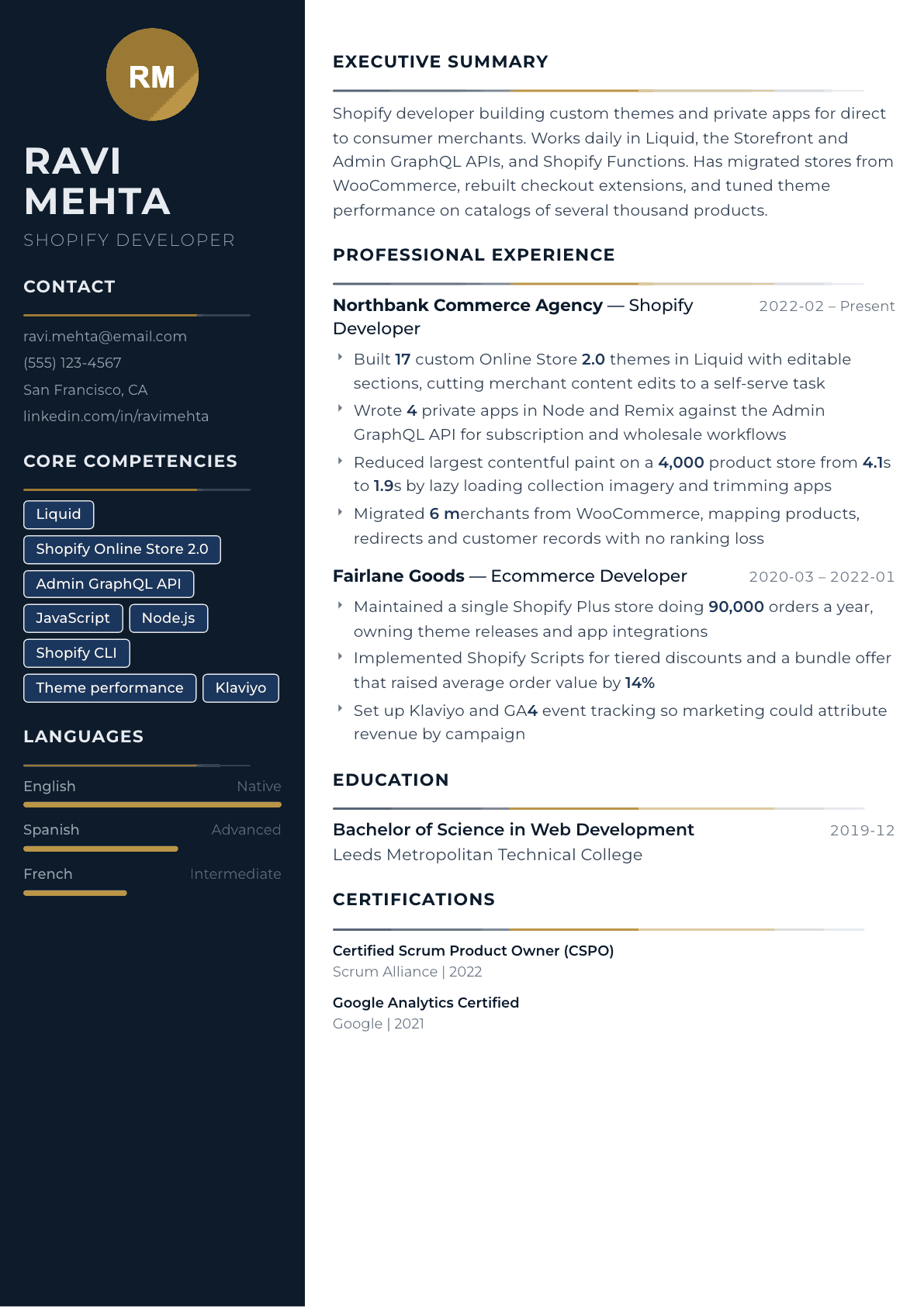
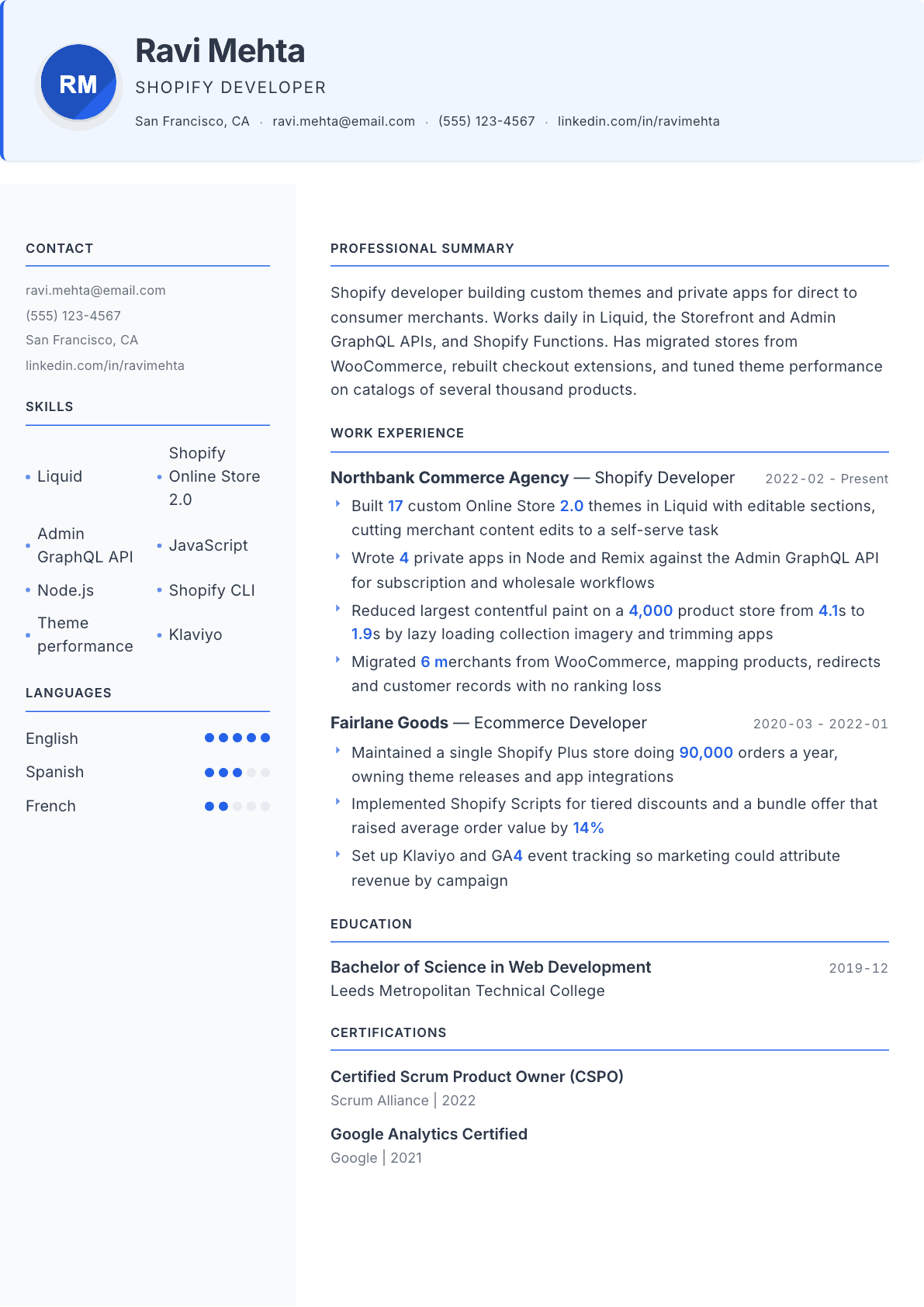
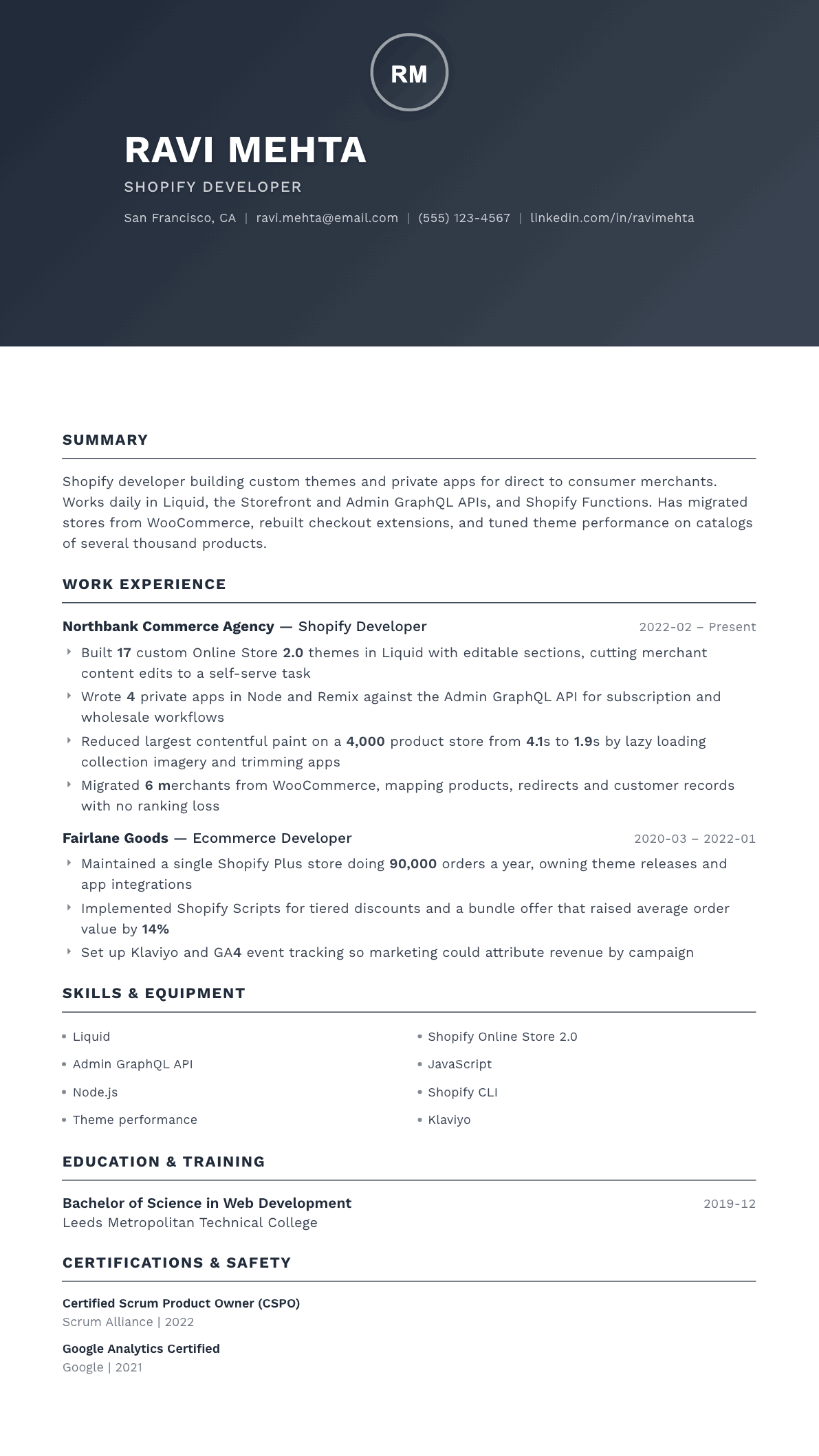
The same shopify developer content laid out in three CVBooster templates, so you can see what the finished document looks like before you write a word.
Example Shopify Developer summary
Shopify developer with four years building custom themes and private apps for direct to consumer brands. Fluent in Liquid, the Admin GraphQL API and Shopify Functions, with migration experience from WooCommerce and Magento. Cut largest contentful paint on a 4,000 product store from 4.1s to 1.9s and raised average order value 14% through bundle logic. Seeking an in-house role on a Shopify Plus team.
Skills to list on a Shopify Developer resume
- Liquid
- Shopify Online Store 2.0
- Shopify CLI
- Admin GraphQL API
- Storefront API
- Shopify Functions
- Checkout extensibility
- JavaScript
- Node.js
- React
- HTML
- CSS
- Theme performance optimization
- Platform migration
- Klaviyo
- Shopify Plus
What actually gets this resume read
- Say whether you build themes, apps, or both, because those are two different hiring pipelines at most agencies.
- Name the Shopify surfaces you have touched: Liquid sections, checkout extensions, Functions, Scripts, or the Admin API.
- Give store scale in orders, revenue or catalog size so a reader knows whether you have handled a Plus merchant.
- Include performance work with real before and after numbers, since theme speed is a constant merchant complaint.
- List migrations separately, naming the platform you moved from and how you handled redirects and data.
- Mention the third party apps you integrated, such as Klaviyo, Recharge or Yotpo, since postings usually name them.
How to write a shopify developer resume
Shopify developer covers at least three jobs that share a title. One person builds custom themes in Liquid for an agency and touches a new merchant every month. Another builds public or private apps in Node and React against the Admin API and rarely opens a theme file. A third sits in-house at a single brand, owning one large store, its integrations, and the release process around it. A resume that does not say which of these you are makes the reviewer do the sorting, and reviewers sort quickly.
The people reading this resume are agency technical leads and in-house ecommerce managers. They care about merchant outcomes because their own review is written in those terms: page speed, conversion, order volume, hours of merchant support saved. They also know exactly which Shopify surfaces are hard. Checkout extensibility, Shopify Functions, migrating a store without losing search rankings, and taming an app stack that has accumulated for years all read as senior work. Editing a theme through the admin does not.
This guide walks through the format, the summary, the experience section that proves platform depth, the tool list, and the questions Shopify developers ask when writing this document.
Format: one page under five years, and lead with the Shopify surface you own
Reverse chronological, one page for most candidates, plain single column. Put a short technical profile line under your name naming your primary surface: custom themes, app development, or full store ownership. Agency leads scan for that line before anything else because it decides which team you would join.
Add a link to a store list or a GitHub profile. Public store URLs are the strongest evidence in this field, since a reviewer can open a site, view the source, and see the quality of your section schema and asset handling in about ninety seconds.
- Header: name, title, city, email, phone, GitHub, and links to live stores you built.
- Order: profile line, skills grouped by surface, experience, notable stores, education.
- Say Shopify Plus explicitly if you have worked on it, because postings filter on the word.
Summary: surface, merchant scale, and the hardest thing you have done
Three lines. Name what you build, the size of the merchants you build it for, and the single most demanding piece of platform work you have completed. Store scale matters more here than years of experience, because a developer who has kept a store doing six figures of orders a year stable through peak season has faced problems that a portfolio of small builds never produces.
Say which APIs you work in. The Admin GraphQL API, the Storefront API, Shopify Functions and checkout extensibility are the vocabulary that separates a platform developer from a theme editor, and using them correctly in one sentence establishes credibility faster than a skills list.
Experience: build type, merchant scale, and the number that moved
Give every job a scope line: agency or in-house, how many stores, what platform tier, and the merchant category. Then write bullets around the four things this field actually rewards, which are custom theme architecture, app and API work, performance, and migrations.
For theme work, describe the architecture rather than the visual result. Editable sections and blocks under Online Store 2.0, metafield-driven content, and a schema a merchant can operate without calling you are what make a theme good. A bullet saying you built a custom theme could describe a template purchase and a color change; a bullet naming the section structure and the merchant self-service outcome could not.
For app work, name the framework, the API, and the workflow it solved. Subscription logic, wholesale pricing tiers, warehouse synchronization and bundling are common private app territory, and each of them tells a reviewer something about the business problems you are used to holding.
Performance and migration bullets both need before and after numbers. Largest contentful paint before and after, app count removed, runtime saved. For migrations, name the source platform, the record volume, and how you handled redirects, because losing search traffic during a replatform is the fear every merchant carries into that project.
- Scope line: agency or in-house, store count, Plus or standard, merchant vertical.
- One theme architecture bullet that mentions sections, blocks or metafields.
- One app or API bullet naming the framework and the workflow.
- One performance bullet and, if you have it, one migration bullet with record volume.
Skills: separate platform surfaces from general web skills
Split the list. A Shopify group holds Liquid, Online Store 2.0, the Admin and Storefront APIs, Functions, checkout extensibility, metafields, the CLI and theme app extensions. A general web group holds JavaScript, TypeScript, React, Node, HTML and CSS. A third group holds the ecosystem tools postings name directly, such as Klaviyo, Recharge, Yotpo, Gorgias and the analytics stack.
Do not list Shopify Scripts as though it were current headline work without context, and do not claim headless experience unless you have built a real storefront against the Storefront API. Both are checkable in a technical screen within two questions.
Keywords the posting will be written from
Shopify job descriptions are unusually consistent: Liquid, Online Store 2.0, Shopify Plus, Admin GraphQL API, Storefront API, Shopify Functions, checkout extensibility, theme development, app development, metafields, Shopify CLI, Core Web Vitals, and platform migration. Use the exact spellings, including the capitalization Shopify itself uses, and place each one somewhere it is attached to work you did rather than in a keyword block at the bottom.
Shopify Developer resume summary examples
First Shopify role
Front-end developer with a year building Shopify themes for three small merchants, comfortable in Liquid, JavaScript and CSS. Converted a purchased theme into editable Online Store 2.0 sections so the owner could publish campaigns without developer help. Looking for a junior Shopify developer position at an agency.
Four years on the platform
Shopify developer with four years building custom Online Store 2.0 themes and private apps in Node and Remix against the Admin GraphQL API. Cut largest contentful paint on a four thousand product catalog from 4.1s to 1.9s and migrated six merchants off WooCommerce with redirects mapped and rankings intact.
Lead on a Plus store
Lead developer for a Shopify Plus merchant handling ninety thousand orders a year, owning theme releases, checkout extensions and the integration layer to an enterprise resource planning system. Runs the release process, reviews all Liquid and app code, and mentors two developers on API and performance work.
Work experience bullets: before and after
Before: Built custom Shopify themes for clients.
After: Built seventeen custom Online Store 2.0 themes in Liquid with editable sections and metafield-driven content, so merchants could change campaign pages without developer time.
Volume plus the architecture detail shows real theme engineering rather than template customization.
Before: Made the store faster.
After: Cut largest contentful paint on a four thousand product store from 4.1s to 1.9s by lazy loading collection imagery, deferring third party tags and removing four unused apps.
The metric, the numbers and the three specific techniques make the improvement verifiable and repeatable.
Before: Created apps for internal use.
After: Wrote four private apps in Node and Remix against the Admin GraphQL API covering subscription management, wholesale pricing tiers and nightly inventory synchronization.
Naming the stack, the API and the business workflows proves platform depth instead of generic app experience.
Before: Moved a client from WooCommerce to Shopify.
After: Migrated six merchants from WooCommerce, mapping products, customer records and order history, and building redirect tables that held organic search traffic through the cutover.
The record types and the redirect work address the exact risk merchants worry about during a replatform.
Before: Set up discount logic on the store.
After: Implemented tiered discount and bundle logic through Shopify Functions, raising average order value by 14% across two peak seasons.
It names the platform surface and ties the technical change to the commercial result a merchant cares about.
Hard skills
- Liquid
- Shopify Online Store 2.0 sections and blocks
- Admin GraphQL API
- Storefront API
- Shopify Functions
- Checkout extensibility
- Shopify CLI and theme app extensions
- Metafields and metaobjects
- JavaScript and TypeScript
- Node.js and React
- Core Web Vitals optimization
- Platform migration and redirect mapping
Soft skills
- Merchant communication
- Scoping under agency deadlines
- Documentation for non-technical owners
- Release planning around peak season
- Code review
Certifications worth listing
- Shopify App Development Certification (Shopify)
- Shopify Theme Development Certification (Shopify)
- Shopify Foundations Certification (Shopify)
Mistakes that cost shopify developer candidates the interview
- Not saying whether you are a theme developer, an app developer, or the person who owns an entire store.
- Listing Shopify experience with no merchant scale, so a reviewer cannot tell a hobby store from a Plus account.
- Claiming headless commerce experience when the work was a standard theme with a few API calls in it.
- Describing performance work without before and after numbers, which is the one place this field expects them.
- Omitting the app ecosystem entirely, when most postings name Klaviyo, Recharge or a review platform directly.
- Sending a resume with no live store links, which removes the fastest way a reviewer has to judge your work.
Shopify Developer resume questions
Should a Shopify developer resume list the stores I have built?
Yes, if the merchants allow it. A short notable stores block with three to six live URLs gives a reviewer something to inspect immediately. When a client will not permit naming, describe the store by category and size instead and keep the technical detail.
Is Liquid enough, or do I need JavaScript for Shopify developer jobs?
Liquid alone will get you theme work at small agencies. Anything involving apps, checkout extensions, headless storefronts or integrations expects JavaScript and usually Node and React. If you want the higher band of roles, put real JavaScript projects on the page.
How do I show Shopify Plus experience on a resume?
Name it in the scope line under the job title, then back it with a Plus-only capability you used, such as checkout extensibility, Shopify Functions, or organization-level admin work. The word alone is weak; the word plus a Plus-specific feature is convincing.
What metrics belong on a Shopify developer resume?
Core Web Vitals before and after, order volume or catalog size for scale, conversion or average order value where your change caused the movement, and merchant hours saved by a self-service theme. Avoid claiming revenue you cannot reasonably attribute to your work.
Do Shopify certifications matter for hiring?
They help most when you are early or self-taught, because they show a structured grasp of the platform rather than a collection of habits. For senior roles, live stores, app repositories and migration history carry far more weight than any certificate.
Related resume examples
- Web Developer Resume example
- Frontend Developer Resume example
- WordPress Developer Resume example
- Web Designer Resume example
- Full-Stack Developer Resume example
- Software Engineer Resume example