Piping Engineer Resume Examples: the lines they read
Craft a Piping Engineer Resume Around Line Lists and Stress Runs
By Mustafa Tarabya, founder of CVBooster · Published · Updated
Piping engineer resume example with routing, stress analysis, isometrics, code work, recruiter keywords and a detailed writing guide.
Sample resumes for a piping engineer
The same piping engineer content laid out in three CVBooster templates, so you can see what the finished document looks like before you write a word.
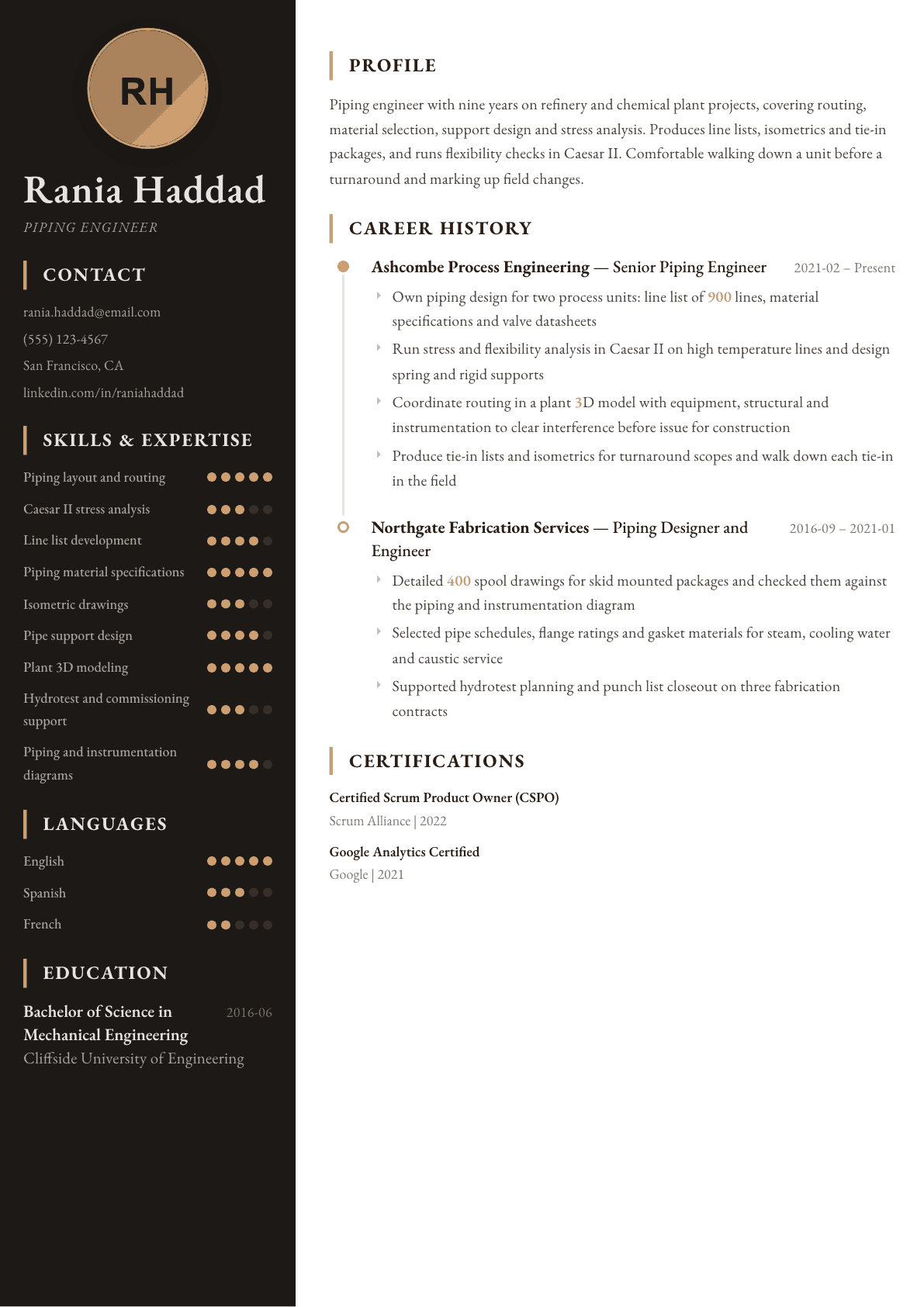
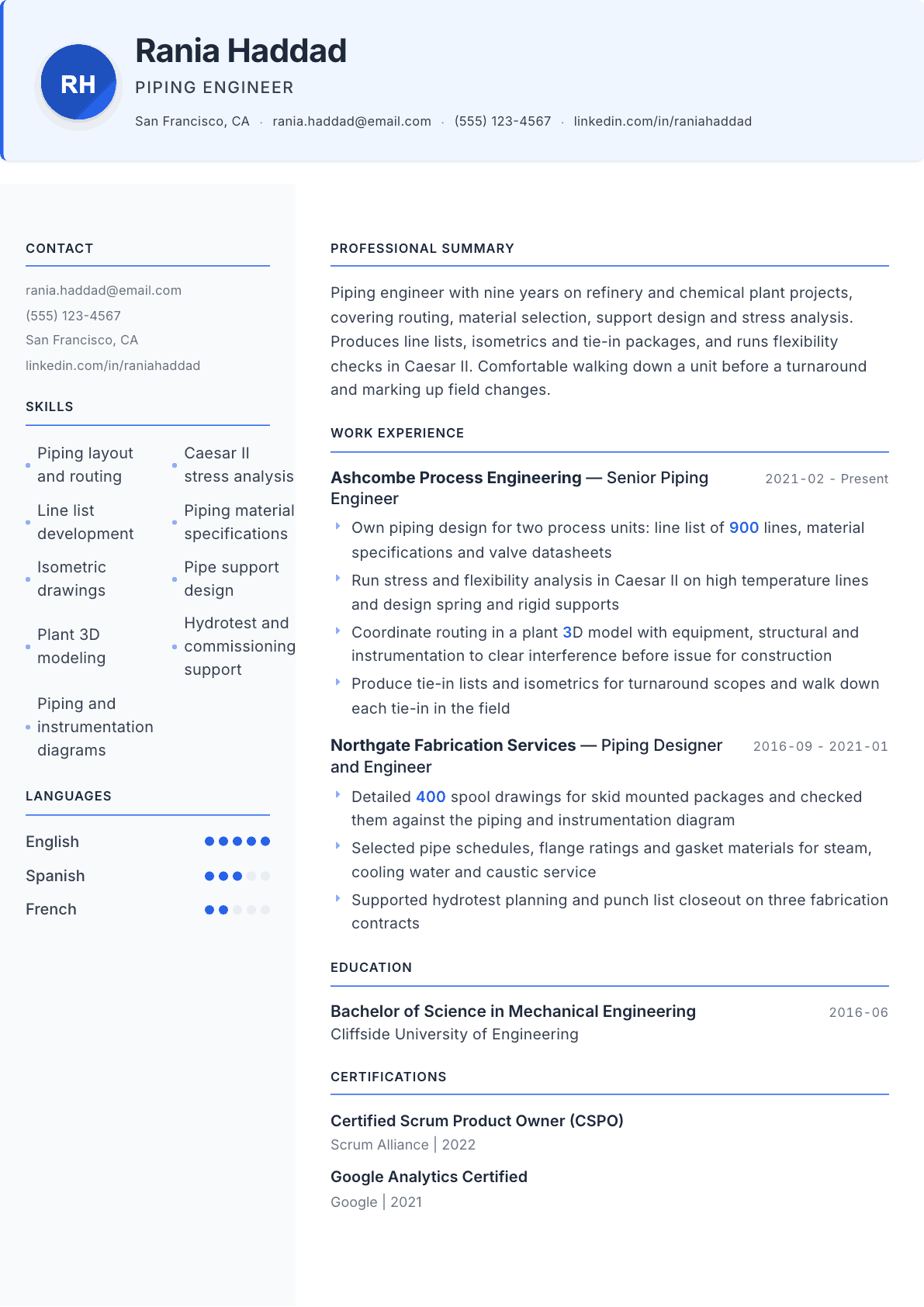
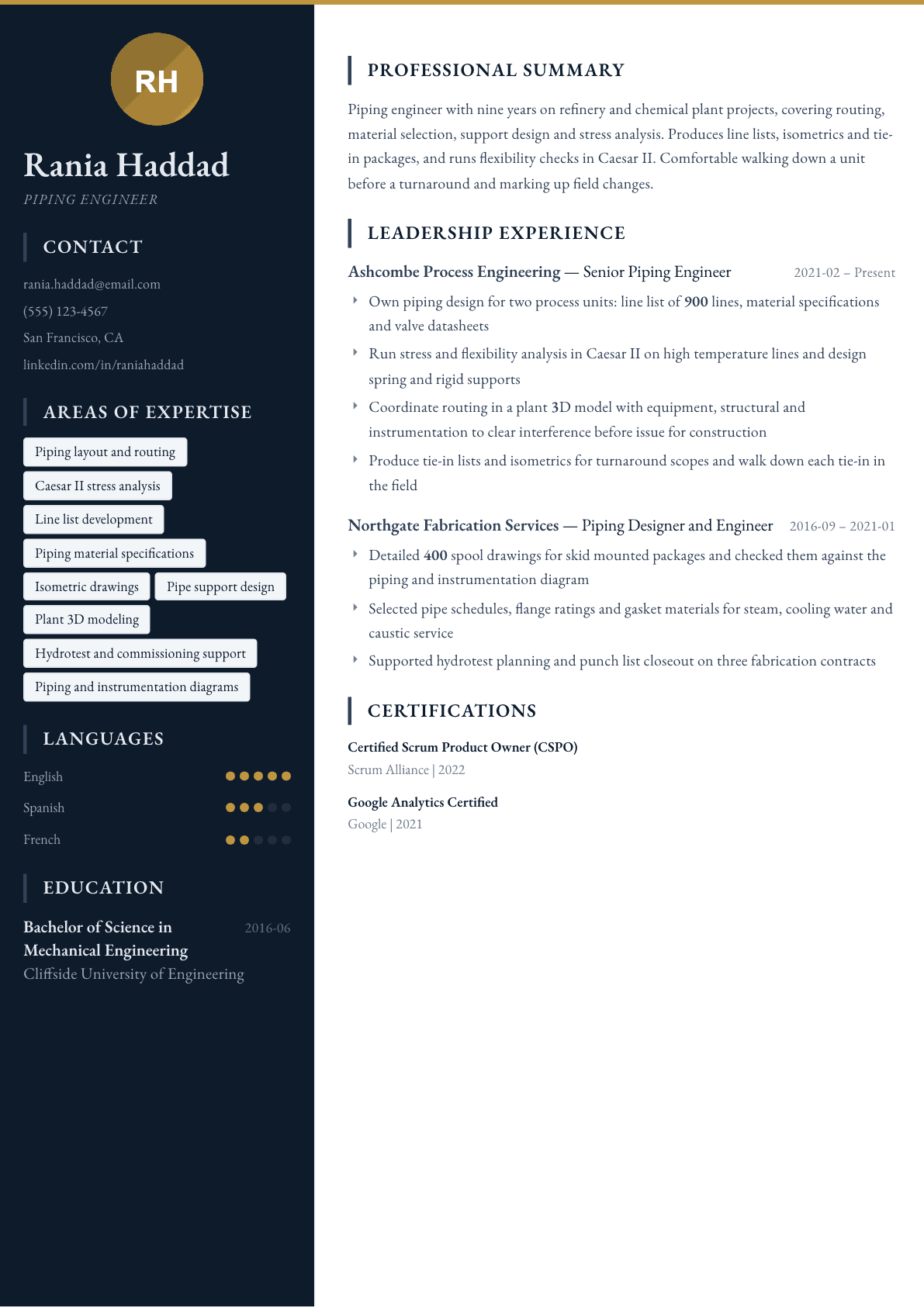
Example Piping Engineer summary
Piping engineer with nine years on refinery and chemical plant work, from routing and material specification through stress analysis and field walkdowns. Maintains line lists and isometric packages, runs flexibility checks on hot lines, and designs the supports that come out of them. Has closed out hydrotest and punch list scopes on live units during turnaround windows.
Skills to list on a Piping Engineer resume
- Piping layout and routing
- Stress and flexibility analysis
- Caesar II
- Piping material specifications
- Line list and valve list
- Isometric drawing production
- Pipe support design
- Plant 3D and PDMS modeling
- Piping and instrumentation diagrams
- Flange rating and gasket selection
- Tie-in packages
- Hydrotest planning
- Turnaround scope development
- Vendor and fabrication coordination
- Field walkdowns
What actually gets this resume read
- Name the industries you have piped: refining, chemicals, power, pharmaceutical, water, because the codes differ.
- Say which stress package you use and what kinds of lines you have analyzed for flexibility.
- Quantify by line count, spool count or unit size rather than by how many projects you touched.
- Show that you read a piping and instrumentation diagram and can trace a line from vessel to pump.
- Include field work: walkdowns, tie-in verification, hydrotest witnessing and punch list closeout.
- List the design codes you work to by name, and only the ones you have actually applied.
How to write a piping engineer resume
Piping is one of the few engineering disciplines where the hiring decision turns almost entirely on which plants you have worked in. A refinery lead reads a resume looking for hydrocarbon service, hot lines and turnaround exposure. A pharmaceutical project manager reads for hygienic tubing, slope requirements and cleanability. The word piping appears on both resumes and means very different work.
The second thing a lead looks for is whether you are a design engineer or a designer who drew what an engineer specified. Both are real jobs and both are hired, but the resume has to be honest about which, because the interview will find out in the first ten minutes when someone asks how you set a spring hanger cold load.
This guide covers how to organize a piping engineer resume around units and deliverables, what to say about stress work, how to present field and turnaround experience, and the questions that come up when moving between industries or from design office to site.
Format: organize by plant and unit, not by job title
Reverse chronological employers, but inside each one, break the work down by project and unit. Give the plant type, the unit, the service and the phase. A line such as crude unit revamp, hot lines to 700 degrees Fahrenheit, front end engineering through issue for construction, tells a reviewer more than a paragraph of duties.
Two pages is standard once you have a few projects. Put a deliverables line near the top listing what you personally produce: line lists, piping material specifications, isometrics, support drawings, tie-in lists, stress reports. Leads hire against deliverables.
- Header: name, city, phone, email, license status and any specialty design code experience.
- Sections: summary, industries and codes, software, project experience by unit, education.
- Contract and site-based candidates add an availability and travel line near the top.
Summary: industry, service conditions, and where you sit in the workflow
Name the industries, the pressure and temperature range you are used to, and the part of the workflow you own. Someone who routes, specifies material, analyzes stress and issues support drawings is a full scope piping engineer. Someone who checks isometrics against the piping and instrumentation diagram is doing valuable but different work.
If you cross industries, name what transfers. Material selection logic for corrosive service moves from chemicals into water treatment cleanly, and saying so is stronger than leaving the reader to assume it does not.
Stress and flexibility: be specific or leave it out
Stress analysis is the fastest credibility check in a piping interview. If you run it, say what you analyze and to which code: thermal expansion on hot lines, occasional loads, nozzle load compliance against equipment allowables, spring hanger selection and cold load setting, and support design that came out of the run.
If your role is to hand lines to a stress group and act on their markups, say that instead. Claiming analysis you have not personally run is the single most common way a piping engineer loses an interview, because the follow-up question is always about a specific case you would have had to solve.
- State the analysis package you use and the volume of lines you have analyzed.
- Name the load cases: sustained, thermal, occasional, wind and seismic where applicable.
- Mention nozzle load checks against pump, vessel and exchanger allowables.
Materials, codes and specifications
Material selection is a large part of the job and is usually underwritten on resumes. Say which services you have specified for: steam, cooling water, caustic, acid, hydrocarbon, cryogenic, hygienic. Then say what you selected: pipe schedule and material grade, flange rating and facing, gasket and bolting, valve types and trim, and insulation and tracing where it applies.
Name the design codes you have actually worked to and the project where you applied them. A reviewer will trust one code named with a concrete application more than a list of six that reads copied from a course syllabus.
Field work: walkdowns, tie-ins and turnarounds
Office-only piping engineers are common, so field experience is worth putting where it will be seen. Walkdowns before a tie-in, verification of existing line routing against outdated drawings, hydrotest planning and witnessing, punch list closeout and support of a turnaround window all show that you understand what happens to your drawings after they leave.
If you have worked live plant scopes, say so plainly, along with the permits and safety requirements you worked under. A lead planning a turnaround wants to know you have been in that environment before the clock started.
Piping Engineer resume summary examples
Graduate piping engineer
Mechanical engineering graduate with an internship in a process design office, building line lists, checking 90 isometrics against process diagrams and learning piping material specification structure. Trained on plant 3D modeling. Seeking a graduate piping engineer role in chemicals or water treatment.
Five years in
Piping engineer with five years on chemical plant projects, covering routing, material specification and support design for a line list of 600 lines. Runs flexibility analysis on hot and cryogenic services, issues isometrics and tie-in packages, and walks down field scopes before construction.
Lead piping engineer
Lead piping engineer with fourteen years across refining and petrochemicals, responsible for full unit scope from front end design through construction support. Owns piping material specifications, stress strategy and nozzle load resolution, coordinates a team of five designers, and leads turnaround tie-in planning.
Work experience bullets: before and after
Before: Responsible for piping design on process projects.
After: Owned piping design for two process units, including a 900 line list, piping material specifications, valve datasheets and the issue for construction isometric package.
Naming the deliverables and the line count tells a lead exactly what scope you can be handed.
Before: Did pipe stress analysis.
After: Analyzed 120 hot lines for sustained, thermal and occasional load cases, resolved two exchanger nozzle overloads by re-routing, and set spring hanger cold loads.
Line count, load cases and a resolved nozzle problem show real analysis instead of a software mention.
Before: Selected piping materials.
After: Specified pipe schedule, flange rating, gasket and valve trim for steam, cooling water and caustic services, and issued three new piping material classes.
Services and specific selections prove material judgment, which is where corrosion failures are prevented.
Before: Coordinated with other disciplines.
After: Cleared routing interference with structural, electrical and instrumentation inside the plant 3D model before issue for construction, closing 140 clash reports.
A clash count and a milestone show coordination that actually reached resolution.
Before: Supported plant turnarounds.
After: Walked down 60 tie-ins against as-built conditions, corrected 9 that did not match the drawings, and produced the isometric and hydrotest packages for the outage window.
Field verification and the corrections found are the piping work a turnaround manager values most.
Hard skills
- Piping layout and routing
- Piping material specifications
- Line list development
- Isometric production and checking
- Stress and flexibility analysis
- Caesar II
- Pipe support design
- Nozzle load evaluation
- Plant 3D and PDMS modeling
- Piping and instrumentation diagram interpretation
- Tie-in packages
- Hydrotest planning
- Valve and specialty item selection
- Field walkdowns
Soft skills
- Discipline coordination
- Vendor management
- Constructability thinking
- Clear markup and redlining
- Turnaround pressure handling
- Squad check participation
Certifications worth listing
- Professional Engineer (PE), Mechanical (State board of professional engineers)
- Fundamentals of Engineering (FE) (National Council of Examiners for Engineering and Surveying)
- API 570 Piping Inspector (American Petroleum Institute)
- Certified Welding Inspector (CWI) (American Welding Society)
- PMP (Project Management Institute)
Mistakes that cost piping engineer candidates the interview
- Leaving the industry off, so a refinery lead cannot tell whether your experience is hydrocarbon or municipal water.
- Claiming stress analysis you have never run yourself, which collapses under the first specific interview question.
- Listing software instead of deliverables, when leads staff projects by who can issue a line list and an isometric package.
- Describing project value in money terms rather than in units, line counts and service conditions.
- Omitting field walkdowns and turnaround work, which is the experience that distinguishes a site-ready piping engineer.
- Naming a long list of design codes without a single project where you applied one of them.
- Blurring designer and engineer scope, which wastes everyone's time when the technical screen begins.
Piping Engineer resume questions
What is the difference between a piping engineer and a piping designer?
The designer models and details the layout, produces isometrics and manages the drawing package. The engineer sets material specifications, service conditions, support philosophy and stress requirements, and carries technical responsibility. Many people do both, so state which parts you own.
How important is Caesar II experience on a piping resume?
For engineering positions in process industries it is often the first filter, because flexibility analysis governs routing decisions. If you have used another stress package, name it and describe the load cases you ran so a reviewer can judge the transfer.
How do I move from fabrication or site work into a piping design office?
Lead with constructability knowledge, spool detailing, weld types and hydrotest experience, then show the design side: software you model in, specifications you have read closely, and any formal engineering study. Field background is a genuine advantage once the office skills are visible.
Should I list projects by client name?
Only when your agreements allow it. Otherwise describe the plant type, unit and scope: a chemical plant expansion, two reactor units, front end design through construction support. Reviewers care about the process conditions far more than the logo.
How do I show turnaround experience on a resume?
Give the outage window, the scope you owned, and what you produced before and during it. Tie-in counts, walkdown findings, hydrotest packages and punch list closeout tell a turnaround planner that you have worked to a shutdown clock rather than a project schedule.
Related resume examples
- Mechanical Engineer Resume example
- Process Engineer Resume example
- Pipeline Engineer Resume example
- Plant Engineer Resume example
- Product Engineer Resume example
- HVAC Engineer Resume example