Echocardiography Salary: BLS Pay by State and 8 Examples

The median annual wage for diagnostic medical sonographers, the federal occupation that includes cardiac sonographers and echocardiographers, was $96,590 in May 2025, according to the U.S. Bureau of Labor Statistics. The one condition that moves the number most is location: the BLS state estimates put the annual mean at $126,610 in California and $88,940 in Texas for the same occupation. The figures come from the BLS Occupational Employment and Wage Statistics program for occupation 29-2032 and the BLS Occupational Outlook Handbook. Below are the national percentiles, a state table, pay by industry, the RDCS credential path and eight worked examples you can reuse for an offer, a raise or a resume.
An echo tech can measure an ejection fraction to the percent while the patient is still breathing on the table. The same person is usually told their own pay band "depends on experience", which is not a measurement of anything. This page replaces that phrase with numbers.
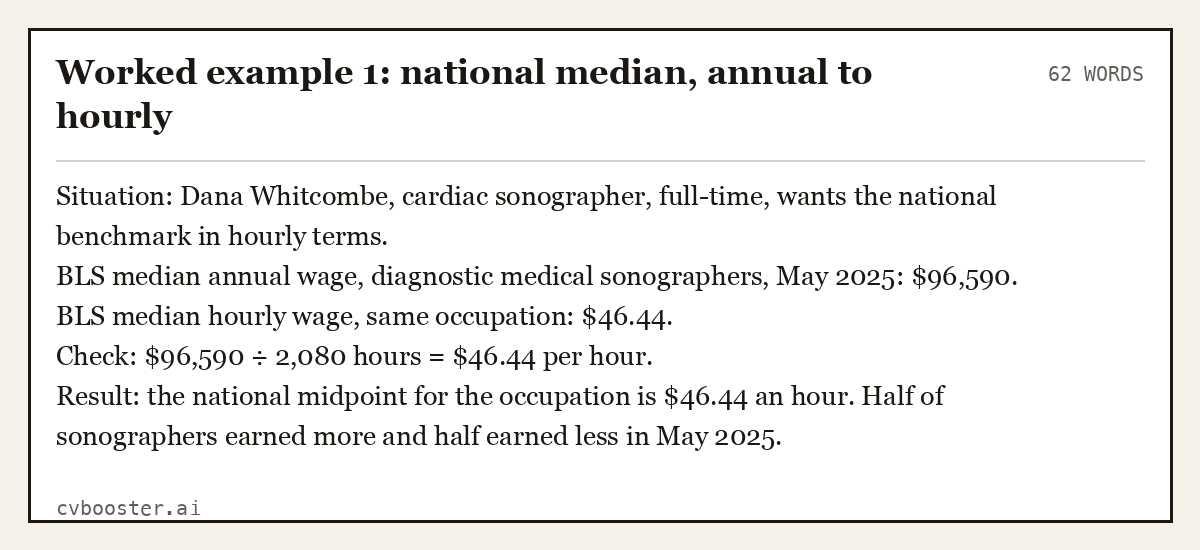
Worked example 1: national median, annual to hourly
62 wordsSituation: Dana Whitcombe, cardiac sonographer, full-time, wants the national benchmark in hourly terms. BLS median annual wage, diagnostic medical sonographers, May 2025: $96,590. BLS median hourly wage, same occupation: $46.44. Check: $96,590 ÷ 2,080 hours = $46.44 per hour. Result: the national midpoint for the occupation is $46.44 an hour. Half of sonographers earned more and half earned less in May 2025.
Create my CVOr start from one of our free resume templates
What the BLS counts as an echocardiography job
The BLS does not publish a separate wage line called "echocardiographer." Cardiac sonographers are described inside the diagnostic medical sonographer occupation, code 29-2032. The Occupational Outlook Handbook says that cardiac sonographers "specialize in imaging a patient's heart," and that they "use ultrasound equipment to examine the heart's chambers, valves, and vessels."
The same occupation also includes obstetric and gynecologic sonographers, who, in the Handbook's words, "specialize in imaging the female reproductive system." Abdominal, vascular and musculoskeletal sonographers are in the same code. That matters for anyone reading these numbers: the BLS figures describe sonographers as a whole, and an echo-only figure does not exist in federal data. When a website quotes a precise "echo tech salary" that differs from these numbers, ask where it came from.
The practical consequence is simple. Use the 29-2032 figures as your benchmark, then adjust for the two things the data does show clearly: the state you work in and the type of employer.
National pay: percentiles from the May 2025 survey
The OEWS program surveys employers and reports wages for wage and salary workers. The table shows the national estimates for diagnostic medical sonographers from the May 2025 survey, the most recent release.
| Measure, diagnostic medical sonographers (29-2032), May 2025 | Value |
|---|---|
| Employment (OEWS) | 90,160 |
| Mean hourly wage | $46.75 |
| Mean annual wage | $97,240 |
| 10th percentile, annual | $67,820 |
| 25th percentile, annual | $80,430 |
| Median, annual | $96,590 |
| Median, hourly | $46.44 |
| 75th percentile, annual | $106,930 |
| 90th percentile, annual | $129,370 |
The Handbook states the spread in one sentence: "The lowest 10 percent earned less than $67,820, and the highest 10 percent earned more than $129,370." The middle half of the occupation, from the 25th to the 75th percentile, earned between $80,430 and $106,930. That band of $26,500 held the middle half of all sonographers in the survey.
The mean, $97,240, sits only $650 above the median. In many occupations a few very high earners pull the mean far above the median. In sonography the distribution is fairly balanced, which means the median is a fair description of typical pay in the occupation.
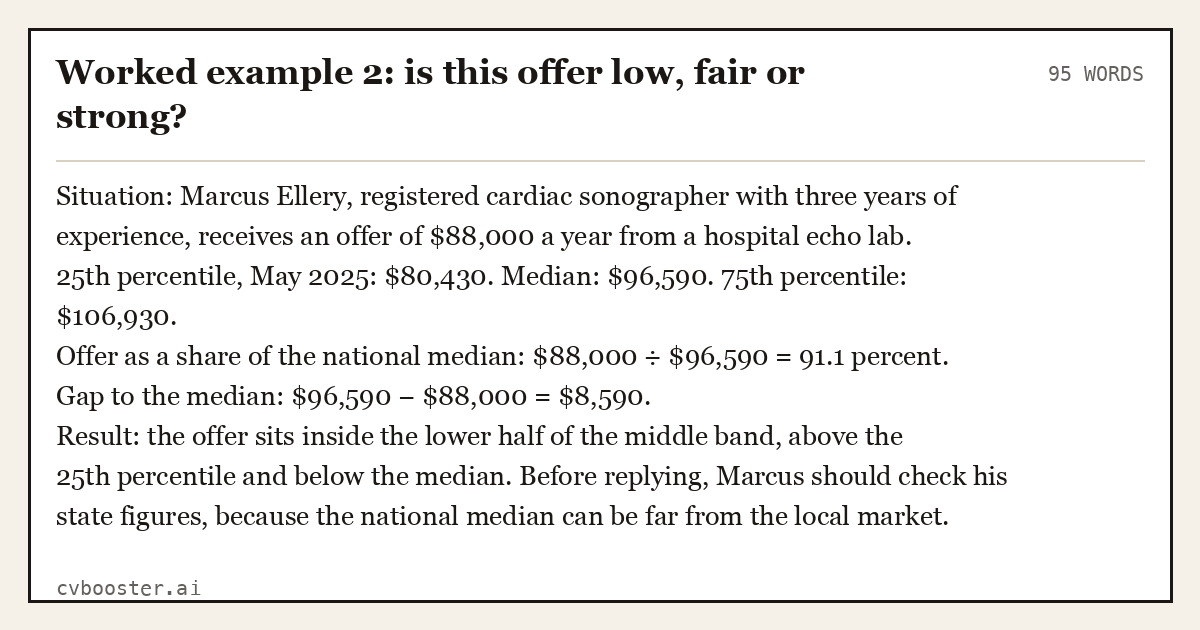
Worked example 2: is this offer low, fair or strong?
95 wordsSituation: Marcus Ellery, registered cardiac sonographer with three years of experience, receives an offer of $88,000 a year from a hospital echo lab. 25th percentile, May 2025: $80,430. Median: $96,590. 75th percentile: $106,930. Offer as a share of the national median: $88,000 ÷ $96,590 = 91.1 percent. Gap to the median: $96,590 − $88,000 = $8,590. Result: the offer sits inside the lower half of the middle band, above the 25th percentile and below the median. Before replying, Marcus should check his state figures, because the national median can be far from the local market.
Echocardiography salary by state
State estimates show the largest differences in the data. The table lists eight large states from the BLS OEWS May 2025 state estimates for occupation 29-2032, with employment, annual mean and annual median.
| State, May 2025 | Employment | Annual mean wage | Annual median wage |
|---|---|---|---|
| California | 10,110 | $126,610 | $128,530 |
| Washington | 2,190 | $115,060 | $121,340 |
| Massachusetts | 2,190 | $113,410 | $107,480 |
| New York | 6,880 | $104,990 | $103,920 |
| Illinois | 3,270 | $98,730 | $100,660 |
| Texas | 6,960 | $88,940 | $92,580 |
| Pennsylvania | 2,980 | $86,130 | $82,710 |
| Florida | 6,670 | $85,990 | $82,940 |
California had the most sonographers in this table and the highest wages: its median, $128,530, was $31,940 above the national median. Washington's median of $121,340 was the second highest. At the other end, Pennsylvania and Florida had medians below $83,000, about $14,000 under the national median.
The state gap is large enough to change career decisions. A sonographer at the California median earned $45,820 more than one at the Pennsylvania median. The BLS data does not adjust for living costs. If you are comparing a relocation, compare the salary difference with your own housing and tax costs, not with a national average.
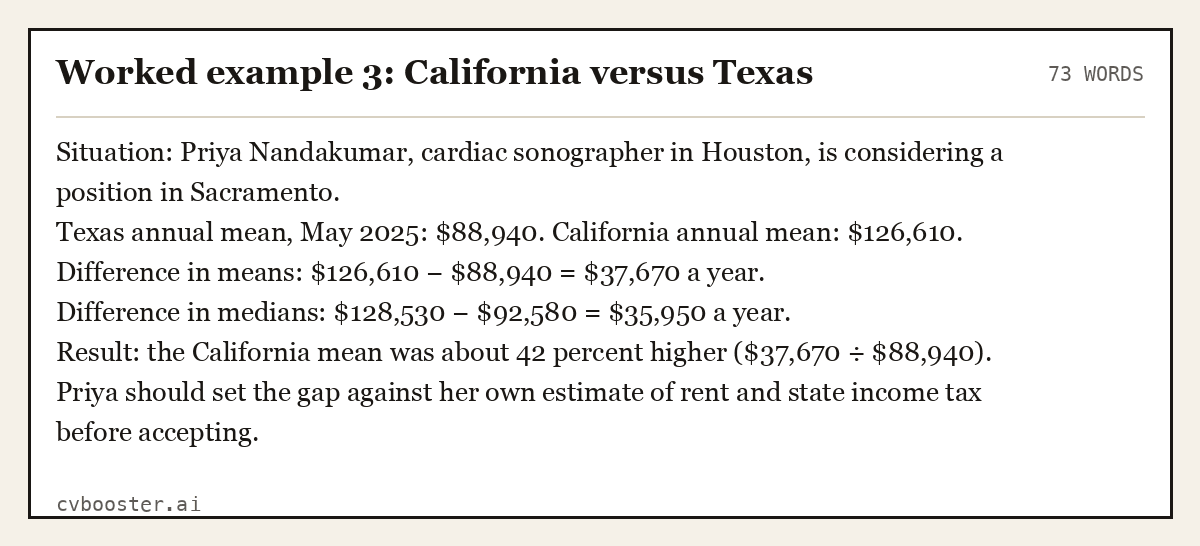
Worked example 3: California versus Texas
73 wordsSituation: Priya Nandakumar, cardiac sonographer in Houston, is considering a position in Sacramento. Texas annual mean, May 2025: $88,940. California annual mean: $126,610. Difference in means: $126,610 − $88,940 = $37,670 a year. Difference in medians: $128,530 − $92,580 = $35,950 a year. Result: the California mean was about 42 percent higher ($37,670 ÷ $88,940). Priya should set the gap against her own estimate of rent and state income tax before accepting.
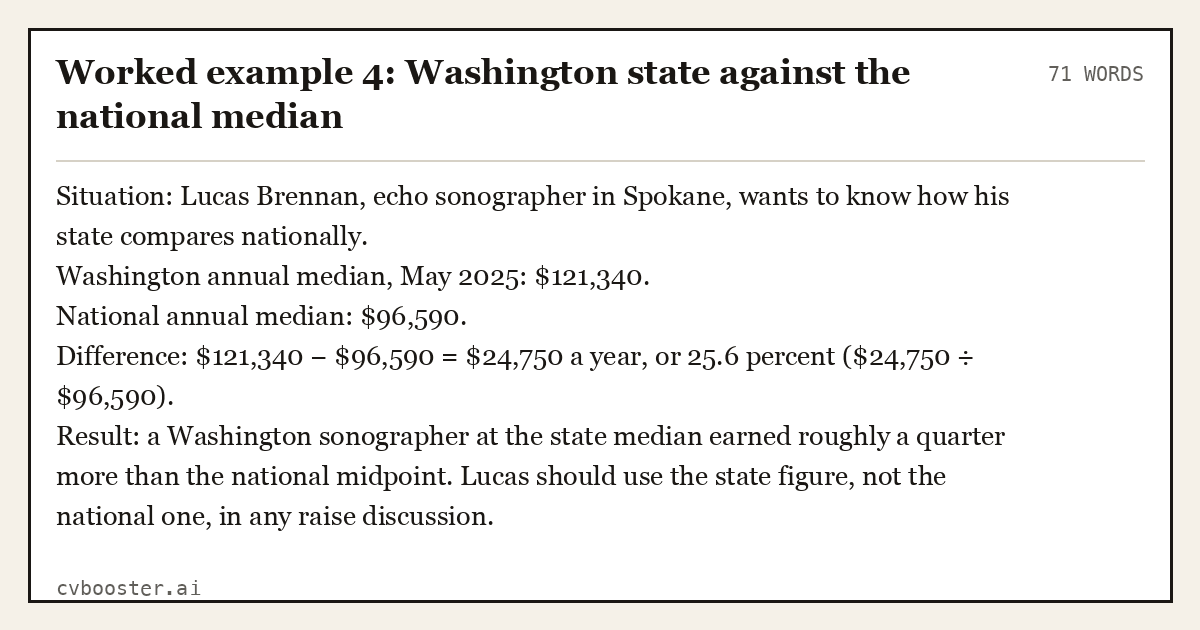
Worked example 4: Washington state against the national median
71 wordsSituation: Lucas Brennan, echo sonographer in Spokane, wants to know how his state compares nationally. Washington annual median, May 2025: $121,340. National annual median: $96,590. Difference: $121,340 − $96,590 = $24,750 a year, or 25.6 percent ($24,750 ÷ $96,590). Result: a Washington sonographer at the state median earned roughly a quarter more than the national midpoint. Lucas should use the state figure, not the national one, in any raise discussion.
Pay by type of employer
The Handbook lists median annual wages for sonographers in the largest industries. In its words, these are "the median annual wages for diagnostic medical sonographers in some of the top industries" in May 2025.
| Industry, May 2025 | Median annual wage |
|---|---|
| Outpatient care centers | $127,940 |
| Administrative and support services | $100,350 |
| Hospitals; state, local, and private | $97,390 |
| Offices of physicians | $95,220 |
| Medical and diagnostic laboratories | $87,580 |
Outpatient care centers paid the highest median, $127,940, which was $30,550 above hospitals. Administrative and support services came second at $100,350. Hospitals, where many echo labs sit, were close to the national median at $97,390.
For an echocardiographer, the employer type usually means a specific trade-off. Hospital echo labs often include call, inpatient studies and stress echo. Outpatient cardiology centers and physician offices tend to run scheduled studies. Agency and travel roles are another option, and their pay terms vary by contract. The BLS figures give the median for each group; the trade-offs in hours and call are yours to weigh.
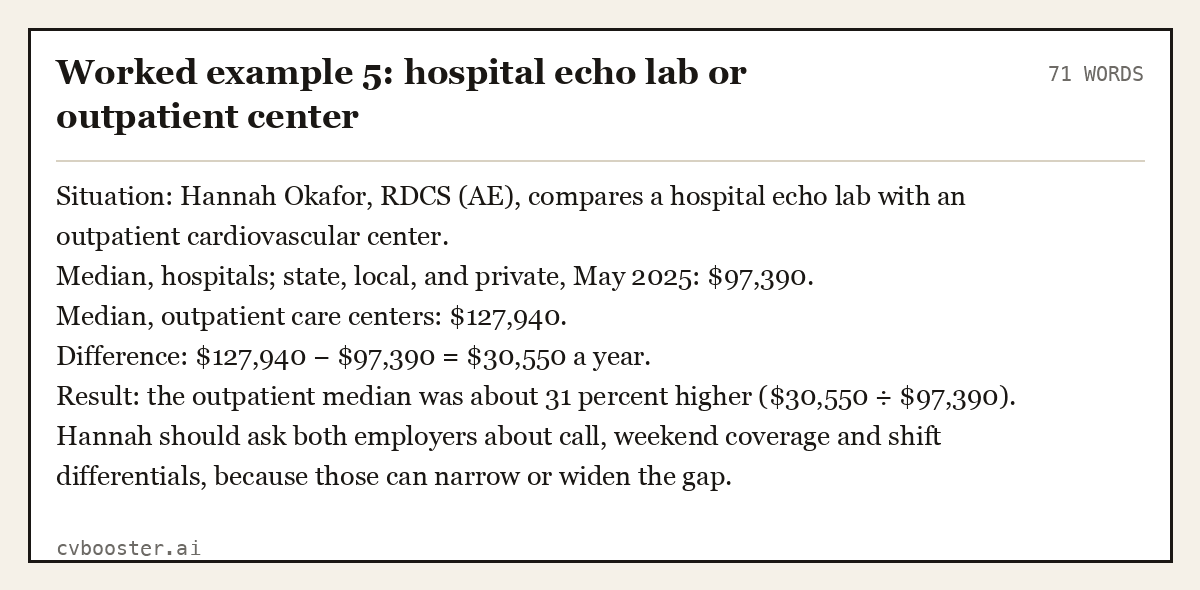
Worked example 5: hospital echo lab or outpatient center
71 wordsSituation: Hannah Okafor, RDCS (AE), compares a hospital echo lab with an outpatient cardiovascular center. Median, hospitals; state, local, and private, May 2025: $97,390. Median, outpatient care centers: $127,940. Difference: $127,940 − $97,390 = $30,550 a year. Result: the outpatient median was about 31 percent higher ($30,550 ÷ $97,390). Hannah should ask both employers about call, weekend coverage and shift differentials, because those can narrow or widen the gap.
Credentials: what RDCS requires and why it matters for pay
The Handbook explains the credential landscape briefly: "Some sonographers need a license or certification." It adds that "Employers may require or prefer that these workers earn professional certification" and that "Some diagnostic medical sonographers need a state-issued license." In echocardiography, a widely used credential is the Registered Diagnostic Cardiac Sonographer, RDCS, administered by ARDMS.
The ARDMS RDCS page states the requirement plainly: "RDCS certification requires the SPI exam and one cardiac specialty exam." The specialty exams listed are Adult Echocardiography (AE), Fetal Echocardiography (FE) and Pediatric Echocardiography (PE). ARDMS describes the SPI exam this way: "The SPI exam is the foundation for all ARDMS certifications. It tests your knowledge of basic sonography principles and ability with instrumentation."
Why does this matter for salary? The BLS does not publish wages by credential, so no federal number shows the exact premium. What the data does show is that employers may require certification, and a requirement you do not meet removes you from that offer altogether. Earning the RDCS keeps the whole market open to you. A second specialty, such as pediatric echo, can open roles that fewer candidates can fill.
Obstetric sonographers follow a different ARDMS credential path, listed on the ARDMS website. The pay data for obstetric sonographers is the same 29-2032 data as for echo, because the BLS counts them in one occupation.
Education and the path into the field
The Handbook says that "Diagnostic medical sonographers typically need at least an associate's degree or a postsecondary certificate." It also notes that "Two- and 4-year colleges and universities offer associate's and bachelor's degree programs in sonography." The typical entry-level education it lists is an associate's degree.
Many echocardiographers enter through a cardiac or cardiovascular sonography program, then sit for the SPI exam and the adult echocardiography exam. Others start in general sonography and add cardiac training. Either way, the entry-level education is relatively short for an occupation with a median above $96,000.
Job outlook: growth through 2035
The Handbook projects strong demand: "Employment of diagnostic medical sonographers is projected to grow 14 percent from 2025 to 2035, much faster than the average for all occupations." It lists 92,200 jobs in 2025 and a projected employment change of 12,900 over the decade.
Note the two employment numbers on this page. The OEWS survey counted 90,160 wage and salary sonographers in May 2025, while the Handbook lists 92,200 jobs in 2025. The two programs measure employment in different ways, so the counts do not match exactly. For salary comparisons, use the OEWS wages; for career planning, use the Handbook's projections.
A growing occupation tends to favor the worker in negotiations. If an employer has struggled to fill an echo position, that is information you can use when you discuss pay, sign-on terms or schedule.
Negotiating an echo sonographer salary
A salary conversation goes better with three numbers prepared in advance: your state median, the industry median for the employer type and the national 75th percentile. For most experienced echo sonographers, the strongest argument is a specific one: credentials held, study types performed independently and any stress, TEE assist, pediatric or fetal experience.
- Use your state figure first. The national median is a poor anchor in California or Florida. Quote the BLS state median for 29-2032.
- Name the employer type. Outpatient care centers and administrative and support services had higher medians than hospitals in May 2025.
- List study types. Transthoracic, stress echo, TEE assist, contrast studies, pediatric or fetal echo.
- State your credentials. RDCS with AE, plus any second specialty or RVT.
- Ask about the full package. Call pay, shift differentials, weekend rates and continuing education support change the real value of an offer.
Put the proposal in writing, with a number. Asking for market rate gives the employer nothing to agree to. Asking for $104,000, based on the state median and your RDCS with two specialties, does.
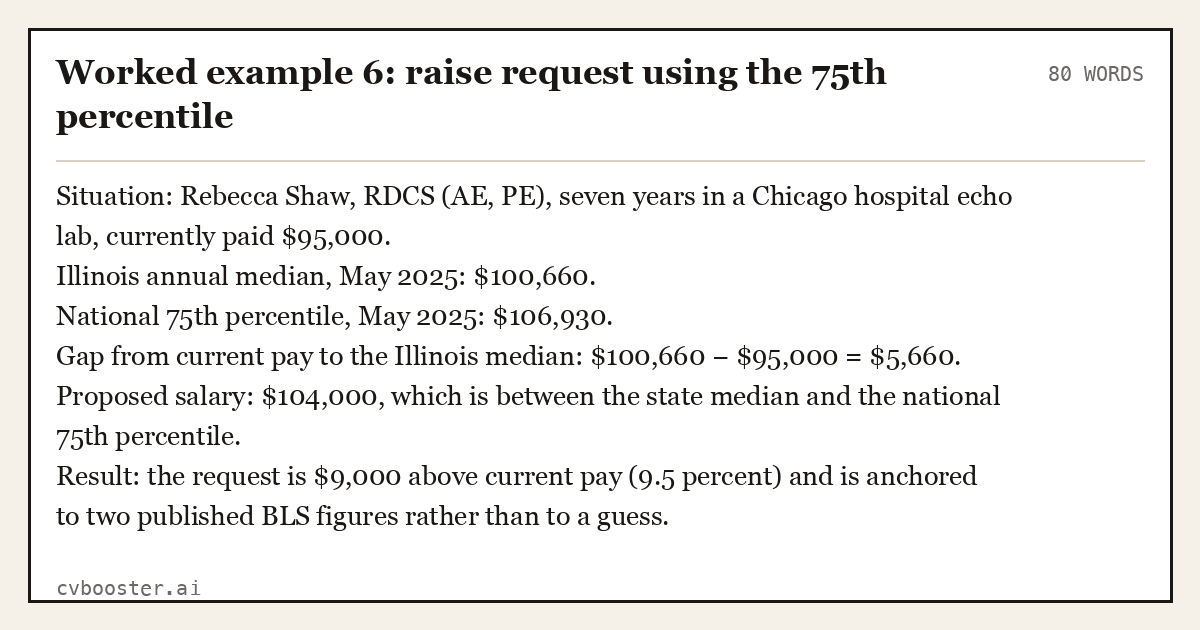
Worked example 6: raise request using the 75th percentile
80 wordsSituation: Rebecca Shaw, RDCS (AE, PE), seven years in a Chicago hospital echo lab, currently paid $95,000. Illinois annual median, May 2025: $100,660. National 75th percentile, May 2025: $106,930. Gap from current pay to the Illinois median: $100,660 − $95,000 = $5,660. Proposed salary: $104,000, which is between the state median and the national 75th percentile. Result: the request is $9,000 above current pay (9.5 percent) and is anchored to two published BLS figures rather than to a guess.
Eight examples at a glance
| Example | Situation | Result |
|---|---|---|
| 1 | National median, annual to hourly | $46.44 an hour |
| 2 | Offer check against percentiles | $8,590 below median |
| 3 | California versus Texas | +$37,670 mean |
| 4 | Washington versus national | +25.6% |
| 5 | Hospital versus outpatient center | +$30,550 median |
| 6 | Raise request in Illinois | $104,000 proposal |
| 7 | Resume credential line | ready line |
| 8 | Salary expectation email | ready email |
Putting the numbers on your resume and in your application
A cardiac sonographer resume does not need a salary figure, but it should make the pay case for you before anyone asks. Put the credential and specialties in the headline, then list the study types and the volume you handle. A line that names the credential, the yearly study volume and the study types, such as stress echo and TEE assist, tells a hiring manager more about your value than "experienced echo tech."
For the salary question itself, see our guides on salary requirements and how to negotiate salary. The medical resume examples show how to structure a clinical resume, the healthcare cover letter examples cover the letter, and the sonographer resume example shows a finished document for this occupation. If you are comparing allied health careers, our guide to nurse assistant salary uses the same BLS method. When your credentials and study types are on the page, an employer can place you in the upper half of the range without a long negotiation, and you can build that resume in our editor: signing in, filling any template and the ATS score are free.
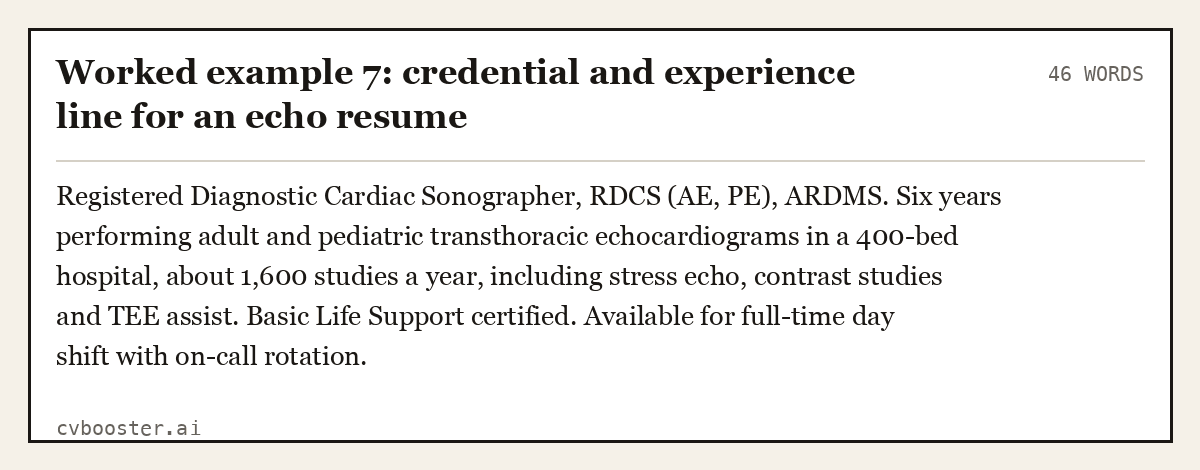
Worked example 7: credential and experience line for an echo resume
46 wordsRegistered Diagnostic Cardiac Sonographer, RDCS (AE, PE), ARDMS. Six years performing adult and pediatric transthoracic echocardiograms in a 400-bed hospital, about 1,600 studies a year, including stress echo, contrast studies and TEE assist. Basic Life Support certified. Available for full-time day shift with on-call rotation.
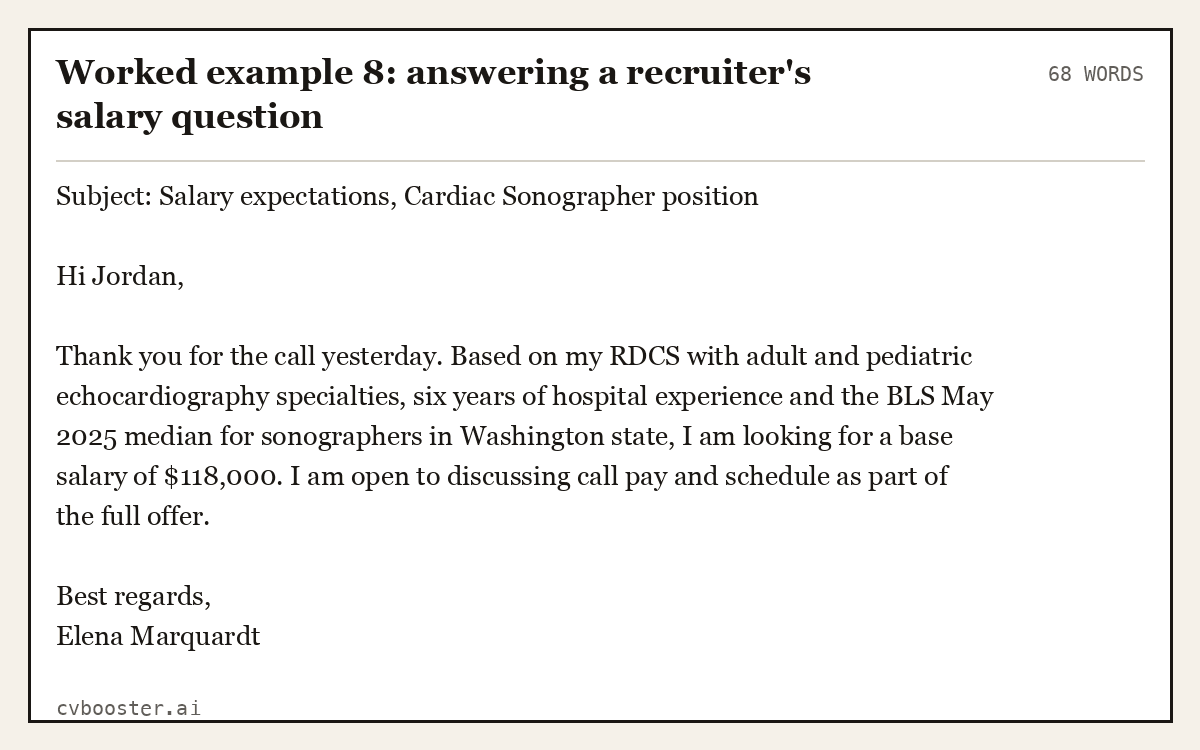
Worked example 8: answering a recruiter's salary question
68 wordsSubject: Salary expectations, Cardiac Sonographer position
Hi Jordan,
Thank you for the call yesterday. Based on my RDCS with adult and pediatric echocardiography specialties, six years of hospital experience and the BLS May 2025 median for sonographers in Washington state, I am looking for a base salary of $118,000. I am open to discussing call pay and schedule as part of the full offer.
Best regards, Elena Marquardt
Frequently asked questions
How much does an echocardiographer make?
The BLS does not publish a separate echocardiographer figure. Cardiac sonographers are counted in diagnostic medical sonographers, whose median annual wage was $96,590 in May 2025. The lowest 10 percent earned less than $67,820 and the highest 10 percent more than $129,370.
What is the hourly pay for an echo tech?
The BLS median hourly wage for diagnostic medical sonographers was $46.44 in May 2025, and the mean hourly wage was $46.75. Hourly pay varies by state: the California annual mean of $126,610 works out to about $60.87 an hour on a 2,080-hour year.
Which state pays cardiac sonographers the most?
Among the states in our table, California had the highest wages in May 2025, with an annual median of $128,530 and an annual mean of $126,610. Washington followed with a median of $121,340. Florida and Pennsylvania had medians below $83,000.
Do I need RDCS to work in echocardiography?
The BLS says employers may require or prefer professional certification, and some states require a license. ARDMS states that RDCS certification requires the SPI exam and one cardiac specialty exam, such as adult, fetal or pediatric echocardiography.
Is obstetric sonographer pay different from echo pay?
Federal data cannot show a difference, because the BLS counts obstetric, cardiac and other sonographers in one occupation, 29-2032. Their shared median was $96,590 in May 2025. Differences in actual pay come from state, employer type and credentials.
Is echocardiography a growing field?
Yes. The BLS projects employment of diagnostic medical sonographers to grow 14 percent from 2025 to 2035, much faster than the average for all occupations, an increase of about 12,900 jobs from 92,200 in 2025.
Looking for a worked example for your job title? Browse the resume examples by job title.