How to Become an Arborist: Steps, ISA Certification, Pay

To become an arborist, get hired on a tree care crew as a groundworker, learn to climb and prune on the job, build three years of full-time experience, and pass the ISA Certified Arborist exam. No degree is required, though a degree or training program in arboriculture shortens the experience you need. The constraint is that experience requirement: the ISA Certified Arborist program guide from the International Society of Arboriculture asks for three years of full-time experience or education plus experience. Below are the steps, the real pay, and six examples, including a complete arborist resume.
Most careers ask you to climb a ladder. This one hands you a harness and points at a 70-foot oak. The ladder is optional.
Step 1: Start as a groundworker
Almost every arborist starts on the ground. Groundworkers drag brush, run the chipper, manage the drop zone, handle ropes for the climber and keep the site safe. You do not need experience to get hired, but you need to be fit, reliable, and comfortable with early starts in any weather. A driver's license helps, and a commercial driver's license helps a lot.
The application can be short. Tree companies hire people who show up. Here is a message that gets a call back.
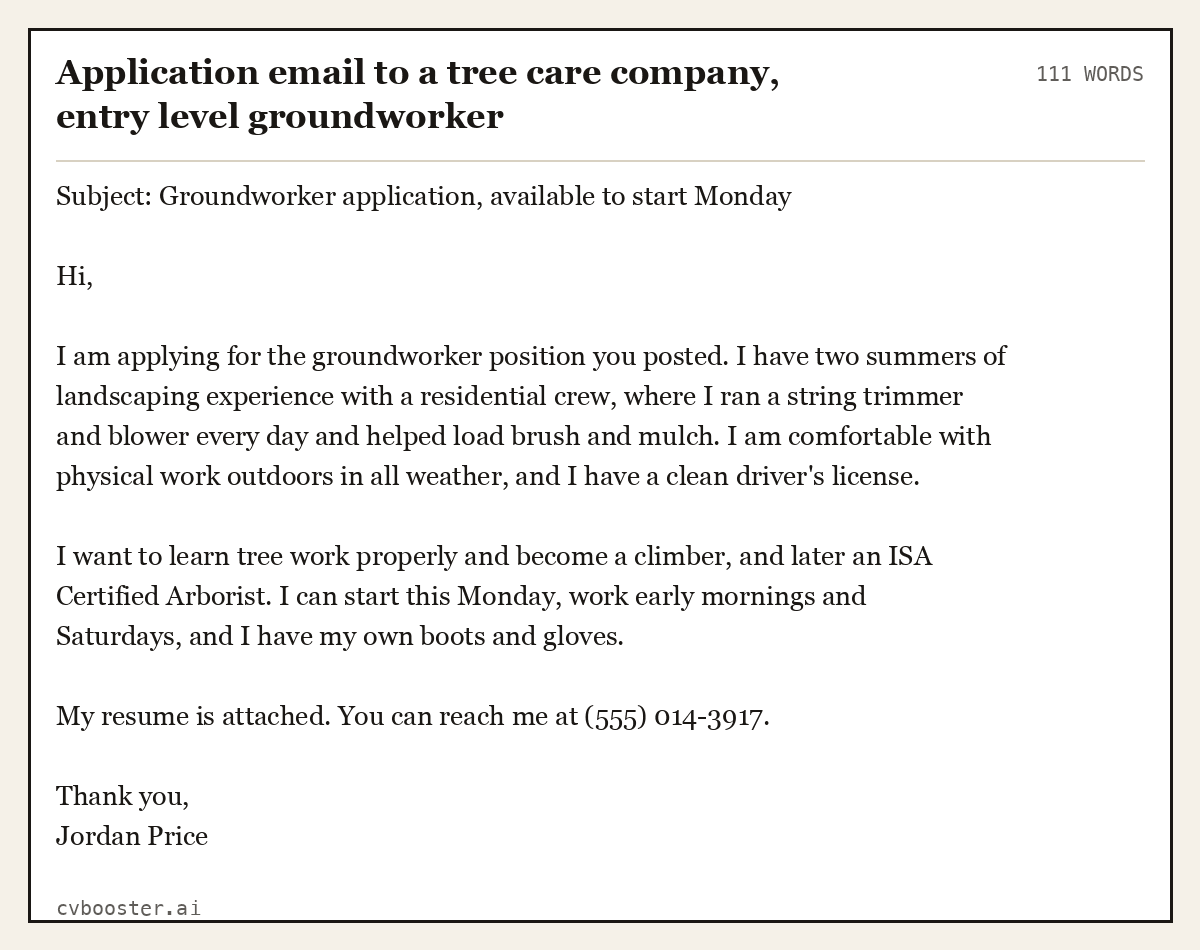
Application email to a tree care company, entry level groundworker
111 wordsSubject: Groundworker application, available to start Monday
Hi,
I am applying for the groundworker position you posted. I have two summers of landscaping experience with a residential crew, where I ran a string trimmer and blower every day and helped load brush and mulch. I am comfortable with physical work outdoors in all weather, and I have a clean driver's license.
I want to learn tree work properly and become a climber, and later an ISA Certified Arborist. I can start this Monday, work early mornings and Saturdays, and I have my own boots and gloves.
My resume is attached. You can reach me at (555) 014-3917.
Thank you, Jordan Price
Create my CVOr start from one of our free resume templates
Step 2: Learn safety first
Tree work is dangerous, and the first thing a good crew teaches you is safety. OSHA's tree care industry page collects its guidance on the biggest hazards, including falls, falling objects and electricity near power lines. Chainsaws and chippers add their own. The industry's safety standard is ANSI Z133, and pruning practice follows ANSI A300. Learn both names: employers look for them on a resume, and the ISA exam covers safe work practices.
A First Aid and CPR course is worth doing in your first season. Many crews require it.
Step 3: Learn to climb and prune
After a season or two on the ground, most companies start training groundworkers to climb. You learn knots, harness and rope systems, aerial rescue, pruning cuts and, later, rigging for removals. Some crews also train you on aerial lifts (bucket trucks).
The Bureau of Labor Statistics grounds maintenance workers page groups arborists with tree trimmers and pruners, and notes that tree workers must be comfortable working high off the ground. If you find out in week one that you hate heights, there are still plant health care and consulting routes, but most arborists climb at some point.
Step 4: Consider formal training (optional)
You do not need a degree, but education can count toward the ISA experience requirement. According to the ISA program guide, you can qualify with any of these:
| Route | Experience you also need |
|---|---|
| No degree | Three years of full-time arboriculture experience |
| Two-year associate degree with at least two arboriculture courses | Two years of full-time experience |
| Four-year bachelor's degree with at least four arboriculture courses | One year of full-time experience |
| 900 hours of assessed training (90 hours in arboriculture) | Two years of full-time experience |
| 1,800 hours of assessed training (180 hours in arboriculture) | One year of full-time experience |
The guide says one year of full-time experience is about 1,795 hours of work. Community colleges with horticulture, forestry or urban forestry programs are the usual place to get the courses.
Step 5: Pass the ISA Certified Arborist exam
The ISA Certified Arborist credential is the one employers ask for by name. The exam has 200 multiple-choice questions across 10 areas of knowledge, according to the ISA program guide, which also lists an application fee of $40 for ISA members and credential holders or $50 for others, and an exam enrollment fee of $295 for members or $369 for others. The same guide says certification is valid for three years, and you can renew by earning at least 30 continuing education units in that time and paying the recertification fee.
ISA's credentials page lists the next steps after you are certified, such as tree climber, utility specialist, tree risk assessment and Board Certified Master Arborist.
Some states also license tree work or arborists separately, so check your state's agriculture or environmental agency before you advertise services.
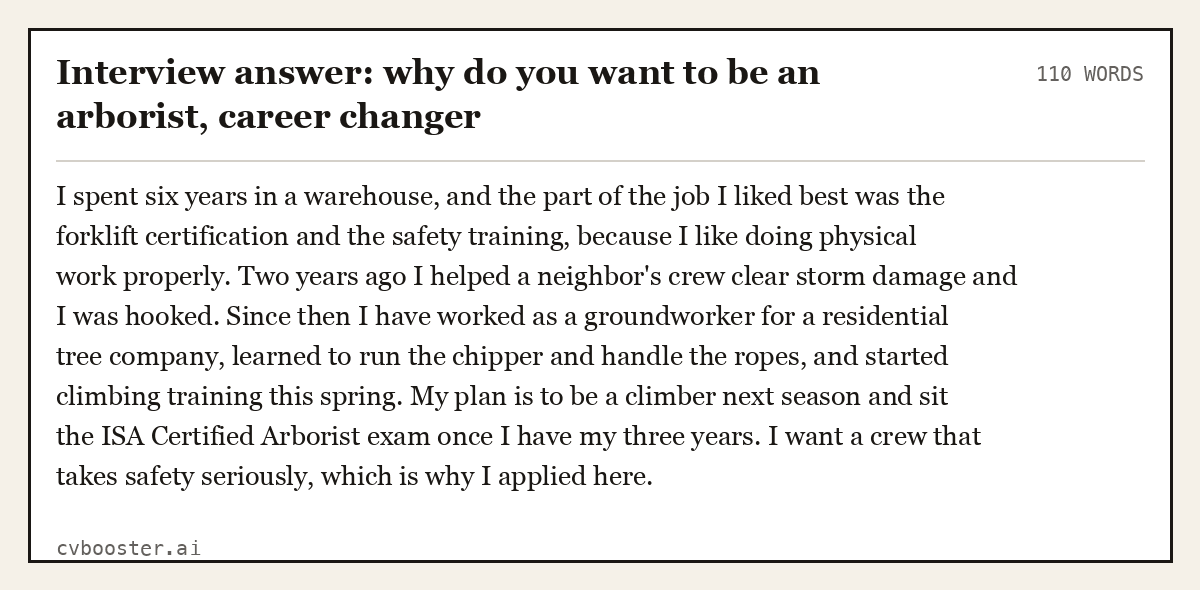
Interview answer: why do you want to be an arborist, career changer
110 wordsI spent six years in a warehouse, and the part of the job I liked best was the forklift certification and the safety training, because I like doing physical work properly. Two years ago I helped a neighbor's crew clear storm damage and I was hooked. Since then I have worked as a groundworker for a residential tree company, learned to run the chipper and handle the ropes, and started climbing training this spring. My plan is to be a climber next season and sit the ISA Certified Arborist exam once I have my three years. I want a crew that takes safety seriously, which is why I applied here.
What arborists earn
Tree trimmers and pruners, the group BLS uses for arborists, earned a May 2025 median of $24.50 an hour according to the BLS grounds maintenance workers page. That is a median: groundworkers usually start below it, and certified climbers, crew leaders, utility arborists and consulting arborists are where the higher pay sits. Overtime after storms is common. For more trades with strong pay, see our guide to well paid trades.
How to write an arborist resume
Arborist resumes are short and practical: certifications at the top, equipment you can run, and the work you do every day with numbers where you have them. Our arborist resume page has more versions, and the landscaper resume suits the step before.
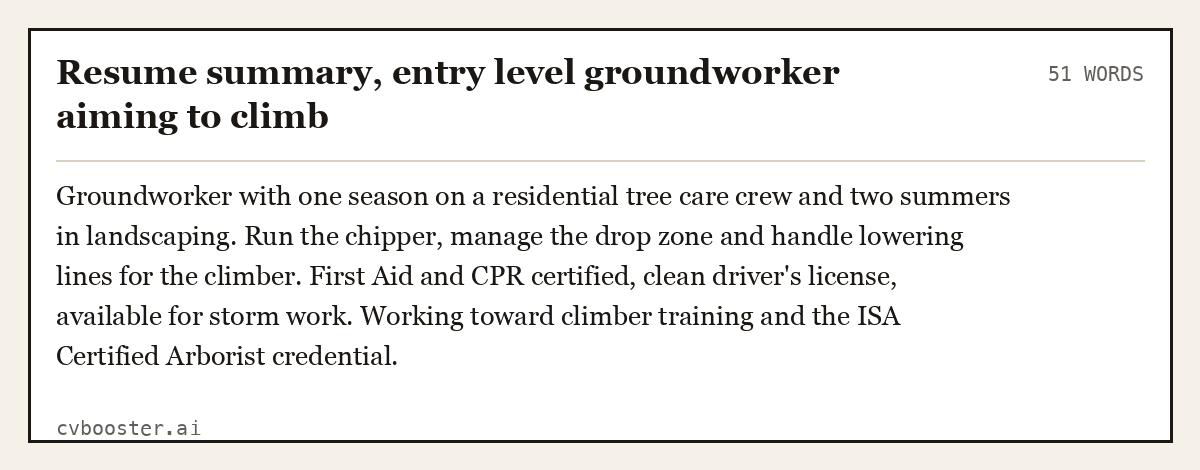
Resume summary, entry level groundworker aiming to climb
51 wordsGroundworker with one season on a residential tree care crew and two summers in landscaping. Run the chipper, manage the drop zone and handle lowering lines for the climber. First Aid and CPR certified, clean driver's license, available for storm work. Working toward climber training and the ISA Certified Arborist credential.
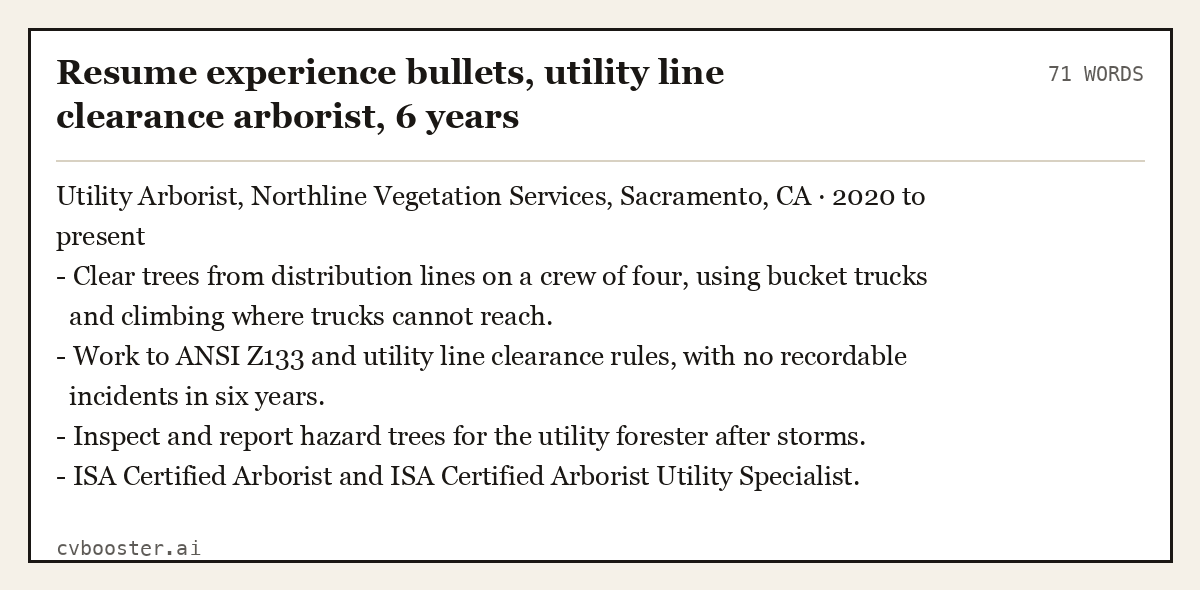
Resume experience bullets, utility line clearance arborist, 6 years
71 wordsUtility Arborist, Northline Vegetation Services, Sacramento, CA · 2020 to present - Clear trees from distribution lines on a crew of four, using bucket trucks and climbing where trucks cannot reach. - Work to ANSI Z133 and utility line clearance rules, with no recordable incidents in six years. - Inspect and report hazard trees for the utility forester after storms. - ISA Certified Arborist and ISA Certified Arborist Utility Specialist.
Here is a complete resume for a certified climber looking for a crew leader role.

Complete arborist resume, ISA Certified Arborist and climber, 4 years
251 wordsMarcus Bell ISA Certified Arborist and Tree Climber (555) 014-8820 · marcus.bell@email.com · Portland, OR
Summary ISA Certified Arborist with four years of climbing and crew work for a residential and municipal tree care company. Prunes, removes and assesses trees up to 90 feet using rope and aerial lift. Holds a Class A CDL and trains new groundworkers on chipper and rigging safety. Looking for a crew leader role.
Experience Arborist and Climber, Cedar Ridge Tree Care, Portland, OR · April 2024 to present - Climb and prune 6 to 10 trees a day for residential and city contracts. - Carry out removals with rigging in tight backyards next to houses and power lines. - Write pruning recommendations for clients after each tree inspection. - Train two new groundworkers a season on chipper, rigging and drop zone safety.
Groundworker, Cedar Ridge Tree Care, Portland, OR · May 2022 to March 2024 - Ran the chipper, managed the drop zone and handled ropes for climbers. - Drove the crew truck and loaded equipment for daily jobs. - Completed climbing training and moved to climber after two seasons.
Education Horticulture coursework (arboriculture and plant health), Clackamas Community College, 2023
Skills and equipment Rope and harness climbing · Aerial lift operation · Pruning to ANSI A300 · Rigging and removals · Tree inspection · Chainsaw maintenance · Chipper and stump grinder · Class A CDL
Certifications ISA Certified Arborist, International Society of Arboriculture, 2025 · First Aid and CPR, American Red Cross, 2026
Foundation template: Use this template
Arborist career paths after certification
Once you are certified, the job splits into several directions:
- Crew leader or foreman. Running a crew and the client conversations on site. Our foreman resume keywords help here.
- Utility arborist. Line clearance for power companies, with its own ISA specialist credential.
- Municipal or urban forestry. City tree programs, inspections and planting plans.
- Plant health care technician. Diagnosing pests and disease and treating trees, often with a state pesticide applicator license.
- Consulting arborist. Tree risk assessments, appraisals and reports for property owners, builders and insurers. Usually after many years of field work.
- Business owner. Many experienced arborists start their own tree service.
Every one of these starts with the same three years. If you are switching from another job, our guide on how to change careers covers how to explain the move.
LinkedIn about section, certified arborist looking for municipal work
72 wordsI am an ISA Certified Arborist with four years in residential and municipal tree care in the Portland area. I climb, prune and remove trees, write care recommendations for clients, and train new crew members on safe rigging. I am most interested in urban forestry: the planning, inspection and planting work that keeps a city's trees healthy for decades. Open to municipal arborist and urban forestry technician roles in Oregon and Washington.
Frequently asked questions
How long does it take to become an arborist?
You can work as a groundworker right away, and most crews start training you to climb within one or two seasons. To become an ISA Certified Arborist you need three years of full-time experience, or less with a relevant degree or assessed training, before you can sit the exam.
Do you need a degree to be an arborist?
No. Most arborists learn on the job and qualify for ISA certification through three years of experience. A two-year or four-year degree with arboriculture courses reduces the experience needed to two years or one year, and it helps for municipal, consulting and urban forestry jobs.
How hard is the ISA Certified Arborist exam?
It is a 200-question multiple-choice exam covering 10 areas of knowledge, from tree biology and soil to pruning, safety and tree risk. People with field experience who study the ISA materials usually find it manageable. If you fail, the ISA program guide allows a retake after 30 days.
Is being an arborist dangerous?
It can be. OSHA's tree care guidance focuses on falls, falling objects and contact with electricity, and chainsaws and chippers add their own risks. Good companies reduce the risk with training to the ANSI Z133 safety standard, proper equipment, and clear communication between climbers and ground crew.
What is the difference between an arborist and a tree trimmer?
A tree trimmer cuts and removes trees. An arborist does that work with a deeper knowledge of tree biology, health and risk, and in the industry the word often means someone with ISA certification. The BLS groups both under tree trimmers and pruners.
Do arborists work in winter?
Yes. Winter is a busy season for pruning many trees, removals and storm cleanup, and utility arborists clear lines all year. Work may slow in deep snow or extreme cold, but most full-time arborists work year-round, with overtime after storms.
More in this series: related guides
- AI Recruitment Tools: What They Do With Your Resume
- ATS Full Form: Applicant Tracking System, Explained
- Achievements in Resume: 36 Examples by Job, and the Formula
- CV Meaning: What Curriculum Vitae Means, With Examples
- Citizenship on Resume: When to List It and How to Word It
- Dancer Resume Example: 5 Complete Resumes for Auditions
- Declaration in Resume: Format and 10 Samples to Copy
- How Far Back Should a Resume Go: The 10 to 15 Year Rule
- How to Ask Someone to Be a Reference: 10 Messages to Copy
- How to Build a Resume Website: 7 Steps and Copyable Text
- How to Introduce Yourself in a Letter: 8 Examples to Copy
- Job Titles: 200+ Examples by Department and by Level
- Personal Details in Resume: What to Include, With Examples
- Resume Builder for High School Students: 5 Teen Resumes
- Resume Margins: The Right Size for Every Situation
- Resume Summary for Freshers: 14 Examples by Degree
- Should I Use a Resume Template: Yes, If It Passes 8 Checks
- Six Figure Jobs: 27 Careers With Median Pay Over $100K
- Strengths and Weaknesses List: 90 Examples and 8 Answers
- Timeline Resume Template: 6 Examples and When to Use One
- What Is Background Information: Definition and 7 Examples
- Why Should We Hire You: 10 Sample Answers That Work
Looking for a worked example for your job title? Browse the resume examples by job title.