Nurse Assistant Salary by State: BLS Pay and 7 Worked Cases

The median nurse assistant salary in the United States is $42,260 a year, or $20.32 an hour, according to the Bureau of Labor Statistics Occupational Employment and Wage Statistics (OEWS) for May 2025. The one condition that moves that number most is where you work: the annual mean ranges from $32,250 in Louisiana to $52,230 in Washington in the same BLS release. Those figures are for occupation code 31-1131, Nursing Assistants, and the federal training rules behind the CNA credential are in 42 CFR 483.35 and 483.152. Below are the national percentiles, all 50 states plus DC, pay by employer type, and seven worked cases with the math shown.
Every CNA job posting says competitive pay. Competitive with what is never stated. So here is the actual comparison, starting with the case most readers are in: an hourly offer and no idea whether it is fair.
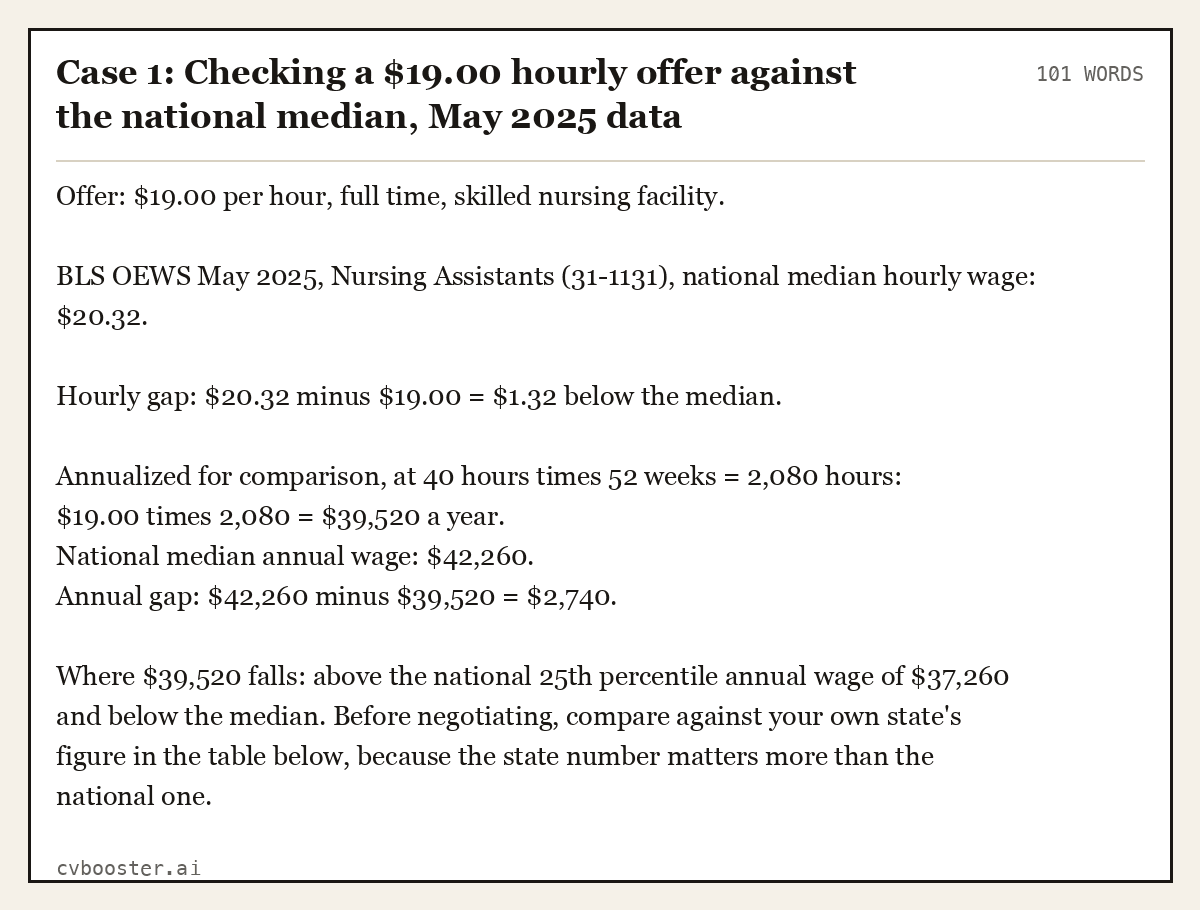
Case 1: Checking a $19.00 hourly offer against the national median, May 2025 data
101 wordsOffer: $19.00 per hour, full time, skilled nursing facility.
BLS OEWS May 2025, Nursing Assistants (31-1131), national median hourly wage: $20.32.
Hourly gap: $20.32 minus $19.00 = $1.32 below the median.
Annualized for comparison, at 40 hours times 52 weeks = 2,080 hours: $19.00 times 2,080 = $39,520 a year. National median annual wage: $42,260. Annual gap: $42,260 minus $39,520 = $2,740.
Where $39,520 falls: above the national 25th percentile annual wage of $37,260 and below the median. Before negotiating, compare against your own state's figure in the table below, because the state number matters more than the national one.
Create my CVOr start from one of our free resume templates
Nurse assistant pay nationally: the full BLS distribution
BLS publishes more than one number for each occupation, and they answer different questions. The median is the middle worker: half earn more, half earn less. The mean is the average and gets pulled up by higher earners. The percentiles show the spread. All figures below are from the BLS OEWS profile for Nursing Assistants, May 2025 estimates, pulled from the BLS Public Data API on November 8, 2026.
| Measure, May 2025 | Hourly | Annual |
|---|---|---|
| 10th percentile | $33,940 | |
| 25th percentile | $37,260 | |
| Median (50th percentile) | $20.32 | $42,260 |
| Mean | $20.53 | $42,700 |
| 75th percentile | $47,220 | |
| 90th percentile | $51,980 | |
| Employment | 1,448,910 jobs |
Two readings matter. The spread from the 10th to the 90th percentile is $18,040 a year ($51,980 minus $33,940), which is large for an occupation with the same federal training floor everywhere. And the mean sits only $440 above the median, which tells you there is no small group of very high earners distorting the picture. Most of the spread comes from location and employer, not from a few outliers.
These are wages for the occupation as BLS defines it, across all experience levels, before taxes. They do not include overtime premiums, shift differentials, or benefits as separate items, so a posting with differentials can pay more per year than its base rate suggests.
Nursing assistant pay by state, May 2025
Here is every state plus the District of Columbia, sorted by annual mean wage. Employment is the number of nursing assistant jobs BLS estimates in that state. Source: BLS OEWS May 2025, state estimates for 31-1131.
| Rank | State | Annual mean wage | Employment |
|---|---|---|---|
| 1 | Washington | $52,230 | 30,270 |
| 2 | Oregon | $52,160 | 14,800 |
| 3 | California | $50,190 | 110,060 |
| 4 | New Hampshire | $49,290 | 7,810 |
| 5 | Alaska | $48,920 | 2,060 |
| 6 | New York | $48,800 | 87,990 |
| 7 | District of Columbia | $47,930 | 3,490 |
| 8 | Massachusetts | $47,700 | 38,130 |
| 9 | Maine | $47,510 | 8,540 |
| 10 | Colorado | $47,400 | 22,240 |
| 11 | Vermont | $46,850 | 3,030 |
| 12 | New Jersey | $46,810 | 32,400 |
| 13 | Rhode Island | $46,360 | 10,220 |
| 14 | Minnesota | $46,030 | 29,120 |
| 15 | Hawaii | $45,710 | 5,050 |
| 16 | Connecticut | $45,440 | 21,380 |
| 17 | Illinois | $45,230 | 68,640 |
| 18 | Nevada | $44,900 | 8,100 |
| 19 | Arizona | $44,820 | 20,320 |
| 20 | Wisconsin | $44,600 | 28,370 |
| 21 | Pennsylvania | $43,960 | 67,740 |
| 22 | North Dakota | $43,330 | 6,840 |
| 23 | Maryland | $43,310 | 27,720 |
| 24 | Montana | $43,160 | 4,390 |
| 25 | Nebraska | $42,390 | 16,450 |
| 26 | Delaware | $42,290 | 5,530 |
| 27 | Virginia | $42,160 | 40,580 |
| 28 | Iowa | $41,490 | 22,670 |
| 29 | Michigan | $41,490 | 43,290 |
| 30 | Wyoming | $41,470 | 2,830 |
| 31 | New Mexico | $41,400 | 4,750 |
| 32 | Ohio | $40,520 | 63,280 |
| 33 | Utah | $40,450 | 12,260 |
| 34 | Indiana | $40,200 | 33,640 |
| 35 | Kansas | $39,730 | 24,610 |
| 36 | South Dakota | $39,510 | 6,860 |
| 37 | North Carolina | $39,280 | 64,010 |
| 38 | Kentucky | $39,170 | 23,410 |
| 39 | Florida | $39,160 | 96,960 |
| 40 | Idaho | $39,100 | 7,910 |
| 41 | Texas | $38,780 | 88,680 |
| 42 | Georgia | $38,760 | 43,440 |
| 43 | Missouri | $38,410 | 34,050 |
| 44 | Tennessee | $38,230 | 27,040 |
| 45 | West Virginia | $37,490 | 9,390 |
| 46 | South Carolina | $37,390 | 21,760 |
| 47 | Oklahoma | $35,920 | 19,410 |
| 48 | Arkansas | $33,970 | 17,260 |
| 49 | Alabama | $33,670 | 25,250 |
| 50 | Mississippi | $32,890 | 14,200 |
| 51 | Louisiana | $32,250 | 20,690 |
Remember that this column is the mean, not the median, so it runs a little higher than what the middle worker in each state earns. Compare state to state with the same measure, and compare your offer to your own state's figure.
Pay by employer type
Where you work inside a state changes pay too. BLS publishes industry estimates for the occupation. National figures, May 2025:
| Employer type (NAICS) | Annual mean wage | Employment |
|---|---|---|
| State government, excluding schools and hospitals | $45,150 | 12,830 |
| Hospitals | $43,480 | 479,330 |
| General medical and surgical hospitals | $43,350 | 442,820 |
| Nursing care facilities (skilled nursing facilities) | $42,280 | 534,270 |
| Continuing care retirement communities and assisted living | $41,090 | 161,150 |
| Home health care services | $39,420 | 70,770 |
Skilled nursing facilities employ the most nursing assistants, 534,270 of them. Hospitals pay $1,200 more on average ($43,480 minus $42,280). Home health care pays the least of these six, and state government pays the most, though it employs far fewer people.
The training rule behind the credential
The federal floor for nurse aide training is the same in every state, which is part of why location, not credential, drives most of the pay spread. Under 42 CFR 483.152, a state-approved program must "Consist of no less than 75 clock hours of training" and "Include at least 16 hours of supervised practical training." States can require more hours than that; your state's nurse aide registry publishes its own requirement.
The hiring rule is in 42 CFR 483.35: "A facility must not use any individual working in the facility as a nurse aide for more than 4 months, on a full-time basis, unless that individual" is competent and has completed a state-approved training and competency evaluation program. The same section says facilities must check the registry before you start, and it sets a retraining trigger: if you go "a continuous period of 24 consecutive months" without paid nursing or nursing-related work, you must complete a new program or competency evaluation.
That 24-month rule matters for your salary as much as for your license. If you have been out of the field for close to two years, take a paid shift, even per diem, before the clock runs out. Retraining costs time you could be earning in.
Converting an hourly offer the right way
Most CNA offers are hourly, and most salary data is annual. The cleanest comparison uses one fixed conversion and applies it to both sides:
- Multiply the hourly rate by 2,080. That is 40 hours times 52 weeks. It is a comparison tool, not a promise of hours.
- Compare against your state's annual mean, not the national median. A $21.00 offer is $43,680 a year at 2,080 hours. That is above the national median of $42,260, but $8,550 below the Washington mean of $52,230 and $11,430 above the Louisiana mean of $32,250.
- Adjust for your real schedule. If the job is 36 hours a week in three 12-hour shifts, your actual hours are 1,872 a year (36 times 52), and the same $21.00 is $39,312.
- Add differentials separately. A night or weekend premium only counts for the hours you actually work at that rate.
Done this way, two offers with different schedules and differentials stop looking alike, and the better one is obvious on paper before you have to decide on the phone.
Six more worked cases
Each case uses only the BLS figures on this page. They are illustrations of how to read the data, not salary promises.
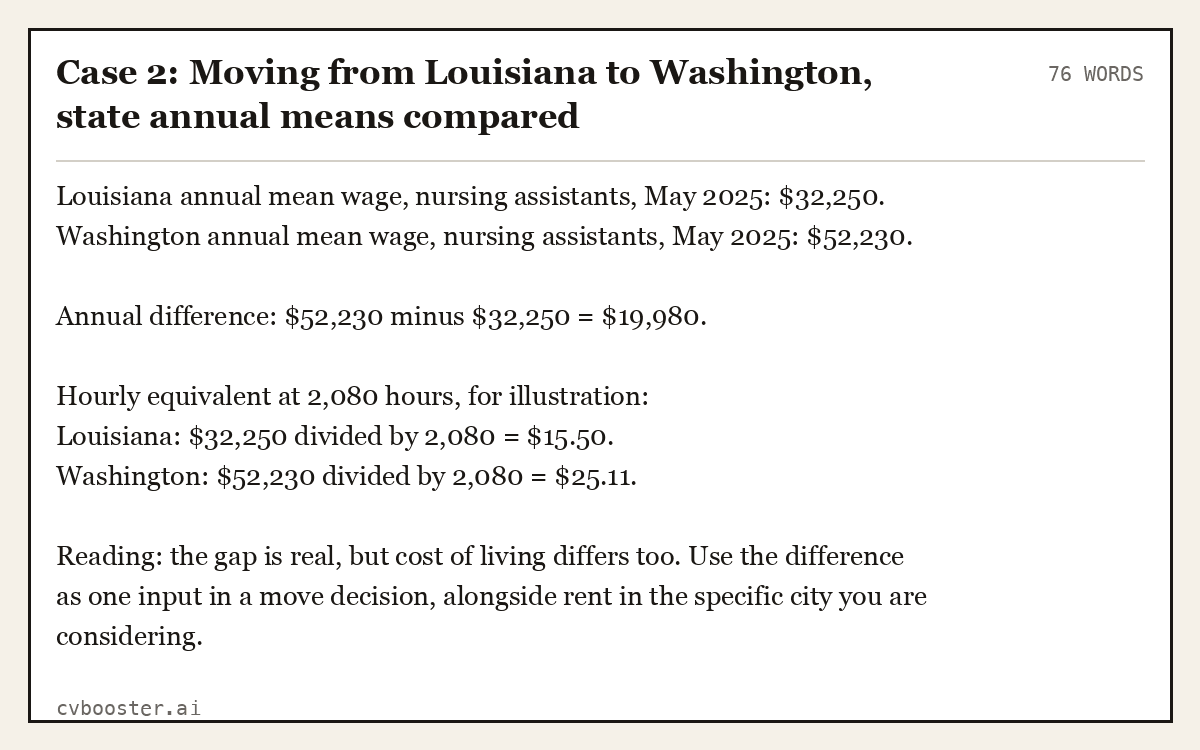
Case 2: Moving from Louisiana to Washington, state annual means compared
76 wordsLouisiana annual mean wage, nursing assistants, May 2025: $32,250. Washington annual mean wage, nursing assistants, May 2025: $52,230.
Annual difference: $52,230 minus $32,250 = $19,980.
Hourly equivalent at 2,080 hours, for illustration: Louisiana: $32,250 divided by 2,080 = $15.50. Washington: $52,230 divided by 2,080 = $25.11.
Reading: the gap is real, but cost of living differs too. Use the difference as one input in a move decision, alongside rent in the specific city you are considering.
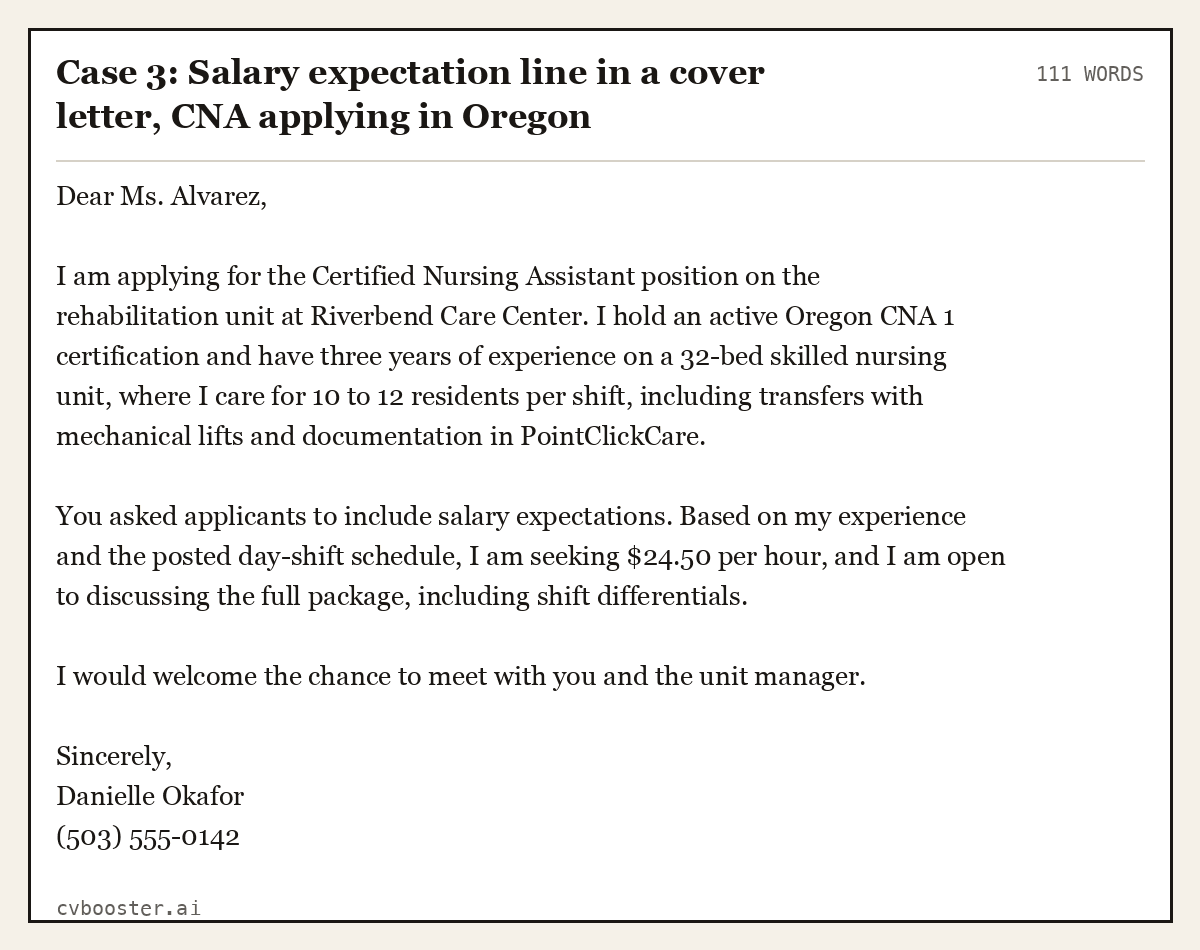
Case 3: Salary expectation line in a cover letter, CNA applying in Oregon
111 wordsDear Ms. Alvarez,
I am applying for the Certified Nursing Assistant position on the rehabilitation unit at Riverbend Care Center. I hold an active Oregon CNA 1 certification and have three years of experience on a 32-bed skilled nursing unit, where I care for 10 to 12 residents per shift, including transfers with mechanical lifts and documentation in PointClickCare.
You asked applicants to include salary expectations. Based on my experience and the posted day-shift schedule, I am seeking $24.50 per hour, and I am open to discussing the full package, including shift differentials.
I would welcome the chance to meet with you and the unit manager.
Sincerely, Danielle Okafor (503) 555-0142
The figure in Case 3 is not pulled from thin air. Oregon's annual mean of $52,160 works out to about $25.08 an hour at 2,080 hours, so a request of $24.50 with three years of experience sits just under the state average and is easy to defend.
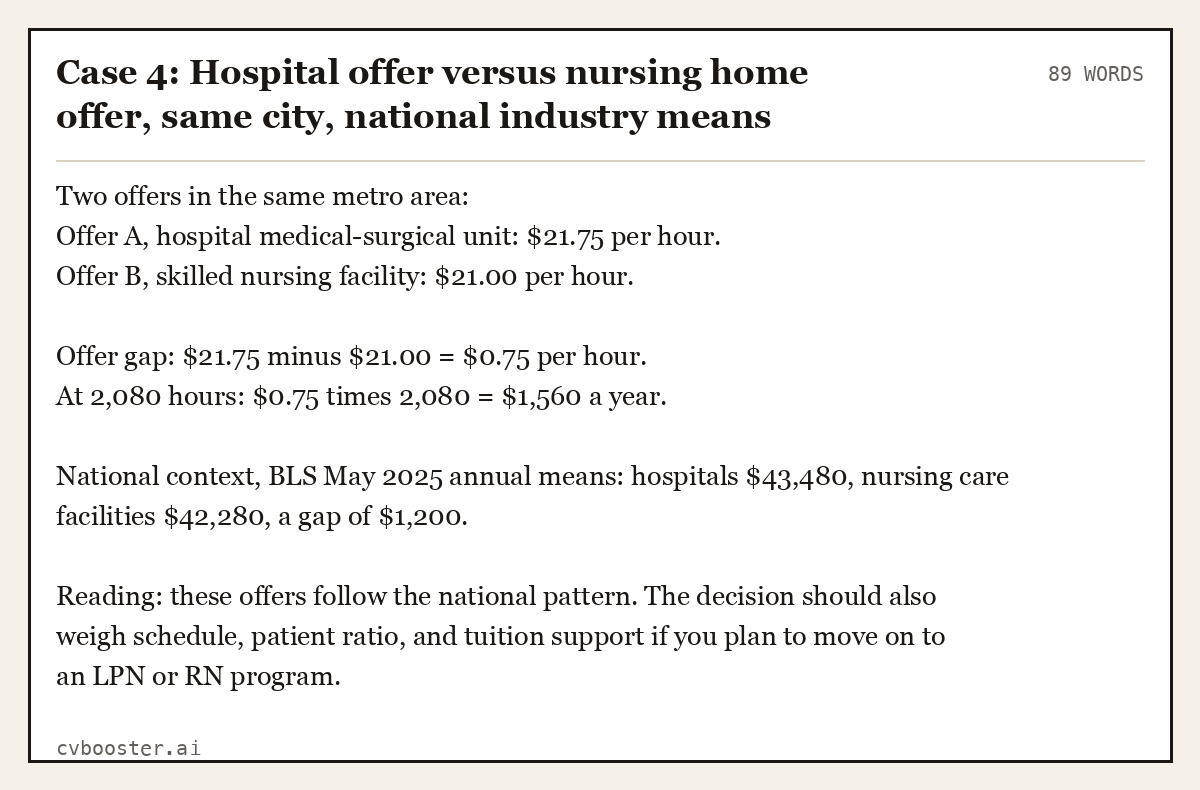
Case 4: Hospital offer versus nursing home offer, same city, national industry means
89 wordsTwo offers in the same metro area: Offer A, hospital medical-surgical unit: $21.75 per hour. Offer B, skilled nursing facility: $21.00 per hour.
Offer gap: $21.75 minus $21.00 = $0.75 per hour. At 2,080 hours: $0.75 times 2,080 = $1,560 a year.
National context, BLS May 2025 annual means: hospitals $43,480, nursing care facilities $42,280, a gap of $1,200.
Reading: these offers follow the national pattern. The decision should also weigh schedule, patient ratio, and tuition support if you plan to move on to an LPN or RN program.
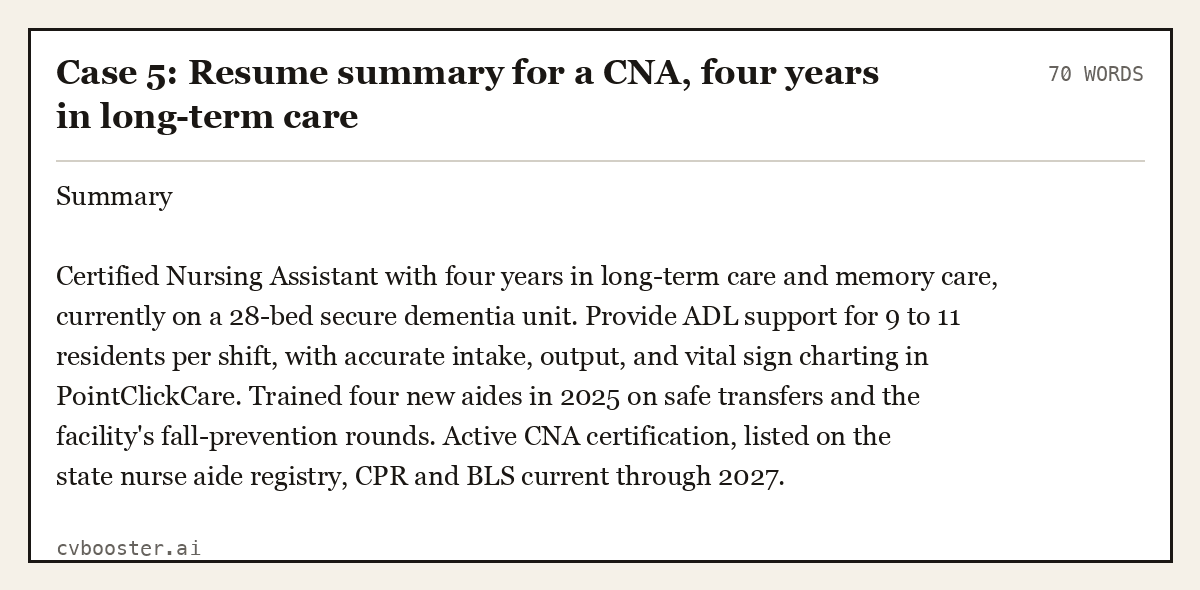
Case 5: Resume summary for a CNA, four years in long-term care
70 wordsSummary
Certified Nursing Assistant with four years in long-term care and memory care, currently on a 28-bed secure dementia unit. Provide ADL support for 9 to 11 residents per shift, with accurate intake, output, and vital sign charting in PointClickCare. Trained four new aides in 2025 on safe transfers and the facility's fall-prevention rounds. Active CNA certification, listed on the state nurse aide registry, CPR and BLS current through 2027.
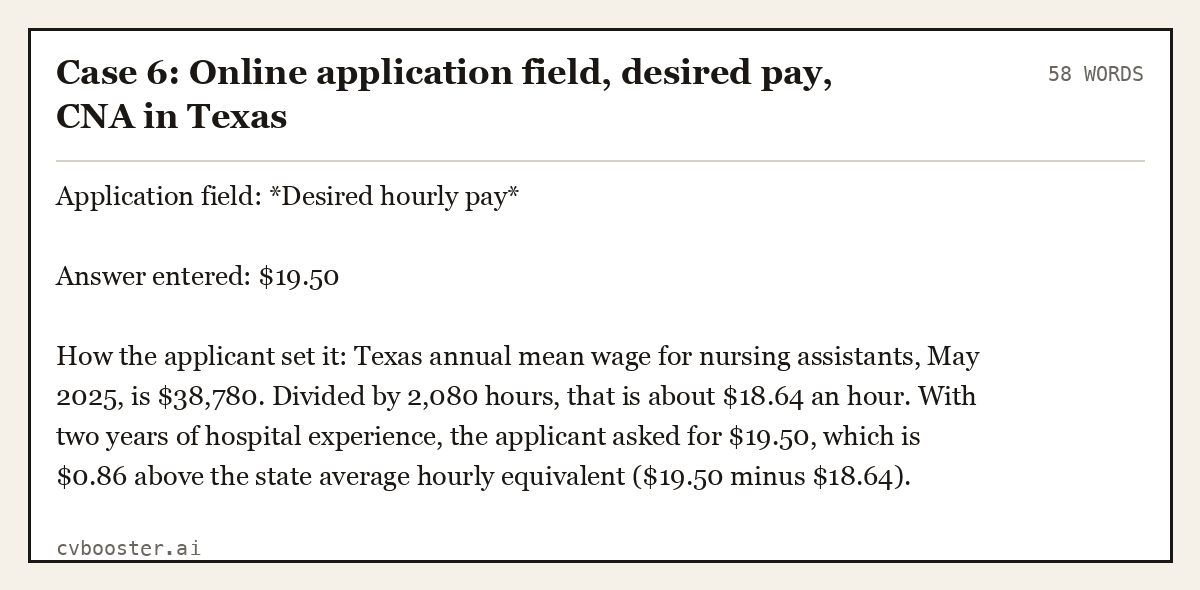
Case 6: Online application field, desired pay, CNA in Texas
58 wordsApplication field: Desired hourly pay
Answer entered: $19.50
How the applicant set it: Texas annual mean wage for nursing assistants, May 2025, is $38,780. Divided by 2,080 hours, that is about $18.64 an hour. With two years of hospital experience, the applicant asked for $19.50, which is $0.86 above the state average hourly equivalent ($19.50 minus $18.64).
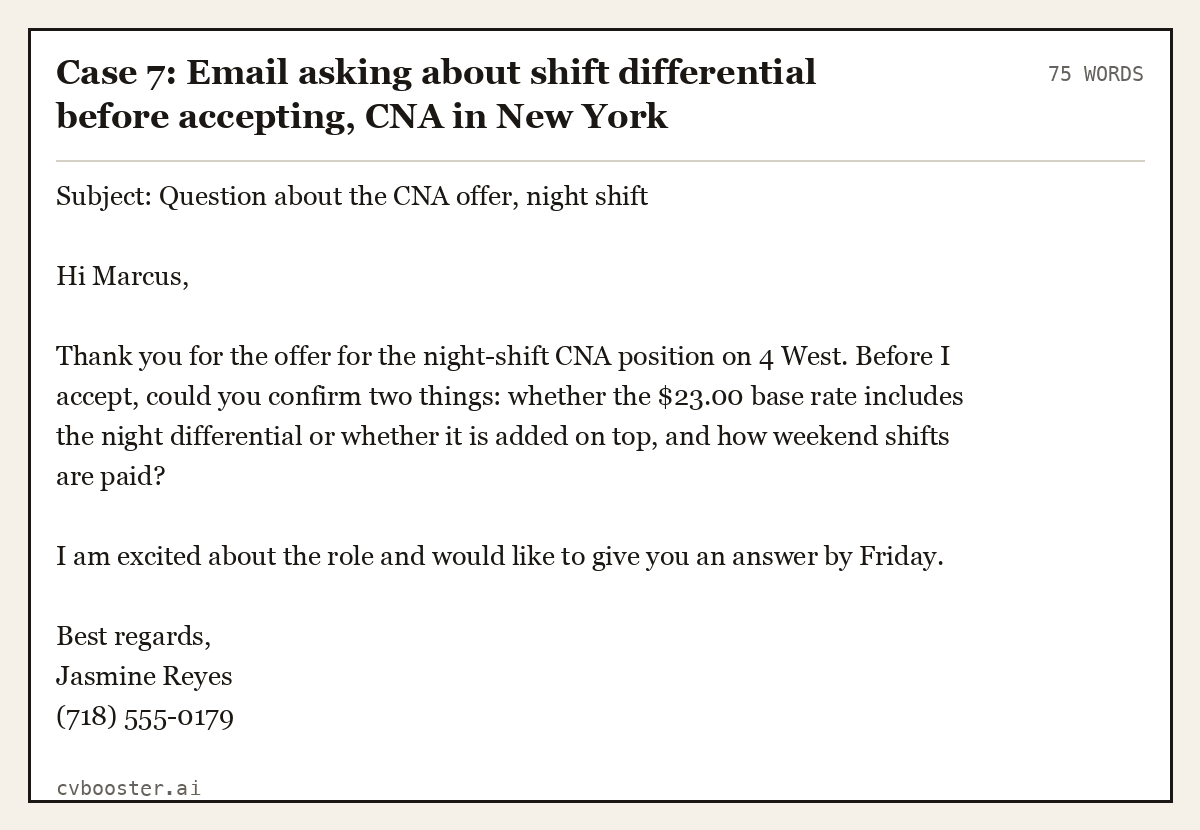
Case 7: Email asking about shift differential before accepting, CNA in New York
75 wordsSubject: Question about the CNA offer, night shift
Hi Marcus,
Thank you for the offer for the night-shift CNA position on 4 West. Before I accept, could you confirm two things: whether the $23.00 base rate includes the night differential or whether it is added on top, and how weekend shifts are paid?
I am excited about the role and would like to give you an answer by Friday.
Best regards, Jasmine Reyes (718) 555-0179
Case 7 is the cheapest raise most CNAs never ask for. New York's annual mean of $48,800 is about $23.46 an hour at 2,080 hours, so whether the differential sits inside or on top of a $23.00 base changes where the offer lands against the state average.
Seven cases, seven uses of the BLS numbers
| Case | Who | What the data decided |
|---|---|---|
| 1 | CNA with an hourly offer | Whether $19.00 is below the national median |
| 2 | CNA considering a move | The real gap between two states |
| 3 | CNA in Oregon | A defensible salary request in a cover letter |
| 4 | CNA with two offers | Hospital versus nursing home pay |
| 5 | Experienced CNA | A resume summary built on numbers, not pay |
| 6 | CNA in Texas | What to type in the desired pay field |
| 7 | CNA in New York | Whether the differential is inside the base |
What actually raises a CNA's pay
The data on this page points to five levers, roughly in order of size:
- State. The single biggest factor, nearly $20,000 a year between the top and bottom states in the May 2025 means.
- Employer type. Hospitals and state government pay more on average than nursing homes and home health.
- Shift and differentials. Nights, weekends, and specialty units often carry a premium. Ask whether it is included in the quoted rate.
- Experience you can show. A resume that lists residents per shift, units, and systems gets a stronger offer than one that lists duties. Our guide to the CNA job description for a resume shows how to write those lines.
- The next credential. Many CNAs use the role as a step to LPN or RN. Our licensed practical nurse guide covers that path.
If you are applying for your first CNA job, the pay numbers matter less than getting the first offer. Our CNA resume with no experience guide shows how to build it around clinical hours, and the certified nursing assistant resume example gives you a full layout. For the negotiation itself, see how to negotiate salary and, if a posting asks for numbers up front, salary requirements. If you are comparing healthcare roles, the echocardiography salary guide uses the same BLS method for sonographers.
Put the numbers in your application
A fair offer starts with an application that shows what you do on a shift: how many residents, which units, which systems, which certifications are current. That is what turns your state's average into your floor instead of your ceiling. You can build that resume in our resume builder: filling in any template is free and so is the ATS score; PDF or Word download and AI help are Pro.
Frequently asked questions
How much does a nurse assistant make an hour?
The national median hourly wage for nursing assistants is $20.32 and the mean is $20.53, according to BLS OEWS estimates for May 2025. Hourly pay varies widely by state: the annual means range from $32,250 in Louisiana to $52,230 in Washington, about $15.50 to $25.11 an hour at 2,080 hours.
What state pays CNAs the most?
Washington has the highest annual mean wage for nursing assistants, $52,230, in the BLS May 2025 estimates, followed by Oregon at $52,160 and California at $50,190. California also has the most nursing assistant jobs of any state, 110,060. Louisiana has the lowest annual mean, $32,250.
Is a CNA salary the same as a nursing assistant salary?
In BLS data, yes in practice. Certified nursing assistants are counted under occupation 31-1131, Nursing Assistants, which is the series used on this page. Federal rules in 42 CFR 483.35 require nurse aides in certified facilities to complete a state-approved training and competency evaluation program within four months of full-time work.
Do CNAs earn more in hospitals or nursing homes?
Hospitals pay slightly more on average. BLS May 2025 national figures show an annual mean of $43,480 for nursing assistants in hospitals and $42,280 in nursing care facilities, a gap of $1,200. Nursing care facilities employ more nursing assistants, 534,270, than hospitals, 479,330.
How much training does a CNA need?
Federal rules set the minimum. Under 42 CFR 483.152, a state-approved nurse aide training program must include no less than 75 clock hours, with at least 16 hours of supervised practical training. States can require more, so check your state nurse aide registry for the exact requirement.
Looking for a worked example for your job title? Browse the resume examples by job title.