What Is Background Information: Definition and 7 Examples

Background information is the context a reader needs before your main point makes sense: who is involved, what happened before, what a key term means and why the topic matters now. In an essay it sits in the introduction before the thesis. In a report, a cover letter or an email it is the two or three sentences that set the scene. The constraint is size: only include what this reader needs for this point. The UNC Writing Center warns against starting too broad. Below are the parts, a four-step method and seven examples you can copy.
Every essay that opens with "Since the dawn of time, humans have" is about to tell you something that happened last Tuesday. Background information is the cure for the dawn of time.
Background information in one example
Here is the idea in its most common form: the opening paragraph of an essay. The background takes three sentences. The thesis takes the last one.
Essay introduction with background information, high school or college
80 wordsIn 2020, millions of office workers moved from a commute to a kitchen table in a matter of weeks. Some companies called the switch temporary, while others gave up their offices for good. Five years later, many employers are asking staff to return for part of the week, and workers are pushing back. This essay argues that a fixed hybrid schedule, agreed by each team, keeps the benefits of remote work without losing the collaboration that offices were built for.
The first three sentences give the reader the story so far. Without them, "a fixed hybrid schedule" arrives with no reason to care.
Create my CVOr start from one of our free resume templates
What counts as background information
Background information answers the questions a reader would ask before they can follow you. Five kinds come up again and again:
| Type | Answers | Example sentence |
|---|---|---|
| Context | What was happening? | "The clinic switched to online booking in January." |
| History | What happened before? | "The bridge was last repaired in 1998." |
| Definitions | What does this term mean here? | "By burnout we mean exhaustion caused by work, not by life in general." |
| People and places | Who and where? | "The team of six works across Denver and Lisbon." |
| Stakes | Why does it matter now? | "The contract expires in March." |
What does not count: your opinion, your evidence and your conclusion. Those come after. For how the claim and the support are built once the scene is set, see Purdue OWL's guide to establishing arguments.
How to write background information in four steps
- Write your main point first. You cannot choose context until you know what it is context for. The UNC Writing Center suggests writing the introduction last for exactly this reason.
- List what the reader does not know. Picture the actual reader: a teacher, a hiring manager, a client. Write down every fact they would need.
- Cut to the three that matter most. Background is a doorway, not a hallway. If a fact does not change how the reader sees your point, drop it.
- Order from wide to narrow. Start with the situation, end with the detail closest to your point, then make the point.
A quick test: read your background out loud and ask "so what?" after each sentence. If the next sentence does not answer it, one of them is in the wrong place.
Background information examples for school and research
Academic writing uses background most heavily, because the reader expects you to show you understand the field before you add to it. Purdue OWL's overview of research papers covers the full structure these sections sit in.
Research report background section, college level
98 wordsBackground Food insecurity among college students has been studied in the United States for more than a decade, but most surveys focus on four-year universities. Community college students are more likely to work while studying and to support family members, which may change how they experience a shortage of food. At Riverside Community College, the campus food pantry opened in 2022 and has no data on who uses it or why. This study surveys pantry users over one semester to describe who they are, how often they visit and what else they do to get enough to eat.
Lab report background, high school chemistry
67 wordsBackground Enzymes are proteins that speed up chemical reactions in living things. Each enzyme works best at a particular temperature, and too much heat changes its shape so it stops working. Catalase, found in potatoes, breaks hydrogen peroxide into water and oxygen, and the oxygen can be measured as foam height. In this experiment we heated potato samples to five temperatures to find where catalase works fastest.
Background information examples for work
At work, background is shorter and does a different job: it saves the reader from scrolling back through a thread or asking "wait, what is this about?" One to three sentences is usually enough.
Project brief background, workplace
69 wordsBackground Our customer support team answers about 300 emails a week, and the same ten questions make up most of them. The help center articles for those questions were written in 2021 and still show the old checkout screens. Customers who cannot find an answer email us instead.
Goal Rewrite the ten most-viewed help articles by the end of Q1 so that customers can solve these problems without emailing.
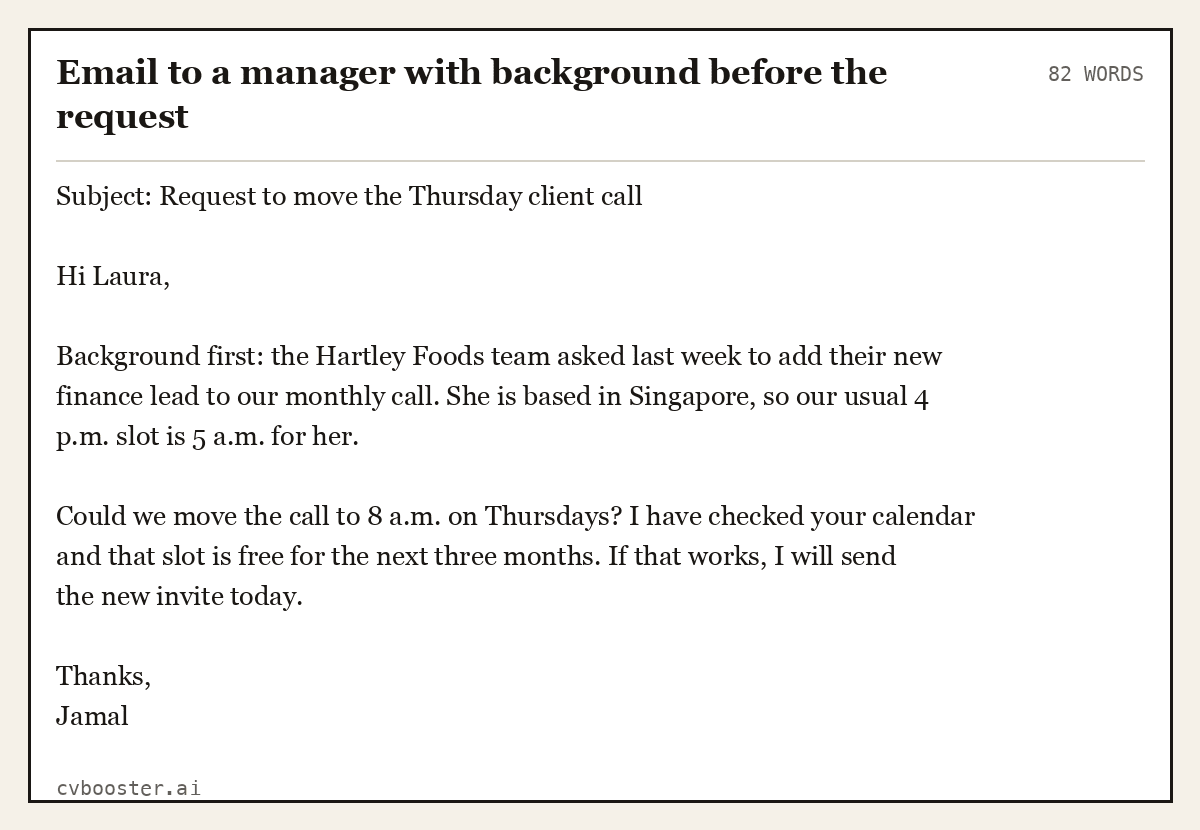
Email to a manager with background before the request
82 wordsSubject: Request to move the Thursday client call
Hi Laura,
Background first: the Hartley Foods team asked last week to add their new finance lead to our monthly call. She is based in Singapore, so our usual 4 p.m. slot is 5 a.m. for her.
Could we move the call to 8 a.m. on Thursdays? I have checked your calendar and that slot is free for the next three months. If that works, I will send the new invite today.
Thanks, Jamal
Background information examples for job applications
In a job search, background information is the short version of your story. It tells the reader where you come from so that your skills make sense for the job. Our guide to how to write a cover letter shows where it fits in the full letter.
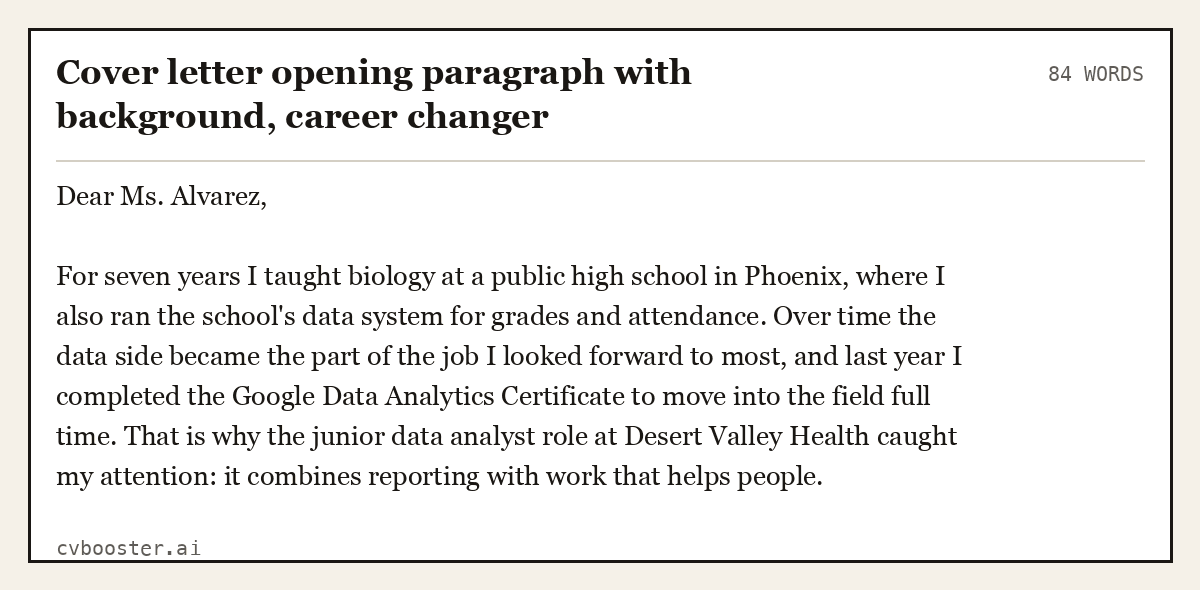
Cover letter opening paragraph with background, career changer
84 wordsDear Ms. Alvarez,
For seven years I taught biology at a public high school in Phoenix, where I also ran the school's data system for grades and attendance. Over time the data side became the part of the job I looked forward to most, and last year I completed the Google Data Analytics Certificate to move into the field full time. That is why the junior data analyst role at Desert Valley Health caught my attention: it combines reporting with work that helps people.
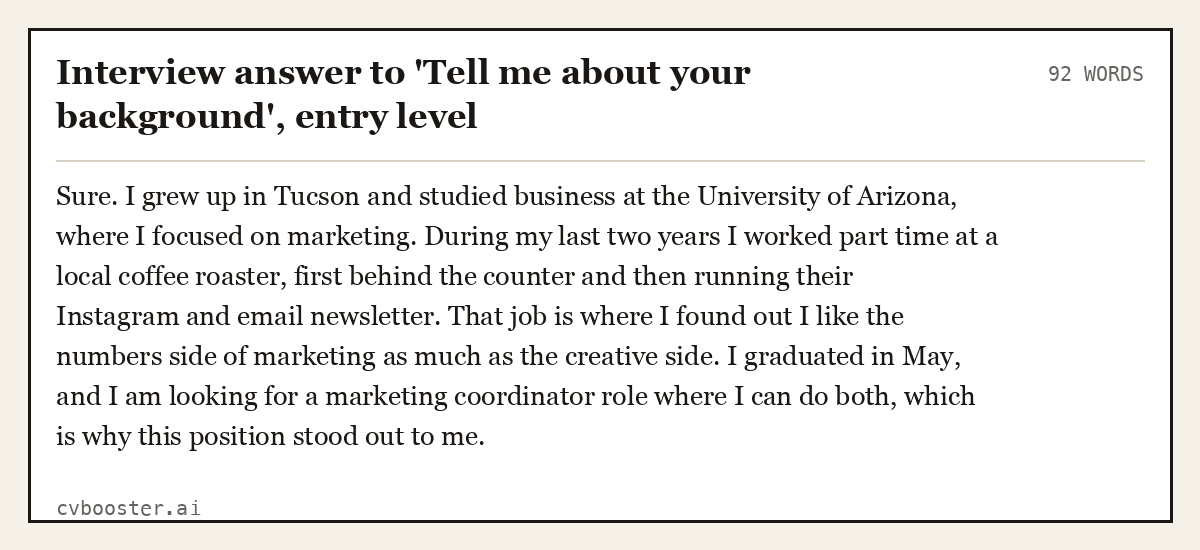
Interview answer to 'Tell me about your background', entry level
92 wordsSure. I grew up in Tucson and studied business at the University of Arizona, where I focused on marketing. During my last two years I worked part time at a local coffee roaster, first behind the counter and then running their Instagram and email newsletter. That job is where I found out I like the numbers side of marketing as much as the creative side. I graduated in May, and I am looking for a marketing coordinator role where I can do both, which is why this position stood out to me.
Harvard's Mignone Center for Career Success recommends knowing your resume well enough to talk through any part of it, and a background answer like this is the most common place you will need to. For more answers in the same rhythm, see common interview questions and answers, and if the question is really "who are you", our about me examples give short versions.
Common mistakes with background information
- Starting too wide. "Throughout history" and "In today's world" tell the reader nothing. Start with the situation closest to your point.
- Too much of it. If the background is longer than the point, the reader forgets why they are there. In an essay, a few sentences. In an email, one or two.
- Arguing inside the background. "The terrible new policy" is an opinion. Save it for after the thesis.
- Repeating what the reader knows. Your manager knows who the client is. Your teacher knows what photosynthesis is. Background is for what they do not know.
- Forgetting the definition. If your whole point depends on a word like "burnout" or "remote", say what you mean by it once.
Background information vs context vs introduction
The three words overlap, which is why they confuse people:
- Background information is the set of facts the reader needs: history, definitions, who and where.
- Context is the bigger situation those facts sit in: the time, the place, the problem.
- The introduction is the paragraph that delivers both and ends with your main point.
In short, the introduction is the container, background is what you put in it, and context is the reason you chose those facts. In a resume, the same idea shows up as the professional summary at the top. Our resume summary examples are background information in two lines.
Frequently asked questions
What is background information in an essay?
It is the context in the introduction that comes before the thesis statement: history, definitions, key people or places and why the topic matters. It gives the reader enough understanding to follow your argument. In most essays it takes three to five sentences and moves from the wider situation to your specific point.
How long should background information be?
Short enough that your main point is still the star. In an essay introduction, three to five sentences. In a research paper, it can be a full section of a page or more. In an email or a project brief, one to three sentences is usually enough for the reader to follow your request.
What are some examples of background information?
The year a policy changed, a definition of a key term, a short history of a problem, who the people in a project are, the result of earlier research, or the reason a deadline matters. In a cover letter, it is a short summary of where you worked and why that led you to this job.
Where does background information go?
In essays and reports it goes in the introduction or in a section titled "Background", before your thesis or research question. In emails and briefs it goes at the top, before your request. In an interview answer it comes first, before you explain why you want the role.
What is the difference between background information and a thesis?
Background information sets the scene and contains facts the reader needs. The thesis is your own claim or argument about those facts. Background answers "what is going on", while the thesis answers "what do I think and what will I prove". The thesis usually comes directly after the background.
More in this series: related guides
- AI Recruitment Tools: What They Do With Your Resume
- ATS Full Form: Applicant Tracking System, Explained
- Achievements in Resume: 36 Examples by Job, and the Formula
- CV Meaning: What Curriculum Vitae Means, With Examples
- Citizenship on Resume: When to List It and How to Word It
- Dancer Resume Example: 5 Complete Resumes for Auditions
- Declaration in Resume: Format and 10 Samples to Copy
- How Far Back Should a Resume Go: The 10 to 15 Year Rule
- How to Ask Someone to Be a Reference: 10 Messages to Copy
- How to Become an Arborist: Steps, ISA Certification, Pay
- How to Build a Resume Website: 7 Steps and Copyable Text
- How to Introduce Yourself in a Letter: 8 Examples to Copy
- Job Titles: 200+ Examples by Department and by Level
- Personal Details in Resume: What to Include, With Examples
- Resume Builder for High School Students: 5 Teen Resumes
- Resume Margins: The Right Size for Every Situation
- Resume Summary for Freshers: 14 Examples by Degree
- Should I Use a Resume Template: Yes, If It Passes 8 Checks
- Six Figure Jobs: 27 Careers With Median Pay Over $100K
- Strengths and Weaknesses List: 90 Examples and 8 Answers
- Timeline Resume Template: 6 Examples and When to Use One
- Why Should We Hire You: 10 Sample Answers That Work
Looking for a worked example for your job title? Browse the resume examples by job title.